For All Mankind S2E4 Review: Pathfinder's Crew Gets Built on Lies
Ed assigns himself a command, Gordo hallucinates ants, Dani forces a reckoning, and a T-38 dogfight ends in the Gulf.
“Pathfinder” is where Season 2 stops pretending the founders’ generation is okay. Ed Baldwin is putting himself in command of a nuclear shuttle he has never flown. Gordo Stevens is climbing back into a suit nine years after he broke down on the moon. Danielle Poole is being told, on her commander’s last day, that her command will have to be argued for instead of offered. Tracy Stevens is doing an NBC live-from-orbit interview that doubles as a victory lap over a marriage that already does not exist. The hour distributes its crises across four households and then sets Ed’s T-38 on fire so the audience cannot pretend any of them will resolve quietly.
Ed casts himself, then walls his crew off from scrutiny
The opening kitchen-table scene gives Joel Kinnaman’s Ed the cleanest decision he gets all hour. Shantel VanSanten’s Karen Baldwin pushes paperwork across the breakfast table and tells him to go back. She has watched the look on his face at every launch and would rather run the Outpost as a woman whose husband is in space than watch him sit a desk for another fifteen years. The honesty cuts both ways. She also tells him, plainly, that she cannot sit by the squawk box this time and that the business is now her life. Ed nods, says he can handle it, and walks out of the marriage as a man who has been given permission to want what he wants.
What he wants, the next scene clarifies, is to assign himself the maiden flight of the agency’s first nuclear-engine shuttle. Sonya Walger’s Molly Cobb is the only person in the hour who reacts the way the show needs someone to react. She calls the move ballsy, points out that he has never flown a shuttle, and notes that no one has flown Pathfinder. Then she takes the Astronaut Office job he came to offer her because Ed has correctly intuited that her boredom is louder than her caution. The transaction is the first move in a self-dealing chain that the back half of the episode will not let him forget. Tom Paine catches the smell of it in the parking lot. By the last-day cake, Ed has stacked his own mission with his oldest friend and a young captain who lost a bet, and the audience has been shown each link.
Dani makes Ed name the math
The Poole strand is the episode’s most controlled piece of writing. Krys Marshall’s Danielle goes to Dallas to bring Clayton’s sister a box of report cards and birthday cards, and the conversation that follows is the show’s most direct accounting of what the Apollo 15 cover-up cost. Clayton, before he killed himself, told his sister what really happened on the moon. He told her that Dani broke her own arm to protect a white crewmate’s career. The sister hands the conversation a Vietnam medal Clay had kept, then sends Dani out the door with the line that re-frames everything that follows. “They may have let you on the bus, but you will always have to ride in the back.”
Dani brings the line straight to Ed. On his last day as chief, in his office, she asks for a command slot and tells him she will not be a footnote. The numbers do the rest. Two hundred and five astronauts, eleven Black, one commander. Ed retreats to the Gus Grissom defense — the press never let Grissom forget the hatch either — and Dani refuses to let him equate a hatch malfunction with a race. Marshall plays the scene without raising her voice, which is what makes it land. She is not asking him to feel guilty. She is asking him to do the only thing the chair he is leaving still has the power to do. The episode pays it off in the Apollo-Soyuz meeting later, when Ed names her commander before Tom Paine has finished his sentence and Bradford backs the call into the secretary of defense’s office. The system bent because one person told it the truth on the right afternoon.
Gordo’s suit fits worse than his life does
Michael Dorman’s Gordo gets the season’s first sustained look at what nine years of grounded drinking has left of him. The suit-up sequence is staged like a procedure scene and then quietly turned into a panic attack. The technicians ask if he is comfortable in the new turtle-shell EMU. Gordo says he likes it. Then his breathing goes uneven, his comm cuts in and out, he tells them he is hot, and finally he tells them he has to be over at building 9. The audience watches him stumble out of frame and rip his helmet off in a corridor where no one can see him. The show does not name the diagnosis. It does not have to. The man is afraid of the suit and of being inside a suit, and he is being measured for the same kind of suit he will wear on Jamestown 91.
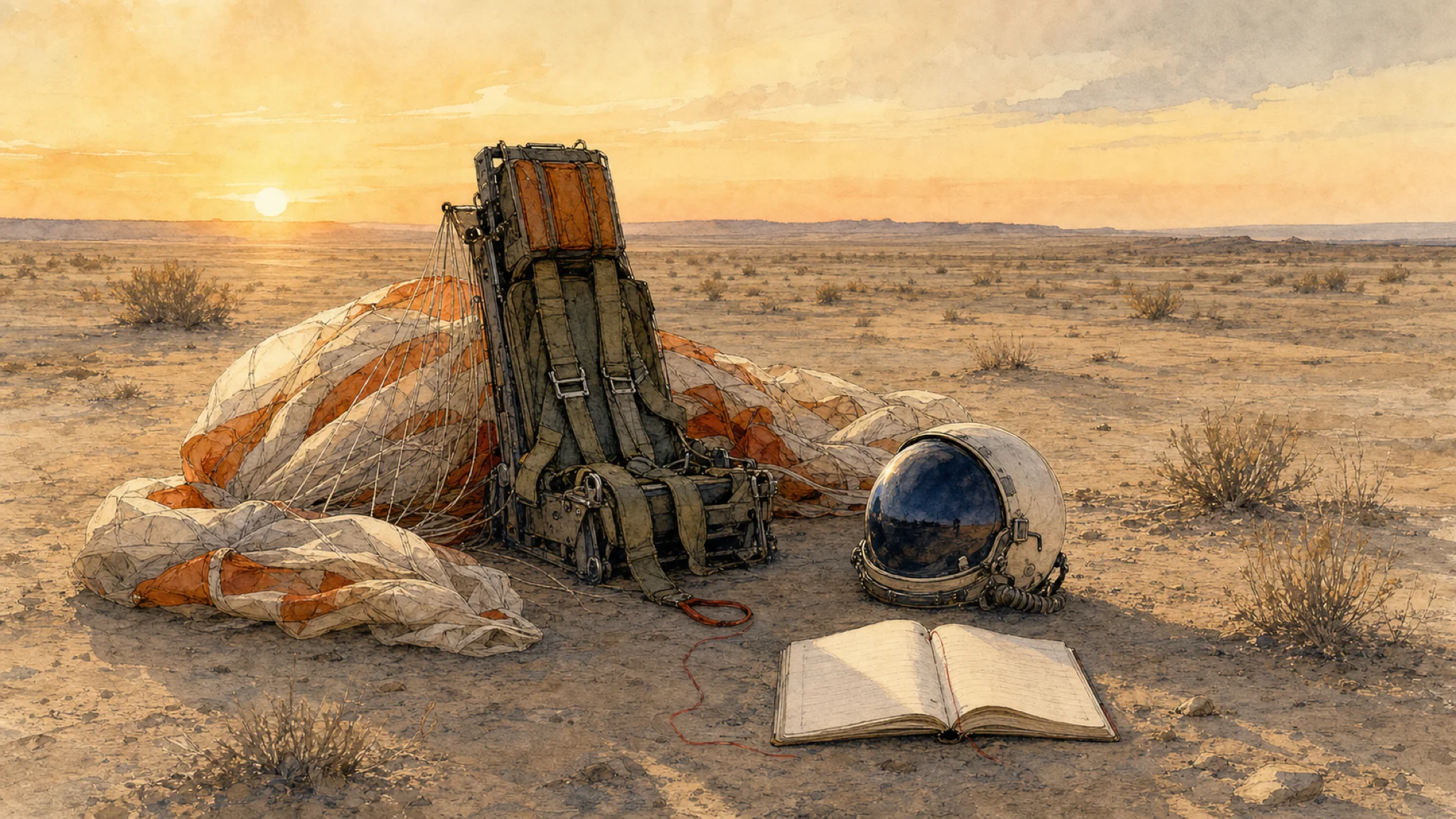
The dinner with Marshall and Kinnaman is where Gordo tries to launder the moment into a story he can tell. He calls it a weird little thing, says he felt hemmed in, and lets Ed reassure him that the man who saw spiders on the moon is not the man at this table. Dani plays along long enough to be a friend and then watches him across the next two scenes. The Outpost set piece refuses to let Gordo off the hook. Real ants are crawling on the bar. Gordo cannot tell the difference between the real ants and the moon spiders, sweats through a Vette ride to the airfield, and finally tells Ed in a parking lot. Ed’s response is the worst thing he says all season. He calls Gordo a baby, tells him to grow a pair, and uses “El Gordo” like a slur. Then he drags him into a T-38 to dogfight over the Gulf, where his own left engine catches fire and he has to eject into open water. The man who will not let his friend admit weakness has to be fished out of the Atlantic because he could not.
Ellen learns the room she is in
The Ellen strand is the quietest of the four and the one that most clearly sets up the season’s second half. Jodi Balfour’s Ellen Wilson is being mentored by Thomas Paine in his office, and she walks in convinced he is a Reagan lackey who got his job through Nixon. Paine corrects her. He wrote the Lang “moondoggle” speech himself, because Lang was in a tough race and NASA had the votes anyway, and the favor turned into a bill that licensed agency technology to private industry. The speech she thought was an attack was actually the long lever that will make NASA self-funded in less than a decade. Paine is showing her what a real player looks like, and his final line — the trick is not to lose track of who you really are — lands as both a teaching and a warning. The episode cross-cuts to her watching Peter and his date head out to see a Donna Summer impersonator at the Bullshot, and to a stack of moon mail she has not opened since she got back. The strand does not resolve. It sits under the season like a depth charge.
The Tracy strand offers the cleanest counterpoint to Ellen’s careful self-management. Sarah Jones’s Tracy is doing the on-orbit NBC interview as a married-name dodge, holding “Stevens” because everyone knows her by it and because keeping the camera on her makes the marriage to Sam Cleveland an irrelevance. The cross-cut between her live-from-Discovery feed and a Wheel of Fortune episode in the same television hour is one of the season’s best visual jokes. Tracy is the show’s first astronaut to be entirely a media figure, and the episode treats that with neither pity nor mockery. She brings her son into the front seat of her convertible later, lets him take a hit off her joint, and tells him she does not want him doing this with Kelly. The fond corruption of that scene is what makes the launch sequence work. She has learned to ride the camera the way Ellen is learning to ride Paine’s gamesmanship.
What this episode argues
“Pathfinder” argues that the systems the founders built have started outpacing the people who built them, and that the gap is where the season’s damage will live. Ed assigns himself the maiden flight because he can, and the chair he is leaving does not have a check on his hand. Dani forces an exception that should have been a policy a decade ago. Gordo is being sent back into a suit because his name still works on the roster. Ellen is being trained for a chair like Paine’s, where the goal is not honesty but knowing which honesty to deploy with which person. Tracy is being launched as a television product. The plaque Ed invokes at the Apollo-Soyuz meeting — we came in peace for all mankind — is now a thing a couple of men in suits use to win each other over in a conference room.
The other argument running underneath is about cost. Karen tells Ed she cannot afford the squawk-box marriage again. Clayton’s sister tells Dani that her medal cost her brother his life. Ed’s “act like a man” speech costs Gordo what little protection he had left. The dogfight costs Ed an aircraft and a piece of his own legend. The agency is going back to the moon, going to Mars, and shaking hands with Andropov, and the people doing it are showing the strain in private. The premiere set the table. This is the episode that names the bill.
Verdict
“Pathfinder” is one of the most efficient plot-engine hours For All Mankind has shipped. Five threads — Ed’s command, Dani’s confrontation, Gordo’s panic, Ellen’s tutorial, Tracy’s launch — run in parallel without any of them feeling clipped. The Dani-Ed office scene is the season’s best dialogue scene so far. The Outpost ants sequence is the scariest the show has been since the Apollo 15 break. The Paine monologue does in five minutes the kind of mentor work most shows take a season to set up. And the T-38 ejection closes the hour with the first time Ed has been wrong in public.
The only soft tissue is the Tracy strand, which is staged for laughs and gets them, but never quite tells us what Tracy thinks of herself when the camera is off. That is fixable in later episodes. The case the hour makes for the season’s spine — that the founders cannot keep grading their own homework — is the strongest the show has made since the Apollo 15 finale. The crews are being picked, the marriages are bending, and the chairs of power are changing hands. The next eight episodes have a lot of fuel to burn.
Rating: 8.6/10
More episodes from For All Mankind — Season 2 — Cold War escalates to the lunar surface, episode by episode. Jump to any episode in the season:
Where to go next
Reviewed by Mira Vance · QuizFandom Editor & Lead Reviewer. Every rating is an honest per-watch assessment from the desk that also writes the quizzes — not a press release rehash.