If Wishes Could Kill S1E03 Review: Se-ah walks through grief while the curse gets personal
What happens — the short version (spoilers)
- Geon-woo recovers exactly as wished, framed as a chilling 'wish granted' receipt rather than relief.
- Ha-joon reveals his secret sister Ha-young is a shaman, and takes Se-ah to her rule-bound house guarded by the gatekeeper Bangwool.
- A call from Geon-woo's number turns threatening, trapping Se-ah emotionally before she collapses into the spirit world.
- Ha-young runs a three-door ritual with one rule: never look back, or the spirit will see her too.
- Se-ah walks through illusions of dead Hyeong-wook and her parents, refusing to stay even as they beg.
- Ha-joon panics and uses Girigo himself, exposing Ha-young and forcing a three-minute rescue race.
- Ha-young explains they must find the maehyung, the red phone, which only Se-ah can hold.
Episode 3 gives the wish app a ritual language, then makes Se-ah pay for every second of survival.
The scariest thing about If Wishes Could Kill has never been the app itself. Girigo is nasty, sure, with its cheerful prompt and murder-coded bargain, but Episode 3 knows the real horror is recognition. It is one thing to know a curse wants you dead. It is another to hear it use your friend’s voice, your parents’ love, and your own panic like saved passwords.
Se-ah meets the curse on someone else’s floor
Episode 3 opens with a miracle that should feel like relief and instead lands like a threat. Kim Geon-woo breathes on his own after Yoo Se-ah wishes for him to recover, and the screen gives her the brutally simple answer: wish granted. On another show, that would be the emotional release after a hospital cliffhanger. Here, it is a receipt.
That choice immediately sharpens the episode’s shape. The wish app does not only punish selfishness. It also takes a clean, loving desire and routes it through something filthy. Se-ah does not ask for popularity, revenge, money, or power. She asks for Geon-woo to live. The payment still comes due.
Kang Ha-joon becomes the one who moves the story out of school corridors and into folklore territory. He calls Se-ah, says he can help her only in person, and brings her to the one person he has been hiding out of shame: his older sister, Ha-young. The confession is messy in a believable teenage way. He told people she was studying abroad because the truth embarrassed him. She quit her job, changed her name, and became a shaman. He says this like a family scandal, minutes before she proves she is the most competent person in the room.
The trip to Ha-young’s house is a nice little genre switch. The taxi driver regrets the fare, the road goes wrong, and Se-ah’s bravery briefly collapses at bugs in the dark. She can charge toward danger, but the woods still get to be gross. The house carries the best kind of K-horror energy: not abandoned, not theme-park gothic, but governed by rules the kids do not know. Ha-joon has never been inside. A strange gatekeeper, Bangwool, always stops him and insists he cannot enter without an invitation. Worse, Bangwool says Ha-young would die if she left.
Bangwool could have been a one-note eccentric, but the writing gives him snap. He calls Ha-joon “brother-in-law,” grins through the tension, moves fast when danger hits, and later slaps Ha-joon with exactly the amount of force the boy has earned. He is comic relief with a knife under the table, which helps because Episode 3 has to explain a lot of ritual mechanics.
Then Geon-woo calls.
The first phone scene is the episode at its meanest. Geon-woo is awake, confused, and hurt that Se-ah has not come to see him. Then the voice shifts. It demands her location, threatens to rip out his tongue, and promises to smash his skull. Se-ah freezes because the curse has found the perfect emotional trap. If she answers, she may lead it to him. If she does not, she sounds like the worst friend alive.
That is the show’s sweet spot: haunted teen melodrama with actual teeth.
Ha-young turns fear into a three-door ritual
Once Se-ah collapses, Episode 3 becomes Ha-young’s showcase. She is Ha-young when Ha-joon talks about his sister and Haetsal when Bangwool addresses her in the ritual space. That split gives her instant texture. Ha-young is the sister he hid. Haetsal is the woman who knows exactly how to pull a living girl back from a dead place.
The ritual works because it is both ceremonial and practical. Ha-young identifies Se-ah as a descendant of the Yoo family, eighteen years old, then asks protection for the living soul and expulsion for the dead one. Bangwool guards the house with invocations to door gods, fire, hearth, gates, beams, birds, kings, and shadows. The language is dense, but the stakes are clean: Se-ah has been dragged into the realm where her curse began, and she has to pass through three rooms before the doors close.
The rule is even cleaner. Do not look behind you.
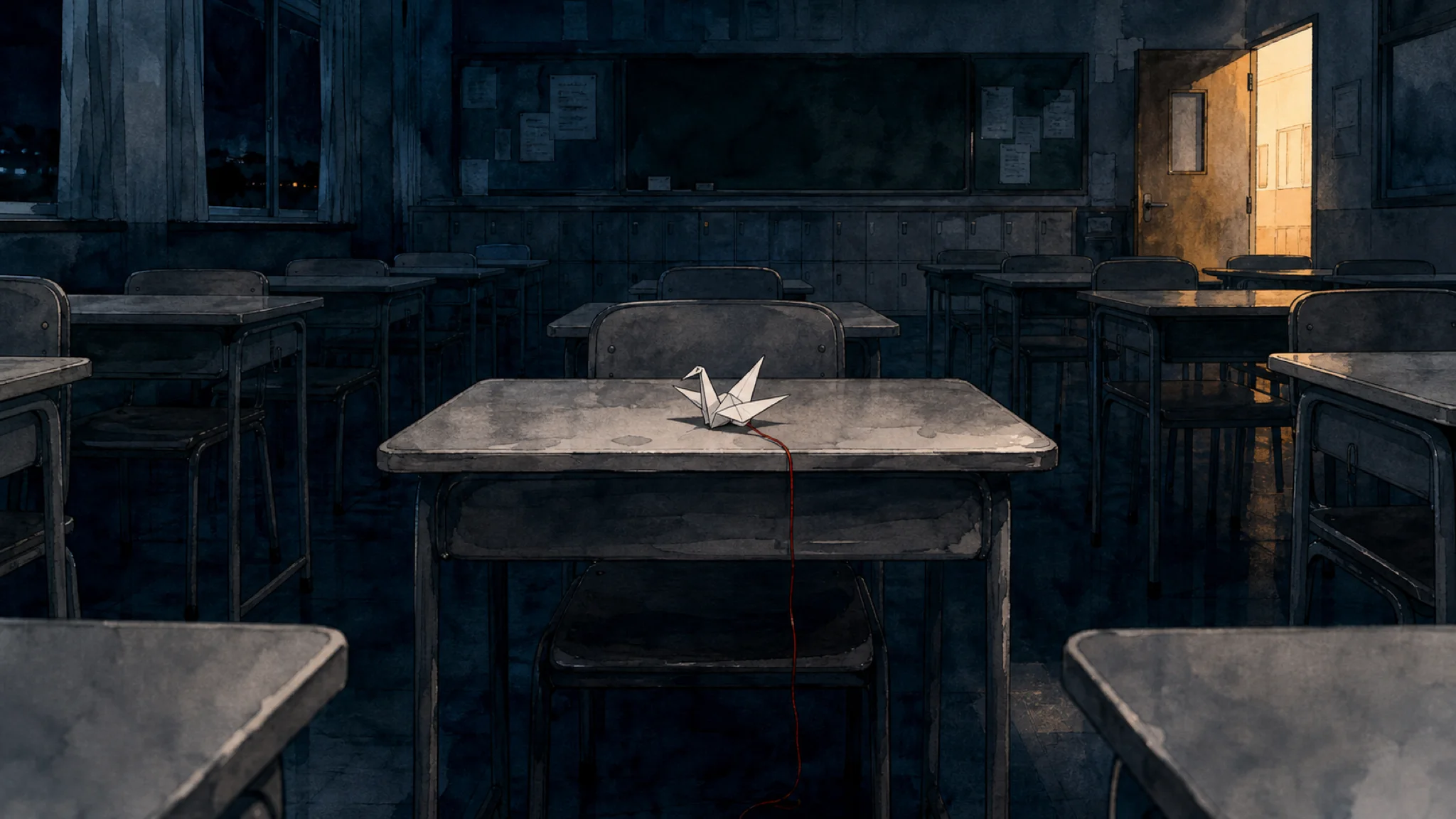
That is such a classic horror command that it risks feeling familiar for about half a second. Then the rule gets a clever emotional reason. Ha-young can guide Se-ah through a thread around her wrist, but if Se-ah turns and sees her, the spirit can see Ha-young too. Looking back exposes the one person trying to guide her home.
The first room sends Se-ah into a nurse’s office and back to Choi Hyeong-wook. His wish for a perfect score plays again, followed by the terror of what happened to him. He begs for help. He says it is Se-ah’s fault. He says he does not want to die alone. The cruelty is not only gore or screaming, though the scene is plenty nasty. The curse stages Hyeong-wook’s death as an accusation.
Se-ah’s response is the first real proof that she can survive this story as more than the brave girl who runs first. She realizes the voice copying Geon-woo was not him. She names the illusion as fake. She tells it: you are no friend; you are nothing. It is a very teen line, almost playground-level in its bluntness, which is why it hits. She needs enough nerve to keep walking.
The second room is much more personal. Se-ah returns to a memory with her parents in the car. Her younger self asks what present she will get when she wins her first school competition. Her father teases her. Her mother calls her sweet girl. Then the crash comes.
The episode is smart about the way it weaponizes warmth before impact. It does not introduce Se-ah’s parents only as loss symbols. The scene is tender and ordinary first: a child fishing for praise, a dad pretending to be stern, a mom smoothing the moment over with affection. When the illusion of her mother later asks Se-ah to stay, the temptation is not abstract.
That is where the episode gets its best emotional beat. Se-ah knows she cannot stay, and she keeps moving even when the voices turn cruel. The fake mother pivots from apology to punishment, claiming she and Se-ah’s father will suffer forever if Se-ah refuses to look back. It is a horrible inversion of family love: stay and be loved, leave and be guilty. Se-ah leaves anyway.
For a few seconds, it looks like she has made it out.
Ha-joon’s wish makes the rescue worse
The false exit is Episode 3’s sharpest trick. Se-ah wakes with Ha-joon and Bangwool near her, but another voice tells her not to answer them. She is in a third space. The spirit has latched onto her, and now every instruction has a twin. One voice tells her to call Ha-young. Another warns that Ha-young is still masked. One says the doors are fake. Another tells her to find a door and leave quickly. Se-ah, already scraped raw by Hyeong-wook and her parents, has to solve a trust problem while everyone around her sounds urgent.
That is also where Ha-joon’s flaw finally costs more than attitude. He panics because Se-ah looks like she is dying, so he uses Girigo too. His wish lets him see the thing the others have been seeing. He does it out of fear, maybe even out of care, but the result is chaos. The spirit gains more leverage, Ha-young is exposed, and the rescue has to become a fight with a three-minute clock.
This is good writing for Ha-joon because it does not flatten him into the cold analyst from the character board. He is logical until logic cannot bear what is happening in front of him. Then he makes the exact emotional mistake he would probably roast someone else for making. Later, when Bangwool hits him and tells him not to use the app again because it only hurts his sister, the reprimand works. Ha-joon wanted control. He made the room worse.
The action climax is brief but clear. Ha-young reopens the door with only three minutes available, reaches Se-ah, and tells her they need to stay connected. The visual grammar is simple enough to read through the panic: thread, door, run. When Se-ah comes back and Ha-young collapses from the strain, the room gets one tiny breath of relief.
It refuses to let that relief last. Ha-young explains that they have only severed the thread to the other side for the moment. To stop the curse, they need to find the maehyung, an object containing the essence of a powerful curse. In this case, that object appears to be the red phone connected to Se-ah’s wrist when she saw the girl. Se-ah is the only person who can hold it because she is connected to the vengeful spirit, Ha-young, and the other side.
That reveal gives the season a concrete quest without shrinking the horror. Girigo is still an app, but now the app has a buried object, a dead realm, and a girl on the other side.
The quieter hospital thread gives Lim Na-ri a small but pointed turn. She learns Geon-woo is awake and allowed visitors, then tells him Se-ah could not bear to see him after what happened. Maybe she is cushioning the blow. Maybe she is enjoying the access. Either way, horror does not pause high school politics; it gives them better lighting.
What this hour costs
Episode 3 says bravery is not the same thing as certainty. Se-ah survives because she keeps moving while unsure, not because she suddenly becomes fearless. She is scared of the woods, shaken by Hyeong-wook, gutted by her parents, and disoriented by the third space. Her win is refusal.
The episode also makes trust feel active. Se-ah has to trust Ha-young’s voice. Ha-joon has to learn that helping is not the same as grabbing the nearest tool. Bangwool has to hold the line when everyone else wants to break it. Even Geon-woo, waking up away from the ritual, becomes part of the cost because his voice can be copied and weaponized.
Verdict
If Wishes Could Kill S1E03 is the strongest episode so far because it finally gives the curse a mythology that feels playable and painful. The three-door structure is easy to follow, the ritual details add flavor without smothering the teen drama, and Se-ah’s grief lands harder than the jump-scare machinery around it. Bangwool turning “brother-in-law” into both a bit and a threat helps too.
There are a few spots where the lore arrives in heavy chunks, especially near the maehyung explanation, but the episode mostly gets away with it because the emotional math is clear. Se-ah saved Geon-woo. The curse came for her. Ha-young pulled her back. Now the red phone has to come home. That is enough to make Episode 4 feel less like a continuation and more like a dare.
Rating: 8.8/10
More episodes from If Wishes Could Kill — Five high school students, one supernatural arbiter, eight episodes that escalate fast. Jump to any episode in the season:
Where to go next
Reviewed by Mira Vance · QuizFandom Editor & Lead Reviewer. Every rating is an honest per-watch assessment from the desk that also writes the quizzes — not a press release rehash.