If Wishes Could Kill S1E05 Review: Na-ri learns the wish app keeps bloody receipts
What happens — the short version (spoilers)
- A flashback shows a drunk Na-ri using Girigo as a dare, wishing for Hyeong-wook and Dong-jae to die.
- Dong-jae's death confirms the wish worked, and classmates turn on Na-ri, saying she should have died instead.
- The group works out Girigo's rule: starting a new timer stops the previous one, so someone else must take the countdown.
- Se-ah secretly tells Geon-woo not all three of them can survive, turning the group into a triage problem.
- Geon-woo and Na-ri break into the school, finding records of Kwon Si-won, a wounded girl both saw in the videos.
- Na-ri receives messages on a dead phone and admits her wish, then flees as Girigo begins downloading again under the arbiter's voice.
Na-ri's drunken dare becomes a body count, while Geon-woo and Se-ah discover Girigo has rules meaner than any classroom rumor.
The fifth episode of If Wishes Could Kill opens with a party game and ends with a download button, which is exactly the kind of nasty little symmetry this show likes. By now, Girigo has killed enough people that nobody can treat it like a creepy app-store urban legend. The real pivot this hour belongs to Lim Na-ri, whose cool-girl armor cracks the second her own throwaway cruelty gains a corpse attached to it. Episode 5 is not the scariest chapter yet, but it is the one that makes the curse feel social, sticky, and impossible to delete.
Na-ri’s party girl flashback lands like a confession
The opening flashback is dated November 4, 2008, and it immediately rewrites Na-ri from glossy mean girl into someone much more volatile. She is drunk, loud, and performing for a room that keeps rewarding the worst version of her. Her friends tease her about Geon-woo, mock Choi Hyeong-wook as the “otaku loser,” and pass around the idea of Girigo like a meme nobody expects to have a pulse. Even before the horror arrives, the scene has that specific high-school ugliness where everyone is trying to be funny enough to avoid becoming the joke.
Na-ri is not innocent in that room. When Dong-jae needles her, she grabs the app and turns it into a dare, asking whether it can kill people if she is offering her life as payment. The wish she makes is brutal because it comes dressed as drunk spectacle: first Choi Hyeong-wook, then Dong-jae, two names tossed out in front of a laughing room. The show does not soften the moment by making Na-ri possessed or confused. She chooses the words, and the fact that she does not believe they matter only makes the scene uglier.
That is why Dong-jae’s death hits harder than a standard slasher beat. Hyeong-wook has already become the group’s proof of concept, the kid whose death everyone is whispering about in the hallway. Dong-jae is the second invoice, the one Na-ri cannot dismiss as coincidence. His phone goes unanswered, the funeral ribbon tells its own story, and suddenly the classmates who were eager to gossip about Hyeong-wook have a new target. They say Na-ri should have died instead. They drag her mother’s scandal into it. They accuse her of putting Yoo Se-ah in danger because Na-ri was flirting with Kim Geon-woo. The curse does not create cruelty from nothing. It just gives everyone a more dramatic excuse to say what they already wanted to say.
There is a sharp little cruelty in making Na-ri the center of the hour after she spent earlier episodes treating vulnerability like a disease. She attacks Se-ah for knowing about Girigo and staying quiet. She is right to be furious, and also wrong in the way she aims it. Se-ah admits there was a girl named Kwon Si-won who made Girigo to bully Do Hye-ryung, and that Do Hye-ryung died by suicide. The old story sounds like rumor until the present keeps bleeding in the same pattern. Na-ri hears all of that and still has to live with the simpler fact: she said the names.
The timer gets crueler once it gets logical
The best horror mechanics are usually simple enough to explain at lunch and mean enough to ruin the rest of your day. Episode 5 finally gives Girigo a rule that feels both clean and horrible: when a new timer starts, the previous timer stops. That discovery does a lot of work. It turns the app from a death sentence into a social trap. Surviving is possible, but only if someone else makes a wish and steps into the countdown.
The hour walks us there through panic rather than lore dump. Se-ah, Geon-woo, Na-ri, and Kang Ha-joon try to understand why Geon-woo’s training cancellation came through at the same minute Girigo marks his wish as granted. Se-ah compares Hyeong-wook’s death with her own countdown and realizes her stopped timer lines up with Geon-woo’s new one. Then Geon-woo wakes at the exact point his timer should have continued killing him. The numbers are blunt, almost childish, and that makes them scarier. No mystical riddle. No ornate prophecy. Just arithmetic with bodies.
Ha-joon, to his credit and his detriment, keeps trying to make the app behave like technology. He calls it phishing, hacking, the most logical explanation available. That tracks for him. He is the kind of person who would rather be wrong inside a system he can name than right inside a nightmare. His tension with Na-ri is a nice counterweight to the supernatural panic because their conversation is also about pride, desire, and old crushes. He refuses to defend her in front of the others, she accuses him of still liking Se-ah, and he fires back by asking whether she still likes Geon-woo. Girigo may be the monster, but jealousy is doing its own cardio.
The episode’s meanest move is the secrecy around Se-ah’s message. She texts Geon-woo that she found a way to stop the timer, but tells him to keep it from Na-ri because not all three of them can make it out alive. That line changes the group dynamic instantly. The teens are no longer just trying to beat a curse together. They are also ranking each other’s survival value while pretending they are still a team. Se-ah has always been the brave athlete, the girl who charges toward danger, but here bravery curdles into triage. If the rule is “someone else has to take the timer,” then friendship becomes a math problem nobody wants to solve out loud.
There is a smart bit of genre nastiness in the way Na-ri keeps ending up with phones that should not work. She cancels her number, logs out of her accounts, wipes the digital version of herself as hard as a teenager can, and still receives messages. Geon-woo calling it a dead phone is one of the hour’s better chills because it strips away the last normal explanation. Girigo is not hiding in the device. The device is just the stage where it performs.
Geon-woo and Na-ri make the messiest detective pair
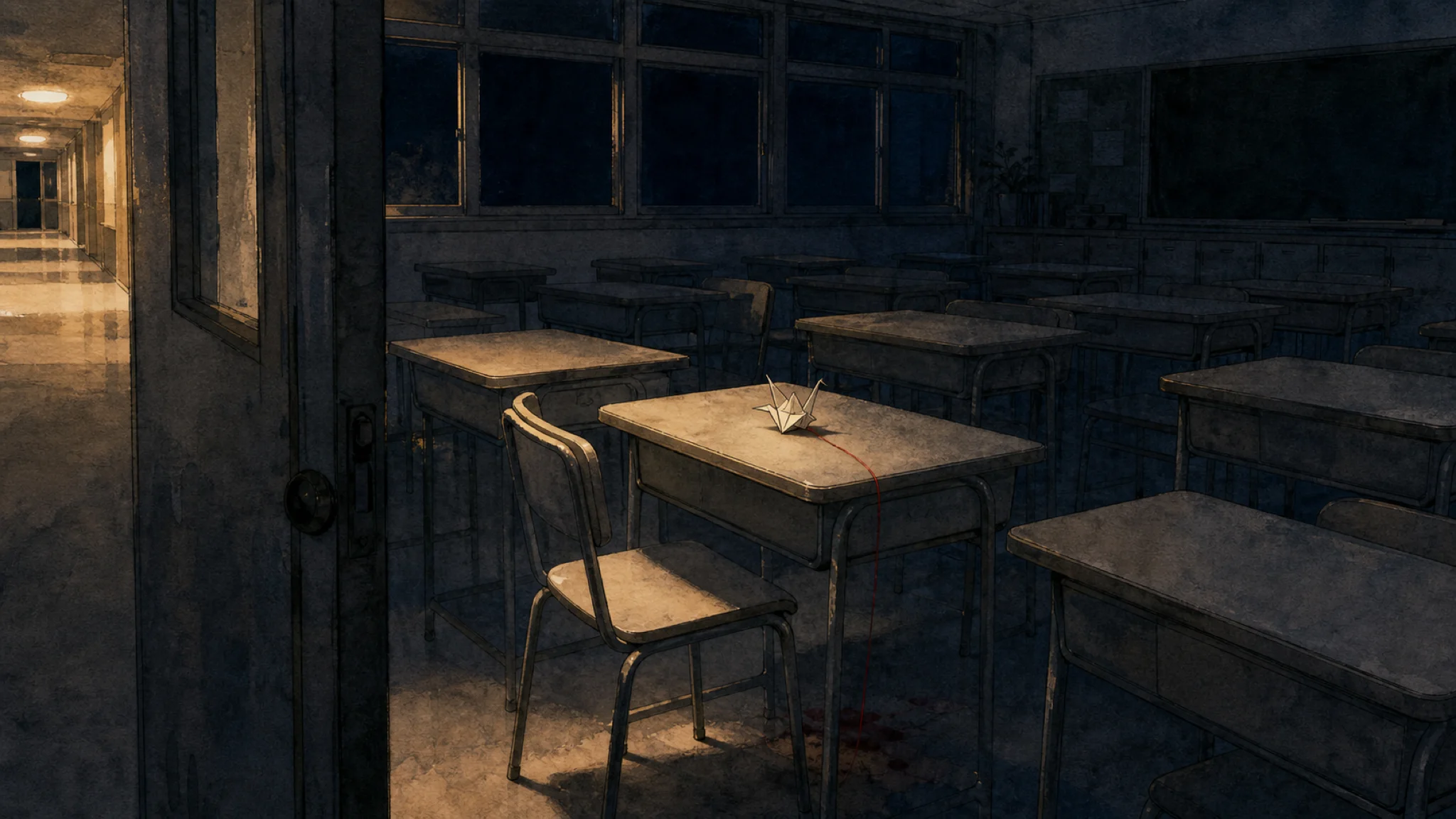
For all the episode’s timer math, its most watchable stretch is the nighttime break-in at school. Geon-woo gets Na-ri to help him by saying he needs to check the nurse’s office after remembering someone else was present in her video: a girl in their school uniform with a huge cut on her face. It is a great horror image because it is not overdesigned. Same logo, same uniform, wrong era, wrong presence. The ordinary school hallway suddenly feels archived by something angry.
Geon-woo and Na-ri are terrible together in a way that is very good television. She clocks that he knows Se-ah’s passcode, that he and Se-ah were eating fried chicken at her house in the wish video, that their intimacy has been hidden under the group’s panic. He tries to apologize for lying. Na-ri, with perfect toxic timing, says she lies to him all the time and then dodges the request for a specific example. Their banter has sparks, but the sparks are from a power line hanging in floodwater. Every sentence could become evidence.
The Kwon Si-won clue gives the hour a needed shove toward mythology. In the nurse’s office, Geon-woo finds an old record noting a laceration with bleeding under Kwon Si-won’s name. That matches the wounded girl he remembers from the video. Na-ri saw her too, which means the haunting is no longer just something Hyeong-wook or Geon-woo experienced alone. The show is careful about this reveal. It does not stop everything for exposition. It lets the realization arrive while Na-ri is already deciding whether Geon-woo has been manipulating her.
That suspicion explodes. Na-ri thinks Geon-woo lured her to an empty school to scare her, and he tries to convince her that they are both in danger because they both saw the same girl. Then she notices messages from a number that should no longer exist. The curse has learned to use social paranoia as a delivery system. Every text can be a friend, a trap, or the dead wearing the shape of a friend. When Na-ri finally says her wish was “Please let Hyeong-wook die,” then immediately toys with whether that was truth or lie, she becomes the episode’s sharpest horror object: someone so addicted to control that even confession becomes another weapon.
The final stretch is messy in a way that feels intentionally frantic. Na-ri runs, Geon-woo chases, and Girigo starts downloading again. The show cuts through dread, physical panic, and that eerie masked logic of the app until the supernatural arbiter energy finally presses closer to the surface. A stranger asks Geon-woo where the girl he was shouting for went, then tells him to stay still. By the time the voice says the rules are simple, write down your saju and make a wish, the episode has snapped the school-horror plot back to ritual. Girigo may look like software, but its roots are older, meaner, and more personal than any hack.
What this hour costs
Episode 5 says a wish is never private once it enters a group. Na-ri’s wish begins as drunken theater, becomes a death sentence, then mutates into gossip, blame, math, secrecy, and betrayal. Everyone wants to treat Girigo as a problem they can isolate: delete the app, break the phone, wipe the number, explain the code, trace the signal. None of that works because the real infection is relational. The app feeds on who wanted whom, who lied for whom, who would trade whose life for one more morning.
That makes this a strong Na-ri episode even when she is being awful. She is fragile, jealous, funny, vicious, frightened, and smart enough to know when others are hiding something from her. The show does not ask us to forgive her. It asks us to watch what happens when a girl who survives by controlling the room meets a curse that controls the room better.
Verdict
“Episode 5” is a tense, nasty middle chapter that gives If Wishes Could Kill its most useful rule so far and uses it to poison the friend group from the inside. The timer handoff idea is strong because it makes survival morally expensive. Se-ah’s secret, Geon-woo’s half-truths, Ha-joon’s logic, and Na-ri’s panic all become pieces of the same game, and nobody looks clean after playing.
The hour is slightly less elegant when it sprints through the late-school chase and the final download sequence, where the images are scary but the transitions feel a little rushed. Still, the episode’s emotional targeting is nasty in the best K-horror way. Na-ri does not get punished because she is a mean girl. She gets trapped because she knows exactly how words can hurt people, then finds out Girigo knows too.
Rating: 8.7/10
More episodes from If Wishes Could Kill — Five high school students, one supernatural arbiter, eight episodes that escalate fast. Jump to any episode in the season:
Where to go next
Reviewed by Mira Vance · QuizFandom Editor & Lead Reviewer. Every rating is an honest per-watch assessment from the desk that also writes the quizzes — not a press release rehash.