If Wishes Could Kill S1E08 Review: The curse dies, but Girigo still knows where to hurt
What happens — the short version (spoilers)
- A fake calm opens the episode until Se-ah notices the changed multimedia room and realizes she is still trapped.
- Geon-woo refuses a fake call mimicking Ha-young's voice and drags Se-ah away from the curse's instructions.
- Na-ri confronts Se-ah with real jealousy and resentment, finally saying she does want them dead, and is lost to the curse.
- Hye-ryung's ghost points to Kwon Si-won as the source, since destroying the red phone alone won't end the curse.
- Haetsal makes herself the binding tool with a blood deolmi ritual, and Se-ah finds Si-won's phone to defeat her.
- A funeral ceremony gives Hyeong-wook his goodbye, and Bangwool returns with comic relief.
- Se-ah keeps Girigo on her phone out of guilt, and a final sting shows someone has found the app again.
The finale sends **Se-ah** through one last nightmare and leaves Girigo's aftertaste crawling under the victory lap afterward.
If Wishes Could Kill ends its first season by letting everyone breathe for about five minutes, which is exactly how you know the show is lying. The opening plays like a recovery-room miracle: Se-ah wakes, Na-ri apologizes, Geon-woo proves the Girigo app has vanished, and the friend group tries to joke about birthdays like they have barely crawled out of a supernatural murder maze. Then Se-ah notices the multimedia room has changed, and the finale yanks the floor out from under that comfort. Episode 8 works best when it treats relief as another trap.
The fake calm is mean in the right way
The first stretch is almost cruel because it knows what the audience wants. Se-ah is alive. The timers are gone. Girigo has disappeared from every phone. Na-ri, shaken and soft-voiced, says she knows forgiveness will take a while, and for a second the show lets her sound like a girl waking up from possession rather than the friend who helped put everyone through hell.
That is a smart place to start, because this finale has a lot of mythology to clear and it needs an emotional cheat code before the lore hits. The birthday banter does that job. Hyeong-wook would have eaten that scene alive if he were there: Se-ah has the next birthday, Na-ri is offended nobody knows hers, and the others immediately vote to forget Ha-joon’s. It is stupid, tiny, teenage, and necessary. After seven episodes of wishes becoming death sentences, a normal school hallway joke feels like contraband.
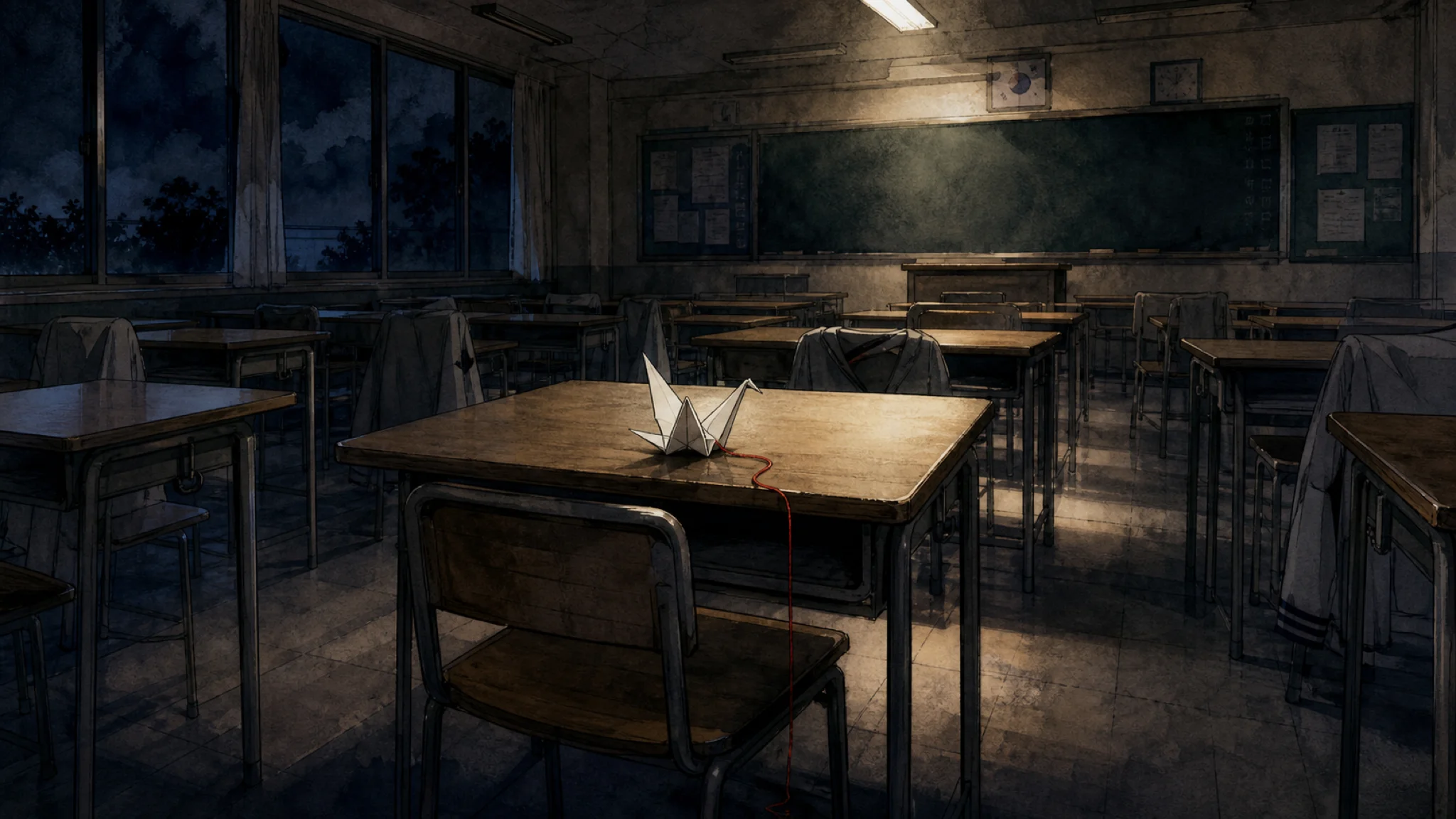
The crack arrives through production design, not exposition. The multimedia room is under asbestos-removal signs, the bars are gone, and the project that had been frozen before the students arrived is now somehow complete. Se-ah does not need a demon monologue to understand something is off. Her body knows before the group does. That is one of the finale’s sharper horror choices: trauma is not presented as paranoia here. Se-ah’s suspicion is evidence.
From there, the episode rewinds into the truth of what happened after the warehouse. Geon-woo gets the call from Ha-joon’s sister’s voice, supposedly guiding him toward a compound with a lantern signal. Se-ah, barely conscious, keeps insisting he cannot listen. The show has trained us to fear phones, but Episode 8 turns that fear into something nastier: the voice of help can be puppeted, and urgency itself can be weaponized. “Se-ah’s life is in your hands” sounds heroic until you remember this curse loves borrowing people’s best instincts and making them lethal.
Geon-woo choosing Se-ah over the fake instructions lands because the scene skips romantic grand-gesture sparkle and goes straight for panicked, sweaty, physical loyalty. Na-ri, possessed and vicious, tells Se-ah she made a wish and now has to die. Geon-woo drags Se-ah through the chase, refuses the rules, curses at them, and keeps moving while the demon keeps insisting she is already lost. The sequence is messy in the correct way. It lets fear make everyone loud and graceless.
Na-ri’s anger refuses the easy exit
The finale could have given Na-ri the softest possible absolution. It almost does. She says she was not in control of her actions. Se-ah, who has every reason to flinch, still wants to believe there is a person under the curse worth reaching. For a show about killer wishes, that is the real danger: not the app, not the red phone, but the temptation to file every ugly choice under supernatural interference.
Episode 8 refuses to make that simple. When Se-ah meets Na-ri again inside the cursed space, the confrontation becomes less about Girigo and more about the rot Girigo amplified. Na-ri’s accusations are brutally adolescent, which is why they sting. She remembers being attacked. She remembers feeling disposable. She remembers Se-ah and Geon-woo keeping secrets while she had a crush on him. The wound is petty, romantic, humiliating, and deadly all at once.
That is where Na-ri becomes one of the finale’s most uncomfortable pieces. Her jealousy does not excuse her, but the show lets it sound recognizably human. She calls Se-ah a backstabber. She mocks the “I was gonna tell you” defense. She turns the friendship language back on Se-ah and makes every hidden feeling sound like betrayal. The curse may have given Na-ri a weapon, but it did not invent every resentment she spits out.
The strongest choice is that Na-ri eventually says she does want them dead. She blames Hyeong-wook for telling her Girigo existed, as if knowing about the app were the first domino in her misery. It is ugly because it is so childish: if that loser had kept his mouth shut, she says, she never would have made a wish. That line does not ask for sympathy. It asks us to sit with the way pain can make a teenager turn consequence into grievance.
Se-ah’s response is the reason the finale stays emotionally grounded. She does not magically talk Na-ri back with a perfect friendship speech. She tries. She tells Na-ri they can fix it, that Na-ri did not mean for anyone to die, that the app took over. But Na-ri keeps choosing rage. The show lets Se-ah’s compassion matter without pretending compassion is a cheat code. Some people are reachable. Some moments pass before anyone has the words to stop them.
That makes Na-ri’s loss hit differently from a standard possession death. She is not cleanly villain, victim, or cautionary tale. She is a girl whose hurt was real and whose choices became unforgivable. In a less honest finale, that would be softened until everyone could cry neatly. Here, the grief has splinters.
Haetsal’s mythology finally gets bloody
The supernatural side of If Wishes Could Kill has always been at its best when folklore feels practical. Episode 8 gives Haetsal her biggest swing by making the curse bigger than the red phone. Destroying the device does not end it, because the maehyung is still out there. That reveal works because it changes the finale from “break the cursed object” into “find the original wound.”
Do Hye-ryung’s ghost becomes the key. She is not the creator of Girigo; she is pointing toward the multimedia room and toward Kwon Si-won, the girl whose date, February 1, 2005, marks the older horror hiding under the students’ present-day disaster. The season has been crowded with blame, so making Hye-ryung a witness instead of the source feels right. The dead are not all villains in this world. Some are stuck trying to clarify the record.
Haetsal’s plan brings the finale’s folklore into body-horror territory. She needs a deolmi because Si-won is too strong inside the cursed space, and she makes herself the binding tool when nothing else will work. The image of blood soaking into thread is the kind of ritual detail this show should lean into more often: simple enough to understand, creepy enough to linger. It also gives Haetsal a cost, pulling her out of rule-recital mode and forcing her to bleed into the mechanism.
The actual defeat is satisfyingly chaotic. Se-ah finds Si-won’s phone. Haetsal binds Si-won. The Girigo screen appears again, that smug “make a wish” interface somehow more annoying after everyone has died for it, and Se-ah gets the moment she has been running toward all season. She is the athlete who charges danger, yes, but the finale is careful to show that bravery is not fearlessness. She is terrified. She keeps moving anyway.
Geon-woo’s role in this stretch is quieter after the rescue, but the episode has already made its point about him. His love language is refusal: refusing the fake Haetsal call, refusing to let Se-ah fall, refusing the curse’s rule that she has to die. Ha-joon, meanwhile, works better here when the show lets his logic crack. His sister, Bangwool, Haetsal, the deolmi, the spirits: the finale forces him into a world where analysis still matters, but only after he accepts that not everything will arrive in a clean proof.
Then Hyeong-wook gets the goodbye the season owes him. The ceremony scene is restrained, and the line wishing him peace in a place without troubles or sorrows is devastating because it lands after his comic-relief armor has finally been stripped away. He knew more than he let on, joked more than he should have had to, and died in a story that keeps punishing kids for wanting things too loudly.
What this hour costs
The finale’s best idea is that surviving the curse does not mean deleting what happened. Se-ah keeping Girigo on her phone after the ceremony is a perfect character beat: part fear of forgetting Hyeong-wook, part guilt over Na-ri, part punishment she thinks she deserves. When Geon-woo tells her she was brave and did everything she could, it matters because he is not offering a clean slate. He is offering permission to stop holding the blade by the sharp end.
The episode also makes a sneaky case for memory as a responsibility, not a haunting. Bangwool’s return brings comic bounce back into the room, complete with his dramatic Samdocheon story and Ha-joon absolutely failing to pretend he did not cry. But even that scene carries a future. Bangwool saw Hyeong-wook happy, saw power moving through Se-ah, and believes her gift may help Haetsal leave the compound. The finale closes one curse while opening the possibility that Se-ah’s survival has changed what she can see, do, and owe.
Verdict
If Wishes Could Kill S1E08 has rough edges. The Si-won reveal arrives late enough that some of the original-curse mythology feels compressed, and the post-curse mechanics could use a little more room to breathe. Still, the episode has the right priorities: Se-ah’s terror, Na-ri’s bitterness, Geon-woo’s stubborn devotion, Haetsal’s bloody sacrifice, and Hyeong-wook’s absence all feel more important than puzzle-box neatness.
The last sting is mean, funny, and genuinely rude. Someone is still asking why Choi Hyeong-wook died. Someone has found the phone. Girigo is still there, grinning through text bubbles like an app that cannot wait to ruin another semester. For a season that made teenage wanting feel cursed before the demons even arrived, that is the correct final chill.
Rating: 8.7/10
More episodes from If Wishes Could Kill — Five high school students, one supernatural arbiter, eight episodes that escalate fast. Jump to any episode in the season:
Where to go next
Reviewed by Mira Vance · QuizFandom Editor & Lead Reviewer. Every rating is an honest per-watch assessment from the desk that also writes the quizzes — not a press release rehash.