Mayor of Kingstown S3E2 Review: A Poisoned Batch Tests Every Cage in Town
A contaminated supply pushes Kingstown's private grief toward public triage, while Mike learns every favor has a body count.
Mayor of Kingstown Season 3 Episode 2 opens with Mike McLusky’s narration framing the prison system as a machine with no clean exit. That could be heavy-handed, but here the metaphor holds because the episode keeps showing the same machinery at different scales: a prison visit, a parole grievance, a drug supply chain, a jurisdiction fight, a father on a video call. Mike, played by Jeremy Renner, spends the hour trying to contain damage that has already left containment. The season’s Russian and prison-power instability is still gathering shape, but this episode is most effective when it studies how quickly one poisoned decision becomes civic infrastructure.
The bad batch prices bodies as evidence
The first crisis is brutally procedural. Big Hush gets sick inside the prison after carrying balloons, Ton tries to keep him moving, and Raphael arrives too late to do anything except manage the corpse. The detail that matters is not only that Hush dies. It is that the package is cut out of him and moved anyway, as if the dead body were a damaged wrapper around usable inventory.
That is where the episode’s opening thesis stops being narration and becomes plot. Bunny Washington, played by Tobi Bamtefa, answers Mike with the language of commerce. Hush’s death is bad luck, but the product has already been distributed, and the customer base will not care where it came from. Mike tells him to pause anything Sharon touched, to think of it like a recall or refund. Bunny’s reply is not sentimental. “It’s product, Mike.” That is the hour’s coldest line because it is not a villain speech. It is a business principle spoken inside a town that has trained everyone to price catastrophe.
The episode makes Bunny both culpable and exposed. He defends Sharon as one of his people before admitting she is not answering, and his barber-shop scene with Rhonda gives him a private register the prison scenes cannot. He is affectionate, proud, touchy about tone, and still a man whose empire can kill strangers before breakfast. When bodies start dropping, Bunny knows Raph will take the institutional heat. His panic is the realization that somebody has made his pipeline a weapon aimed at him.
Mike’s response is pure Kingstown management: not justice, not public health, but supply stabilization. He goes to Raphael and tells him to pivot, cut a deal with another group, find clean supply, double the payout, and keep the internal economy from tearing itself apart. Raphael pushes back because Luis was torched and because Bunny’s blessing does not automatically become trust. Mike does not ask to be believed. He asks Raphael to do the job Bunny has handed him.
That scene is ugly because it makes sense. Mike is trying to save lives by advising a prison drug dealer to secure better narcotics. The episode does not need anyone to announce the contradiction. It simply lets Mike stand in the corridor and argue that a cleaner criminal supply chain is the least deadly option available. For a show built around compromised mediation, this is one of the cleaner examples of its moral design: the mayor’s office is not above the market. It is the emergency regulator of the market.
The morgue sequence widens the crisis without overexplaining the chemistry. Evelyn shows Mike bodies from the street and describes a combined narcotic mix that still needs lab isolation. One victim is thirty, another is twenty-two and a mother of three. Mike asks about meth, fentanyl, bleach, anything that will make the unknown usable. Evelyn has only bodies and delay. When Mike says the outbreak will hit the schools because it always does, the prison problem enters the public bloodstream. The walls are real, but they are not sealed.
Anna makes grief another kind of sentence
The Anna story initially looks like a side case, but it is the episode’s moral counterweight. She comes to Mike because Greg Stewart, the man who killed her son, is at StoneBrook and has been repeatedly denied parole after she delivered victim statements. Now he has done his time. She wants to know whether something could happen inside that would make the board reconsider.
Mike does not pretend there is an obvious remedy. If parole is stamped, he tells her, it is done. Still, he takes the name, calls Carney about a sister who teaches theater at StoneBrook, and promises to look into it. The scene is small, almost office-drama plain, but it catches how Kingstown converts grief into procedure. Anna is asking whether the system can be made to keep hurting the person who hurt her.
The stronger scene comes later, when Anna waits outside in the cold and asks Mike about the man who killed his brother. She is really asking about Mariam, about what a mother does after a son is shot. Anna describes driving through winter to a support group where grieving parents clutch framed photographs. Communal grief, she suggests, can be another airless room. When she learns Mitch’s killer did not survive, she calls that a lucky break. The line lands because it is indecent and completely legible.
That is the episode’s best use of Mike’s silence. He cannot offer Anna comfort without lying, and he cannot condemn the thing she wants without condemning half the favors that keep his office open. Later, after he learns Greg got out that morning and was a model prisoner, Anna returns to thank him and tries to pay him anyway. She tells him he has the kind of face that would have helped if it could. Mike is briefly caught off guard by being seen as decent.
The final movement makes that decency feel useless. Greg is out, a father elsewhere is beaten during a video call while his daughter screams for help, and Greg’s name is called in the street before the episode gives itself over to dread and silence. Episode 2 does not make that ending a courtroom-clear sequence of cause and effect, which is part of why it works. Enough has already been shown. Release does not bring resolution here; it just changes the geography of unfinished punishment.
The riot still governs the people who survived it
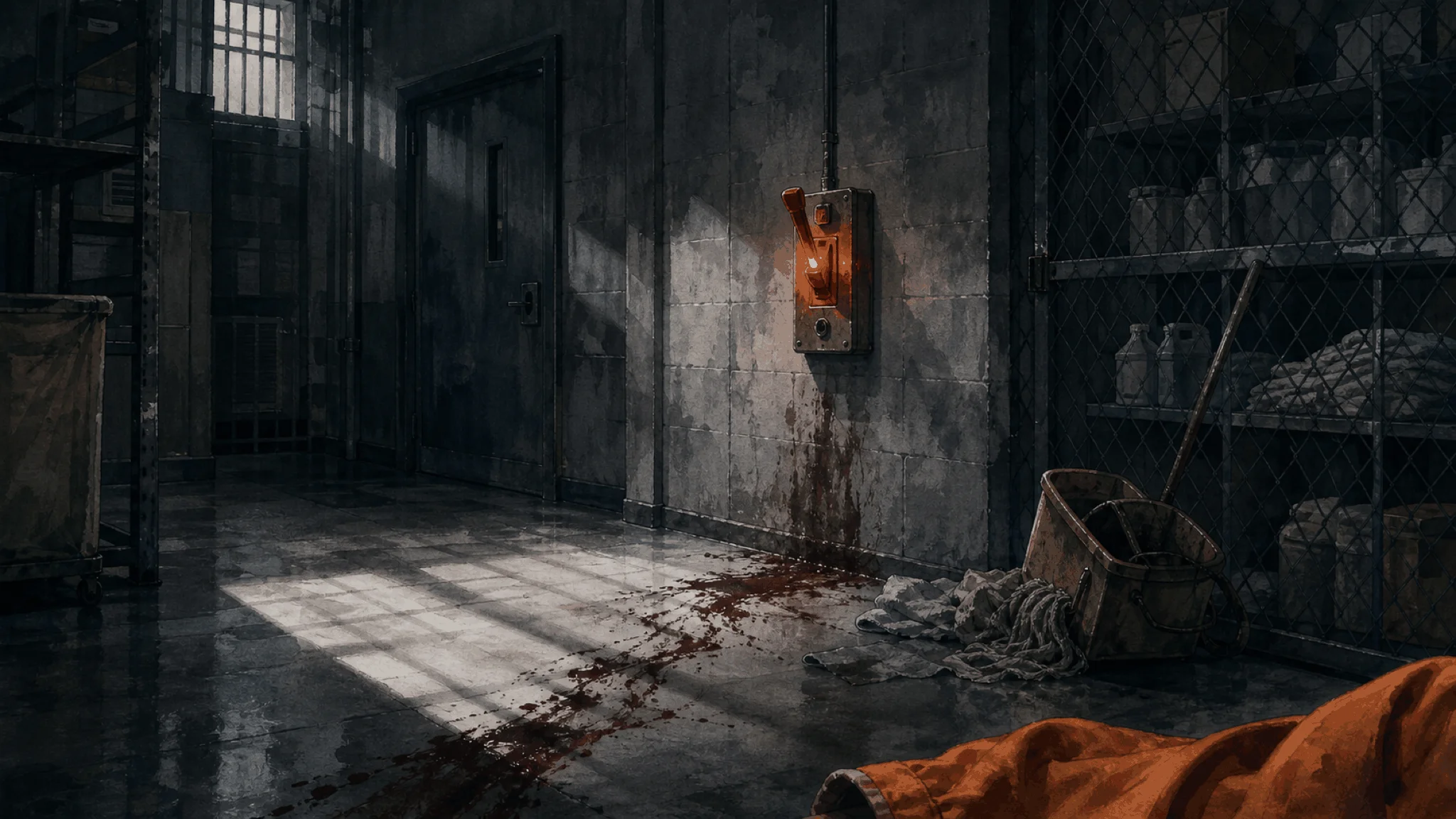
Season 3 keeps returning to the riot as more than backstory, and Episode 2 uses Kareem and Carney to show how institutional trauma becomes office politics. Kareem catches that Mike has been inside without appearing on the visitor log and confronts Carney, who defends Mike as backup. Carney’s argument is blunt: the prison is full of new hires who cannot carry the weight, bodies are dropping, and Mike can do what Kareem cannot. Kareem’s answer is equally blunt. Mike is a criminal who helps criminals.
The scene works because both men are right from inside their own jobs. Kareem wants a prison that acknowledges his authority as warden, especially after what happened to him during the riot. Carney wants the old informal network because the official one feels too slow and too young. When Carney reaches for shared trauma, Kareem attacks the phrase. He knows exactly who endured what, and he refuses to let Carney borrow his wounds as workplace currency.
Kareem’s punishment is bureaucratic and humiliating: he moves Carney to def-watch, where Carney ends up picking through waste. The episode nearly plays it as gallows comedy, with Carney unable to stop talking about intestines and prison filth while Mike tries to eat. But the joke curdles when Carney suggests Kareem “evened the score” after the riot and then tries to take the comment back. The line plants a darker suspicion without forcing a confession. In Kingstown, even trauma has an evidence trail.
Ian Ferguson, played by Hugh Dillon, brings another version of damaged masculinity through Kyle’s domestic scene. Kyle, played by Taylor Handley, and Tracy are in a rare pocket of ordinary life, wrestling with baby gear, when Ian and Patty arrive. Ian is tender with the new father for a moment, telling Kyle to do skin-to-skin and look his son in the eye because boys need their fathers. Then Kyle says he is thinking of transferring from Homicide to SWAT because the work feels like waiting for aftermath and nobody talks anyway.
Ian does not dress up the answer. Kyle is a good cop, but in the thick of danger he is either too angry or too afraid, and that gets people killed. It is a hard thing to say at a baby visit, which is why the scene belongs here. Parenthood, police work, riot aftermath, and the need to feel useful all collapse into one living room. Kingstown does not let men separate tenderness from threat for very long.
Iris, played by Emma Laird, is the missing pressure point threading through these heavier civic stories. She takes Mariam’s car to the grocery store and does not come back. A traffic stop escalates after she admits she has no license, refuses to get out, starts the engine, and drives off while the officer is still at the car. Later, at the station, she refuses fingerprinting and dares them to get a court order. Mike leaves her a voicemail that begins as a check-in and becomes something closer to absolution. If she took off, he says, he does not blame her. For once, his instinct is not to manage a system, but to let someone leave one.
What this episode argues
Episode 2 is strongest when it treats Kingstown as a set of overlapping jurisdictions that all fail in different ways. The prison cannot keep poison inside. The street cannot investigate without prison footage. The warden cannot secure authority without isolating a subordinate. The police cannot close cases, so Kyle dreams of a tactical unit where action might feel cleaner than aftermath. Mike cannot save people through legitimate channels, so he brokers cleaner crime.
That argument could become schematic, but the hour keeps finding human interruptions: Anna’s cold-weather grief, Bunny’s intimacy with Rhonda, Ian’s fatherly advice, Lucas learning his sister Sharon is dead, Mike stumbling through a voicemail to Iris. Those scenes keep the episode from becoming a board of factions. The factions matter because people live inside them, and because every attempt to leave one cage seems to require stepping into another.
Verdict
Mayor of Kingstown Season 3 Episode 2 is not the season’s flashiest hour, but it is a disciplined one. The contaminated-drug plot gives the episode forward momentum, while Anna’s story gives it an ache that lingers beyond the mechanics of Bunny, Raphael, and the new Russian pressure Ian identifies through Konstantin Noskov. The writing is occasionally blunt, especially in Mike’s opening narration, but the scenes that follow give that bluntness enough blood and paperwork to hold.
The best material belongs to the spaces between official power and practical power: Mike in the prison corridor, Kareem behind his desk, Evelyn at the morgue, Ian in Kyle’s living room, Anna outside the office. Everyone has a title or a wound or a claim. None of those things is enough to stop the machine once it starts moving.
Rating: 8.3/10
More episodes from Mayor of Kingstown — Season 3 — Mike's truce strategy collapses as a Russian mob bid reshapes the town. Jump to any episode in the season:
Where to go next
Reviewed by Mira Vance · QuizFandom Editor & Lead Reviewer. Every rating is an honest per-watch assessment from the desk that also writes the quizzes — not a press release rehash.