Mayor of Kingstown S3E8 Review: A Town Learns the Price of Bad Protection
Mike tries to steer a prison-town war while every private mercy starts looking like another form of control.
Mayor of Kingstown S3E8 opens with the city already past the point where anyone can pretend this is a managed conflict. The river murders have broken something in Bunny, the Aryans are reading Mike’s interference as weakness, and Konstantin is losing the line between grief, calculation, and panic. The episode’s sharpest move is to make the war feel less like one clean front than a chain of protective gestures curdling into coercion. Mike McLusky can still move men around the board, but the hour keeps asking whether moving them is the same as saving anyone.
The yard attack gives Mike an enemy he can use
The first substantial beat belongs to Merle Callahan’s side of the prison economy. Before the attack, the Aryan leadership is almost celebratory: the cook is running, surplus is coming, and Mike’s balancing act looks like a temporary inconvenience. The politics are plain. They think they have material advantage, ideological certainty, and less to lose than Mike.
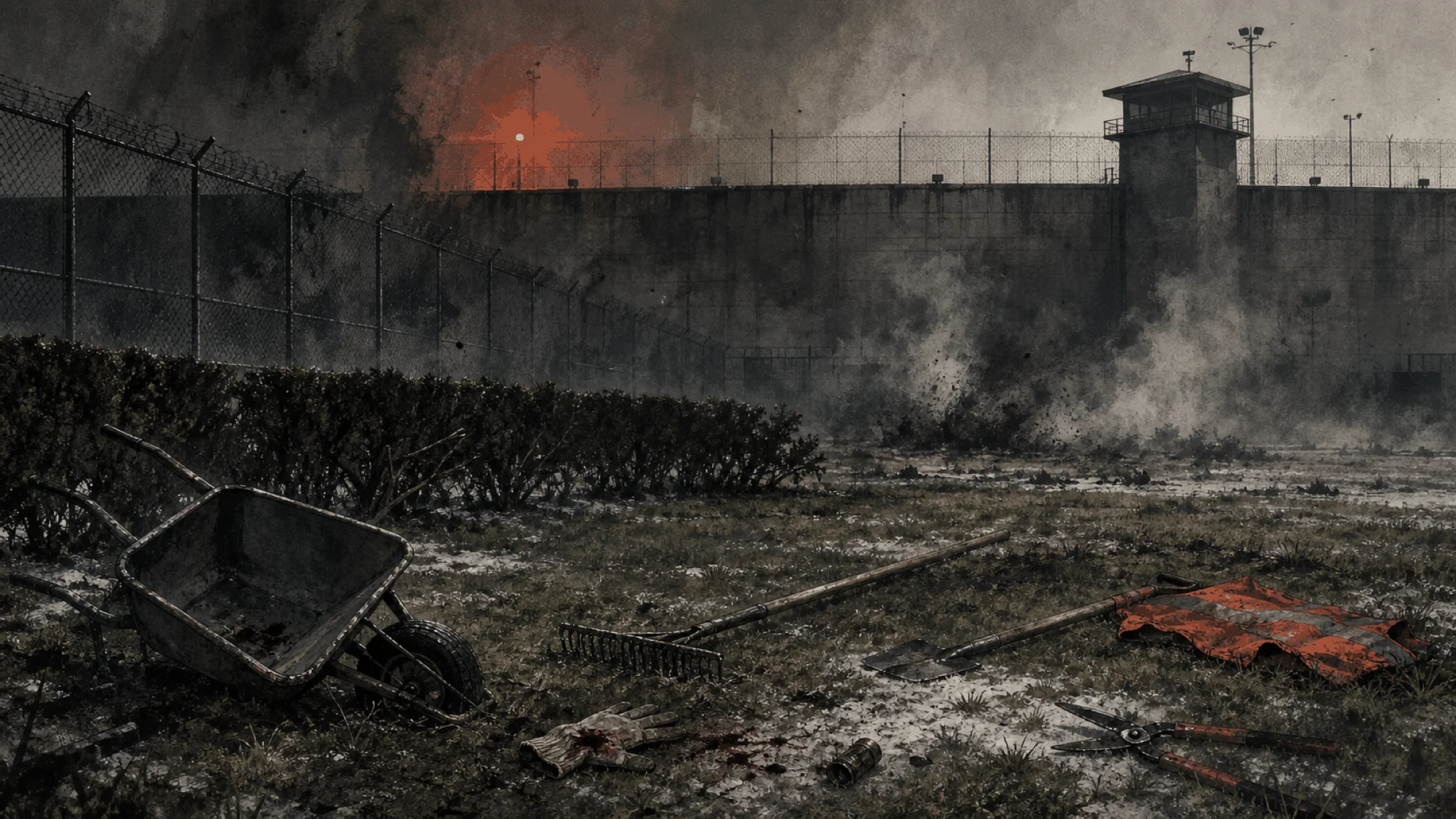
Then the yard erupts. Grenades come over the wall, a guard is shot from distance, and Carney calls Mike with the kind of report Kingstown usually needs several departments to misunderstand before anyone acts. Three inmates are dead, a correctional officer is dead, and Callahan is unconscious. When Mike arrives, the facts have a shape: Aryans targeted on landscape duty, a high-caliber shot from long range, military precision, and army-issue explosives.
Mike’s reaction is fast arithmetic rather than shock. He asks who went down, where Kareem is, where Ian is, and what the shot says about the shooter. Ian carries his usual profane impatience, but he and Mike reach the same operational conclusion quickly: Bunny has access to military-grade weapons, and that makes Bunny the easiest target to point law enforcement toward. Mike gives Ian an address and tells him to hit it with a warrant.
Episode 8 draws a careful line, though, between suspicion and use. Mike may believe Bunny could do it, but the hospital scene with Callahan reveals the move he really wants to make. Merle wakes up racist, furious, and still powerful enough to demand blood. He wants Bunny dead and everyone around Bunny dead. Mike answers by redirecting him: a military sniper and army-issue grenades do not sound like the Crips, he argues, and Konstantin is the one trying to devour him.
That is the episode’s most consequential piece of brokerage. Mike is not proving a case in a courtroom. He is rerouting rage before it lands on the wrong neighborhood. He tells Callahan the hit was Russian and promises to end Konstantin on Callahan’s behalf, then adds that he will take care of Bunny too. Mike needs Callahan pointed at the boat, but every sentence he spends buying that direction becomes another claim on his future violence.
Kingstown’s families absorb the riot aftershock
The episode keeps cutting away from tactical violence to the households forced to metabolize it. Kareem’s scene with Vanessa and their daughter is small, painful, and necessary. His phone keeps buzzing because a prison yard has just become a battlefield, but at home the emergency is older than the call. Their daughter needs therapy after what she has read, heard at school, and seen in him since the riot. Vanessa explains the cost, and Kareem promises to work it out with the desperation of a man trying to repair a family while his job keeps taking the tools out of his hands.
That scene gives Warden Kareem Moore, played by Michael Beach, more than institutional function. Later, when he speaks with young CO Kevin after the attack, Kareem offers the language of care: take the day, speak with someone, use the counselors, there is no shame in asking for help. The advice is humane, but the scene is haunted by the earlier one. Kareem can identify trauma in a subordinate because he is living beside it at home.
Kyle and Tracy’s morning works in the same register. Kyle, played by Taylor Handley, wants to make eggs, send Tracy with coffee, and perform the little rituals of a safe house. Tracy, played by Nishi Munshi, is already elsewhere. She has not slept, she is late, and she cannot make domestic tenderness do the work Kyle wants it to do. Kingstown does not only break people in alleys and yards; it makes breakfast feel like a place where no one can quite say the truth.
That truth arrives when Tracy comes to Mike’s office and says she thinks COs at the women’s prison are raping inmates. Mike’s first response is ugly but grounded in the show’s institutional vocabulary: assault or “dating”? Tracy corrects him immediately. These women are being assaulted by their keepers, and she knows the difference. Cherry Maxwell becomes the name that connects the grievance to the season’s ongoing moral injury: raped, forced to give birth, and left to tie a sheet after the baby was taken away.
Mike’s suspicion changes when Tracy names William Breen and cannot give him the proof he asks for. He presses the question that matters most to him: did Breen touch her? Tracy does not give him a clean spoken answer, but her silence is enough for Mike to move. He calls Ian from a gas station and says he is going to hurt someone, then clarifies why Ian is there: not to help him, but to stop him.
The bar confrontation is pure Kingstown justice, satisfying for five seconds and morally insufficient the moment it begins. Ian identifies Breen, Mike pulls him outside, mocks the missing “rapist’s uniform,” beats him, and orders him out of the women’s prison and into Anchor Bay until Mike decides what to do with him. It protects Tracy in the only language Mike trusts. It leaves the underlying system intact, dependent again on one man terrifying another man.
Protection keeps sounding like ownership
Iris’s material gives the episode its clearest vocabulary for the difference between being guarded and being held. Mike calls her from outside the hotel after the river murders and asks if she wants out, or an exit. Iris asks what that fixes. She insists Konstantin does not treat her like the dead women in the river, and the episode lets that statement sit uneasily because Mike and Konstantin both arrive for the same stated reason: checking on her.
Iris (Emma Laird) stays controlled and unreadable through the first half of the exchange with Konstantin. He is soft with her, even apologetic. He admits that protecting her and controlling her can feel indistinguishable, then offers to buy her a life somewhere away from Kingstown, with no old haunts and no hand from him in what comes next. It is the kindest thing he says in the episode and also a transaction spoken by a trafficker who knows exactly how money can rename ownership.
Iris says she cannot leave him, then repeats that she is loyal to him. Konstantin’s response about the river’s source gives the episode one of its most pointed images. He wonders whether the water begins foul or whether Kingstown poisons it. Coming from him, the line is not absolution. It is a confession from a man trying to decide whether rot is born inside people or added by place, while standing inside a business that has treated people as replaceable.
The boat scene answers his own question badly. Callahan’s men arrive for a re-up after the prison attack, and Konstantin lets them aboard against Roman’s caution. The exchange hinges on manners, not strategy. He lectures them about deference, asks what effect might follow their irritation of him, then shoots one of them and sends the survivor away with the body. When he asks Iris if she still wants to stay, the offer of a cure has already become a demonstration.
That killing becomes useful to Mike almost immediately. Iris calls him and reports that Konstantin shot an Aryan on the boat; Mike calls it a gift because it pulls Callahan’s people toward the Russian without Mike having to manufacture the spark. Iris also tells him Konstantin is cracking, using cocaine in the morning and heroin to sleep, and that his offer to stake her comes with the invisible strings she has learned to expect.
Bunny, played by Tobi Bamtefa, is running his own version of care and command. His visit with Raphael’s son Trey is tender on its face. He praises the boy’s grades, says his father thinks of him day and night, and promises to move Trey and his mother somewhere safer. But he also tells the child to watch his father’s back, to be a man for him, and to separate what feels false from what is true. Bunny’s protection is real. So is the burden he places on a boy.
The phone call to Cesar sharpens the manipulation. Bunny knows his side will be the most wanted after the attack, so he tells the rookie to confuse the issue and keep working Kareem with the same eager-to-please face. Later, the raid on Bunny’s warehouse comes up empty: no gun, no bullets, no drugs. Robert reads that as proof Mike tipped Bunny off, while Kyle defends his brother and exposes how little trust remains inside the police side of the machine.
What this episode argues
S3E8 is about protection as Kingstown’s most unstable currency. Everyone claims to be protecting someone: Mike protects Bunny from Callahan and Tracy from Breen; Bunny protects Raphael’s family and his own operation; Konstantin protects Iris while trying to send her away; Kyle wants Tracy armed because the world outside has become a mess; Kareem wants both his daughter and his staff to receive care. The problem is that Kingstown rarely allows protection to stay gentle. It becomes leverage, debt, surveillance, or an excuse to hurt someone first.
That is why the episode’s scattered structure works better than a cleaner war-hour might have. The prison attack is the loud event, but the quieter scenes show where that blast wave goes: a child’s therapy bill, a marriage’s morning silence, a warden’s dissociation, a woman’s trembling report, a boy asked to inherit adult danger, and Iris trying to tell whether loyalty is a choice or another locked door. The city poisons the river because every institution keeps dumping its damage downstream.
Verdict
Mayor of Kingstown S3E8 is not the season’s neatest hour, but it is one of its more revealing ones. The episode can feel overstuffed as it moves from prison attack to hospital negotiation to boat killing to workplace assault fallout, yet those pieces circle the same question: who gets protected, who pays for it, and who gets renamed as collateral when the bill comes due.
Mike is strongest when he is thinking three disasters ahead and still losing ground emotionally. Iris’s divided loyalty plays as a wary intelligence, while Bunny’s warmth with Trey feels inseparable from command. The episode’s violence is blunt, sometimes punishingly so, but the better scenes treat the aftermath as procedure, marriage, parenting, and bad sleep. Kingstown’s war is widening; this hour makes the widening feel personal.
Rating: 8.3/10
More episodes from Mayor of Kingstown — Season 3 — Mike's truce strategy collapses as a Russian mob bid reshapes the town. Jump to any episode in the season:
Where to go next
Reviewed by Mira Vance · QuizFandom Editor & Lead Reviewer. Every rating is an honest per-watch assessment from the desk that also writes the quizzes — not a press release rehash.