Mayor of Kingstown S3E4 Review: Mike Chases a Name Through a Burning City
A bombing manhunt pushes Mike toward Callahan while Anna Fletcher and Kyle expose Kingstown's appetite for simple answers.
Mayor of Kingstown Season 3 Episode 4 moves like a citywide alarm: radios stepping on each other, patrol cars cutting through intersections, prisoners waiting for news to leak through the walls. Mike McLusky (Jeremy Renner) is trying to turn the KPD bombing into a usable name before the police, the gangs, or the prison bury the evidence for him. The episode’s best sections understand Kingstown as a place where information has to survive several competing systems before it can become truth. By the time Mike reaches Merle Callahan again, the question is no longer whether Callahan has returned with influence. It is how much of Mike’s old life Callahan can still claim.
Mike Needs a Living Witness in a City That Keeps Producing Bodies
The episode opens on pursuit, panic, and bad police infrastructure. KPD has identified John York as one bombing suspect, thanks to the burners used to detonate the bombs and the two devices that failed to go off. Kyle McLusky (Taylor Handley) and the others have a name, a weak address, and a problem: the bomb squad says this signature does not match the attack on Mariam’s funeral, which means the Aryan Brotherhood may be copying old trauma for new leverage.
That uncertainty matters because Mike does not have time for a clean theory. A tactical raid catches one suspect, but the exchange of shouted commands and gunfire leaves Robert down, with Mike staring at the result and begging for him to be kept alive. The scene is not staged as a triumphant police hit. It is a preview of the episode’s operating principle: every attempt to close the circle creates another casualty, another grudge, another faction with a reason to harden.
Outside the police channel, Bunny Washington (Tobi Bamtefa) and Donnell listen to the chase like spectators with better equipment than the cops. Their running commentary is funny until it lands on the racial geography of Kingstown. When the suspect description confirms that KPD is chasing a white Aryan rather than another Black man, Bunny’s relief comes out as mock celebration. The manhunt is public safety on paper, but everyone in town knows which bodies usually absorb police urgency.
Mike’s next move is to Kareem Moore (Michael Beach), because getting to Callahan requires prison access more than police authority. Kareem is at home, blasting music before the day has properly begun, and Mike arrives with a request that turns a private garage into an extension of the prison. The Aryans have set off bombs at KPD; Mike needs a pass to Callahan immediately. Kareem sets it up, and the scene shows how thin the boundary is between job and home.
The Callahan meeting is the episode’s central piece of political theater. Merle is brought to Mike in a kennel built out of old death-row exercise runs, and he notices the conversion before Mike can turn the conversation practical. His riff about solitary, dreams, and the town becoming “rudderless” is menace dressed as patience.
Mike needs the second bomber alive because a living witness can name the person who ordered the attack. Callahan does not give him that freely. He asks for a return to general population and offers only the possibility of an ID. Mike asks for a day; Callahan gets six hours. That bargain says more than either man admits. Mike wants Callahan buried in maximum isolation if the order traces back to him, but he still has to use Callahan’s network to prove it. In Kingstown, even containment begins as cooperation.
Anna Fletcher Makes Grief Too Plain for the Court to Use
The Anna Fletcher arraignment is the hour’s hardest moral moment. Anna stands before the judge and refuses every exit the legal system tries to leave open. She understands the charges. She killed the man who murdered her son. She would do it again a hundred times if she could. Then she pleads guilty.
That scene is powerful because it is almost anti-dramatic. Anna does not beg, strategize, or dress revenge in nobler language. She says the thing plainly, and the court responds by turning plainness into evidence against her. The judge notes her lack of remorse. The machinery likes ambiguity when ambiguity keeps the machinery moving, but Anna gives it something easier to process: a confession without negotiation.
Mike’s hallway conversation after the plea is where the episode widens. He tells the prosecutor that Anna is a client of his and once wanted him to grease the parole board to keep her son’s killer inside. Mike told her he could not do that. Now he asks for something else: consider minimums, amend the charge, keep her from dying in prison. The answer is procedural and convenient. Murder One means life without parole. There is too much happening outside to spend energy on a case gift-wrapped by a guilty plea.
Mike plays the scene with a small but telling weariness. Mike is not arguing that Anna did not kill anyone. He is arguing that grief has a longer jurisdiction than the code can admit. When he says someone has to put a statute of limitations on grief, the line carries the whole season’s burden. His mother is dead, her funeral was bombed, his town is chasing Aryan soldiers through traffic, and still he recognizes Anna’s face because it resembles something he saw in Mariam. Kingstown trains people to punish pain because it has no institution capable of absorbing it.
The court scene also reframes Mike’s frantic need for the bomber’s name. Anna is what happens when grief becomes a single clean act and the system finally knows what to do with a person. The bombing is the opposite: a collective act with too many hands, too many old loyalties, too much racial and prison history behind it. Mike can plead for Anna because her story has a human outline. He needs Macon alive because the bombing’s chain of command vanishes the moment the wrong person dies.
Kyle Learns the Job by Resisting the Easy Shot
Kyle’s thread is the episode’s most quietly brutal training sequence. When Ian Ferguson (Hugh Dillon) and the police catch the driver after the crash, the scene could have tipped into another killing without much effort. The suspect is scared, unarmed, and insisting that he only gave the bomber a ride. Ian orders him down and tells Kyle to drop him if he moves wrong. The street has already decided what kind of day it is.
Kyle does something harder than shooting. He talks the man down, separates the grand-theft problem from the larger hunt, and makes the man believe cooperation is the only way to get out alive. The language is not soft, but it is controlled. Kyle gets him onto his knees, hands behind his head, then cuffs him. Ian’s irritation afterward is revealing. He asks whether Kyle knew the man was unarmed, then demands to know what would have happened if he was not.
That exchange continues later at the bar, where Ian praises Kyle to Mike before confronting Kyle directly. The contradiction is very Kingstown. Ian can admire the result and still reject the method. To him, field survival depends on assuming danger until the body proves otherwise. His lesson is blunt: if you do not know whether someone is armed, then he is armed. When Kyle answers with “two in the chest, one in the dome,” he is not learning an abstract policy. He is learning the emotional grammar of a badge from a man who has already crossed lines and named them survival.
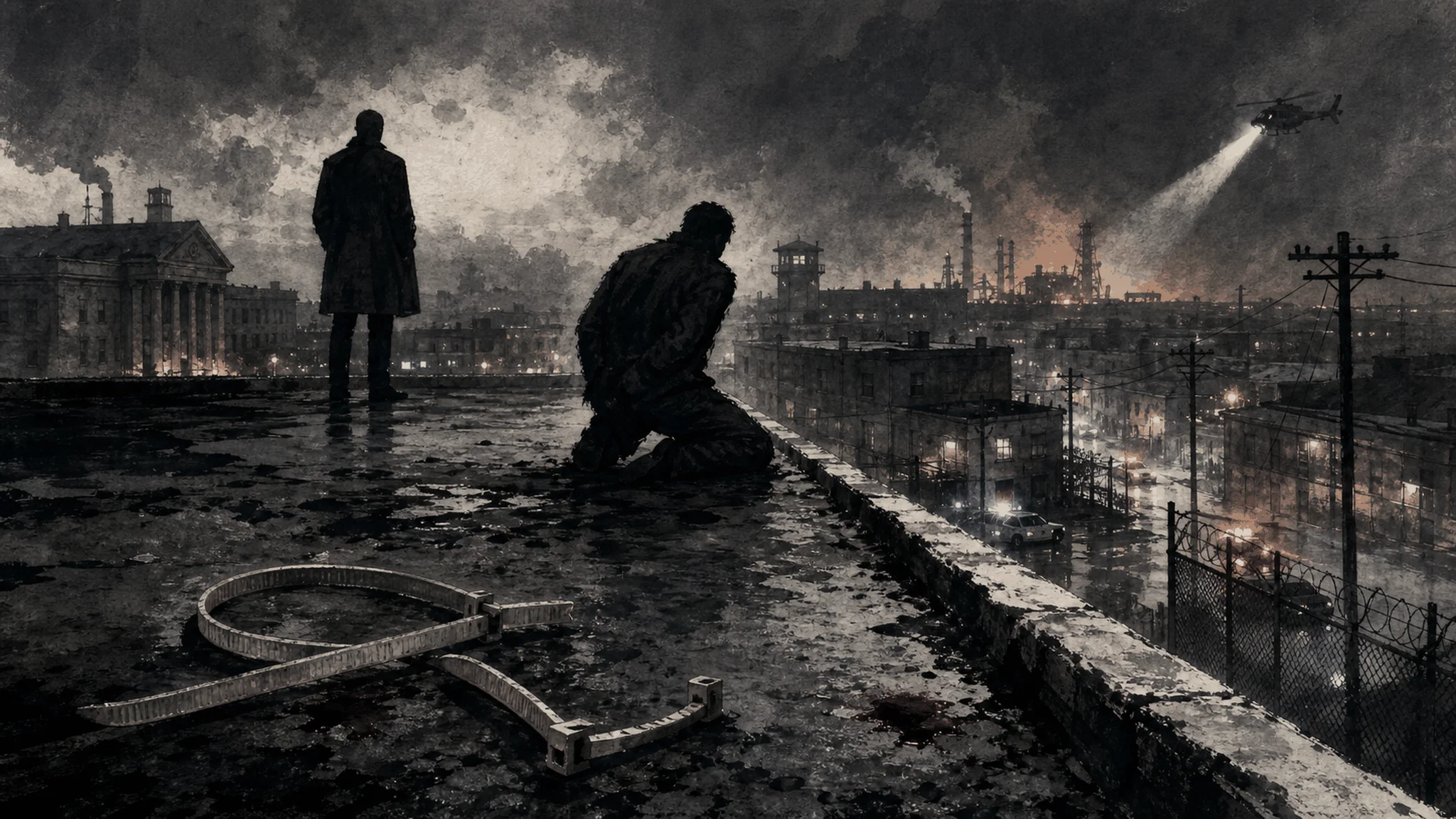
The episode does not let that debate sit alone. Macon’s flight ends in Crip territory, where Bunny and his men catch him before KPD can. Mike arrives to find Macon bound on a rooftop. Bunny calls it catch and release, but the phrase is ugly in context. Macon has failed to comply with more than one power structure.
Mike’s interrogation is a study in collapsing leverage. He offers Macon safety, a way off the rooftop, even a way out of the state. Macon answers with ideology, fear, and personal knowledge. He says the order came from “on high” but refuses to give the clean name. He invokes the Aryans burned alive, calls himself a soldier, and then starts working on Mike’s old prison history: Gunner, Mike’s house being shot up, the funeral bombing, and the fact that men inside once spoke of Mike with reverence. When Mike feeds Callahan’s name into the air, Macon’s rage gives the closest thing to confirmation. Then the interrogation ends with Macon’s body hitting the ground.
That outcome leaves Mike with exactly the kind of truth Kingstown specializes in: enough to know, not enough to prove. When he returns to Callahan, he says the cops flushed Macon into the wrong neighborhood and that the Crips threw him off a three-story building. Whether that is the full truth matters less than how Mike uses it. The witness cannot testify. The caller is safe. Callahan will be back in general population because he “dealt.”
What this episode argues
Season 3 Episode 4 is about the difference between order and control. Kareem tries to keep the streets from entering the prison by cutting calls and visitation without punishing the whole population. A rookie CO reports possible contraband moving through X-ray, and Kareem warns him that certainty matters less than social survival among officers. If he seeks corruption out too aggressively, dead air on the radio can become a death sentence. The prison has rules, but the rules are secondary to whether anyone answers when you call.
Callahan’s return sharpens that argument. He tells Kareem that sleep under one’s own roof is different from drink-induced sleep, then tells Mike that the Aryans are one percent of the population and twenty percent of the violence because violence is how they survive. It is a vile philosophy, but the episode presents it as a working political theory inside a rotten institution. Mike does not defeat it. He negotiates with it, honors old debts, and promises to pick up when Callahan calls. The final club scene, where an arrival is greeted as a friend and promised great things, makes the compromise feel less like a solution than a door opening somewhere else.
Verdict
“Mayor of Kingstown” S3E4 is strongest when it treats the bombing investigation as a stress test for every unofficial government in town. The police chase, Bunny’s scanner room, Kareem’s prison lockdown, Anna’s arraignment, and Callahan’s kennel meeting all belong to the same civic anatomy. Everyone is trying to route violence through a channel that benefits them, and Mike is the man expected to keep the channels from flooding each other.
The hour can be blunt, especially when characters explain their codes directly, but the bluntness fits a day built around sirens and forced choices. Kyle’s restraint, Anna’s refusal to soften her guilt, and Mike’s dependence on Callahan give the episode a strong spine. Its final cost is not the death of a witness alone. It is Mike accepting that containing Callahan may mean making himself useful to him again.
Rating: 8.1/10
More episodes from Mayor of Kingstown — Season 3 — Mike's truce strategy collapses as a Russian mob bid reshapes the town. Jump to any episode in the season:
Where to go next
Reviewed by Mira Vance · QuizFandom Editor & Lead Reviewer. Every rating is an honest per-watch assessment from the desk that also writes the quizzes — not a press release rehash.