Spider-Noir Episode 3 Review: Who Framed the Rat?
What happens — the short version (spoilers)
- Finn Byrne (Silvermane) lets himself into Ben Reilly's office, makes Winston apologize to Janet, and hires Ben to find who sent Addison to torch his mansion and tipped the cops to his booze shipment, leaving a retainer and the line "people lie, only money tells the truth."
- Ben realizes Silvermane marks every bill he hands out, digs out the retainer Cat Hardy paid him, finds the same mark, and confirms Cat has been spending Silvermane's money on the man hired to burn him.
- Posing as union rep "Officer Batnick" at the hospital, Ben plays the wounded patrolmen against each other and traces the order for the docks raid up to Mayor Morris.
- Robbie Robertson follows a lead to a Hooverville police sweep where Lonnie Lincoln shrugs off nightsticks and Flint Marko's fists turn to stone; Janet confirms Marko, Addison, and Lincoln were POWs together in the photo Ben found.
- Cat finds Flint hiding out and begs him to run away with her, but when he holds her his skin crumbles to sand and he admits there's no fixing him, calling the escape a fantasy.
- Ben pays Vera Addison a thousand marked dollars to leave town and relays the bills through street vendors and pickpockets; when Winston drags Ben and Cat to Silvermane and Vera names Cat, Ben reveals the marked bills trace to Winston, Vera flips, and Silvermane shoots Winston dead, then tells Ben they'll need another grave.
Hired to sniff out a traitor in Silvermane's crew, Ben Reilly already knows the answer — so he spends the hour engineering a lie good enough to bury someone else.
A detective story usually withholds the culprit until the last reel. “Double Cross” does the opposite. By the time the title card has faded, Ben Reilly (Nicolas Cage) has already worked out that Cat Hardy is the rat eating away at Silvermane’s empire — she’s been meeting the mayor, the mayor called the raid, she’s tangled up with Flint, and Flint served with the man who burned down the mansion. The mystery isn’t whodunit. It’s whether Ben can manufacture a more convincing answer before the truth gets the woman he’s started to care about killed.
That inversion is what makes the hour tick. Ben isn’t chasing a solution; he’s building a frame, and the suspense comes from watching a broke gumshoe try to out-con the most paranoid man in New York with nothing but a deck of someone else’s money.
Silvermane walks into the office and hands Ben a leash
The hour opens with the Silvermane problem already “handled” — Ben has rearranged the furniture and told Janet Ruiz (Karen Rodriguez) the old gangster won’t be coming around. Then Silvermane comes around. Finn Byrne (Brendan Gleeson) lets himself in, makes Winston apologize to Janet for shoving her the night before, and lays out a job Ben can’t refuse: find the rat who sent Addison to torch the mansion and tipped the cops to the booze shipment. Gleeson plays the recruitment like a benediction, all soft Irish vowels and lethal patience, and his exit line lands as the episode’s keynote — “People lie, Reilly. Only money tells the truth.” He leaves a retainer and the promise of a bonus.
It’s a leash, and everyone in the room knows it. “Getting paid is better than getting murdered,” Ben tells a horrified Janet, which is about as much agency as anyone in this city gets. But Silvermane’s parting wisdom hands Ben more than a paycheck. The line about money becomes a literal clue when Ben notices the gangster marks every bill he hands out — and when Ben digs out the retainer Cat paid him back in the pilot, it’s stamped the same way. “Bingo.” Cat’s been spending Silvermane’s own money on the man she hired to burn him.
Ben works a hospital ward and the trail climbs to the mayor
Before he commits to protecting anyone, Ben needs to know how high the rot goes, so he puts on the slipperiest performance of the episode. Posing as “Officer Batnick” of the Patrolman’s Benevolent Association, he works the ward full of cops wounded in the docks raid, playing each bedridden patrolman against the next. He flatters Jones, needles Miller, dangles the threat of being scapegoated, and lets wounded pride do the rest. Cage runs the whole sequence as a con-man’s etude — a little syrup here, a little menace there — and the chain of fingers pointing up the ladder ends where he suspected it would: the order to ambush Silvermane came straight from Mayor Morris.
The scene leans into the genre’s deepest pleasure, the lone operator who talks his way into any room and out with the one fact he came for. It also confirms the political shape of the season. The mayor, running on a law-and-order platform and crowing about the raid, is using the police as his private weapon against the gangster who bankrolled his first campaign. Everybody in this city used to be on Silvermane’s payroll. Now half of them are trying to get off it.
A Hooverville sweep exposes two more men with powers
While Ben works the angles, Robbie Robertson (Lamorne Morris) chases the photograph that’s been nagging at both of them. He follows a lead to a Hooverville just as the police arrive to clear it on Mayor Morris’s authority, and the eviction turns into the episode’s loudest set piece. A man named Lonnie Lincoln tries to stop a cop from manhandling a woman, takes a half-dozen nightsticks to the skull, and shrugs them off like rain. Lincoln has powers. So does Flint Marko, who’s there too, swinging fists that have turned to stone. Robbie gets caught in the brawl — “I’m a reporter, I’m with the Bugle,” he pleads, to a cop who couldn’t care less — and barely walks away with his film.
It’s the supernatural rhyme the show keeps pulling on. Janet runs down Ben’s hunch and confirms it: Marko, Addison, and Lincoln were prisoners of war together, and the photo Ben found was taken the day they were liberated. Three men, one camp, one rescue, and now three sets of impossible abilities. Whatever happened to those POWs is the question the season is actually about, and the rat hunt is just the door it walks in through.
Cat begs Flint to run, and his own body refuses
The episode’s most tender scene is also its cruelest twist of the knife. Cat finds Flint hiding out and the reunion plays like a real escape hatch — she’s been terrified, she doesn’t care what he owes Silvermane, she just wants the two of them gone. Li Jun Li lets the femme-fatale armor drop completely here, and for a moment “Double Cross” lets you believe in the getaway. Flint agrees. He tells her to pack a bag.
Then he holds her, and the sand takes over. His skin shifts and crumbles against her, he wrenches away, and the truth he’s been hiding spills out: there’s no turning it off, there’s no fixing him. “It’s a fantasy,” he tells her, “kidding myself I could have this life. I could have you.” Jack Huston plays Flint as a man grieving his own body in real time, and the scene reframes everything about Cat’s scheme. She isn’t a cold operator burning down an empire for sport. She’s a woman trying to buy her way out with the only man she loves, and his curse is taking him from her one grain at a time.
A pickpocket relay and a marked bill spring the trap
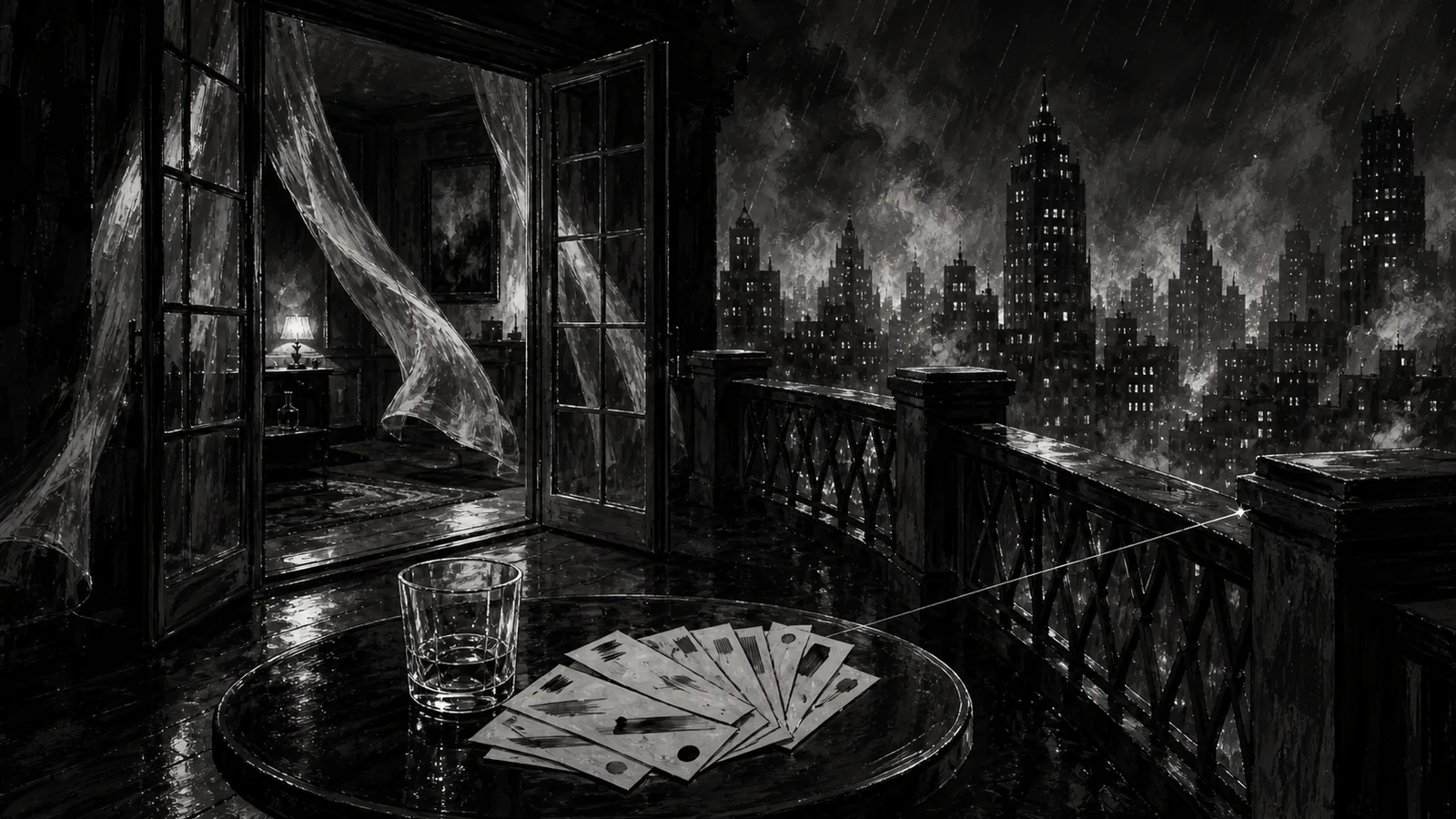
The finale is pure mechanism, and it’s a delight to watch it close. Ben has spent the hour quietly building his frame: he visits Vera Addison at the Geoffrey, the widow living large on her dead husband’s blood money, and cuts a deal — a thousand dollars and she leaves town. He counts out the cash to Frankie, the neighborhood kid, and sets the bills loose through a relay of street vendors and pickpockets so they vanish into the city’s bloodstream. Meanwhile Silvermane pays Ben a second visit, sipping ten-year-old Irish whiskey and musing about entropy — the universe trends toward disorder, all you can do is keep the chaos from your door — and warns him not to trust anyone who claims to have all the answers.
Everything detonates at once when Winston drags Ben and Cat to Silvermane’s, certain he’s caught the rats fleeing town together. Vera, slapped into cooperation, names Cat as the woman who paid Addison a thousand dollars. And then Ben springs it. Silvermane marks every bill, in a different spot for every man on his payroll, and the thousand that was supposed to convict Cat traces straight back to Winston. The gangster’s own gospel turns the key — people lie, only money tells the truth — and the marked bills tell a story Ben wrote. Vera flips on the spot, swearing Winston threatened her. Winston barely gets out “you lying bitch” before Silvermane shoots him dead. The frame holds. The con is perfect. And Silvermane just hands Ben a shovel — “We’ll be needing another grave” — which lands less like a victory than a down payment on the next favor.
Tiny details worth clocking
- Silvermane’s whole ethos — “Only money tells the truth” — becomes the literal instrument of his lieutenant’s death. The bills he marks to keep his men honest are exactly what Ben uses to get one of them executed.
- Ben’s spider-sense warbles twice on cue: once while Carmedy is mid-sentence about the mayor, once on the stakeout when the mobsters close in. Cage’s hero still flinches at danger before his brain catches up.
- Carmedy turns out to be living under the name “Hicks” in apartment four, sniffed out by a sidewalk drunk who describes him as “more pinniped than human” — the show’s pulp-paperback vocabulary at full strut.
- Walters, the Bugle editor, runs Robbie’s Hooverville story but rewrites it into propaganda — Lincoln and Flint become “monsters,” the police become heroes — and keeps the byline “off the books, on the QT.” Robbie’s furious; his editor only cares that “the pictures are great.” A cynical little portrait of how the truth gets laundered into a headline.
- The mayor wants a line to The Spider, convinced Robbie can reach him from “those old Spider days.” The whole city is starting to feel the absence of the hero Ben buried five years ago.
- Vera Addison demands a thousand dollars to disappear, a sum she admits she’s never even seen — the same “I don’t know what that looks like” disbelief Janet had over a fifty in the pilot. Money is the only language anyone in this city is fluent in, and almost nobody has any.
Verdict
“Double Cross” trades the pilot’s mood-setting for clockwork, and the trade pays off. This is a proper con-the-conman caper, structured around a frame Ben assembles in plain sight and detonates in the last five minutes, and the marked-bill payoff is the kind of clean mechanical satisfaction the genre lives for. Cage’s chameleon work — gumshoe, union rep, fast-talking fixer — keeps the detective business buoyant, while the Flint-and-Cat scene smuggles in real heartbreak and the Hooverville brawl widens the supernatural mystery without slowing the plot. It leans hard on Silvermane’s aphorisms and the middle sags slightly under the weight of recap, but as a piece of plotting it’s the most assured the show has been so far. Ben wins, and the win just buries him deeper.
Rating: 8.5/10
More episodes from Spider-Noir — Nicolas Cage's 1930s Spider, episode by episode. Jump to any episode in the season:
Where to go next
Reviewed by Mira Vance · QuizFandom Editor & Lead Reviewer. Every rating is an honest per-watch assessment from the desk that also writes the quizzes — not a press release rehash.