Spider-Noir Episode 8 Review: The Mask Comes Off at a Nightclub Table
What happens — the short version (spoilers)
- After the doctor's lab leaves his men dead, Silvermane orders Ben Reilly found, while Leyden floats mutiny — why serve an old man when they have the powers; meanwhile Cat confesses to Robbie she betrayed Ben out of love for Flint and proposes injecting Flint and Dirk with the antidote.
- At Silvermane's club the powerless Ben tries to sell The Spider for cash, haggling up to two grand and doing a fake phone call as the hero, but Leyden places Ben from the Meuse-Argonne POW camp and Silvermane deduces Ben is The Spider sitting at his own table.
- Silvermane holds Cat at gunpoint as a test — if Ben saves her he's The Spider — but Cat refuses to be a lever, confessing she hired Addison, tipped the mayor about the booze, and loves Flint, and demands Silvermane kill her for his own reasons.
- The Spider smashes through the window, Silvermane jabs him with the antidote to confirm it works, and pulls the mask off to reveal it was Robbie all along, taking Ben's place as the decoy.
- In the brawl that spills into the street, Cat turns the gun on Silvermane and shoots him dead as he insists he's glad it was her, and Leyden rebrands himself Megawatt, billing a Broadway-style fight against the newly dubbed Sandman before Ben beats him to a cheering crowd.
- With one cure left, Cat spends it on Flint and keeps her own sickness; the agency reopens as Reilly Ruiz Investigations, Robbie gets a paper to run and Morris wins the mayor's office, and Ben settles for a new lease on life and a good hot dog.
Silvermane finally guesses who's under the sock, and the season's whole con — the antidote, the betrayal, the man Cat really loved — gets called at one card table.
For eight episodes, the joke has been that nobody in this city can square the two men. There’s Ben Reilly, a broke private investigator who claims to care about no one but himself, and there’s The Spider, the masked relic Robbie Robertson keeps begging to come back. “The Man in the Mask” spends most of its runtime collapsing that distance — putting Ben at Silvermane’s table while the old man circles the one fact that would get him killed — and then, in the kind of reveal a noir saves for last, lets it turn out the man under the mask isn’t even Ben.
The hour opens where the last one left a bruise. Ben’s powers are gone, knocked out of him by Dr. Faber’s antidote, and he’s recovering at Robbie’s place looking, in Robbie’s words, like an overripe banana. The serum that downed Lonnie Lincoln also caught Ben, and the city is suddenly very interested in finding The Spider, because a hero who can be switched off is a hero worth owning. Both the mayor and Silvermane want him. So does Cat Hardy, for reasons that turn out to be the engine of the whole season.
The serum that worked on the wrong man
The cold open belongs to Flint Marko and Leyden, the electric one who never stops auditioning, hashing out the mess after the doctor’s lab. There was never going to be a way out, Flint says; Leyden agrees he won’t tell Silvermane, but the old man is smart and will find out eventually what they did. It’s a rare beat the show plays straight: two men who’ve spent the season as muscle realizing the people they serve see them as advantages to neutralize, not assets to protect. Leyden’s pitch from here is mutiny — why run errands for an old man, he keeps asking, when the powers are ours?
Cat, meanwhile, goes to Robbie with a plan. If Ben hands over the last of the antidote, she can inject Flint and Dirk without raising suspicion. Robbie’s reception is two open-handed slaps — one for Ben, one for himself — and a flat accounting of what she did. Ben put everything on the line for her, and she used it to betray him; that doctor cut him to pieces. Li Jun Li plays Cat’s defense as a confession in progress: she swears she didn’t know Faber would hurt him, she thought it was for the best, she did it for love. For whose love, Robbie wants to know. The answer — Flint — is the rock the rest of the episode breaks on.
Ben sells The Spider to Silvermane over a glass of Green Spot
The middle stretch is a single long scene at Silvermane’s club, and it’s the best thing the season has done with Cage. Leyden hauls Ben in — quoting the three little pigs at the door, because of course he does — and Ben, with no powers and no leverage, decides his only play is to sell the one thing everyone wants. He’ll deliver The Spider. For a price.
The negotiation that follows is this show’s dialogue at its sharpest. Silvermane needs The Spider; ipso facto, he needs Ben, who can’t quite manage the Latin he’s reaching for and drops it mid-phrase. They haggle from five hundred to two thousand, Ben insisting it’s the principle, Silvermane admitting afterward he’d have happily paid ten. Then comes the part that only works in a show this comfortable in its own pulp: Ben gets the man on the phone and “translates,” doing a fussy, over-Latinate impression of The Spider for Silvermane’s benefit, narrating a negotiation with himself. Cage is playing a man playing a hero he used to be, badly, on purpose, and the grief under the bit never quite clears the frame.
What Ben doesn’t account for is that Silvermane is also a detective. The old man watches, listens, keeps track of things up here, and he’s been adding it up all night. The thread that snaps him to certainty comes from Leyden, who keeps insisting he’s met Ben before — and then places it: Meuse-Argonne, France, the POW camp, the fellow who saved them. Flint knew him there. So did Lonnie. So did Addison. Brendan Gleeson lets the realization arrive slowly and almost pleasantly, working it like an arithmetic problem he’s enjoying. The detective who was at the site where all of them got experimented on, who just happens to be best friends with The Spider, hasn’t walked through the door, Silvermane decides, because he’s already sitting at the table.
Cat takes the gun meant to prove Ben is the hero
To get from convinced to certain, Silvermane reaches for the one person Ben can’t watch die. He has Cat held at gunpoint and lays out the test with horrible patience: if he kills her and Ben does nothing, Ben is only a clever PI who cares about no one; if Ben stops him, he’s The Spider. It’s the season’s cruelest scene and also its most honest, because of what Cat does with it. She refuses to be a lever. He’s not going to save me, she tells the room, but not because he’s a bad man — and then she says the rest of it out loud. She loves Flint. She hired Addison. She told the mayor about the booze delivery. She’s Ben’s Judas, and she’ll admit all of it, but she wants Silvermane to kill her because he wants her dead, not because it’ll prove something about Ben. The only thing Ben’s guilty of, she says, is being in way over his head.
That confession is the season’s whole con laid on the table by the person who ran it. Then the gun comes around — and the actual Spider crashes the window. Whoa, whoa, whoa, he says, did I come at a bad time. It’s the reveal the title has been promising and withholding: the man in the mask is Robbie Robertson, who took the suit and the syringes to buy Ben time and cover. Silvermane, mid-monologue about a man who can be switched off, jabs the masked figure with the antidote just to see if it works — it does, the figure drops — and then orders the mask pulled. The reporter, he says, when Robbie’s face appears. The decoy was the friend who spent the whole season insisting Ben still had a choice.
Megawatt’s Broadway debut and the gun Cat finally fires
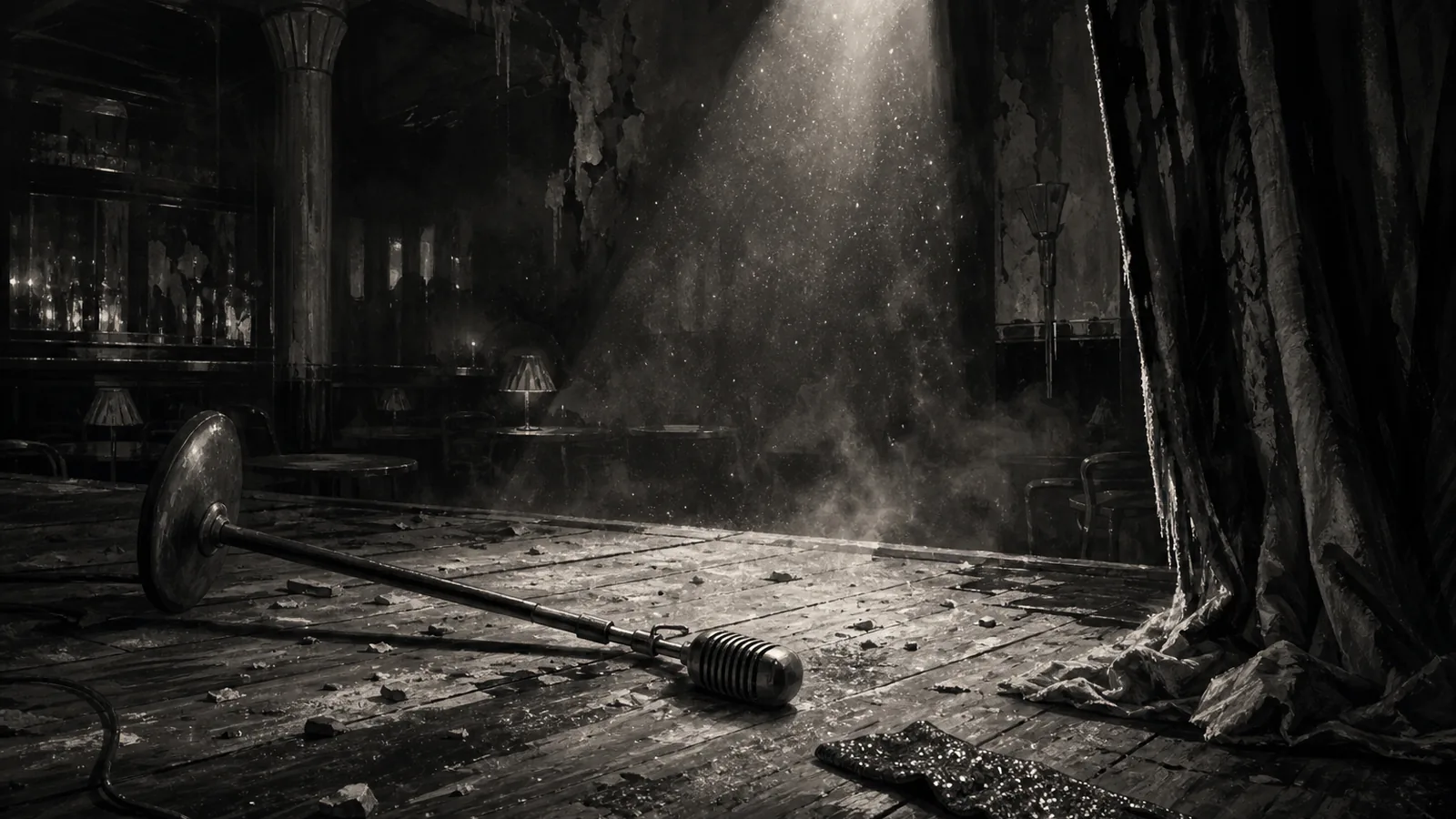
The brawl erupts at the club — Janet, of all people, gets a shot off — and then spills into the street, where Leyden finally gets the spotlight he’s been chewing scenery for. He singsongs “down came the rain and washed the spider out” while Ben, drained of his powers, takes a beating across the cobblestones. Then the season’s hardest beat plays out away from the fists: Cat turns the gun on Silvermane, the man who, by his own account, saved her from the dentist she might have settled for and from every other man she ever picked. After all I did for you, he says, it breaks my heart you’d betray me — no, she corrects him, it breaks your heart you didn’t see it was me. She throws his own mantra back, never be satisfied, don’t accept what’s given to you, and Gleeson takes his exit with a line that curdles the whole romance: the truth is, my love, I’m happy it’s you.
The last stand belongs to Megawatt. Powers blazing, Leyden rebrands himself and announces a double bill — him versus the Sandman — to a terrified crowd he keeps addressing like a sold-out house. He waited his whole life for this, he says: his star turn on Broadway, standing room only, packed house, even as the crowd boos. He’s a man who once wanted to be a dentist, now electrocuting strangers and quoting Hamlet over a downed Spider — good night, sweet prince — and he plays as both genuinely dangerous and genuinely pathetic, a failed actor who finally got a stage and can’t tell the difference between applause and screaming. Ben puts him down to a real round of cheers and a “well done, Spider” from the crowd that watched. Then comes the cost: Cat has one syringe of the cure left, and when Ben asks why she won’t use it on herself, she says he knows why — and so does he. She spends it on Flint, who turns up at the graveside looking well, thanks to her, while Cat keeps whatever the powers have made of her.
Tiny details worth clocking
- The cold open’s mantra — never get comfortable, never be satisfied, don’t accept what you’re given — is Silvermane’s advice to Leyden, and Cat throws it back in the old man’s face right before she shoots him. The season’s villain dies to his own pep talk.
- Leyden announcing himself at Robbie’s door by huffing and puffing through the three little pigs, then thanking an imaginary audience, tells you everything about a man who treats every room as a curtain call.
- Ben can’t keep his own bluff straight under pressure: “Res ipso locutor,” he tries, then immediately, “Well, I mean, I don’t speak Latin.” The accent isn’t the only thing that drifts.
- The funeral coda is mostly Latin and silence, with Robbie alive and Ben paying respects — a rare quiet beat before the closing gag rush.
- Ben’s parting shot to Cat at the graveside is the season’s noir creed in two lines. She tells him to go to hell; he answers, “I have. I’m keeping it warm for you.”
A city that won’t leave an ordinary man alone
The denouement, to borrow Megawatt’s word, is almost shockingly warm. Robbie gets a newspaper to run, Morris wins the mayor’s office, Flint gets the girl, and Janet gets a desk she won’t let wobble. Ben, asked what he gets out of all this, settles for a new lease on life and, more to the point, a really good hot dog. The agency reopens as Reilly Ruiz Investigations, the phone-that-was-a-paperweight finally rings, and Janet slots a client in at two o’clock because it makes them seem busy. Amy Winehouse’s “You Know I’m No Good” carries it out, a 1930s nightclub bleeding into a 2000s torch song the way this show has cheerfully crossed its eras all season.
It’s a finale that earns its softness by spending its hardest scene first. The card-table sequence is patient, nasty, and funny all at once, and it resolves the masquerade with a genuine surprise instead of a cape-flutter. Where it strains is the street fight, which leans on the season’s wobbliest effects and gives Megawatt a touch more runway than his one note supports, and Cat’s last choice — keeping the sickness to give Flint the cure — is an ending raced past rather than sat in. Season 2 is unconfirmed, but the door’s open: Ben back on the clock, a cure that worked on the wrong men, and a city that, as the opener warned, doesn’t let ordinary men alone for long.
As a season, Spider-Noir delivered exactly what its consensus promised — gloriously pulpy, stylish, craft-forward, more interested in the pleasures of the genre than in deconstructing them. Cage gave it a worn wit that kept the noir from curdling, the black-and-white photography stayed the genuine draw, and the case-of-the-week structure smuggled a full mob-and-monster plot through grubby surveillance jobs. The finale isn’t the peak — episode one’s cleaner mystery and a couple of mid-season set pieces edge it — but it lands the masquerade, pays off Cat’s con, and sends everyone home with a hot dog and a torch song. That’s a closing argument worth hearing out.
Rating: 8.0/10
More episodes from Spider-Noir — Nicolas Cage's 1930s Spider, episode by episode. Jump to any episode in the season:
Where to go next
Reviewed by Mira Vance · QuizFandom Editor & Lead Reviewer. Every rating is an honest per-watch assessment from the desk that also writes the quizzes — not a press release rehash.