Spider-Noir Episode 7 Review: The Cure He Came to Drink
What happens — the short version (spoilers)
- Dying and dissolving from his mutation, Flint says a bitter goodbye to Cat at her piano, promising not to tell Silvermane she sold the boss out — but warning he can't protect her once he's dead.
- Silvermane shrugs off the loss of Faber's cured lab and sends his three remaining supers to raid Mayor Morris's campaign war chest and throw the cash around shouting "vote for Hudson."
- Janet turns up at The Alcove and deduces Ben didn't get cold feet but was taken — the out-of-character envelope of cash tipped her off — and starts working the phones to find him.
- Robbie tracks Ben to a dive bar where he's drunk, waving the vial he calls "the antidote to all my problems," and takes it away, arguing the city shouldn't lose its one hero and that Ben now has the choice he never had with Ruby.
- In Harlem, Ben and Robbie try to dose the looting supers; Lonnie refuses and nearly kills them both, until Robbie — not The Spider — jabs Lonnie in the eye with the needle and brings the giant down sobbing.
- Cat rescues them in a stolen car to repay her debt and takes the unconscious Ben to her place, while Silvermane hears the antidote felled Lonnie, quotes Macbeth, and orders his men to find Ben Reilly.
Ben Reilly hits bottom with the one vial that could end The Spider for good — and the friend who won't let him take the easy way out.
“Nobody’s Hero” opens on the wreckage of last week. Cut up on Dr. Faber’s table, sold out by Cat, and handed a choice by a man who used to be a wrinkled old secretary named Ogden, Ben Reilly walks out of the lab with a vial in his pocket and a city falling apart behind him. The antidote cures the mutation. It would also, by Ogden’s reckoning, cure The Spider — turn the only superhuman in New York back into an ordinary man, the one thing Ben has wanted since Ruby died. This is the episode where he almost does it.
It’s a quieter hour than the season’s usual run of fistfights and femme-fatale standoffs, and it’s the better for slowing down. The plot barely moves an inch; what moves is Ben, dragged the long way around to a decision he’s been postponing for five years. Greg Yaitanes directs it like a bender — woozy edges, songs bleeding across scenes.
Flint says goodbye to Cat while he’s still solid enough to mean it
Before Ben’s story starts, the episode gives Flint Marko (Jack Huston) his ending. Cat sits at a piano begging him to stay; Flint, dissolving by the hour from a mutation that’s killing him, can only manage “stay away.” What follows is a strange, lovely two-hander between a dying man and the woman who didn’t choose him. He’s bitter — he calls Ben “that private dick” and accuses Cat of running off with him before “the dirt hit my casket.” But the venom keeps slipping into grief. “You can’t touch the Sun and then come back down to Earth again,” he tells her, and you understand he means both the powers and her.
What makes the scene work is its restraint. Flint isn’t asking for a reunion; he knows he’s “long gone,” and the closest thing he can offer is a promise — he won’t tell Silvermane that Cat sold the boss out. The cruelty in it is honest: “I can’t protect you when I’m dead.” Huston plays a man too far gone to be angry for long, and Li Jun Li lets Cat take the blow without flinching, which is somehow worse than tears. It’s the most human Cat has been all season, paying for a betrayal whose bill is only now coming due.
Silvermane sends the supers to rob the mayor’s piggy bank
The villain plot stays mostly in one room, and Brendan Gleeson makes the room enough. Lonnie reports back that they torched Faber’s lab — “a bunch of meat in big jars,” burned to the ground — and Silvermane, who can’t stand uncertainty, files the loss of his cure under things not worth crying about. Cat needles him about what he’s actually fighting for, since he already owns the best whiskey, the best car, the best club. His answer is the closest the show gets to a philosophy: “The fighting is the point. It’s what gives the whiskey its taste.”
Then he points his three remaining supers at the mayor. With Faber dead, the math is simple — three of them to Morris’s one — so he sends them to “go forth and maraud,” raid the campaign war chest, and buy voters for the opponent, Hudson. The robbery is played for grim comedy: a super named Dirk and his crew terrorize the mayor’s office, threaten a secretary named Alice, and toss stolen bills in the air shouting “vote for Hudson,” to the bafflement of a city that would, by one drunk’s account, sooner vote for the devil. The message Silvermane wants carried back to Morris is courtly and bloodless: he sends his regards.
Janet realizes Ben didn’t get cold feet — he got taken
Janet Ruiz (Karen Rodriguez) gets the detective work this hour, and it’s a small marvel of deduction. She turns up at The Alcove looking for Ben, and the scene is loaded: Ben was supposed to leave town with Cat, and now both women are circling the same missing man. When Cat suggests he simply got cold feet, Janet won’t have it — “you wouldn’t be here if that’s what you thought was going on. You’re too proud for that.” She knows Ben’s tells better than Cat does, too: the envelope of cash he dropped in Cat’s lap was so unlike him (“Ben’s not exactly loose with his money”) that it reads, to Janet, as a man getting his affairs in order before something dangerous.
Rodriguez has been the show’s deadpan anchor since the pilot, and she gets the episode’s quiet emotional center. Alone in the office, she drops the act for one line — “Damn it, Ben, where are you?” — then picks the phone back up and starts working the Bugle for Robbie. It’s the same instinct that ran the agency when Ben couldn’t be bothered to: somebody has to keep looking when the hero’s gone dark.
Robbie finds Ben drunk and takes the antidote away
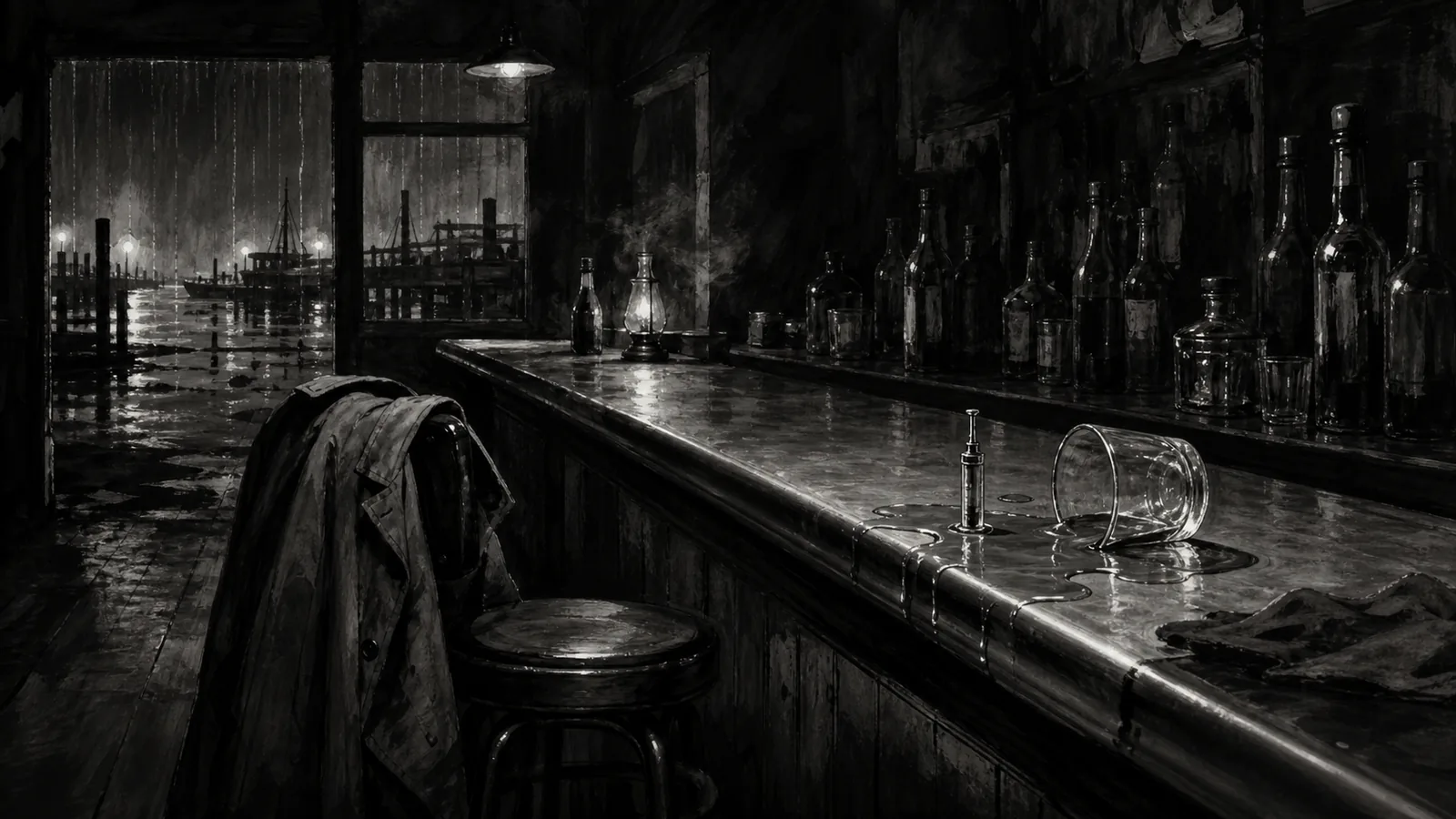
Everything good in this episode comes down to a bar, a bottle, and an argument. Robbie (Lamorne Morris) tracks Ben to a dive where Ben is monologuing to a bartender named Eamon about spider muscles — they have none, he insists, the legs work on hydraulics like “veritable party whistles” — and waving around the vial he’s calling “the antidote to all of my problems.” The patrons have spent the night mocking The Spider as a washed-up glory-hound, and Ben, recognized and jeered, has decided to beat them senseless and then erase himself for good. It’s Cage at full gonzo tilt, slurring and grandiose and pitiable all at once, a man performing his own collapse because the alternative is feeling it.
Robbie takes the vial. What he won’t take is Ben’s self-pity. Ben fell for a woman who didn’t fall back, Robbie grants, but that’s no reason “the whole city should lose the one guy who can help them.” He reframes the antidote as a test of conscience — will Ben sleep better having taken it after doing nothing, or after curing Lonnie and Flint, soldiers suffering exactly as Ben is? And then the line that reaches past the powers to the grief underneath: “You couldn’t save Ruby because you didn’t know. This time, you have a choice. You just have to make it.” Morris plays it without a trace of sermon, more exhausted than righteous, a friend who lost everything when The Spider quit and never once asked him to come back.
Ben fights Lonnie, loses himself, and saves him anyway
Robbie hauls Ben back to the office, where a drunk Ben blurts his secret identity at Janet — who has known for ages and figured he’d worry less if he didn’t know she knew. (“It’s not like you’ve been very Spidery lately.”) Sobered up, Ben joins Robbie in Harlem, where the supers are looting a police warehouse for confiscated booze. The plan: dose all three with the antidote, free them, and then dose himself last — “no more Spider.” Robbie calls it a terrible plan. Ben calls it the end of the story.
Lonnie won’t be reasoned with. “I’ve picked my side,” he tells Robbie — a soft bed and hot meals are more than he’s had in years, and with little life left, he intends to enjoy what he’s got. The fight that follows is brutal and one-sided, Lonnie nearly killing both of them, and the save comes from the least likely hand: it’s Robbie, not The Spider, who jabs Lonnie in the eye with the antidote needle and brings the giant down sobbing on his hands and knees. Cat turns up to bail them out in a stolen car — debt repaid, now they’re even — and takes the unconscious Ben back to her place to heal. The last image of Ben this hour is him asleep while Cat asks who he is. Robbie answers for him: “He’s just a guy,” and then the truer version — “despite what he wants everyone to believe, he’s a good person.”
Tiny details worth clocking
- Robbie’s read on the vial is the whole argument in a gesture: he tells Ben that even drunk, “if you felt right about drinking this, you would have taken it from me and finished it by now.” The proof Ben can still be saved is that he hasn’t.
- Silvermane recites Shakespeare over the report of Lonnie’s fall — Macbeth’s plea to “raze out the written troubles of the brain” with “some sweet oblivious antidote” — and lands on the chilling conclusion that “the good doctor wasn’t so crazy after all.”
- Ben’s bluff that “The Spider was never a hero — I only did it for the thrill” gets quietly dismantled across the hour.
- The drunk-Ben bit with Janet flicking the office lights on and off while he insists “the Spider’s busy, Janet” is slapstick the show earns by surrounding it with real despair.
- Robbie’s exit plan — Niagara Falls, his mom’s been wanting to see it, and does Ben like maple syrup — is a small, sweet feint before the goodbye.
Verdict
“Nobody’s Hero” trades the season’s pulp momentum for something more interior, and the gamble mostly pays off. It belongs to the supporting cast: Morris gives the bar speech its weary conviction, Rodriguez quietly carries the worry, and Huston walks Flint off the board with surprising tenderness. Cage spends much of the hour at the bottom of a bottle, which is a risk — a little of the slurring grandiosity goes a long way — but it sets up the only character turn that matters, a man who insists he wants to disappear and keeps choosing not to. The villain material is thinner, more holding pattern than escalation, and the episode runs slack in its middle. As a penultimate breath before the finale, though, it does the work: it puts the antidote back in play, hands it to Silvermane’s imagination, and reminds you who Ben is before the mask goes back on.
Rating: 7.8/10
More episodes from Spider-Noir — Nicolas Cage's 1930s Spider, episode by episode. Jump to any episode in the season:
Where to go next
Reviewed by Mira Vance · QuizFandom Editor & Lead Reviewer. Every rating is an honest per-watch assessment from the desk that also writes the quizzes — not a press release rehash.