Spider-Noir Episode 5 Review: The Woman He Trusted Gives Him Up
What happens — the short version (spoilers)
- In a diner, Ben Reilly tells Cat Hardy his origin: a POW he tried to rescue in Eastern France bit him, his sergeant ordered the camp burned, and he relearned how to act human by copying movie actors; he admits he took her case hoping the source of their powers could strip his away so he could just be Ben Reilly again.
- Robbie Robertson forces editor Walters to run his story unchanged plus retractions clearing Lonnie Lincoln and Flint Marko, then confronts Dr. Alethea Faber at her Queens VA lab, where he establishes the Germans spliced prisoners with spiders, scorpions, snakes and eels and that her decade-long search for a cure only speeds the men's lethal mutations.
- In Silvermane's club Lonnie Lincoln accepts Finn Byrne's offer, saying he's done risking his life for white men and won't reach old age anyway, while Silvermane installs Flint Marko as his new right hand and orders Cat to scout a younger singer.
- Dirk Leyden, jailed and beaten by a cop, breaks loose reciting Shakespeare, frees the other super-veterans, and is brought before Silvermane, where he kills a man mid-Macbeth-speech and deadpans 'And scene.'
- Silvermane warns Ben to keep The Spider out of his war with Mayor Morris; in the elevator Lonnie reveals he knows Ben framed Winston for Cat and is staying silent to keep them both alive, granting Ben one final pass.
- Ben goes to Cat's window, tells her Flint is dying with every use of his powers, and pitches running off to Santorini; she agrees, but after Lonnie tells Flint that Faber's last hope is The Spider himself, Cat goes to Faber, makes her promise not to hurt him, and gives up his name: 'Ben Reilly.'
Ben Reilly finally lets himself fall for Cat Hardy, and the same night she trades his name to the doctor who's been killing the men she loves.
Five episodes in, Ben Reilly has spent his whole grim career insisting he wants to be ordinary, and “Betrayal” lets him almost get there. He sits across a diner booth from Cat Hardy, lets her pour the coffee, and tells her the one thing he’s told no one: how he became The Spider. It’s the warmest he’s been all season, and the title hangs over their table the whole time like an unpaid check.
The framing is a confession, and Cat is the audience. “You already know how it ends,” Ben (Nicolas Cage) tells her, and she answers, “Well, then start from the beginning.” So he does — and what comes out is not a radioactive spider in a museum but a war.
Ben tells Cat how a POW camp made The Spider
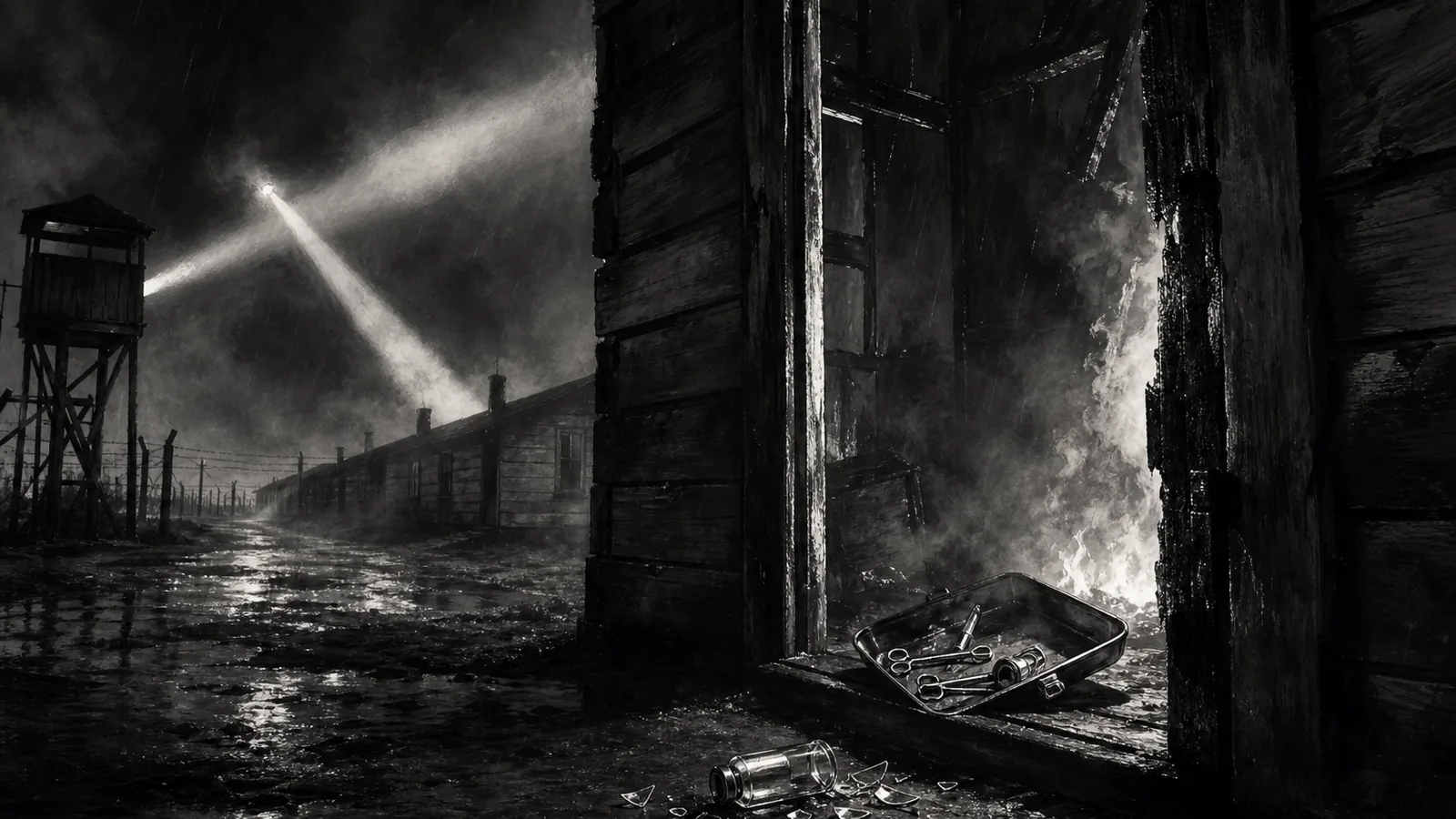
The origin lands in flashback to Eastern France, fifteen years gone. Ben’s unit is sent to liberate a small town, the Germans aren’t keen to give it up, and he fights his way into a prison compound full of groaning, half-dead men. He’s trying to drag one of them to safety when the prisoner snarls, screeches, and a thing that used to be a man lunges — and bites him. The order that follows is the closest the show comes to a thesis on this whole conspiracy: “Burn it. Burn it all.”
Cage plays the recovery as something genuinely strange rather than heroic. Ben describes relearning how to be human — going to the movies, studying how the actors spoke and moved, copying it back into his own body. The arachnid genes are still in him, he admits, the tics and impulses, and he suppresses them most of the time. It quietly reframes the whole performance: the loopy patter, the theatrical asides, even the drifting accent read here less as Cage indulgence than as a man performing humanity because he can no longer come by it naturally. “You once told me you were a coward,” Cat says. “And to think I almost believed you.”
Then he says the dangerous part out loud. He took Cat’s case partly to find Flint, yes, but mostly because if the same source gave them both their powers, maybe that source could take his away — and let him go back to being just Ben Reilly. Since Ruby died, it’s all he’s wanted. It’s also the one secret Cat will carry out of the booth and into the wrong hands.
Robbie chases the doctor making monsters in Queens
While Ben confesses, his journalist friend Robbie Robertson (Lamorne Morris) is working the actual case. He’s been digging into four veterans from the same POW camp, all with superhuman abilities, all patients of one geneticist — Dr. Alethea Faber, Stanford and Cornell degrees, parked at a VA hospital in Queens for reasons that don’t add up. Robbie strong-arms his editor Walters into running the story as-is, no changes, plus a retraction clearing Lonnie Lincoln and Flint Marko. “It’s good to be back,” he says, and the swagger is earned; Morris gives Robbie the bounce of a man who can finally smell a Pulitzer.
The interview with Faber is the episode’s best two-hander of nerve. She stonewalls behind doctor-patient privilege and a hovering bodyguard-secretary named Ogden; Robbie smiles and keeps poking until she snaps “Everything I do, I do for a reason. Everything.” It plays as wounded dignity right up until it doesn’t. The truth comes out of the research itself: the Germans injected prisoners with radiated material and the genes of spiders, scorpions, snakes, eels, then watched most of them die of “lethal mutations” while a few survived in an altered state. Faber has spent ten years hunting a cure and has only managed to activate latent mutations and speed them up. Robbie says it plainly — she’s trying to save them, but she’s killing them.
The horror is that she isn’t a villain in the mustache sense. She’s a brilliant woman convinced her own good intentions exonerate the bodies. When Ogden suggests no one will believe a Black reporter and the doctor flatly disagrees, it’s a sharp beat: Faber knows exactly how dangerous Robbie’s story is, and she’s already calculating what that danger will cost.
Lonnie crawls back to Silvermane and Leyden breaks loose
Across town, the muscle realigns. Lonnie Lincoln (Abraham Popoola) takes Silvermane’s offer, and his reasons cut harder than any threat — he’s done putting his life on the line for white men who’ll never see him as anything but second-class, and with whatever’s eating him from the inside, he isn’t planning to make the retirement home anyway. Popoola plays it as exhaustion shaped like ambition. Silvermane (Brendan Gleeson) welcomes Flint Marko back as his “new right hand” and uses Cat as a prop in the introduction, then idly orders her to scout a younger singer — a casual cruelty Gleeson lands without raising his voice.
The episode’s chaos engine is Dirk Leyden, a captured super-veteran turned hammy stage actor, who gets worked over by a cop in a holding cell, claims he’s “from Poughkeepsie,” then breaks loose to spring the others while narrating his own jailbreak in mangled Shakespeare — “Cry ‘Havoc,’ and let loose the dogs of war.” Strapped to a chair across from Silvermane, he recites the “walking shadow” speech from Macbeth while he kills a man, then deadpans “And scene.” It’s a lot, and it shouldn’t work, but it gives the conspiracy a grinning face and keeps “Betrayal” from drowning in its own grief.
Lonnie warns Ben, and Ben decides to run with Cat
Summoned to Silvermane’s club, Ben gets the threat directly: stay out of the war between Silvermane and Mayor Morris, or The Spider loses his nose. Ben needles back about Broadway and subway trains and walks out whole — but Lonnie catches him in the elevator with the more dangerous truth. Lonnie knows Ben framed Winston, knows he did it for Cat, and hasn’t told the boss because it would get them both killed. “You get one pass because you saved her,” he says. “This is it.”
So Ben does the thing the whole season has dared him toward: he chooses to live. He goes to Cat — through the window, still hiding The Spider — and tells her gently that Flint is dying, that every use of his powers brings it closer. Then he makes the pitch. Leave New York. Santorini, the island with the black sand, where she opens a club and he tends bar. “I don’t know what this is,” he tells her, “but I do know, for the first time in years I’m willing to take a chance and find out.” She says okay. He’s so happy he orders the entire diner menu in front of a baffled Janet (Karen Rodriguez), announces he’s leaving town, and hands her the agency because she’s the better P.I. anyway. Cage plays the giddiness so guilelessly that you start to dread it.
Cat gives Faber the name
The fall arrives quietly. Flint, deteriorating and bitter, finds out Cat tried to kill Silvermane behind his back and turns it into a wound about being nothing but muscle, a meathead with his brains in his fists. He resolves to lean into it — to go out in a blaze of glory beside Lonnie. But Faber has told him the only thing left to try isn’t a what but a who: The Spider, whose mutation she believes is more stable, who might be the cure for all of them. She has no idea who he is or where to find him.
Cat does. She turns up in the doctor’s lab as Faber and Ogden prepare to flee ahead of Robbie’s story, and Faber asks the question she already suspects the answer to: “You know who The Spider is, don’t you?” Cat extracts a promise — that they won’t hurt him — and then gives him up. “His name is Ben Reilly.” Thunder cracks. The man who just confessed his whole soul over a coffee, who offered her a life on a black-sand beach, has been handed to the people hunting him by the one person he let in. The single-word title pays off without any underlining, because Ben never sees it coming, and for once neither do we.
Tiny details worth clocking
- The diner waitress comps Ben a slice of pie at the top of the hour; by the end he’s ordering “the hot dog deluxe,” cottage cheese, scrambled eggs, bacon, and New York cheesecake all at once, then improvising a little tune about cheesecake in the morning. The appetite is the tell — a man who’s decided to want things again.
- Robbie’s price for the story is two retractions and “anything else” he can think of, played as a man who’s spent years being told no and is savoring the word yes.
- Faber’s secretary Ogden floats that “maybe no one will believe him” because Robbie is Black; Faber shuts it down, not out of decency but accuracy. The show keeps its period racism tied to plot, never decorative.
- Leyden recognizes Robbie before Faber does — he was a prisoner in that French camp, and Robbie was one of the soldiers who came to free them. “It’s him.” The war keeps cinching tighter around everyone in present day.
- The Germans’ splice list — spiders, scorpions, snakes, “eels, too” — quietly accounts for the whole rogues’ gallery the season has been deploying, Sandman included, without ever pausing to explain it.
Verdict
“Betrayal” is where Spider-Noir stops being a case-of-the-week and turns into a tragedy with a date on it. The Faber reveal lands the season’s central horror — a healer turning men into monsters in the name of mercy — and the diner confession gives Cage his most human stretch of the run, which makes the final two words land like a trapdoor. It overstuffs the middle with Leyden’s vaudeville and asks a lot of a romance that’s only weeks old, but the betrayal pays for everything around it. The black-sand beach was never going to happen, and Ben gets to believe in it for one whole episode anyway.
Rating: 8.6/10
More episodes from Spider-Noir — Nicolas Cage's 1930s Spider, episode by episode. Jump to any episode in the season:
Where to go next
Reviewed by Mira Vance · QuizFandom Editor & Lead Reviewer. Every rating is an honest per-watch assessment from the desk that also writes the quizzes — not a press release rehash.