Last Samurai Standing Episode 1 Recap: Shujiro Walks Into Kodoku
What happens — the short version (spoilers)
- Shujiro, broke and shamed, sells his sword for medicine, but cholera kills his wife Shino and children Rin and Toya before he can save them.
- A notice promises 100,000 yen to anyone who joins a contest at Tenryuji Temple at midnight, and Shujiro travels to Kyoto to enter.
- Enju greets the 292 participants politely, shows them a pot of gold, then says once they hear the terms they cannot leave.
- A detective named Ando tries to arrest everyone for breaking the sword ban, and Enju kills him on the spot.
- Enju explains Kodoku: cross seven checkpoints along the Tokaido Road to Tokyo, each wooden tag is a point, lose your tag for ten counts and you're out.
- Shujiro chooses to protect a young girl, Katsuki Futaba, and fights their way out of the temple together as the count drops to 128.
- The episode ends with Kanjiya Bukotsu confronting Shujiro in the rain, saying he's waited ten years to face Kokushu the Manslayer again.
Last Samurai Standing, Season 1, Episode 1 Netflix · 2025
The premiere sends a sick family, a ruined samurai, and 292 wooden tags toward the same temple gate.
Last Samurai Standing starts with an ending. A narrator counts 950 years of samurai history, then says a single battle made an entire breed of warriors vanish. In the first minutes, men keep charging after victory has already been called, smoke rises, and Shujiro Saga (Junichi Okada) hears the same cries years later while his wife and children are dying from cholera. Episode 1 is for getting him from that private room of fever and shame to Tenryuji Temple, where Enju (Kazunari Ninomiya) uses desperation as the fuel for Kodoku.
Shujiro sells the last thing he has left
The opening flashback is short, but it tells us what Shujiro carries into every room. The battle is supposedly over. Men shout that victory is theirs. Then violence keeps moving anyway, and Shujiro screams for people to stop while bodies keep falling around him.
A decade later, the government has turned samurai into “shizoku,” taken their privileges and work, and left men like Shujiro with a title that no longer buys rice. Cholera has reached his home in Fuchu, Kanagawa. His wife Shino is ill. His daughter Rin is ill. His son Toya still moves through the room with the obedient seriousness of a child trying to help adults survive.
Shujiro brings a sword to the local merchant and asks for anything he can get. The merchant refuses at first because swords have been banned for two years and the old days are gone. That line lands harder because the sword is not romantic here. It is not freedom, status, or proof of nobility. It is the last thing a hungry father can put on a counter.
The merchant relents only after hearing Shino and Rin are doing badly. He sends for sugar and salt, tells Shujiro to keep the sword, and says, “What a time we’re living in.” Shujiro thanks him, but the mercy comes too late. By the time the pamphlets appear in town, Rin is already gone, apologizing because she could not save her mother and Toya.
Shujiro buries the apology inside himself.
That is why the notice in Kyoto does not feel like temptation alone. “Participants wanted.” Tenryuji Temple. Midnight on May 5th. A chance to win 100,000 yen. Men in the street laugh because the sum sounds impossible. Shujiro reads it like a sentence already passed.
Kyoto smells like the life Shujiro tried to leave
Shino knows what the notice means before Shujiro says it plainly. When he tells her he found work that could bring in money, she asks whether he will draw his sword again. He says no and promises it will not come to that.
Neither of them believes the promise all the way.
Kyoto is already waiting for men like him. Children beg to go near Tenryuji because the newspapers call it a government sword hunt. At the inn, Shujiro meets Yahei, an old acquaintance who has noticed other guests carrying swords. Yahei has heard rumors that survivors of the shogunate forces are gathering allies for revenge, but the rumor matters less than the mood around it. Everyone can feel that something old has crawled back into the street.
Yahei says it directly later: Kyoto feels like the old days. The same iron scent of blood hangs in the air.
Tenryuji Temple fills with men who still know how to wear violence. Tachikawa Kouemon, a former samurai from Kaga, talks because he needs the sound of his own voice to keep calm. He has spoken with men from Hokkaido to Ryukyu, and the reach of the pamphlets convinces him the prize may be real. He is nervous, funny, and doomed in the way early allies in this kind of story often are. He wants company before he understands what company will cost.
The crowd is not a noble gathering. It is a room of broke men, angry men, bored killers, former officials, and strangers pulled across Japan by the same promise. Some want money. Some want purpose. Some only want permission.
Then Enju arrives.
Enju makes everyone choose before explaining Kodoku
Enju introduces himself politely, almost warmly, and that politeness is the first warning. He thanks everyone for coming, says they will enter a test of spirit, skill, and physical limits, then lets the crowd grumble because no one came to hear him talk about a game. They came for proof the money exists.
So Enju gives them proof. A pot of gold is brought out, enough for ten years of luxury, and he says it is nothing compared with what they can earn by staying. The catch is clean and cruel: once they hear the terms, they cannot leave.
He counts down from thirty and offers the exit before the trap has a name. Most men stay because walking out means going back to hunger, illness, useless pride, or nothing at all. Shujiro stays because his family has already paid too much for him to return empty-handed.
Kyoto PD interrupts before the count finishes. Ando, Fourth Division, steps in and identifies himself. The crowd recognizes him as An-Jin, the Swift Wind, a swordsman good enough to carry his own legend. Enju recognizes him too, mocks that legend, and tells him that being present makes him a participant.
Ando says everyone is under arrest for breaking the sword ban. Enju kills him.
That death is the point where the temple stops being rumor and becomes a slaughter pen. People panic. Some try to leave. Enju restarts the countdown as if a body on the floor is only an interruption. The men who remain are impressed, terrified, or too desperate to move.
When the terms finally arrive, they are simple enough to terrify everyone. The contest is called Kodoku. Tokyo is the final stop. Participants must pass seven posts along the Tokaido Road, from Tenryuji through Seki, Chiryu, Hamamatsu, Shimada, Hakone, and Shinagawa. Each person wears a wooden tag. Each tag counts as one point. To leave Tenryuji, a participant needs at least two points. To enter Tokyo, thirty.
If a tag is removed for ten counts, that person is out. If anyone breaks the terms, punishment follows. One frightened man tests that immediately, and the count ends with his death.
No one can pretend after that. Points mean tags. Tags mean bodies.
Enju still finds a way to make the whole thing sound ceremonial. He tells the 292 participants to show the courage that defines the samurai legacy. The words are bait. He knows the men in front of him have been stripped of work, money, rank, and meaning. He offers them one last language they recognize, then makes them tear each other apart inside it.
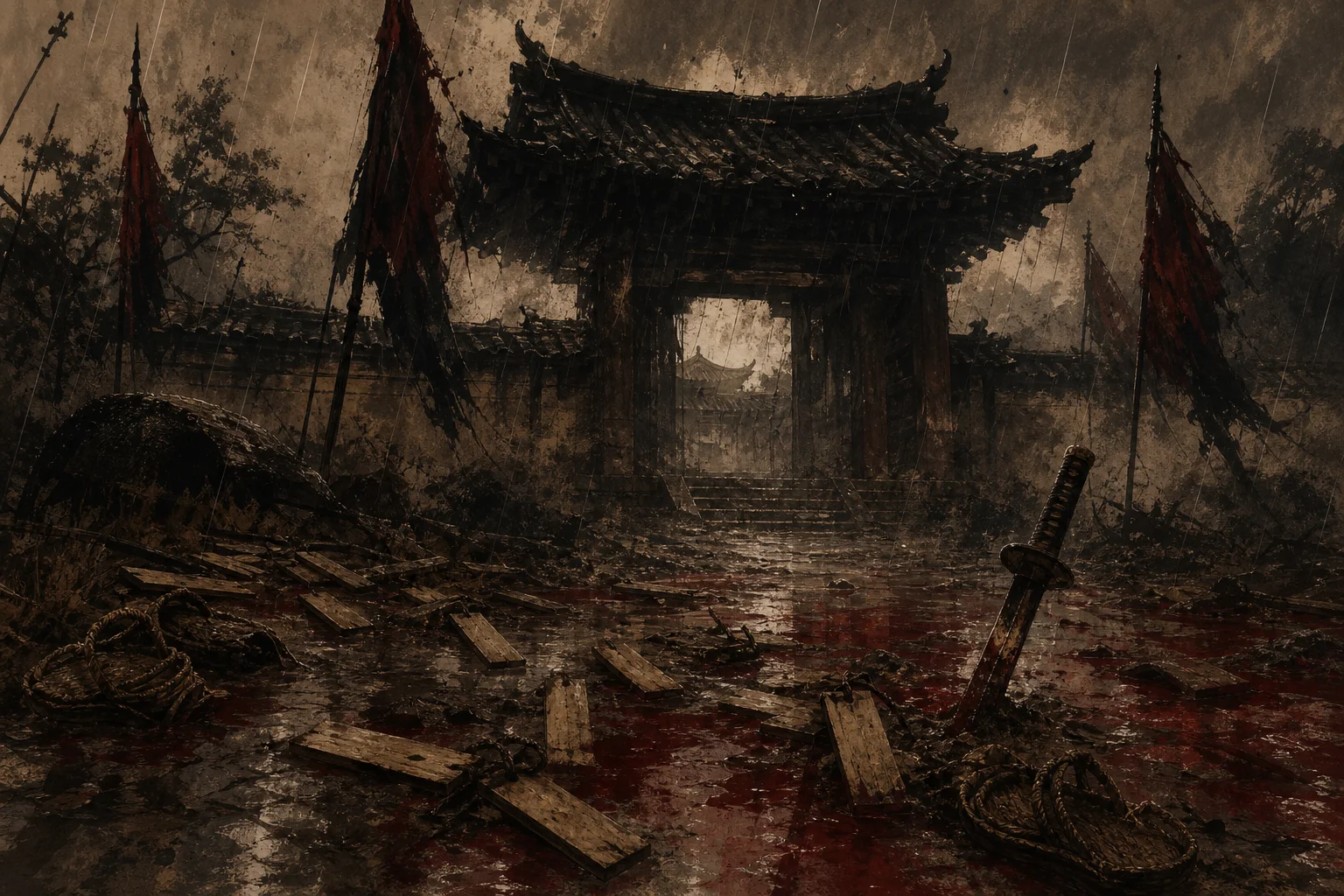
Shujiro protects Katsuki Futaba as the temple erupts
The first rush is ugly. Tags are ripped away. People are cut down in corners and under buildings. Some attack anyone smaller than them. Some move with practiced calm. Kikuomi Ukyo is first through the gate, and Enju calls him a Guardian of the Nobility while Ukyo asks what foul plan is being woven.
Shujiro sees a child.
Her name is Katsuki Futaba. She wants to live because she needs to save her mother. That answer reaches the only part of Shujiro that still has room to move. He tells her not to leave his side until they get out, then starts protecting her through the crush.
It is not a clean rescue. Shujiro can fight, but the old war still has its hands on him. Another participant recognizes him as “Kokushu the Manslayer” and asks why he is not going all out. He names the symptoms plainly: insomnia, shaking hands, a racing heart. The Boshin War left many people losing their minds, he says, and if Shujiro and the girl intend to survive, Shujiro will have to start killing.
That warning cuts deeper than the swords around them. Shujiro came to Kyoto to save what remained of his family, but Kodoku will not let him stay separate from the thing that broke him. The only path forward asks him to become useful in the exact way he hates.
He gets Futaba through anyway. Number 108, Saga Shujiro, and number 120, Katsuki Futaba, pass the first gate together. Rain starts falling. Somewhere else, men watch the results like entertainment and receive a letter from the mastermind.
The letter is pure contempt. The mastermind says samurai can do nothing beyond swinging swords, that they mistake authority for power, that the world has left them behind. He calls them ghosts who call themselves samurai and invites the watchers to enjoy the cruel dance that will lay them to rest.
Then the past steps into Shujiro’s path with a name. Kanjiya Bukotsu (Hideaki Ito) appears in the rain, calls him Kokushu, and says he has waited ten years for this moment. Shujiro has escaped the temple, but the first episode ends with another man eager to drag him back into the person he used to be.
The final count says 128 remain.
What works
- Shujiro’s motive is painfully concrete: medicine, food, Shino, Rin, Toya, and the shame of having a sword nobody wants to buy.
- Enju is frightening because he stays courteous while people die. His calm makes the temple feel colder than a riot.
- The Kodoku setup is easy to follow without feeling thin: tags, checkpoints, points, Tokyo, one month.
- Katsuki Futaba gives Shujiro a living mirror for his grief instead of letting him move through the contest as a lone fighter archetype.
- The Meiji context matters. The sword ban, shizoku status, cholera, and rumors of shogunate revenge make the violence feel rooted in a country that has already discarded these men.
What stumbles
- A few temple fighters blur together once the first scramble begins. Ukyo, Sakura, Kouemon, and the watching patrons have strong flashes, but some of the mid-fight bodies are only movement and tags.
- The episode withholds the mastermind so completely that the spectator room feels more like a promise than a full dramatic space.
- The child-in-the-contest reveal is effective, but Futaba is still mostly defined by her sick mother. The next episode needs to give her more than vulnerability.
What this sets up for Episode 02
Shujiro and Futaba are out of Tenryuji, but Kodoku has already marked them as a pair worth watching. Bukotsu’s arrival puts Shujiro’s old name directly in his path, and the mastermind’s letter makes clear that the contest is built to humiliate samurai as much as exploit them. Episode 02 has to show whether Shujiro can keep protecting a child without becoming Kokushu again.
Rating: 8.7/10
More episodes from Last Samurai Standing — Netflix's Japanese kodoku elegy, episode by episode. Jump to any episode in the season:
Where to go next
Reviewed by Mira Vance · QuizFandom Editor & Lead Reviewer. Every rating is an honest per-watch assessment from the desk that also writes the quizzes — not a press release rehash.