Last Samurai Standing Episode 06 Recap: Shujiro Ends Bukotsu's War
What happens — the short version (spoilers)
- A flashback shows Bukotsu raging that modern guns made sword work obsolete, and Enju later recruits the broken man with the contest notice.
- Okubo refuses Kawaji's demand to arm the police with guns, even as the Kodoku Project sits inside Kawaji's own office.
- Shujiro gives Futaba two days of near-normal festival life, and Iroha admits she should have died in the succession fight.
- Gentosai finds Iroha at the shrine, and the Kyohachi-ryu brothers Shikura and Sansuke arrive to help her face him as one.
- Bukotsu grabs Futaba to force Shujiro to fight, and Shujiro kills him; Bukotsu dies saying he has finally found happiness.
- Hanjiro assassinates Okubo in his carriage with a final 'Farewell,' tying the murder to Kodoku.
- Maejima's messenger orders Shujiro to Tokyo at once, Iroha resolves to defeat Gentosai with her brothers, and Enju repeats the command to fight to the last one standing.
Last Samurai Standing, Season 1, Episode 06 Netflix · 2025
The finale gives Shujiro one last duel with Bukotsu, then ties Kodoku to a murder in Tokyo.
By Episode 06, Saga Shujiro (Junichi Okada) has stopped pretending Kodoku can be survived without damage. He still wants to reach Tokyo with Katsuki Futaba alive, and he still wants to find a life beyond the name Kokushu. The problem is Kanjiya Bukotsu (Hideaki Ito), who has spent ten years rotting inside the belief that men like them only matter when they can kill. “The End of the First Chapter” closes that argument in blood, but it also makes clear that the wooden tags were never the whole contest.
Bukotsu remembers the war that left him alive
The cold open belongs to Bukotsu before it belongs to anyone else. He faces Kokushu the Manslayer after a battle that has already ended, furious that modern weapons have made sword work feel obsolete. Rifles and cannons have changed the shape of war. A small firearm can kill so quickly that, in his words, “It doesn’t even feel like killing.”
That is Bukotsu’s wound. He does not mourn the dead as much as he mourns the loss of a role. The sword made him somebody. The new age has made him useless, and uselessness is the one thing he cannot bear.
Shujiro refuses to finish him, even after Bukotsu begs for death and promises to follow him “to the ends of the earth.” The mercy does not save Bukotsu. It leaves him alive long enough to be imprisoned, mocked, and found by Enju (Kazunari Ninomiya) years later.
Enju knows exactly what to offer him. Bukotsu has been gone for ten years, returned for the Satsuma Rebellion, and killed his own allies. When Enju asks what his life has been like since then, Bukotsu says, “I’ve been dead for a while now.” Enju answers with the Hokoku Newspaper notice.
It is not redemption. It is bait shaped like purpose.
Okubo and Kawaji argue over the future of Japan
Episode 06 widens the road beyond Shujiro’s party before the festival fight begins. Toshimichi Okubo refuses Kawaji Toshiyoshi’s demand to arm the police with guns, even after Kawaji argues that samurai assassins are too fast and too strong to face with anything less. Okubo will allow forfeited swords. He will not answer sword terror with state gun terror.
Kawaji sees that as weakness. Okubo sees the alternative as another uprising. Their argument is political, but it is also personal. Kawaji remembers comrades killed by samurai assassins in Kyoto. Okubo keeps returning to the people, insisting that violence will not win them.
The exchange matters because Kodoku is already sitting inside that national fear. The government says the age of samurai is done. Men like Bukotsu refuse to let it die. Men like Kawaji believe the state must crush them before they rise again. Enju has built a contest where every side can look at the dead and call the deaths useful.
Kawaji receives Okubo’s telegram about the future of the police, and the Kodoku Project sits in his office like proof that his public words are not the whole truth. While Shujiro fights for Futaba and Iroha, powerful men are using the same contest for a larger removal.
Futaba gets two days of almost normal life
Before the killing reaches the festival, Shujiro lets Futaba go enjoy herself. It is a small permission, but it lands with weight because there are only two days before the next appointment. Iroha Kinugasa (Kaya Kiyohara) watches him and says he looks like a father worried about his child.
That line cuts through him without needing a speech. Shujiro tells Iroha that having a family made him happy. He was able to live peacefully, without killing anyone, and that is why he would do whatever it took to save them.
Iroha’s answer is darker. She asks what having a real family is like because her own family history is built around succession and death. She says she should have died in the battle for succession, then stops Shujiro before his comfort can reach her. She knows he means well. She also knows knowing that does not fix anything.
The scene gives Futaba’s festival joy a sad border. These people keep brushing against family without being able to keep it. Shujiro lost his. Iroha survived hers by running from the fight that should have killed her. Futaba has become a child both of them are trying to carry through a road that punishes attachment.
Then Kyojin receives the warning. Shujiro and Iroha will die unless he helps them. Gentosai is at the shrine ahead. Kyojin asks who is speaking and what they want, and the answer is slippery: “I’m not even sure anymore, honestly.” Kyojin chooses to hurry.
Gentosai hunts Iroha at the shrine
The shrine festival turns dangerous with a formal introduction. Gentosai names Iroha as the eighth successor of the Kyohachi-ryu and says he has finally found her. The crowd around them is there for lanterns, noise, and public celebration. Iroha is there because her family past has caught up with her.
Bukotsu arrives almost at the same time, calling for Kokushu. His joy is naked. He wants Shujiro in front of witnesses, in the open, with nowhere polite to put the violence. When the fight spills into the festival, strangers scatter while Bukotsu laughs about the thrill of trying to kill each other.
Futaba steps into the wrong part of the argument with the right heart. She asks why Bukotsu would shed the blood of people who have done nothing and says that is not the samurai way. Bukotsu asks her what that way is, then grabs her because he knows a child’s life may force Shujiro to become the man he wants to fight.
It works. Shujiro can talk about peace, family, and happiness, but he cannot let Futaba die to protect his own idea of himself. Bukotsu says the cruel part plainly: Shujiro cannot save even one person without killing.
That is the ugliest truth Kodoku has found in him. Shujiro has changed. The country has changed. His love for family is real. None of that stops a blade when a child is in Bukotsu’s hands.
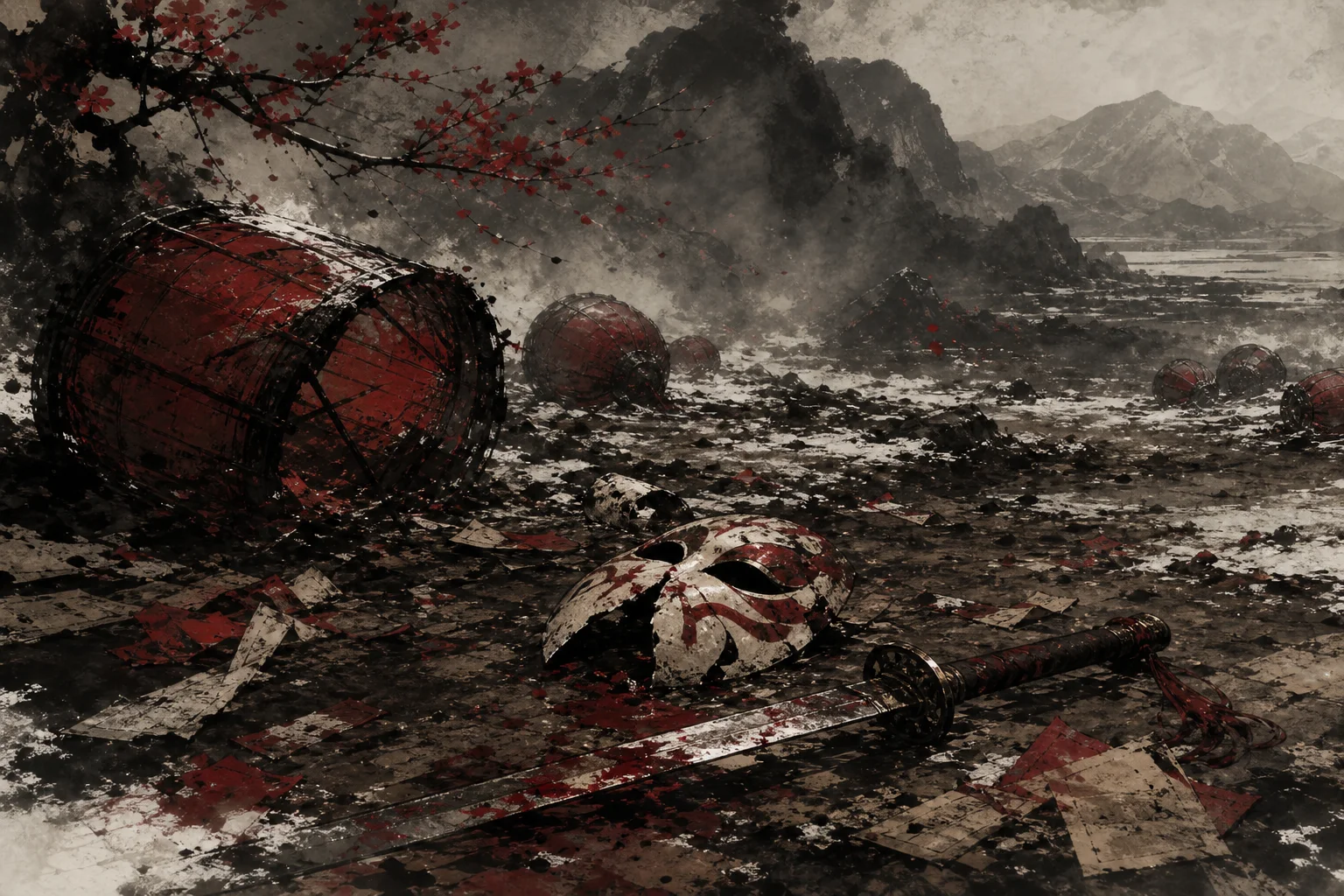
Shujiro kills Bukotsu while Iroha’s brothers face Gentosai
The finale splits its action cleanly. Shujiro and Bukotsu tear through the festival, while Iroha faces Gentosai and receives help from the Kyohachi-ryu brothers who still live. Adashino Shikura arrives as the fourth successor. Gion Sansuke arrives as the third. They are skilled enough to shock Iroha, but Gentosai is still stronger than any one of them.
Iroha tells the brothers to move as one. That is not only tactics. It is the answer her family failed to find earlier. Alone, each successor can be hunted. Together, they may have a chance.
Shujiro’s fight with Bukotsu has no such comfort. Bukotsu has built his whole remaining life around being met by Kokushu again. He wants proof that the manslayer still exists. When Shujiro finally kills him, Bukotsu dies saying that at long last he has found happiness.
It is a terrible line because he means it. Bukotsu does not die healed. He dies satisfied that the old violence answered him one more time. Shujiro survives, but Futaba screaming his name afterward tells the truth of the victory. Nothing about it feels clean.
Away from the road, the wealthy spectators receive the report with appetite. Kamuykocha has reached Chiryu first. Bukotsu has been killed by Saga Shujiro. They call Bukotsu the Savage Slasher and treat his death as fresh entertainment before Kawaji leaves to attend to his duties. Enju tells an aide to keep the wealthy fools busy with their pleasures.
That contempt is important. Enju may feed them the spectacle, but he does not respect them. He is using their money, boredom, and fear the same way he uses the fighters’ hunger.
Okubo’s assassination changes the road to Tokyo
The political trap closes fast. Okubo prepares to visit Kawaji after hearing he has returned, then notices Shinpei has not been in touch. Before he can act, Hanjiro appears in his carriage. Okubo thought Hanjiro was dead. Hanjiro says Kawaji will not be coming and gives Okubo a message: “Farewell.”
Okubo is killed, and the murder reaches Okazaki-juku as urgent news. Shujiro reads the report with Futaba beside him and understands that the timing is not chance. Kodoku is related to the assassination.
Then Lord Maejima’s messenger finds him with a direct order: return to Tokyo, urgent matter, make for the capital at once. Shujiro is being pulled toward the political center of the same violence he has been trying to survive.
Iroha, meanwhile, wakes wounded with Shikura and Sansuke. She tells them about a dream where they all lived together as family, arguing, smiling, and alive. She admits that if Shujiro had not run away, she would have died in the succession fight. But Gentosai remains ahead of them, and unless they defeat him, they cannot move forward.
So they gather their brothers.
The last movements return to the patrons and the board: Chiryu, Okazaki, Hamamatsu, Shimada. The weak are gone, one man says. Only the strong remain. Somewhere on the road, a fighter keeps laughing that killing is fun and collects more tags. Enju’s voice returns with the command that started all this: fight to the death, until the last one standing.
The chapter ends. The contest has not.
What works
- Shujiro and Bukotsu’s final fight pays off the opening flashback because both men want different answers from the same wound.
- Futaba’s festival scene gives the action a human cost before she becomes Bukotsu’s leverage.
- Okubo and Kawaji’s argument gives Kodoku a sharper political shape without drowning the road story in exposition.
- Iroha’s family thread gains force once Shikura and Sansuke arrive, especially because their only hope against Gentosai is unity.
- Enju’s contempt for the patrons adds a useful wrinkle. He profits from their pleasure, but he also looks down on them.
What stumbles
- Gentosai is frightening in motion, but his personal motive remains thinner than Bukotsu’s. The Kyohachi-ryu thread has feeling; its hunter still needs more texture.
- The long stretches of action with little dialogue make parts of the festival fight harder to track on subtitles alone, especially when the chaos cuts between crowds, rooftops, and fleeing bystanders.
- The finale opens enough doors for a continuation that it can feel less like a full ending than a pause after a major death.
What this sets up for Episode 07
There is no Episode 07 in this six-episode first chapter, but the ending points straight at a continuation. Shujiro and Futaba have to reach Tokyo quickly after Okubo’s assassination, Iroha has to gather the Kyohachi-ryu brothers against Gentosai, and Kamuykocha’s lead at Chiryu makes him harder to ignore. If the next chapter happens, Kodoku will no longer be only a road contest. It will be a fight over who gets to define Japan after the samurai have already lost their place in it.
Rating: 8.8/10
More episodes from Last Samurai Standing — Netflix's Japanese kodoku elegy, episode by episode. Jump to any episode in the season:
Where to go next
Reviewed by Mira Vance · QuizFandom Editor & Lead Reviewer. Every rating is an honest per-watch assessment from the desk that also writes the quizzes — not a press release rehash.