Last Samurai Standing Episode 05 Recap: Futaba Finds Hope at Chiryu
What happens — the short version (spoilers)
- At Mitsui Bank, Enju and the bankers discuss participant deaths like market bets and call the former samurai 'ghosts' to be erased.
- Shujiro sends a coded telegram to the Home Minister exposing Tenryuji and the police, plus a brief 'Remain strong' message to his wife Shino.
- Maejima tells Okubo that Kokushu is alive with a child and that the Police Bureau is secretly mobilizing over 150 officers.
- At Chiryu, Shujiro wants to leave the weak officer Sayama Shinnosuke behind, but Futaba refuses and the group spends tags to let him pass.
- Tsurubami's slip reveals nine people may survive to the end, hinting the final stage isn't winner-takes-all, and Kyojin suspects Futaba is the key.
- Mochizuki of the Police Bureau kills Shinpei before he can finish decoding the cipher.
- Enju declines to punish Shujiro directly, letting hunters like Bukotsu pursue him, and a stranger approaches Iroha's brothers as the count hits 63.
Last Samurai Standing, Season 1, Episode 05 Netflix · 2025
Shujiro reaches for the government, Futaba refuses a clean abandonment, and Kodoku starts closing around them.
At the fifth stop, the road to Tokyo becomes political in plain sight. Shujiro Saga (Junichi Okada) sends a telegram that could expose the Police Bureau and Mitsui Bank, but it also puts his name in front of the men running Kodoku. Futaba forces the group to look at Sayama Shinnosuke as a person instead of a weak link. Enju (Kazunari Ninomiya) answers all of it by letting danger travel toward Shujiro from several directions at once.
Mitsui Bank watches former samurai fall
The story opens back in the war before shifting to the rooms where Kodoku is being financed. A commander orders fire even after a smoke signal marks victory for his allies. A soldier objects because friendly troops are still inside enemy lines. The order comes again, and the guns answer.
That memory matters because the men behind the contest do not speak of former samurai as people who lost a war. They call them ghosts. They say the new era has no place for them. At Mitsui Bank, Enju and the bankers discuss death notices like market movement. Number 159, Ikeuchi Tekkan, has been killed by number 66, Kanjiya Bukotsu. The bankers judge Bukotsu as entertainment and a poor bet at the same time. He kills too much and advances too slowly.
Their hatred is not abstract. One man repeats a family motto about never lending money to shizoku and lists loan after loan, betrayal after betrayal. In his telling, the former samurai are not tragic leftovers of a broken order. They are expensive, violent debtors who stole from the powerless and then mourned their own lost status.
Enju gives the room exactly what it wants. He promises entertainment all the way to the finish line and invites them to enjoy the downfall of these ghosts. The word choice is the cruelty. Kodoku is not only a contest with tags and checkpoints. It is a public disposal dressed in private manners, funded by men who want the past erased and want to watch the erasure happen.
The first action stretch keeps that argument close to the body. A gunman is killed, police pursue, and Shujiro hears the accusation that his purpose is pointless. Winning will not make anyone happy. The attack does not stop Shujiro, but it leaves a warning behind: every path forward now belongs to people who already know his old name, Saga Kokushu.
Shujiro sends a telegram to Okubo
The next stretch belongs to documents, codes, and suspicion, and that is a good fit for this stage of the story. Lord Okubo receives news from General Kawaji that the Mount Fuji lead turned up nothing. Nagase worries about Kawaji, but Okubo does not want to believe the man responsible for the modern Police Bureau would betray the government.
That faith starts to look dangerous as Shujiro, Futaba, Iroha Kinugasa (Kaya Kiyohara), Tsuge Kyojin (Masahiro Higashide), and Shinnosuke discuss what they have learned. The man who killed Akayama and attacked Shujiro was not pretending to be police. He was a real officer. From there, the shape of the conspiracy becomes harder to dismiss. The Police Bureau can monitor participants and dispose of bodies. Mitsui Bank can help cover the cost. The zaibatsu behind the banks may reach even further.
Kyojin remains the useful cynic in the room. He points out that Shujiro still has a card hidden away: old connections to important government figures from the war. If the police and the zaibatsu are exposed through that channel, the whole operation could fail. Shujiro does not want to leave Futaba, but he understands the opening. He tells the others he will return by noon the next day and asks them to take care of her.
Before he goes, Futaba trains with a sword because she does not want to be a burden. Iroha gives her the answer Futaba needs. Strength does not lie in the sword alone. Futaba is still a child, and Iroha does not pretend otherwise. She tells Futaba to prepare herself because the strength she carries has not fully shown itself yet.
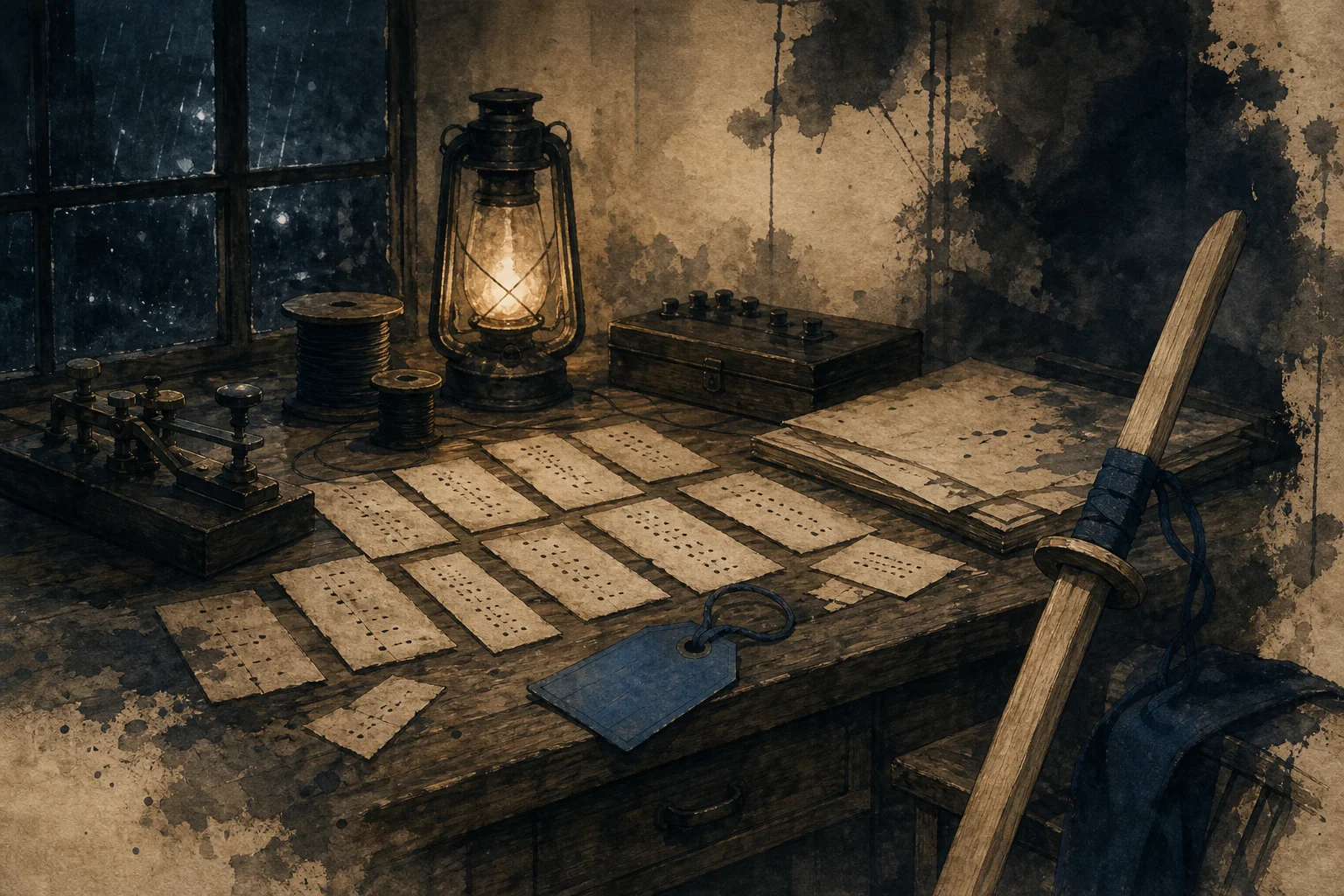
Shujiro’s telegram carries that private lesson into public risk. At the Narumi Telegraph Office, he sends a message addressed to the Home Minister. Maejima Hisoka answers from Okubo’s side, asking for details. Shujiro gives enough to make the danger legible: a serious incident at Tenryuji, shizoku engaged in combat, a child among them, police involvement suspected. He withholds full proof until protection is promised.
Then he breaks the hardness of the sequence with a second telegram. This one is for Shino Saga. The message is spare: “Remain strong.” He says he will return no matter what. It is the only kind of vow Shujiro can make now, because every other promise has been damaged by the road.
Maejima takes the message seriously. He tells Okubo that Saga Kokushu is alive, that a child is with him, and that the Police Bureau is secretly mobilizing more than 150 officers. Okubo orders the telegrams decoded and sends Maejima toward Okazaki. For a few minutes, it feels possible that the government might still contain the rot inside its own house.
Futaba refuses to leave Shinnosuke at Chiryu
The Chiryu checkpoint strips the group down to its choices. Shujiro, Futaba, Iroha, and Kyojin have enough points to pass. Shinnosuke does not. The official asks for tags, and the arithmetic becomes cruel because it is so clean: five points become one blue tag, and anyone short of the threshold cannot move forward.
Shujiro is ready to walk. That is not heartlessness. It is exhaustion sharpened into judgment. He says Shinnosuke lacks the strength to survive, and the argument is not easy to dismiss. The group has been bleeding its way across the Tokaido. Saving one weak adult may only postpone his death and endanger the people still standing.
Futaba cannot accept that. She says she could never return to her mother with pride if she abandoned Shinnosuke. The word honor can sound cheap in a series full of men using old language to cover selfishness, but Futaba makes it small and immediate. She is not arguing for a banner, a clan, or a vanished rank. She is talking about the person directly in front of her.
That is why the Chiryu choice lands. Shujiro’s caution is correct, and Futaba’s refusal is also correct. Kyojin can list the practical reasons not to spend tags on Shinnosuke. Iroha can see the risk. Yet the group gives enough for Shinnosuke to pass, and his gratitude lands with the panic of a man who knows he has been spared by people who did not have to spare him.
The choice also reveals information. Tsurubami has spoken too freely, saying that nine people will stand a chance of survival at the end. Iroha catches the implication. The final stage may not require every participant to die except one. Kyojin takes the thought further and suggests that if Kodoku is a locked door, Futaba may be the key.
For the first time in a while, hope enters the road without feeling sentimental. Futaba has not made Kodoku gentle. She has only proved that the people inside it can still make a choice the organizers did not price correctly.
Enju sends more hunters toward Shujiro
The hope does not last unchallenged. Bukotsu Kanjiya (Hideaki Ito) hears from a frightened man that a samurai was seen walking with a girl. He kills the man and fixes again on Kokushu. Bukotsu does not need the prize to stay moving. He needs Shujiro.
The group then splits. Kyojin and Shinnosuke caused trouble at the police station and their faces are known, so Kyojin decides they should separate until the search cools. He jokes because that is how he survives a room, but the move is practical. Shujiro, Futaba, and Iroha continue one way. Kyojin drags Shinnosuke into another.
Back in the government offices, Shinpei keeps working through the cipher materials and a Mitsui-gumi codebook. He is close enough to matter. That is why Mochizuki from the Police Bureau appears at the Home Ministry late at night. Shinpei asks what the Bureau wants there at such an hour. Mochizuki answers with calm menace, saying they have been watching every move.
Shinpei is killed before he can finish the work. The report that follows is brutally efficient: Okubo’s secretary has been handled, tensions are rising in the central government, Maejima is suddenly bound for Okazaki, and the telegram communications have been traced to participant 108, Saga Shujiro.
Enju does not panic in front of the bankers. He tells them Okubo may know about their involvement with the Police Bureau, then says the situation remains planned. Shujiro has broken the secrecy rule by sending the telegram, but Enju chooses not to eliminate him through procedure. Other participants are already fixated on him. Why interrupt when they can be allowed to tear at him inside Kodoku?
The last move is quieter and nastier. At a festival, two siblings looking for Saga Shujiro and Kinugasa Iroha are approached by a man who knows their names: Gion Sansuke and Adashino Shikura. He also knows Jinroku. He asks whether they would care if their siblings were in trouble. By the closing count, 63 remain, and Shujiro has become a signal flare for enemies, allies, and family at once.
What works
- Futaba’s Chiryu choice works without making Shujiro look foolish. His fear is practical; her mercy is costly.
- The telegram sequence makes the conspiracy feel tangible. Police, bank money, zaibatsu interests, and Okubo’s office all touch the same wire.
- Enju is more frightening when he declines to punish Shujiro directly. He understands that Bukotsu and the other hunters can do the work for him.
- The Meiji details matter here: telegraph offices, police modernization, shizoku debt, and bank resentment all make Kodoku feel rooted in a specific political wound.
What stumbles
- The opening gunfight is tense, but the action geography is a little muddy until Shujiro reaches the next conversation.
- Shinpei’s cipher work is important, yet his death arrives so quickly that he remains more function than person.
- Gion Sansuke and Adashino Shikura enter late with real promise, but they mostly function as setup for the finale.
What this sets up for Episode 06
Shujiro has protection promised in Okazaki, but Maejima’s route is already exposed and Shinpei is dead. Bukotsu is tracking the samurai and the girl, while Enju is turning family ties into another weapon. The finale now has to answer whether Futaba’s hope can survive a contest designed by men who profit whenever mercy becomes a liability.
Rating: 8.8/10
More episodes from Last Samurai Standing — Netflix's Japanese kodoku elegy, episode by episode. Jump to any episode in the season:
Where to go next
Reviewed by Mira Vance · QuizFandom Editor & Lead Reviewer. Every rating is an honest per-watch assessment from the desk that also writes the quizzes — not a press release rehash.