Last Samurai Standing Episode 04 Recap: Shujiro Follows the Bodies
What happens — the short version (spoilers)
- Shujiro finds Iroha working a knife-throwing act where she's heckled and demeaned, and they fill in the years they spent apart.
- Kyojin runs two experiments: hand a tagged participant to the police, and follow the vanishing corpses to whoever is collecting them.
- A teahouse trap set by other participants collapses into a fight, and the group cuts through hired outsiders while Iroha protects Futaba.
- Iroha stops Kyojin from killing a frightened young participant who claims he only took tags from the dead.
- Shujiro lets the system mark him dead and follows the corpse trail to Mitsui Bank records.
- Telegram analysis leads Okubo's men to the Police Bureau, and Kawaji is revealed to be thanking the patrons and calling samurai extermination a mission.
- Sakura is revealed as Nakamura Hanjiro, an old war comrade who blocks Shujiro's path as the count drops to 70.
Last Samurai Standing, Season 1, Episode 04 Netflix · 2025
One roadside fight opens a trail of corpses, telegrams, bank records, and police betrayal.
Last Samurai Standing Episode 04 is for testing how far Kodoku reaches once the swords leave the road. Shujiro Saga (Junichi Okada) reunites with Iroha Kinugasa, learns what has happened to her Kyohachi-ryu family, and lets Tsuge Kyojin turn a captured participant into bait. The result is one of the season’s strongest mid-run pivots: the contest still kills in public, but the rot behind it now runs through telegram offices, zaibatsu money, and the Police Bureau itself.
Iroha meets Shujiro after the Manraku troupe performance
The opening finds Iroha in a knife-throwing act, and the humiliation around her is as sharp as the blades. The audience does not come to admire the skill for long. Men heckle her, ask her to lose the kimono, and reduce her to skin while the troupe owner reminds her who took her in. “Civilization and Enlightenment” hangs over the scene like a cruel joke. The new age has banners, crowds, and paid entertainment, but Iroha is still trapped under another man’s hand.
Shujiro finds her there and is relieved she is alive. Their reunion carries the weight of people who once knew each other before survival became this ugly. He remembers the old Iroha as someone who would have put the hecklers in their graves. She answers with a smaller wound: she is used to it now.
Their conversation fills in the missing years without softening them. Shujiro has been pulling a rickshaw every day to feed his wife and daughter. Iroha has been moving from place to place, hiding from Gentosai. Fugoro and Shichiya are dead, killed by Gentosai, and the surviving disciples of their school are being hunted. Iroha wants Shikura and Jinroku to join her so they can lure Gentosai in and kill him together.
When she tells Shujiro this is their fate as a family, the word family does not comfort anyone. It means abandoned children, shared training, old blood, and a debt that keeps calling them back.
Kyojin sends a contestant to the police
Kyojin enters with a plan that sounds half mad until the pieces start fitting. He wants to run two experiments. First, hand a participant to the authorities with the tag still around his neck and see whether incarceration counts as withdrawal. If the organizers kill him in jail, Kodoku is willing to cross into police custody. If they leave him alive, there is a limit somewhere.
The second experiment is colder. Kyojin has noticed that bodies keep vanishing along the Tokaido Road. With so many shizoku killing one another, corpses should be lying in towns and roadside ditches. They are not. Someone is collecting them, hiding them, and moving them through a concealed network. Find the bodies, Kyojin argues, and they may find the people with enough money and reach to run Kodoku.
That logic sends the group into Kuwana-juku, where the teahouse is full of food, noise, and tags badly hidden or not hidden at all. Kyojin wants a volunteer, and the first plan is simple: whoever leaves the teahouse first. Then a pair of participants beat him to the idea. They have hired outsiders without explaining the contest, turning the teahouse into a trap for anyone carrying a tag.
The trap does not last. Shujiro, Iroha, Kyojin, and the others cut through the hired men, and the fight spills into panic. Iroha protects Futaba. Kyojin keeps watching for the angle. The violence feels less like a duel than a bad business arrangement collapsing in public.
Kanjiya Bukotsu is nearby in Yokkaichi-shuku, measuring strangers by rank as if every body is a lesson. He meets Kocha Kamuy and mocks the bow as too distant, too much like a gun. Kocha answers that his bow is an instrument for tributes and offerings to the gods. Bukotsu spits on that belief after killing in front of him and asks whether the world would look like this if gods existed. It is a nasty little exchange because neither man is speaking in slogans. Kocha carries ritual meaning. Bukotsu carries disgust.
When a host’s agent finally steps in with rifles and police warnings, the message is plain. The patrons want Bukotsu alive because he gives them a thrill. The new era has guns at its back and men like Bukotsu in front of it. Both are useful until they stop obeying.
Iroha spares a frightened participant
After the teahouse fight, Kyojin has two captured men and one cruel choice. One will go to the police with his tag still around his neck. The other will lose his tag and be finished. Both beg for the jail cell because the alternative is immediate death.
The younger man breaks first. He insists he has never killed anyone, that he only took tags from dead men at Tenryuji, and that another participant threatened him into it. He says his family is poor and that he joined to help his father’s failed business. He did not understand that Kodoku would mean killing people. The plea could be a lie, and Kyojin is ready to treat it as one.
Iroha stops him.
That choice matters because the opening has already shown what life has done to her. Iroha is not naive. She has lived among men who buy, threaten, and hunt. She has buried enough of her childhood to know mercy can get a person killed. She still chooses not to let this one end on the ground.
Kyojin accepts the change and makes the frightened man stay at his side. Then he sends Shujiro after the bodies and gives Iroha a smoke ball for the police ruckus. The plan is risky and unpleasant, but it also separates the group by temperament. Kyojin wants proof. Shujiro follows the dead. Iroha protects the living person in front of her, even when that person may not deserve trust.
Futaba’s later conversation with Iroha makes that choice feel more personal. Futaba asks when Iroha started training, and Iroha says the Kyohachi-ryu children were all abandoned so young they do not know their real ages. She was the only girl there and the weakest of all. Futaba wants advice because she wants to become as strong as Iroha. Iroha gives her the kind of answer no child wants: strength will not help her win, and no matter how skilled she becomes, happiness may stay out of reach.
It is a hard thing to tell Futaba, but it is not cruelty. Iroha is trying to keep the girl from mistaking survival skill for salvation.
Shujiro tracks the dead to Mitsui Bank
Kyojin’s jail experiment works too well. The selected participant is thrown into a police branch station, still terrified and still wearing his tag. The guard disappears. Men arrive under official cover. The prisoner tries to explain that unknown devils are making participants slaughter each other and that anyone who tries to escape gets killed. No one comes to protect him.
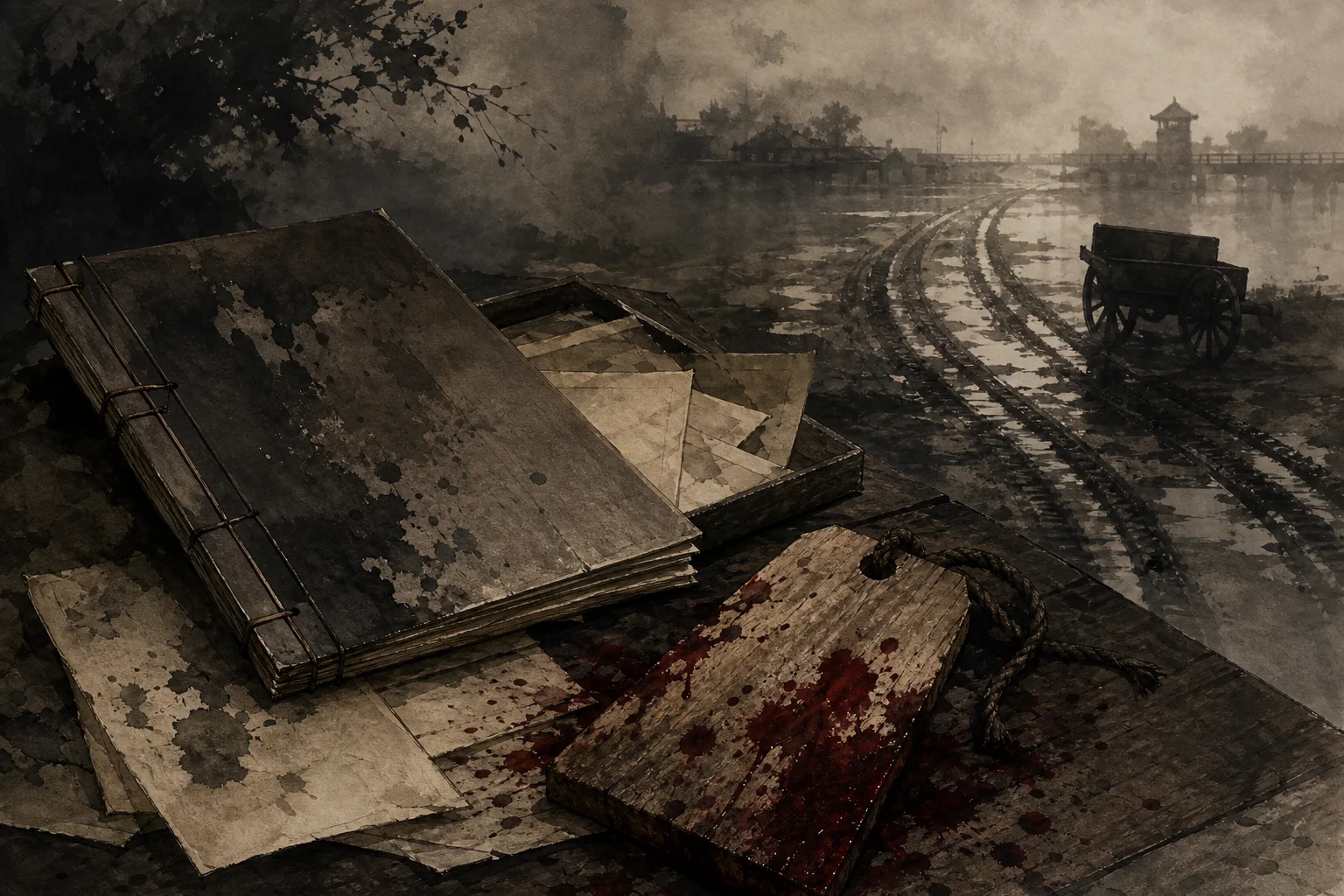
Shujiro follows the corpse trail by letting the system mark him as dead. A young officer named Sayama Shinnosuke helps without fully understanding what he is holding, and the record is made: 108, Saga Shujiro, eliminated at 2:17 p.m. in Kuwana. It is a grim bit of theater. Kodoku has a bureaucracy of death, and Shujiro walks inside it by becoming a line in its ledger.
The trail leads to documents and money. Shujiro finds Mitsui Bank records, including transaction files, opening loan deposits, and internal rules. The sight of a bank behind the bodies sharpens the season’s larger accusation. Kodoku is not only gamblers enjoying shizoku blood from a safe room. It is tied to institutions that know how to move money, messages, rifles, and corpses while the road keeps producing fresh dead.
Outside Shujiro’s path, Lord Okubo and his men are closing in from another side. They have been looking at zaibatsu contracts, rifle purchases, and the possibility that hatred of former samurai has become policy by other means. Telegram analysis points first toward the southern side of Mount Fuji, then back to a worse answer: the coded messages connect to the Nihonbashi Telegraph Office and lead to the Police Bureau itself.
That reveal lands with a sick calm. Kawaji is not slow to catch Kodoku because he lacks information. He is in the room with the patrons, thanking them for their support and calling the extermination of samurai a mission for the country’s tomorrow. Okubo’s question about whether Kawaji can be trusted arrives too late to feel like procedure. It feels like a man hearing the floor give way.
The final confrontation gives Shujiro another ghost from the war. Sakura identifies him as Saga Kokushu, and Shujiro recognizes him as Nakamura Hanjiro. Sakura says he once wanted to be just like Shujiro and that he has been secretly rooting for him since Tenryuji. Shujiro asks what they are trying to achieve. Sakura will not answer. Old comrades, he says, either drink together or fight.
There is no drink waiting here.
By the time the count drops to 70 remaining, Kodoku has widened from roadside slaughter to state machinery. The tags still matter. The swords still matter. But the men collecting the bodies are not living by sword skill. They are living by access.
What works
- Iroha gets the best character material of the episode, from the Manraku troupe humiliation to the Kyohachi-ryu confession with Futaba.
- Kyojin’s experiments make the mystery active. He does not wait for answers; he builds traps that force the organizers to reveal their habits.
- The body-disposal thread gives Kodoku physical reach: police cells, ledgers, banks, telegram offices, and hidden transport.
- Bukotsu and Kocha’s clash gives the action a sharper contrast between brute appetite and spiritual practice without making either man simple.
- The Kawaji reveal makes the conspiracy feel close enough to touch. It is not a distant mastermind anymore. It is inside the office meant to stop it.
What stumbles
- The teahouse trap moves quickly enough that the hired outsiders blur together once the fight starts.
- The cut between Bukotsu’s clash with Kocha and the Kuwana chaos can feel slightly jagged on first watch.
- The bank material is compelling, but the documents flash by faster than the emotional scenes around Iroha and Futaba.
What this sets up for Episode 05
Episode 05 now has two urgent fronts: Shujiro has an old comrade blocking his escape, and Okubo has reason to suspect Kawaji from inside the Police Bureau. Iroha’s Gentosai thread is still waiting to collide with the main road, while Futaba has heard the truth about strength from someone who paid for it. With only 70 participants left, Kodoku is no longer thinning the field quietly.
Rating: 8.9/10
More episodes from Last Samurai Standing — Netflix's Japanese kodoku elegy, episode by episode. Jump to any episode in the season:
Where to go next
Reviewed by Mira Vance · QuizFandom Editor & Lead Reviewer. Every rating is an honest per-watch assessment from the desk that also writes the quizzes — not a press release rehash.