Pachinko S1E2 Review: A shirt worn once, a name worth one billion yen
Kogonada threads Sunja's first encounter with Hansu through Solomon's first negotiation in Tokyo.
The ferry passengers gossip about a man who never wears the same shirt twice, and seventy years later his great-grandson will offer an old woman in Tokyo one billion yen for the dirt under her feet. Between those two scenes the episode never insists that history rhymes; it lets the rhyme accrue, image by image, until the closing shot of Hansu standing where Sunja stood feels less like a cliffhanger than a verdict. Kogonada’s second hour studies what is inherited — land, language, debt — and it is the first episode where the show’s signature gambit, two timelines breathing the same air, settles into something more than experiment.
The fishmonger and the heir
The cold open sets the rate. A father pleads for the length of his forearm. Hansu, played by Lee Min-ho with a stillness that reads as appraisal rather than menace, declines to let a boy’s disrespect go uncosted. Then he turns and pays five yen for twenty croakers and pushes the gratuity back across the table. Fair prices, public humiliation, no tolerance for idiots, and a refusal to be tipped by the people he has just put in their place. The ferry chorus we heard moments earlier — is he still one of us, or one of them now? — gets its answer in his posture before he speaks a word.
Sixty years later in Tokyo, Solomon Baek, played by Jin Ha with a watchfulness that costs him real effort to perform as ease, walks into a wedding reception full of Ministry of Finance officials and a developer named Abe who greets him by asking his blood type. Soo Hugh’s adaptation lets these two scenes share a single emotional weather. Hansu refuses to be pocketed by a man with extra tangerines. Solomon refuses to flinch when Abe smiles and calls him an optimist with a survival instinct. Both encounters end the same way — the Korean man walks out of the room with more leverage than he walked in with — and both leave a residue of the same question. What is the cost of being read?
What an old friend remembers
The wedding sequence contains the episode’s most quietly devastating piece of writing. Solomon’s childhood friend, now well-placed in Japanese finance, recalls a joke from when they were boys. The friend’s father had told him that Koreans must have been raised by dogs, because why else would they shove their faces into their bowls instead of lifting them. The friend offers this as nostalgia. Solomon receives it as a wound that has waited thirty years to be reopened in a tuxedo. We were kids then, the friend says. I’m sure I heard my father wrong. The line is performed as absolution and lands as confession.
Solomon’s face in this beat is the episode’s best case for casting Jin Ha. He does not let Solomon react. He lets Solomon notice himself not reacting, and then lets the noticing settle into the smile he keeps on for Abe a minute later. The scene puts a price tag on what Solomon will be asked to do in Tokyo — to be Korean enough to close a deal with a Korean grandmother, Japanese enough to be promoted to the 43rd floor, American enough to wear the Hermès tie that pings on a coworker’s radar before his name does.
The boys on the path and the man on the rock
The hour’s most viscerally staged sequence is also the one that risks the most. Sunja, on her way back from the market with her load, is cornered by three Japanese teenagers who decide to weigh her breasts against the bag of fish she is carrying. Minha Kim plays the assault with a specificity that refuses any of the iconography this scene usually invites — no slow motion, no swelling score, just a girl screaming in two languages for the one she thinks will hear her. Hansu arrives. The violence he uses is efficient and the threat he delivers is precise: if you bother her again I will kill you and feed your bodies to the dogs.
What follows is the episode’s quietest movement and its most dangerous. He walks her to the ferry. He says he had forgotten how beautiful this country is, how resilient, how strong. He asks her to bring his shirt — bloodied at the cuff — to the cove tomorrow, and to wash it before lunch. The chorus on the ferry told us he never wears the same shirt twice. Now he is asking a fifteen-year-old to launder one. Kogonada lets the contradiction sit. He does not direct Lee Min-ho to play seduction. He directs him to play a man who has decided something and is waiting to see whether the woman in front of him has decided it too.
A melon, a map, a billion yen
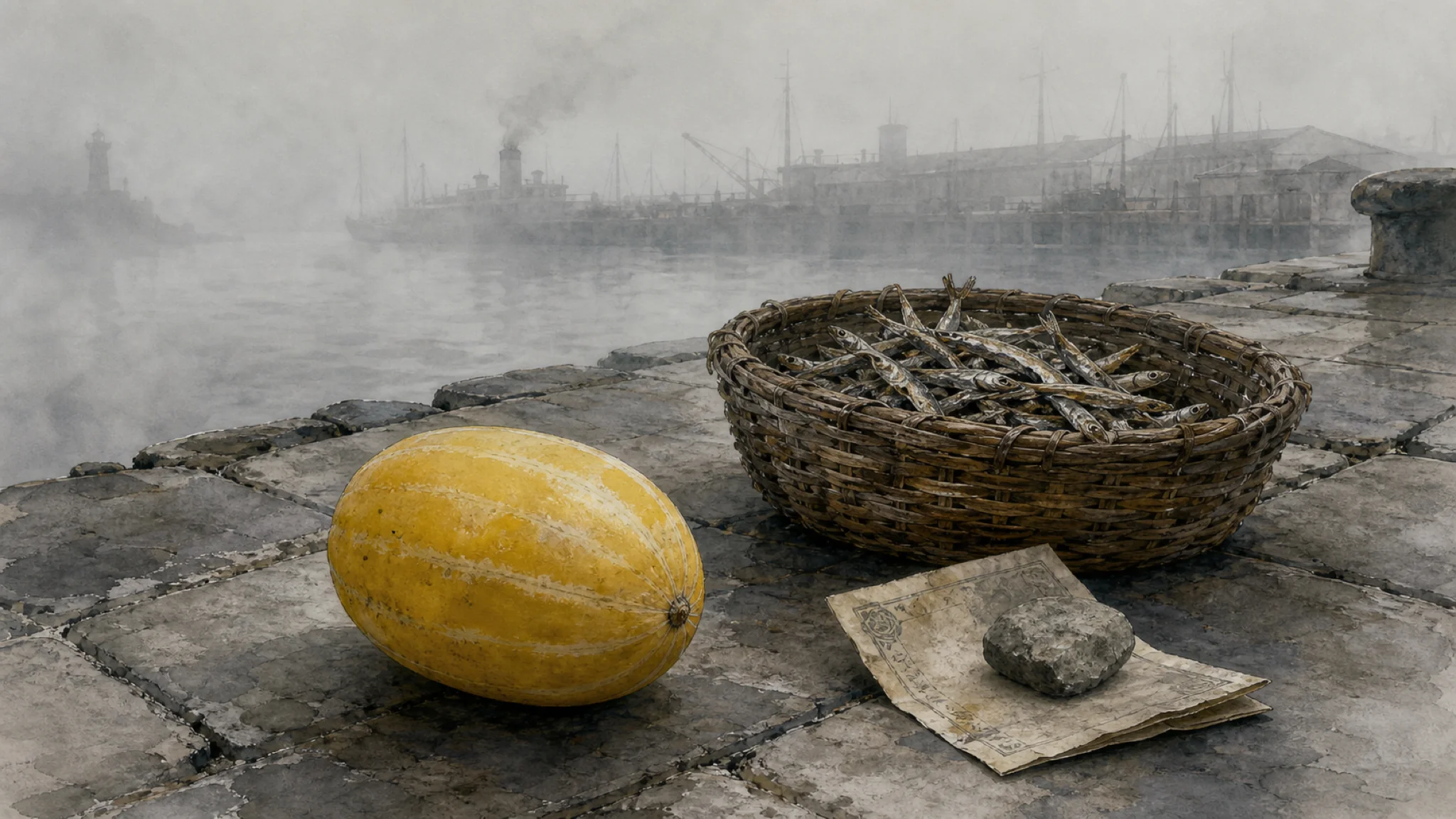
The Tokyo half of the hour belongs to a single conversation in a small house, and it is the conversation the season has been building toward. Han Geumja, played by the Korean stage actress Park Hye-jin with a refusal of any softening, has turned down three offers for the plot of land her family bought in 1955 for four thousand yen. Solomon brings a melon that cost nine thousand. He explains, gently, that her land in 1955 was worth less than half of the melon he has just put on her table. He offers her one billion yen.
She does not take the money. She tells him, instead, about the language her own children no longer speak — the language in which their mother dreams — and asks him whether it is tiresome when the old talk this way. Isn’t that precisely the point, she says, to burden us with the past? Solomon has been sent to extract a signature. What he is being asked to extract, in fact, is a memory, and the price for memory is not one billion yen and never was.
The grandmother’s refusal is shot to rhyme with another refusal we have just watched. Across the strait, sixty years earlier, Sunja’s mother Yangjin, played by Inji Jeong, is being told by Kyunghee — Sunja’s bedridden friend whom Yuh-jung’s older Sunja is nursing in a parallel cut — that she does not want any more medicine. Haven’t we been fighting long enough now? Kyunghee asks. You used to say things to me as they were. The episode braids three women refusing to be moved off their ground — Han Geumja, Kyunghee, and Sunja herself, who tells the gossiping fishmonger she does not know the broker and cannot accept his gift — and lets each refusal annotate the others. Inheritance is more than land. It is the right to say no on land that costs less than a melon.
The pachinko parlor and the older question
A question the pilot raised but did not press finally gets a quiet answer: where does the money come from? Mozasu sits in his pachinko parlor in Osaka and explains to a young technician what Mr Goto once explained to him. Adjusting the nails does not fix the odds. It nudges them. When the players lose, feel their heartache. When they win, feel their joy. It is the most generous piece of writing Pachinko has done so far about the trade that funded Solomon’s Yale tuition and his Cambridge MBA and the Hermès tie at the wedding. Mozasu is not apologetic. He is not defensive. He is teaching, and what he is teaching is a code of conduct for an industry his son’s Japanese coworkers used at the wedding to put him in his place.
This is the structural move that makes the four-timeline gambit hold. The grandmother in Tokyo refuses to be a transaction. The father in Osaka explains that the transaction has rules. The son in the wedding hall pretends he does not hear what is being said in the room. And the girl in 1931 Yeongdo agrees to wash a shirt.
Hana on the phone
The hour’s last surprise is a phone ringing on Solomon’s hotel desk. A woman named Hana — last seen, somewhere in Tokyo, eight months ago, and now apparently no longer in the soapland the detective described to Etsuko with an averted gaze — has found his number. So strange to hear your voice now, she says. The conversation is two minutes long and it changes the shape of Solomon as a character. He has been, for most of the hour, the man with the Hermès tie. On the phone he is sixteen again. Quit joking around, Hana says. Bet you haven’t even thought of me till now. He says: That’s not true.
The placement of the call, immediately after the grandmother’s refusal, is the episode’s loudest piece of structural writing. Solomon has just been told that the past is a debt. Hana is the past calling collect. She tells him she is in the darkness and has been here so long she does not know how to find her way out. She tells him not to tell Etsuko. She hangs up. Whatever Solomon thought he was doing in Tokyo — closing one deal, taking one promotion, putting Osaka behind him for good — has been rerouted by a voice he had not heard in years and now cannot unhear.
What the episode holds
The pilot was a mission statement. This hour is the first sustained piece of patterning. The four-generation structure operates not as a literary conceit but as a moral one — what looks like a real estate negotiation in 1989 cannot be told without the fishmonger in 1931, and what looks like a romance on a Yeongdo path cannot be told without the grandmother refusing the melon. The braided structure makes the case that history is not background. It is the price tag on the foreground.
The hour also begins to define what a Pachinko protagonist looks like. Sunja, Solomon, Hansu, Mozasu, Han Geumja, Kyunghee — each is someone who has been offered a transaction and has to decide what they will not sell. The show, in this sense, is a piece of writing about consent under duress, and the duress is the century itself.
Verdict
This scale is earned. Kogonada lets the actors do the thinking — Sunja refusing the gift in the marketplace, Solomon not reacting to a childhood friend’s confession, Han Geumja asking whether it is tiresome when the old speak this way. The trilingual code-switching never reads as gimmick. Japanese is the language of leverage. Korean is the language of inheritance. English is the language Solomon uses when he wants to pretend he is somewhere else.
If there is a flaw it is that the assault sequence, however carefully shot, asks Hansu’s intervention to do a great deal of structural work and risks letting the rescue swallow the encounter that follows. The next scene — the bloodied shirt, the request to launder it — is Pachinko at its most controlled. It refuses the romantic register the rescue would normally invite, and it lets a fifteen-year-old girl decide for herself what she has just been asked. The pilot established the technique; this hour tests whether the technique can carry an extended sequence opposite a billion-yen negotiation. It mostly can. There is also a heavy lean on Hansu’s mystique — three appearances, three demonstrations of competence, no interiority yet — and that bet will need a payoff the season has not yet promised.
Rating: 8.9/10
More episodes from Pachinko — Sunja's family across four generations and three countries. Jump to any episode in the season:
Where to go next
Reviewed by Mira Vance · QuizFandom Editor & Lead Reviewer. Every rating is an honest per-watch assessment from the desk that also writes the quizzes — not a press release rehash.