Pachinko S1E4 Review: A suit that doesn't fit, a song that does
Kogonada's hour braids a hasty wedding, a mother's pilgrimage for white rice, and a boardroom mutiny into a single argument about who gets to refuse.
The episode opens on a borrowed suit and closes on a chorus rising through a ship’s hull. Between those bookends, three generations of the Baek family are asked to sign documents they can barely read — a marriage register, a land contract, a ferry manifest — and the hour quietly builds toward the question of what it costs to say no. Hansu sneers at Isak’s ill-fitting jacket. Yangjin counts out coins for two bowls of white rice. Solomon watches an old woman refuse a fortune and feels something he can’t yet name. The connective tissue is loss, but the muscle underneath is refusal.
A brother’s suit and a husband’s offer
The cold open sets the hour’s whole moral grammar. Isak stands at a Japanese tailor’s in a suit cut for a dead brother — Samoel, taken by the Japanese during the Independence Movement and never returned. Hansu arrives for his own fitting and reads Isak instantly: the slack shoulders, the long sleeves, the grief stitched into the seams. “It looks pathetic,” he says, in that flat appraising voice the show reserves for him. “Holding on to the past like that.”
Isak refuses the offered gift and pays for a new suit himself — for his wedding, three days from now. He keeps Samoel’s jacket and tells the tailor to re-hem it for his future son. The exchange does what almost every Pachinko scene does: it reads a piece of clothing as a ledger. Hansu sees a sickly man performing martyrdom in a dead man’s clothes. Isak sees an inheritance worth keeping even if it never quite fits. Both men are right. Neither is generous.
The scene also gives the audience information Sunja doesn’t have yet — that Hansu knows exactly who Isak is, exactly what he intends, and finds him beneath contempt. Hansu plays it almost amused, which is more chilling than anger. The pity belongs to him; the suit belongs to Isak; the woman they are both circling does not appear in the scene at all.
The wedding nobody wanted to officiate
Pastor Shin marries them under a low ceiling with the bare minimum of witnesses, and the camera does not flinch from how punishing the ceremony is. He makes Sunja kneel. He calls her a scourge to the child, to herself, to her family, to her husband’s good name. He refuses, when she asks, to forgive her — that, he tells her, is a matter for God. Only after she commits her mind and body to the Lord does he agree to bless the union, and even then his prayer asks not for happiness but for spiritual ties that “must remain impregnable.”
The word choice is the writers’ tell. Impregnable. To a woman who is already pregnant by another man, asking the Lord to make her marriage a fortress is closer to threat than benediction. Isak sits beside her and absorbs the humiliation without protest, which is its own form of vow. He brought her into this room knowing what Pastor Shin would say. He stays.
Sunja plays the scene with her eyes lowered and her shoulders perfectly still — the same posture she will hold an hour later, kneeling before her mother to receive parting advice about how to endure cruel in-laws. Pachinko keeps showing us women being asked to kneel and to thank the person doing the asking. The show treats this as ordinary, which is exactly why it lands.
Two bowls of white rice
The hour’s most quietly devastating sequence is also its least dramatic. Yangjin walks to the market and asks the rice trader for white rice — rationed grain that, under occupation, is reserved for Japanese customers. The trader refuses at first, citing the official who could shut him down. Yangjin offers to pay more. He still refuses.
Then she tells him it is for her daughter, married that day, leaving for Japan tomorrow. The trader’s face changes. He gives her millet at the barley price. He gives her three bowls of rice — one more than she asked for. “Perhaps the taste of it will help swallow some of your sorrow,” he says, and the sentence is so plainly written it doesn’t feel written at all.
Yangjin (Inji Jeong) plays the entire scene from inside a calculation: how to send my daughter to Japan with something that tastes like home, without admitting to a stranger that I do not know when I will see her again. The white rice on the wedding table later — Sunja crying over a bowl of grain her mother had to plead for — is the episode’s single most efficient image of what occupation costs a Korean kitchen. The cost is not only the rice. The cost is the asking.
The orphan sisters’ wedding-day conversation
Donghee and Bokhee, the boarding-house orphans, talk in the kitchen about who they would invite to their own weddings — the Chung Brothers, the pharmacist, even the mean lodger who gave Donghee a terrible look for dropping his pipe. Bokhee cuts the fantasy off with the cruelest sentence the episode contains: “We have no name or dowry. There’s only one option for us. Taking a man who’s just as penniless. And then what? We won’t be able to live together.”
We have spent the first half watching Sunja receive a marriage she did not choose. Bokhee’s monologue reframes that marriage as a privilege the orphans will never have. Sunja gets a husband who will absorb her shame in front of God; Bokhee will not get a husband at all. Grief comes in tiers. K-drama tradition trained audiences to expect comfort to follow this kind of speech; Pachinko refuses. Bokhee gets handed an embroidered wedding gift later — a pair of ducks who mate for life — and gives it to Sunja anyway. The girl who will never marry is the one supplying the wedding favor.
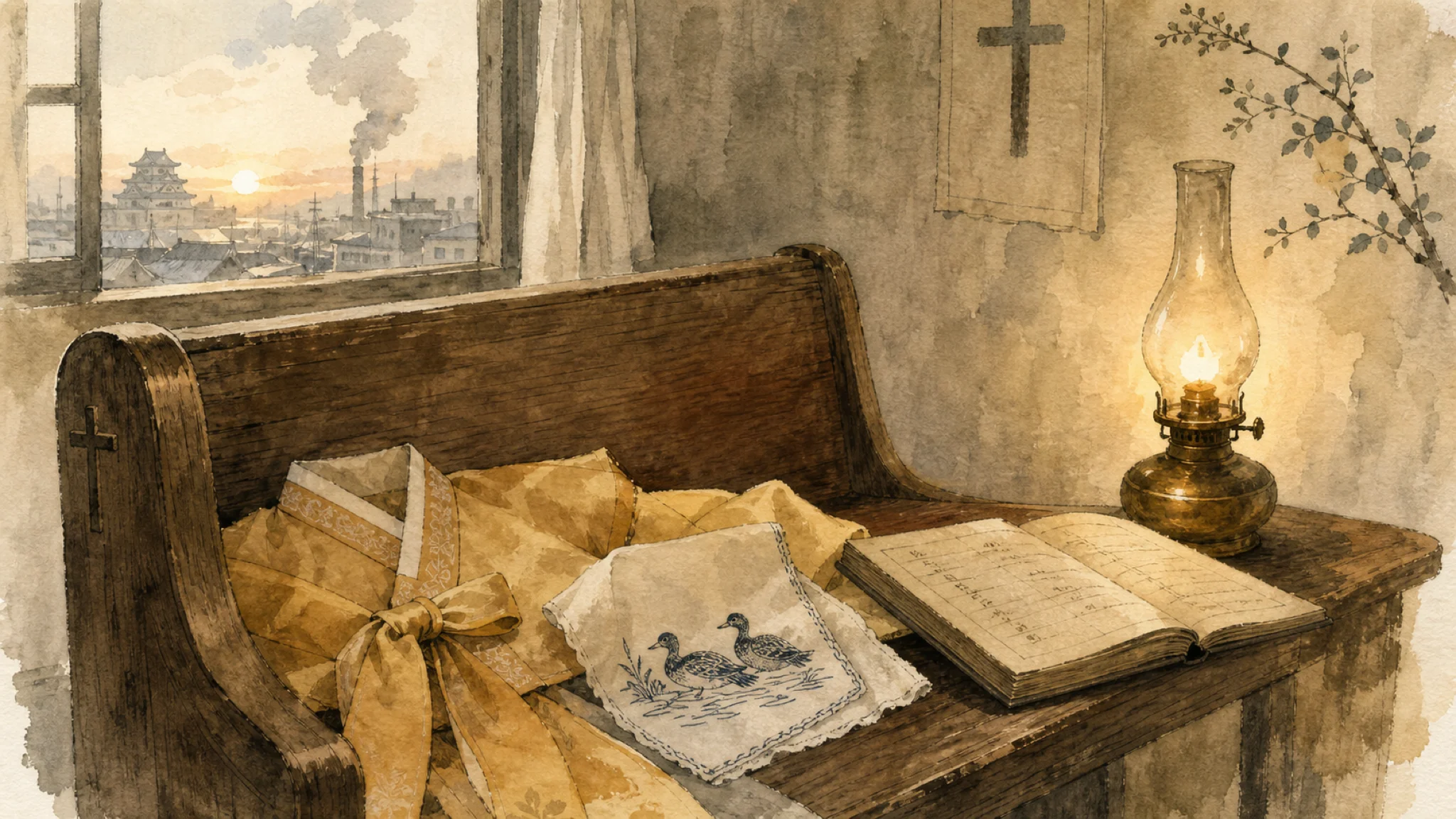
Hansu’s last argument
Hansu pulls Sunja into a locked room one last time. He has heard about the wedding. He knows the husband. He calls Isak a sickly man looking for a vulnerable woman; he tells her she will suffer in Osaka, that their son will suffer; he asks her to stay.
Then, when she will not: “From there, you will call me and beg me to save you. I won’t even remember your name.”
It is the cruelest thing he has ever said to her, and Hansu delivers it almost tenderly, which is what makes it survive being quoted. Sunja answers in the only currency she has left — possession. “This child is mine. Not yours.” The contest over the unborn boy is also a contest over who gets to name what the future will look like. Hansu insists the child is his blood; Sunja insists the child is her decision. Pachinko, which already knows how the boy’s life will go, lets them both be wrong.
Solomon, the soprano, and the song from below
The 1989 thread runs in parallel to the boarding, and Kogonada cuts between them with a confidence that should not work on paper. Solomon is in a boardroom in Tokyo, paid to convince a Korean landowner — Mrs. Han, who came to Japan as a child in the 1920s — to sign over her plot so a hotel can be built. Naomi has already told him the truth about Shiffley’s Tokyo office: it is the graveyard where careers like Arimoto’s go to die, and the place where ambitious women like her can rise precisely because the bar has been lowered for everyone else around them.
Mrs. Han delivers a monologue at the signing table that is the closest the hour comes to naming its own subject. Her father came to work the Chikuho mines. Four hundred Korean miners struck for twenty days and were all fired. No one would rent to Koreans afterward — they were too dirty, too loud. “They were right,” she says. “We had to crowd three families into one room to afford the jacked-up rents.” Then, to the developer’s son who tells her all that is behind them: “If you really believe that, then you’re a bigger idiot than I thought.”
Solomon watches her, and watches the Japanese soprano on the ferry behind his grandmother’s memory — the Italian aria that gets drowned out by Korean miners singing a folk song from belowdecks until the guards are called and the soprano is dragged from the stage. Then he leans in and tells Mrs. Han, in Korean none of the Japanese executives in the room can follow, to refuse the offer. To say no.
She does. She walks out. Tom Andrews is furious; Abe is humiliated; the deal that was supposed to be a formality collapses. Solomon has detonated three years of his career in one sentence, and his face plays the moment with something almost like relief.
What this episode argues
The episode’s argument is that refusal is the inheritance worth keeping. Isak refuses to throw out his brother’s suit. Yangjin refuses to send her daughter away without white rice on her tongue. Bokhee refuses to keep the ducks. Sunja refuses Hansu’s offer to save her. Mrs. Han refuses the contract. The Korean miners belowdecks refuse to let the Japanese soprano be the only voice on the ship.
None of these refusals are strategic. Most of them cost more than they save. Bokhee will still be poor. Yangjin will still be alone in the boarding house. Sunja’s life in Osaka will be every bit as hard as Hansu warned. Solomon has just torched his promotion. The show is not arguing that saying no is wise. It is arguing that saying no is what survives — passed down the way Yangjin’s gold watch is passed down, the way the folk song carries through the hull of the ferry, the way Samoel’s suit waits in a drawer for a son who will inherit a country his uncle did not live to see free.
Verdict
This is the strongest hour of the season so far and the one that justifies Pachinko’s structural ambition. The cross-cutting between 1931 and 1989 finally pays off — not as a stylistic flourish but as a moral rhyme. The orphan sisters’ kitchen scene, the rice-trader exchange, and Mrs. Han’s monologue are all tier-one writing, the kind of material that prestige drama is supposed to deliver and rarely does at this density. Sunja, Yangjin, and Solomon all do career work. The aria-versus-folk-song sequence is the most ambitious set piece the series has attempted, and it lands because the right to be operatic about a song has been earned.
If there is a reservation, it is that Pastor Shin’s wedding scene leans a beat too long on humiliation, and the present-day plot mechanics — the contract, the boardroom theater — occasionally feel arranged rather than observed. Small notes against an hour this large.
Rating: 9.2/10
More episodes from Pachinko — Sunja's family across four generations and three countries. Jump to any episode in the season:
Where to go next
Reviewed by Mira Vance · QuizFandom Editor & Lead Reviewer. Every rating is an honest per-watch assessment from the desk that also writes the quizzes — not a press release rehash.