Pachinko S1E7 Review: The Origin Story That Reframes the Whole Series
A bottle episode set in 1923 Yokohama gives Hansu his wound, and Pachinko finally explains the man behind the white suit.
For six episodes, Koh Hansu has been Pachinko’s most elegant cipher — a fish broker in a white linen suit who appears at a Busan market and changes a teenage girl’s life, then reappears decades later in Osaka with private detectives and a fleet of black cars. This hour rewinds to 1923 and tells us how he became that man. Director Kogonada and writer Soo Hugh build the hour as a self-contained origin story, almost a silent film in its final third, and they trust the audience to feel the connections to the larger Pachinko saga without underlining them. The result is the most formally daring hour Pachinko has attempted, and the most quietly devastating.
A father and son in Yokohama
The opening twenty minutes are some of the warmest scenes Pachinko has staged. Hansu, freed from the imperial reserve he carries in the 1931 timeline, plays as a quick, slightly cocky teenager who tutors a wealthy American family by day and runs errands for a yakuza boss named Ryochi by night. His father Jong-Yul — a Korean expat who works as a numbers man for the same yakuza — moves through these scenes with a tenderness that ambushes you. He tells Hansu, between bites at a noodle counter, that “a person only needs to be good at one thing,” and that he himself is good at making money for other people. The line lands like a confession.
There is patience in how this gets established. They go to boxing matches together. They split feasts at street stalls. Jong-Yul scolds Hansu for being late to deliver a message, then immediately drags him out to eat. When Hansu asks his father what he should be good at, Jong-Yul laughs and says you don’t get to pick — “mostly, you won’t have a choice what that one thing is.” It is the closest thing to a manifesto the series has given us, and it lands in the mouth of a man we have ninety more minutes with at most.
The father’s dream is small and specific: he wants Hansu out. Out of the back rooms, out of the betting slips, out of “cleaning blood off the floor.” When the wealthy Holmes family floats the possibility of taking Hansu to America to tutor their underwhelming son Andrew at Yale, Jong-Yul does not hesitate. He tells his son to take the bet. He tells him that two stars in the night sky can look inseparable from down here while being unfathomably far apart. It is the kind of speech that, in a lesser show, would feel like a writer reaching for a metaphor. Here it lands because Sunja is not in this episode at all, and the absence makes the metaphor about something larger — about every Korean parent in the diaspora who has ever told a child to leave them behind for a better life.
The debt and the choice
The pivot is brutal in its plainness. Jong-Yul has stolen 200 yen from Ryochi to give to a woman named Kiyo — a small, sad scene in her room where she admits she gave the money away to a man who will never repay it, and Jong-Yul accepts this with the resigned patience of someone who has been loving the wrong person for a long time. When Ryochi confronts him about the theft, Jong-Yul does not beg for himself. He begs for his son. He offers his life, his labor, his death — anything to keep the Holmes family’s offer of America intact for Hansu.
Hansu refuses to leave. There is a moment, just before the world ends, where Jong-Yul slaps his son across the face and screams at him to get on the ship and never come back. “From now on,” he tells him, “you must kill me in your heart. You will be better for it.” Hansu plays the reaction with his whole body collapsing inward — a future kingmaker reduced to a boy who has just been told the only person who ever loved him without conditions is making him an orphan on purpose. Jong-Yul kneels in front of Ryochi and offers to work off the debt with his life. Ryochi seems, for a brief moment, ready to grant generosity. Then his lieutenant Genta swings a bat at Hansu’s head, and the hour tilts into something else entirely.
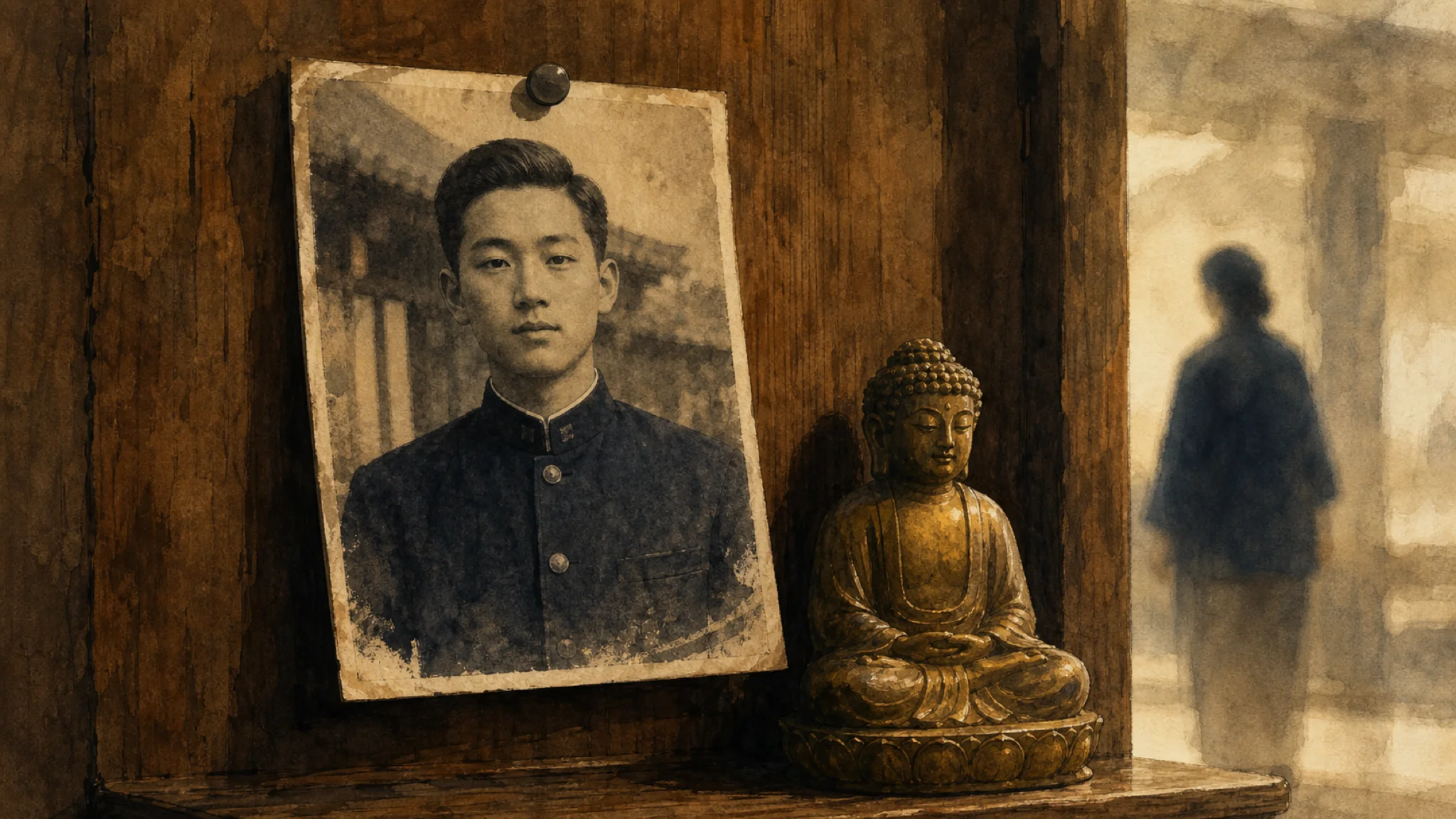
The Great Kanto earthquake
The 1923 Great Kanto earthquake hits without warning, mid-scene. Kogonada shoots it almost entirely without dialogue. Buildings fall. Bells toll. Fires move through Yokohama in slow currents. Hansu surfaces with blood on his face and finds his father pinned under wreckage, dying. There is no last conversation. The boy who refused to leave gets dragged away by Ryochi, who has lost interest in the debt and gained an interest in the boy himself. Whatever was about to happen in that yakuza basement is now buried under tons of stone and ash.
Then comes the second blow, the historical one Pachinko has been building toward since the pilot’s flash-forward to a hostile Japan. As Hansu and Ryochi take shelter in a tea house, news arrives that Korean prisoners have escaped from Negishi Prison and are looting the city, poisoning the wells, attacking Japanese women and children. This is the Kanto Massacre — a real historical atrocity in which Japanese vigilante mobs murdered thousands of Koreans (and some Chinese and political dissidents) in the chaotic days after the earthquake, on the basis of fabricated rumors that play out here exactly as they spread. A miss, a barn, a mob with torches. Hansu watches Korean survivors he just helped hide get burned alive. Ryochi pulls him away. “There’s nothing you can do,” he says. “They’ll just throw you in there.”
This is the moment, the hour argues, that Koh Hansu becomes Koh Hansu. Not the boxing matches with his father. Not the death itself. The realization, watched in real time through smoke, that being Korean in Japan means your life can be ended by a rumor and a match. Ryochi survives because he is Japanese and the mob is afraid of him. Hansu survives because Ryochi hides him under a tarp in the back of a cart and lies to the mob’s face about which way the Koreans ran. The price of that survival is the debt — Jong-Yul’s debt, now Hansu’s. “You still have a father’s debt to pay,” Ryochi tells him in the final scene, with his recovered family weeping behind him, and the contract is sealed.
What this episode argues
Koh Hansu was made, not born. The man who tells Sunja “I am no good for you” in episode three, the man who builds an empire on cold calculation and a precise reading of Japanese power, the man who walks into an Osaka kitchen in episode six like a ghost — that man is the residue of a boy who watched his father die in a yakuza basement and his countrymen burn in a barn on the same afternoon. Pachinko has always been about what gets passed down in diaspora — debt, language, shame, hope — and this hour is its clearest articulation of that inheritance argument. Hansu’s coldness is not a character flaw Sunja is being asked to fix. It is a survival adaptation forged by a specific historical event the Japanese government still has not fully acknowledged.
What is bolder is the formal commitment. By giving an entire hour to a backstory that contains none of the other regular characters — no Sunja, no Yangjin, no Solomon, no Mozasu, no Naomi — the writers are gambling that the audience will trust them. The gamble pays off because the hour is, on its own terms, a complete piece of work. It would play as a short film. The fact that it is also the most important piece of context the series has provided is almost a bonus.
Verdict
This is the best Pachinko has been so far and one of the best hours of television Apple TV+ has aired. The bottle structure works because the bottle is its own complete vessel — a self-contained tragedy that happens to be embedded in a larger one. Hansu is revelatory here, given more emotional range in one hour than the previous six combined, and Jong-Yul (a quietly extraordinary performance) builds an entire relationship in roughly twenty minutes of screen time. Kogonada’s direction in the earthquake sequence — the silence, the ash, the slow drift of bodies through smoke — is the kind of work that gets cited in retrospectives.
This hour also does the hardest thing a prequel hour can do: it changes what you think about every scene that came before it. The next time Hansu tells Sunja he is going to America, the next time he warns her about cholera in Osaka, the next time he tracks her family across an empire — you will be watching a man pay a debt he inherited from a father he was told to kill in his heart. Pachinko was already a great show. This hour makes it a permanent one.
Rating: 9.6/10
More episodes from Pachinko — Sunja's family across four generations and three countries. Jump to any episode in the season:
Where to go next
Reviewed by Mira Vance · QuizFandom Editor & Lead Reviewer. Every rating is an honest per-watch assessment from the desk that also writes the quizzes — not a press release rehash.