Pachinko S1E8 Review: The Grandmothers Speak and the Season Ends in Their Voices
Kogonada and the writers hand the microphone to real Korean grandmothers who lived the history the show has been dramatizing all season.
The Apple TV+ adaptation of Min Jin Lee’s novel has been working in two timelines all season, then a third when memory pulls it back further. The finale collapses all of them into one long exhale. Isak is arrested and broken. Hana asks for the morphine that will let her sleep. Solomon chooses the deal that converts his loss into a weapon aimed back at the men who fired him. And then, over the closing minutes, the show abandons its fictional cast entirely and lets eight real Korean women — born between 1917 and 1924 — speak directly to camera about their lives in Japan. The choice is so confident, and so emotionally specific, that it reframes everything that came before it.
A son taken from the platform, a mother given a calling
The 1931 thread builds toward the train-yard scene that breaks Noa apart. Yoseb’s boss, Mr. Shimamura, fires him not for any infraction but for sharing blood with an arrested brother. “You can’t fight blood,” the boss tells him — the same phrase Mozasu will later use, in a different language, in a different decade, to warn Solomon away from the Yoshii family. The episode lays these rhymes down quietly and trusts the viewer to hear them.
When Sunja finds the woman whose brother-in-law has been jailed three months without a single visit, the season’s political register sharpens. She didn’t know her husband was an organizer. She didn’t know there was a Hasegawa, a daughter, a Communist study group, a Council of Labor Unions. She didn’t know he’d been preaching to the factory men that there is power in numbers. The woman tells her this, not as accusation but as testimony: the hope your husband preached fed us all. The grieving sister-in-law handles the speech with a stillness that lets the words do the lifting. Sunja learns who her husband actually is on the day she is about to lose him.
The platform sequence that follows is the most unguarded performance Minha Kim has given all season. Noa breaks free of Sunja’s grip and runs after the cart, calling Papa, calling Papa, until the soldiers shove him back. The camera doesn’t cut for relief. It stays on the boy’s face and on his mother’s, both of them refusing to look away, until the cart is gone. There is no music swell. The silence after is the loudest thing in the episode.
Hana asks for sleep, and Solomon answers her with revenge
The 1989 thread has been quieter all season, often accused — fairly — of dragging behind the period work. The finale gives Jin Ha his strongest material and the writers their bravest swing. Hana, played by Mari Yamamoto, has refused to die in a hotel room for episodes now. Here she finally says it out loud: I never dreamed it would end like this. Here, in this shitty room. The Hawaii fantasy — warm sand, the sound of waves holding her close — is the version of her death she will not get. She knows it. She asks Etsuko for the morphine anyway.
Before the dose, Hana tells Solomon the line the season has been moving toward: whatever it takes, grab it all. Show them no mercy. Because what mercy did they ever show us? It is the inverse of everything Isak preached on the factory floor. The show is honest enough not to pick between them. It lets both pieces of counsel sit in the room with each other, equally unanswered.
Solomon walks out of that hospital and into Yoshii’s office, and the deal he proposes is not the one Yoshii expected. He doesn’t want the pachinko parlors. He wants to be the angle that gets the woman to sell her land — but not to Colton Hotels or Abe-san. He wants to liquidate the project from inside, ride the coming crash that Yoshii has already mapped out, and make the men who fired him bleed for it. And I’ll make them bleed for it. That’s the point. Solomon plays this as a man who has finally decided whose advice to take. It is not Isak’s. It is not Sunja’s. It is the girl in the hospital bed who is no longer in any condition to argue.
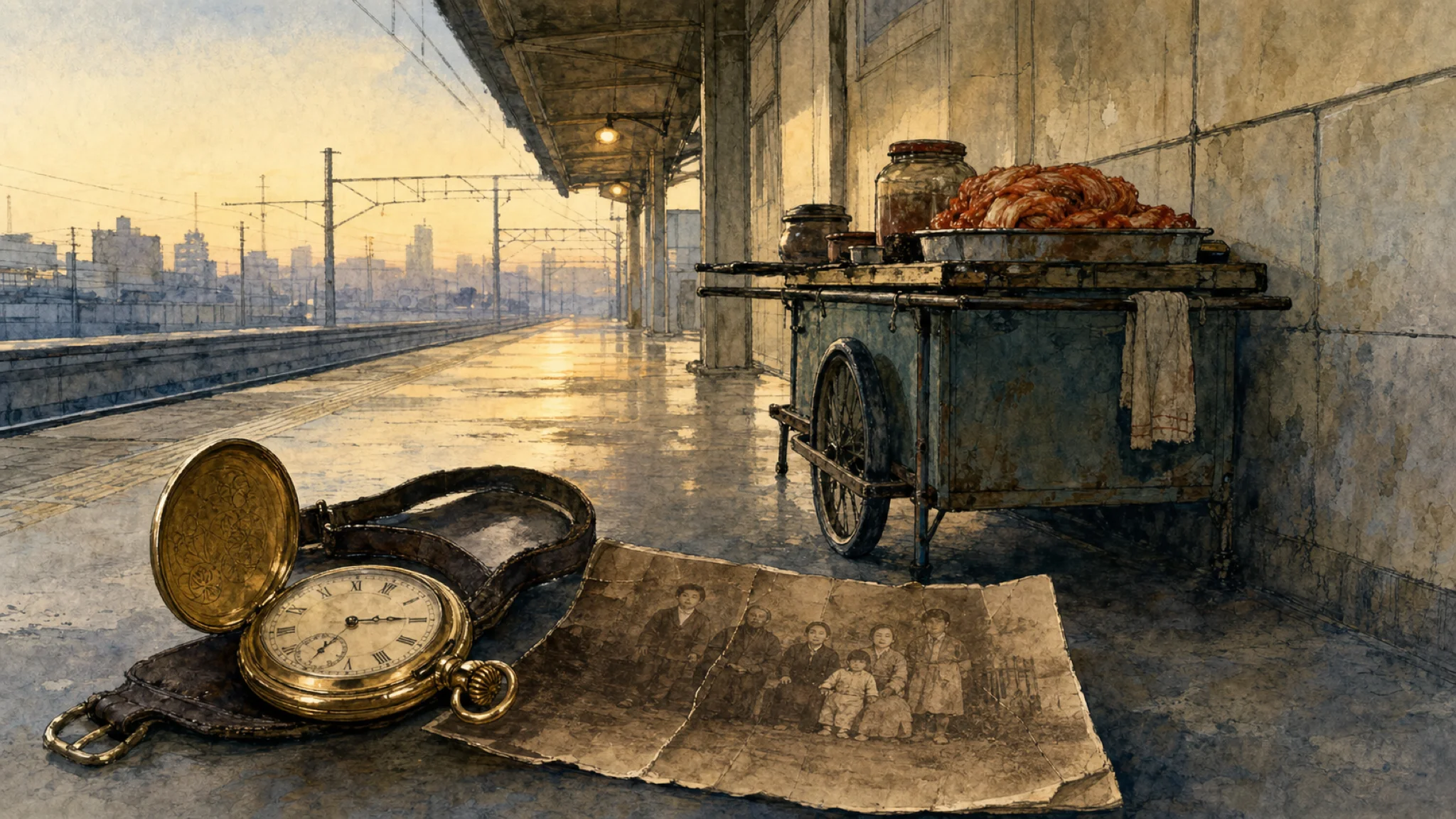
Sunja’s kimchi cart and a market that does not want her
The episode’s last fictional movement — before the documentary — gives the season its title image. With Yoseb fired and Isak gone, Sunja takes the household’s remaining cabbage and goes to the Osaka market with a wooden cart. She is shouted out of three rows. A vendor tells her son to urinate on her cart. She finds, finally, a sliver of pavement where an older Korean woman tells her, you can sell here.
The shouting that follows — kimchi, fresh kimchi, please try, best kimchi in Osaka — is shot like a passage of music. The market noise drops out, then floods back. Sunja’s voice cracks and steadies. This is my country’s food. It is the season’s quietest statement of what survival actually looks like in this story: a woman, alone, selling the only thing she has, in a language that is not hers, to people who would prefer she were not there. The doljabi flashback that opened the episode — Mozasu’s first birthday, Isak’s prayer, the red yarn for a long life — now reads as the last warm moment any of them will share for years.
The watch surfaces one more time. Sunja gives it to Mozasu, fully grown, and tells him: I used to think that this watch was a curse on us all. But now I realize, this watch saved our family. It is Hansu’s watch, traded for the household’s first meals after Isak’s arrest. The show has been building toward this reframe all season — that the price of survival is the inheritance, and the inheritance is the price. Mozasu, who has spent the season’s modern scenes being unsentimental about pachinko and unsentimental about Yoshii, takes the watch without comment. Soji Arai gives the scene exactly the weight it needs and not a gram more.
What this episode argues
Pachinko has been a show about what gets passed down when nothing else can be. The finale’s argument is that what gets passed down is not blood, not the watch, not the language — it is the daily, granular refusal to disappear. Sunja’s cart, Yoseb’s lead at the tire factory, Kyunghee humming over Mozasu, Isak’s last request that Noa look after his mother — these are the same act, repeated in different rooms, across seventy years.
The documentary epilogue states the show’s argument plainly. Eight women — Im Yong-Gil, Chu Nam Sun, Kang Bun-Do, Ryu Chuk Nam, and four others — sit in their own homes and tell the camera what it was like to cross over at eleven, at thirteen, at twenty. I cried and cried. I cried a lot. Nothing you owned actually belonged to you. So we all ate kimchi. This is my hometown now. I can’t go to my country. It’s all a dream. This one’s a dream. That one’s a dream. They’re all dreams now. Ryu Chuk Nam, asked what she remembers most, says: this was the best time of my life. Because everyone was close by. The fiction the show has been telling is no longer fiction in the credits. It is a researched approximation of these specific women, sitting in their own kitchens, saying their own names.
Apple spent prestige-drama money — eight episodes at film-quality budgets, three languages, a Korean-American director of photography credit, Kogonada and Justin Chon trading directing chairs — and ended the season with documentary footage that no algorithm would have suggested. The show treats the dramatization as a debt it owes to the haraboji generation and then pays the debt by name, on camera, before the credits roll.
Verdict
The eighth hour is the season’s best, which is a hard thing for a finale to pull off when the previous episode (Isak’s wedding-to-prison arc, Hansu’s earthquake reveal) was already operating at this register. Youn Yuh-jung’s older Sunja gets less screen time than usual and still carries the watch scene with one line. Minha Kim’s young Sunja closes the season with the market and the platform — two of the year’s strongest performances by any actor in any show. Solomon finally gets a scene that isn’t asking Jin Ha to be both subject and audience surrogate at once. Lee Min-ho’s Hansu is held back for season two, which is the right instinct.
The documentary postscript will be the thing people argue about. Some viewers will call it heavy-handed. The argument is small and answers itself: a show that has just spent eight episodes asking what immigrant grandmothers’ lives were worth then turns to eight real immigrant grandmothers and asks them. The risk lands because the women are not props. They are funny, contradictory, tired, proud, still flirting with the historian asking the questions. Do you think someone will take me as his bride? one of them asks, smiling at the lens. The line is in the show’s final ten minutes. It belongs there.
Pachinko has emerged as one of the most assured first seasons Apple TV+ has produced, and the finale is the strongest argument for why a streamer should let a writers’ room and a director swing this hard at material this large. The closing minutes are unlike anything else on prestige TV in 2022. They are also exactly the right ending for this story.
Rating: 9.4/10
More episodes from Pachinko — Sunja's family across four generations and three countries. Jump to any episode in the season:
Where to go next
Reviewed by Mira Vance · QuizFandom Editor & Lead Reviewer. Every rating is an honest per-watch assessment from the desk that also writes the quizzes — not a press release rehash.