Pachinko S1E6 Review: A son is named, a self is split in two
A shoplifting in Osaka, a deathbed in Tokyo, a labor in Yeongdo — Kogonada threads three timelines into one verdict on inheritance.
The episode opens with a teenage Solomon in a convenience store, watching a girl named Hana run her hand along a wrapped onigiri. She says the rice is hard. He says don’t touch what you aren’t buying. She says: it’s wrapped, it’s meant to be touched. From that line forward, the hour keeps asking whether a thing — a body, a name, a future — can be handled without being claimed. Three timelines run in parallel: 1989 Tokyo, where Hana is dying of AIDS in a Japanese hospital that doesn’t want her; 1931 Osaka, where Sunja goes into a labor that nearly kills her; and 1989 again, where Solomon weighs a yakuza-adjacent pitch from Mamoru Yoshii. By the closing credits, a baby has a name. Everything else is in pieces.
The convenience store and the call
The shoplifting sequence is the episode’s coldest piece of staging. Hana dares Solomon to steal candy to prove she means more than the girls at school who mock her. He does it, gets caught, and the store owner — Mr. Nagano, who has been friendly with the family for years — flips on him without a beat. “Another Korean, these troublemakers,” he tells the police. The voices around Solomon start to echo. The cop says this is how it starts. The phone rings. The cop’s tone changes mid-sentence. “Looks like you have a powerful friend in this world.” Solomon walks free, and his father drives him home in silence, then announces he is sending him to America. The Let’s Live For Today needle drop carries the car ride, the song speeding up and slowing down like the boy’s pulse.
What Kogonada and the writers refuse to spell out — but stage with absolute clarity — is who made the call. The cop’s deference, the abruptness of the release, the father’s resignation: someone with a long reach has just touched the boy’s life. Hansu’s name is never spoken. It does not need to be. The episode trusts us to carry that knowledge into the scene where Solomon, decades later, sits across from a yakuza heir and listens to a pitch about pachinko parlors in Korea, Thailand, Macau, Vegas. The same hand that saved him as a boy has been shaping his runway the whole time.
A hospital that won’t keep her
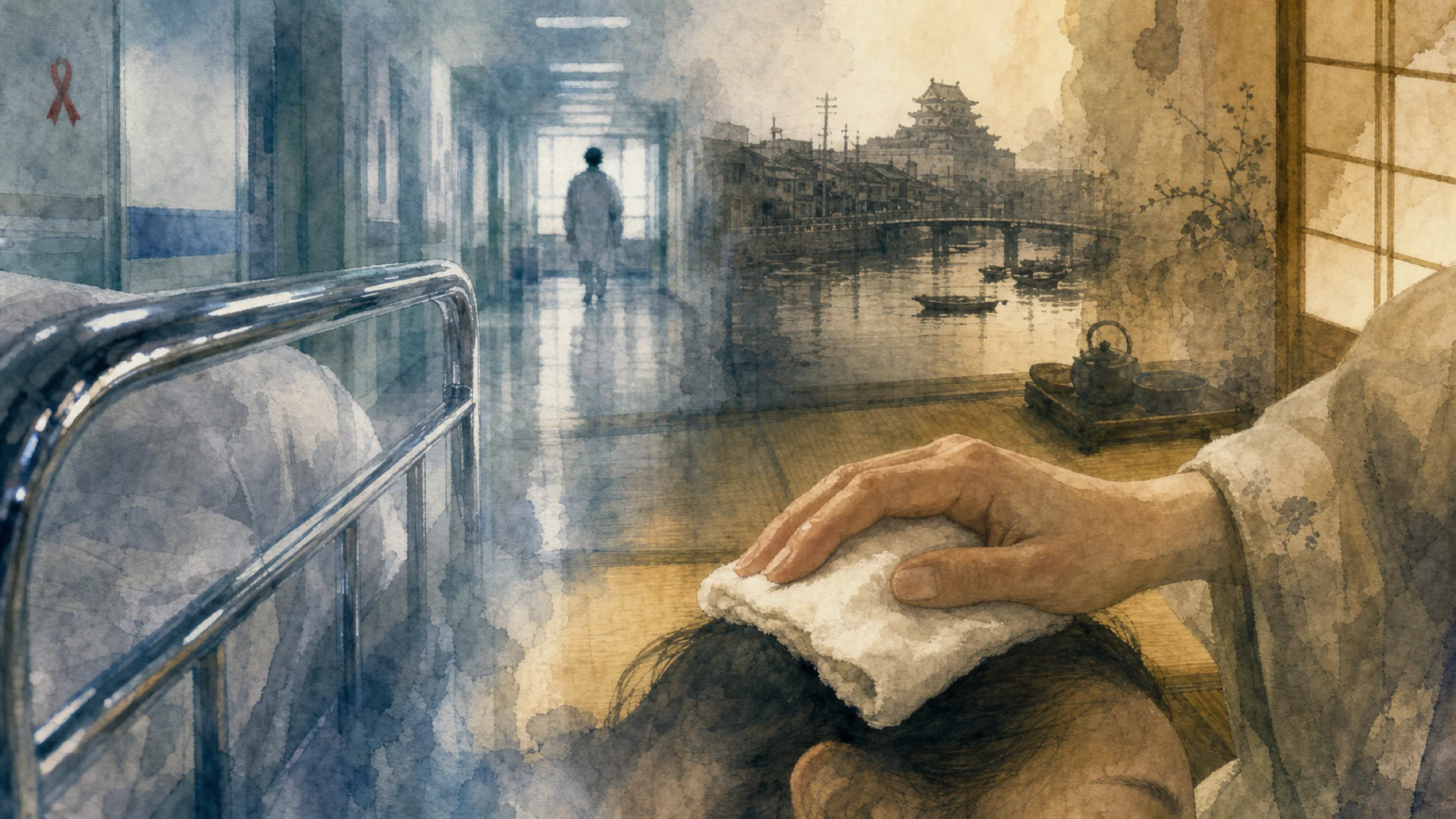
In 1989, Sunja and Etsuko bring Hana to a Tokyo hospital, and the director — polite, apologetic, immovable — tells them there is nothing to be done. He uses the word AIDS the way someone might handle a live wire. He recommends a family doctor. He cannot ask his staff to care for her. A younger doctor in the room volunteers — “I will do it” — and offers a separate wing. Etsuko thanks him. The director thanks the younger doctor for speaking up, which is one of the more quietly damning lines in the season: gratitude as cover for cowardice.
The scene refuses melodrama. The older Sunja sits perfectly still, hands folded, as the director estimates her granddaughter-by-affection might have months, weeks, or days. Later, alone with Hana, Solomon proposes flying her to America, where his college friend’s father is a famous surgeon. Hana laughs. “It is what it is.” She tells him he never could see things as they are. Hana, working from a hospital bed for most of the hour, has a voice emptied of fight without being emptied of memory. She asks if she looks hideous. Solomon says nothing has changed. She knows better. She uses the word she’s been holding all season: gone. “The Hana you knew is gone.”
A pastor finds his outline
In 1931 Osaka, Isak is asked by a neighbor to talk sense into her son — an eldest who’s drifting toward something more dangerous than the dock gangs. The conversation that follows is the episode’s center of gravity. The young man takes Isak to a subway construction site and shows him the work: Koreans breaking their backs to lay track for trains that will carry more Korean workers in to break their backs. He talks about the humiliation that drives men to drink, to fight each other, to beat their wives — because at home, at least, there is someone lower. He says it’s time to break the rules apart. Isak warns that it isn’t only his family who will feel the hammer blow.
Then Isak says something the season will keep returning to. If he were to let his fears take control of him now, he wouldn’t recognize his own outline anymore. And without a body, can he call himself a man? The young man walks away. Tell my mother, he says, that she has a son who is grateful for her love. He goes off-page. He will be a name on a list of the arrested, the disappeared, the unmade. Isak does not stop him.
It’s the question the episode keeps coming back to in different mouths. Solomon tells Yoshii he doesn’t need to walk in his family’s shadow anymore. Hana tells Solomon they’ll never be one of them no matter how nice the clothes get. Sunja tells him she once turned down unspeakable riches because she couldn’t live a life split in half. The outline of a body. The wholeness of a life. The episode argues these are the same thing, and that empire — Japanese empire here, American capital later — is the thing that splits them.
The bar, the raid, the brother
Yoseb is the messy heart of the Osaka thread. He comes home to find that his wife Kyunghee and his sister-in-law Sunja have paid off his debt to a moneylender, and he reads it as castration: his nuts are shriveled, the whole neighborhood knows. He storms out, ends up drunk at a bar near the streetcar stop, performing his old noble lineage to men who turn out to also be noble, because everyone in this room used to be something. Isak finds him there. The reconciliation is interrupted by the Special Higher Police, who burst in for a routine inspection, paw through a customer’s bag, find pamphlets in a coat, and march the man out. The bar goes silent. The two brothers walk home, and a different conversation opens up.
Yoseb thinks Isak takes pity too easily. He thinks Sunja is the burden. Isak tells him to stop. He says he should have died this year, but instead he’s here, and they have Sunja to thank. He says Yoseb has no idea what she’s done or what she’s capable of. The men of this family keep underestimating its women, and the women keep saving them anyway.
What Hansu did, and what Yangjin did not
Late in the hour, in the Tokyo hotel room where Sunja has set up a portable gas stove because she didn’t know how long they would stay, the older Sunja tells her grandson about the choice she turned down before the war. She doesn’t name Hansu. She doesn’t have to. She says she was offered unspeakable riches and refused, because she could not live a life split in half. The line lands twice: once as a moral, once as an indictment. Solomon, fired from the bank, completely ruined, has just been pitched a split life by a man whose grandfather saved him at fourteen.
Meanwhile, in the hospital room, the older Sunja and Hana share a scene that recalibrates the whole earlier hostility. Hana accuses Sunja of telling her, years ago, to run away. She quotes Sunja saying it was good Solomon had gotten away from them — that if he stayed, they would only ruin him. Hana has carried this as proof that Sunja meant her, that the grandmother was condemning the wayward girl. Sunja says no. She was talking about herself. Once, she says, she had another son. He was good as well. But because she ruined his life, he is gone now. The episode hands us the name twenty minutes later, in a different room, in a different decade: Noa. The good son. The lost one. Whatever happens to Mozasu, whatever happens to Solomon, the line of grief in this family goes back to a boy whose father — by money, by reach, by absence — has already begun shaping him before he’s been born.
What this episode argues
The argument here is about names: who gives them, who carries them, who can afford to keep them whole. Hana renames Solomon’s life when she dares him into the candy aisle. Hansu — unnamed, off-screen — renames Solomon’s future with a single phone call to a Japanese cop. Isak names the baby Noa, the man who opened a new world and believed wholeheartedly when no one else did, even as he understands he is naming a child whose biological father he does not yet know about. Yoshii offers Solomon a new name, too: partner in a global pachinko operation, with the family pedigree laundered through Yale and Stanford Law. Each act of naming is also an act of inheritance, and Pachinko is brutally clear that inheritance in this family is never clean — it comes through money you can’t account for, fathers you didn’t choose, and women who carried more than they were ever given credit for.
What ties the timelines is Yangjin in absence and Sunja in presence: the labor scenes in Yeongdo, the older woman’s measured grace in Tokyo, the line that gets repeated across decades — that something matters more than success, which is how you came by it. Solomon, suit off, says he’s trying. The episode lets that be enough, for now. It also lets us see Hansu sneering at his Japanese wife Chiyo in a Kansai sitting room — “where you failed, another woman has succeeded” — and we understand the kind of man who pays the cop, who buys the runway, who waits.
Verdict
This is the season’s most assured hour to date, and the one that retroactively makes the structure click. The triple braid — 1931 Osaka, 1989 Tokyo hospital, 1989 Tokyo hotel — is held together by a single moral question (can a life be split in half and still be a life?) and by Kogonada’s patience with silence. Sunja does extraordinary work in the labor sequence: exhausted, half-conscious, recognizing her own mother and father in her newborn son’s face before she can recognize the son himself. The older Sunja gets two of the season’s quietest devastations — the hospital director scene and the Hana-confession scene — and plays both without ever raising her voice. Solomon lets his American polish crack just enough that you can see the boy who shoplifted candy still inside it.
If there’s a flag to raise, it’s that the Yoshii sit-down leans a little hard on exposition — the Choate/Yale/UCLA/Stanford ticker tape is more script than scene — and Yoseb’s bar collapse, while well-played, treads a track Pachinko has used before. Neither dulls what surrounds them. By the time Isak says the name Noa and Sunja cradles her baby, we have earned the full weight: a family naming the future and not knowing yet what they’ve signed.
Rating: 9.0/10
More episodes from Pachinko — Sunja's family across four generations and three countries. Jump to any episode in the season:
Where to go next
Reviewed by Mira Vance · QuizFandom Editor & Lead Reviewer. Every rating is an honest per-watch assessment from the desk that also writes the quizzes — not a press release rehash.