Pachinko S1E5 Review: Osaka arrives, and so does the long ache
Sunja crosses into Ikaino, an old watch becomes a debt, and Solomon learns the shape of the thing that will haunt him.
Kogonada’s series has always understood that emigration is not a single act but a slow accrual of small, irreversible ones. Episode five lets that accrual breathe. Sunja arrives in Osaka with Isak, into a brother’s house that does not entirely want her, into a neighborhood that smells of pigs and panic, and into a marriage whose tenderness must somehow learn to coexist with a debt collected in yen. A continent away in time, Solomon walks through a Tokyo engagement party and a Yoshiwara alley and a stranger’s improvised family, and finds himself, almost despite himself, in the same emotional latitude as his grandmother. The episode lets these two journeys rhyme without forcing them.
A welcome that is not quite a welcome
Yoseb meets Sunja and Isak at the station with a laugh and a teasing line about stolen inches, and within the same scene he is already glancing at her belly. Kogonada is careful about who looks at whom. Yoseb’s affection for his brother is unmistakable; his appraisal of Sunja is also unmistakable. The streetcar ride into the city is Pachinko at its most quietly devastating — Isak gawking at a subway under construction, Kyunghee’s husband switching to Japanese mid-sentence because “Better to speak Japanese in public,” Sunja silently pressing her hand to a market stall of abalones that cost more than her family back in Yeongdo could imagine. She tells Isak she used to dive for bigger ones at seven. The line lands without italics. Kogonada trusts the gap between the price tag and the memory to do the work.
Then Ikaino. Yoseb’s warning is not melodramatic, which is what makes it land: spies in the church, break-ins the police ignore, neighbors driving pigs through the lane. “We’re still the fortunate ones,” he says, and that statement sits in the dirt where it was spoken. Kyunghee greets Sunja with a kindness so practiced it almost reads as professional — a meal laid out, a seat pulled, the words “Today, you just eat.” It is the first generous thing said to Sunja in the new country, and Sunja plays it the only way it can be played: she sits down, and she weeps.
What an old watch is for
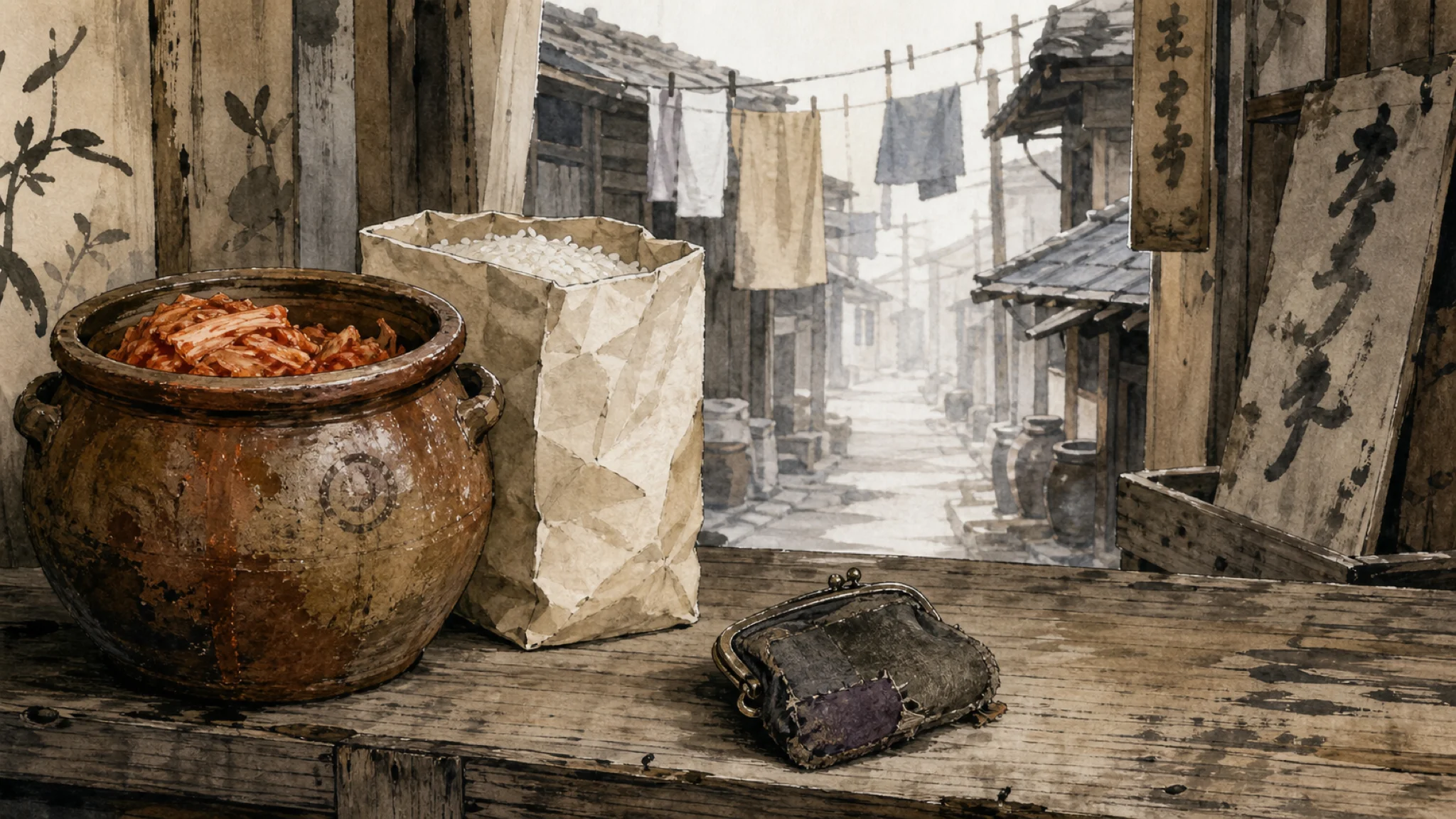
The debt collectors who appear at Kyunghee’s door are the episode’s pivot. 160 yen, doubled by interest, owed against Yoseb’s seal — money he borrowed to bring his brother and brother’s wife across the strait. The boat fare was an act of love that became an act of usury the moment it cleared the lender’s hand. Sunja’s reaction is the most quietly radical thing in the hour. She does not defer to her sister-in-law. She does not wait for Yoseb. She produces the gold pocket watch her mother gave her, and walks it into a pawnshop.
The watch is the hour’s hinge, and the writers know exactly what it carries. It was Hansu’s gift to Yangjin, passed to Sunja against the possibility of a moment like this one. The pawnbroker offers 40, then 50, then 225. Sunja says 300. He pays 300. The pawnbroker is then, in the final minute, revealed to be Hansu’s man — “Get me the promissory note,” Hansu says, and the watch comes home to the man who first gave it. “She married a dreamer,” Hansu tells the pawnbroker. “A man weaker than her. And for that, she’ll pay dearly.” It is a cruel line, and it is correct. Pachinko refuses to let Hansu be a villain in the operatic sense; he is something more difficult, which is a man who knows the future and arranges to be standing in it.
Two women, scared together
Before the watch is sold, Sunja and Kyunghee have the scene that justifies the whole episode. Kyunghee has scrubbed the smell of Yeongdo out of Sunja’s clothes — the only thing she had left of her mother — and Sunja sobs at the laundry line. “When does it go away? This ache, when does it finally stop?” Kyunghee, who has been here long enough to know, gives her the answer the show has been waiting to give since the pilot: “It doesn’t. But eventually, you will learn to endure it.”
Later, when Sunja insists on taking the money to the docks herself, Kyunghee tries to stop her — “this kind of dirty work belongs to men, not us” — and then, ashamed, confesses that she came to Japan never having cooked or washed or handled her own money, and that she has been scared every day since. “Let’s be scared together,” Sunja says. “Perhaps we can find some strength in it.” This is the engine of the season, named out loud. Two women who arrived in this country with no instrument but each other will become each other’s instrument.
Solomon in three Tokyos
The 1989 strand braids around this. Solomon arrives at a friend’s engagement party and learns, in one conversation, that he is being blackballed from every Tokyo bank by Mr. Abe, that Tom Andrews is rumored to be a man atoning for financial irregularities and unlikely to defend him, and that Hana — the girl who has been “stuck in my heart” since he was 14 — can probably be found in the Yoshiwara red-light district by the Uguisudani stop. Solomon plays the moment with the smallest, most expensive smile. He does not flinch in front of his classmate. He files the information.
Naomi finds him outside the conference room of his own undoing. She admits she saw him dancing in the plaza that day, and that she heard, through office walls, the call from Hana. She gives him the assessment no one else will: “It wouldn’t affect you so much if something wasn’t still there.” She also gives him the diagnosis no one else will give the woman who refused to sell — “Do you think that was her plan all along? To humiliate you.” Solomon does not answer. Naomi plays as someone who has already paid the cost Solomon is just discovering exists, and the scene closes with her line about being born a woman in this country: “Being married to a job that doesn’t even want you, is that what you call winning?” It is the question Sunja’s storyline is answering in 1931, sixty years before Naomi will think to ask it.
The third Tokyo is the one Solomon does not expect. He hands a flyer of Hana to a man at a tobacco stall and is recognized by Haruki, the police officer who was his father’s closest friend, who disappeared from their lives years ago. Haruki takes him home — to a small apartment, a trans neighbor named Masako who flirts gently with the handsome stranger, a man named Satoru, a found family — and tells him, “I may not have much here, but I can be myself.” Solomon brings the message that his father mourned him, that his wife and brother mourned him, and Haruki accepts the gift the way it is given. Then he passes Solomon a bowl of food and says, “Just eat your fill.” It is the same line Kyunghee said to Sunja in 1931, and Pachinko does not underline it.
Bokhee, and the laundry rocks
The Osaka 1989 thread runs in parallel: the older Sunja and Mozasu trying to find her father’s grave under a parking lot. A clerk processes Sunja with the small bureaucratic violence the country has practiced for decades — “Ah. You’re one of those, huh?” — and then, almost by accident, surfaces a relocation note bearing the name Shin Bokhee. The reunion at Bokhee’s door is the episode’s most extravagant gesture, and the show earns it because it knows what to do next, which is to sit at a kitchen table.
Bokhee tells the story of Donghee — the factory work in Manchuria that was not factory work, the return after the war, the laundry rocks where Bokhee found her sister. “Some people live in their dreams. They are simply not made to endure in such times.” Sunja hears this and registers what she has long suspected: she was the lucky one because she was the one who left. Mozasu, in the only line he gets in the scene, says, “It’s not shameful to survive, Mom.” He plays it gently, like a son who has been waiting years for the right moment to say it.
What this episode argues
That endurance is not a posture but a practice, and that women are mostly the ones who learn it. Kyunghee teaches Sunja the syllabus in a Osaka courtyard; Bokhee writes the curriculum in a Yeongdo kitchen; Naomi, sixty years downstream, is still being graded against it. The men — Isak with his “reservoir of courage” speech, Yoseb with his borrowed boat fare, Solomon with his charm in three languages, Haruki with his small apartment — are all trying to find a stance from which to bear it.
The episode also argues that the most important transactions in this story are not financial but they will be measured in money anyway. Yangjin’s watch, given by Hansu, returned to Hansu through Sunja’s hand, pays a debt Yoseb took on out of love and humiliated him into. The gift was never neutral. Nothing about Hansu ever is.
Verdict
Here is where Pachinko stops being a prologue and becomes a novel. The Osaka arrival sequence — station, streetcar, market, Ikaino — is one of the most controlled pieces of immigrant storytelling on television in years, and the Kyunghee-Sunja confession at the laundry line will be the scene this season is remembered for. Solomon’s thread is finally beginning to earn its parallel to the past, helped enormously by Naomi, who plays the role like someone who has already lost the argument the season is asking her to keep having. The Hansu sting in the final minutes is the only moment the hour lets melodrama in, and even there it is rationed.
Minor reservations. The engagement-party exposition does a lot of plot work in a short span — Abe’s blackball, Tom’s irregularities, Hana’s whereabouts — and you can feel the gears. And the parking-lot grave material, while quietly devastating, leans on a clerk-as-mouthpiece beat the show has used before.
These are small notes against an hour that does the very hard thing of letting two timelines speak to each other without either one shouting.
Rating: 9.0/10
More episodes from Pachinko — Sunja's family across four generations and three countries. Jump to any episode in the season:
Where to go next
Reviewed by Mira Vance · QuizFandom Editor & Lead Reviewer. Every rating is an honest per-watch assessment from the desk that also writes the quizzes — not a press release rehash.