Tom Clancy's Jack Ryan S2E2 Review: The Witness Makes Jack's Certainty More Dangerous Than Proof
Tertia Optio gives Jack a suspect, a partner, and a warning that evidence can be used as bait.
The second hour of Tom Clancy’s Jack Ryan Season 2 begins with Jack Ryan refusing the clean exit Washington has arranged for him. Senator Moreno is dead, Caracas is closing ranks, and Jack is no longer treating the Venezuela investigation as an analyst’s assignment. “Tertia Optio” widens the season’s arc by making Reyes look guilty while carefully showing that guilt is not the same as control. Jack has grief, Greer has a larger theory, and Harry has an agenda he cannot yet read.
Ramos makes the assassination a live problem
The embassy scenes give the episode its first strong pulse because they do not let Moreno’s murder sit as a simple inciting tragedy. Filiberto Jose Luiz Ramos, the National Police captain who led the convoy security detail, arrives desperate and asking for asylum after his wife and children have been murdered. His story is the testimony of a compromised man who took money to send the senator’s convoy toward a different exit, then learned too late that a small act of corruption had placed him inside an assassination.
That confession works because Jack reacts with grief before procedure can tidy the room. Ramos describes a blond, blue-eyed European who spoke good Spanish with an accent, knew Ramos was police, and paid him three thousand dollars to change the route. Jack calls him out because Ramos’s excuse about a sick mother cannot compete with Moreno’s body. Still, the important detail is the absence of Reyes and Ubarri from Ramos’s account. The witness makes the conspiracy more real while also making Jack’s preferred answer less complete.
James Greer catches that gap faster than Jack wants to. Outside the room, Jack says Reyes did it, and Greer does not dismiss him so much as widen the frame. Greer ties the assassination back to the Almeta, the rocket launch in the South China Sea, and whatever military shipment first brought them to Venezuela. The line that matters is his insistence that something bigger is happening, bigger than Reyes. “Tertia Optio” puts Jack and Greer back together by making their partnership tactical rather than sentimental: Jack wants the man who killed his friend, Greer wants the structure that needed Moreno dead.
The hour is also smart about the new American presence in Caracas. Mike November becomes more than a harried chief of station because his caution has a jurisdictional logic. He has Ramos inside an embassy, a grieving analyst refusing to leave, a Venezuelan regime looking for scapegoats, and a foreign agent circling Jack. When Jack brings him a tape acquired through Harry, Mike’s anger is the sound of a station chief realizing one of his people has made a private arrangement with another service before anyone knows the price.
Harry gives Jack leverage with a hook in it
Harriet Baumann enters this episode as a problem wrapped in competence, and the ship sequence is the sharpest expression of that. Jack follows the Cinco Palmas lead and runs into Jost, a dockside enforcer who sees through the coffee-shipment cover story. Harry appears at the exact moment Jack needs extraction, performs the role of irritated colleague, then proves in the fight that her earlier barroom ambiguity was not charm alone. She knows how to move, how to lie, and how to make Jack feel late to a room he thought he had entered first.
Her first explanation is half-confession and half-test. She calls herself Lee Klein, says she is former KSK, and claims to be a private investigator looking for a missing German businessman whose last cable came from Cinco Palmas. Her phrase for his line of work, selling toys to naughty children, makes arms dealing sound almost childish while keeping the consequences visible. Harry says Reyes has him. She also knows Jack should have been on a plane and is still in Caracas because he thinks Reyes killed Moreno. Her proposed bargain is simple: when Jack gets Reyes, Harry gets her businessman.
That bargain gives Jack his first move, but it also exposes his weakness this hour. The recording Harry supplies catches Miguel Ubarri inside his own home with enough political intimacy to wound Reyes from inside his own circle. The tape has Ubarri saying Gloria Bonalde has a real chance, that Reyes is blind to what he does not want to see, and that Ubarri should be the one leading the country. Jack hears proof that Reyes was afraid and therefore dangerous. Mike hears the larger operational problem: Jack has trusted a foreign spy, traded intelligence, and assumed alliance means alignment. Greer’s answer, that BND cannot lean on people the way CIA can, converts the tape into leverage.
The resulting pressure play on Mateo Bastos is one of the episode’s sharper procedural passages. Jack, Greer, and Mike do not confront Ubarri directly. They drag Reyes’s head of security into a garage after staging car trouble, photograph him with Americans from the CIA, play enough of the recording to poison his certainty, and let him go. Greer’s line about planting the seed of doubt gives the scene its thesis. The goal is not information yet. The goal is contamination. If Bastos tells Ubarri the Americans have bugged his home, suspicion enters Reyes’s inner circle on American terms.
That is where the episode’s title begins to feel pointed. “Tertia optio” means third option, and the hour keeps looking for paths that are neither open accusation nor formal diplomacy. Harry needs the CIA but cannot ask cleanly because CIA rules could get Max killed. Jack needs Harry’s tape without surrendering the exchange. Mike needs leverage but cannot be seen manufacturing it. The spycraft is less glamorous than invasive: bug a home, stage a breakdown, take a photo, feed paranoia, then wait for frightened men to make worse choices.
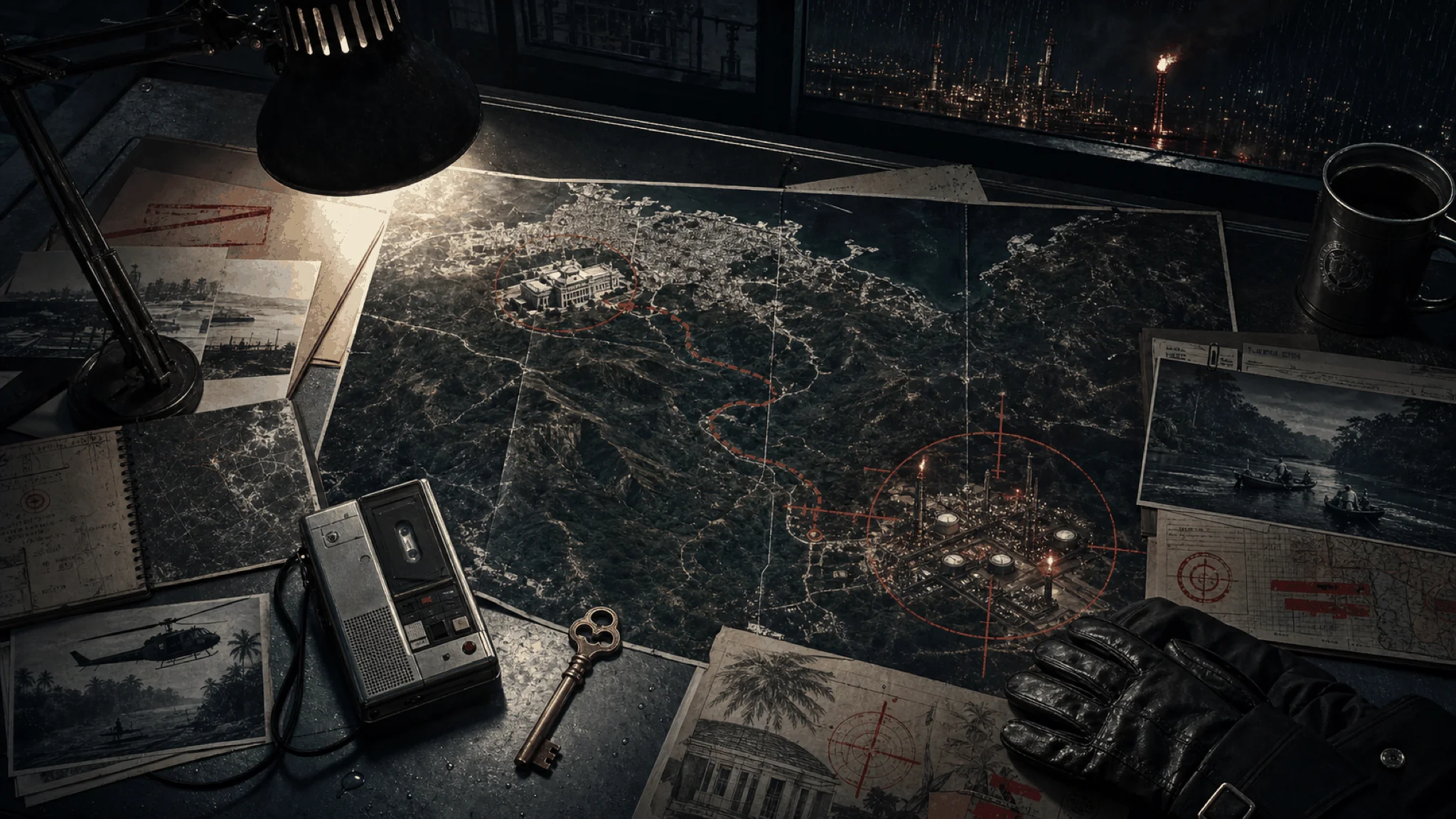
Reyes performs innocence while Max closes the circle
President Reyes is most effective here when he is not raging. The quinceanera preparations place him amid tablecloths, ceremony, and family presentation while state violence keeps pushing through the walls. Ubarri asks why he did not know about Moreno, and Reyes answers with the wounded vanity of a man who understands blame as something unfairly done to him. When Ubarri reveals that Ramos has turned himself in at the U.S. Embassy, the scene changes temperature. Reyes’s calm is calculation with music playing nearby.
The later meeting at the palace is a public performance built from the same instinct. Reyes offers condolences for Moreno, announces that a radical group called Fuerzas Armadas de Liberacion has been blamed, and claims uniforms and explosives were found in a raid. Four suspects are dead, two have confessed, and everyone in the room is meant to accept the story because a head of state has delivered it with ceremony. Jack does not. He tells Reyes that he knows he killed Jimmy, and Reyes answers with condolences again. The exchange is blunt, but it fits Jack’s state of mind. He has evidence, grief, and no patience for plausible denial.
The episode then punishes that impatience by moving faster than Jack can prove anything. Jack sees Bastos’s injured left arm and connects it to Ramos’s detail that the killer who came for his family was bitten by his dog. The deduction is good. It is also late. When Mike goes to show Ramos a photograph, the cell discovery and the shouted call for a doctor make identification impossible. That sequence is a useful correction to the more satisfying spy beats before it. Jack can notice the right thing and still lose the witness. Intelligence can arrive after the door has closed.
The palace party chase gives the hour its action climax, but its real function is connective tissue. Max Schenkel is no longer an offscreen German problem or Harry’s missing asset. He is the man with Moreno’s murder on him, the man Jack fights through corridors and crowd noise while Reyes’s daughter is being celebrated. The cutting between ceremony and pursuit is obvious but effective: a young woman’s public rite of passage above, covert violence below and behind it. Jack survives the fight, Greer finds him shaken, and Max escapes.
The final Jack-Harry scene is stronger than the chase because it strips away the pleasure of tradecraft. Jack brings Harry the photograph and asks whether the man is Max. Harry’s face answers before her words do. She admits Max recruited her into KSK after they met at boarding school, protected her after an operation in Afghanistan went wrong, and later left the official world for something worse. Jack presses until the implication becomes plain: Max kills people for money, Moreno’s murder carried his signature, and Harry knew more than she told Jack. Her silence placed Jack’s grief inside her operation.
What this episode argues
“Tertia Optio” argues that certainty is dangerous when every side is feeding it. Jack is right to suspect Reyes, but the episode keeps separating suspicion from proof and proof from usable power. Ramos gives him a European assassin, not a presidential order. Harry gives him a tape, not clean motive. Bastos gives him a physical clue, then the witness who could confirm it is gone. Reyes gives him a false solution, and Jack’s refusal to accept it still does not stop Max from escaping.
The politics are sharper when the hour lets Venezuela’s election story complicate the spy plot. Gloria Bonalde is a pressure point inside a regime scared of losing its narrative. Ubarri’s discomfort matters because it shows that Reyes’s circle is not made of equal believers. The American operation exploits that fracture, but the episode’s critical eye remains intact. Jack and Greer are not liberators sweeping in with pure purpose. They are intelligence officers using a rival government, a foreign service, and a dead man’s frightened witness to force movement inside a sovereign crisis already soaked in manipulation.
Verdict
“Tertia Optio” is a strong escalation episode because it gives Jack forward motion while making that motion feel compromised. The Ramos confession, the Harry reveal, the Bastos pressure play, and the palace confrontation all feed one another without collapsing into a single easy answer. Jack is sharpest when his intelligence and anger are working against each other, while Greer brings the older, colder patience the hour needs.
The episode is less graceful in the Marcus Bishop recruitment thread, which has texture and a strong sense of wounded military identity but still feels parked beside the Caracas material rather than fully joined to it. Even so, the hour lands because its central machinery is clear. Jack gets closer to Moreno’s killer, and that closeness makes the case less clean, not more.
Rating: 8.0/10
More episodes from Jack Ryan — Season 2 — The Venezuela arc — Jack chases a stolen nuclear-capable shipment. Jump to any episode in the season:
Where to go next
Reviewed by Mira Vance · QuizFandom Editor & Lead Reviewer. Every rating is an honest per-watch assessment from the desk that also writes the quizzes — not a press release rehash.