Tom Clancy's Jack Ryan S2E8 Review: Jack Lets Venezuela Judge Its Own Strongman in Public
The finale closes the Venezuela arc by measuring Jack's fury against proof, process, and a country refusing Reyes's script.
“Strongman” begins after the camp has been liberated, but Tom Clancy’s Jack Ryan is not interested in treating liberation as an ending. Jack Ryan has proof that President Nicolas Reyes is tied to the mining front, James Greer is still inside the palace system, and Venezuela’s election is being bent in real time by men who already know what result they want announced. The finale’s best tension comes from that overlap: an American operation racing toward personal rescue, while the Venezuelan public pushes toward a more legitimate reckoning. The hour is uneven as political drama, but its central idea is strong. Jack can expose Reyes, and he can survive Reyes, but he cannot be the person who decides Venezuela’s future with a gun in his hand.
The paper trail gives Jack proof, not permission
The episode’s early movement is built around paperwork, which is a smartly dry choice for a finale with helicopters waiting nearby. Mike November gets Jack out of the camp chaos with documents courtesy of Lisa Calabrese, then lays out the ownership chain with the weary pleasure of someone who knows bureaucracy has finally produced something useful. Vogler Industries is owned by Northlake Allied and Cinco Palmas. Cinco Palmas leads to Monica Herrera, then to Reyes. Northlake Allied leads toward Philadelphia, a law firm, and the phone number that had been calling Rupert Thorne before Jimmy Moreno’s murder.
That scene matters because it gives Jack exactly what he has been chasing since the season’s opening assassination, but it refuses to make proof feel emotionally satisfying. Mike says they have Reyes and should leave. Jack hears the same evidence and sees a missing person: Greer. The argument between them is not complicated, which helps it. Mike is thinking in mission boundaries, refugee extraction, State Department jurisdiction, and the election calendar. Jack is thinking in debt. Greer was taken because of the same operation they are now trying to close, and Jack cannot convert that into acceptable loss.
The show also folds Harriet Baumann back into the plot with admirable restraint. Jack calls her for Thorne’s phone, and Harriet tells him MI5 has it, then promises two days. The call is brief, almost too brief for a character who has had such a thorny season-long orbit around Jack, but its understatement works better than a sentimental goodbye would have. Harriet becomes part of the evidence chain rather than another emotional detour. Jack needs the phone because Max said there was someone else, and the finale trusts that detail to sit quietly until the Washington coda makes it decisive.
Reyes loses the story before Jack reaches him
Reyes’s regime spends much of “Strongman” trying to manufacture inevitability. On television, his representative praises record turnout as proof of Venezuelan democracy, then blames U.S. and CIA intrusion while predicting a landslide before the polls have closed. The scene is almost blunt, but the bluntness is useful. Reyes is not merely trying to steal votes; he is trying to steal the public’s sense that voting can matter. Gloria Bonalde sees that immediately. When she says Reyes wants people to stay home and believe their vote is meaningless, her response is not a speech. She goes to vote, and her son asks to come with her.
The polling-place sequence gives the episode its strongest civilian counterweight to Jack’s palace raid. Bonalde moves through the crowd with Carlos, while people gather around an election that still has time left on the clock. Then the footage of the secret prison camp breaks across the news, verified by U.S. State Department sources, and Reyes orders the polls shut down. The local announcement is pure authoritarian theater: the early votes have been calculated, Reyes’s lead is insurmountable, no more voting is necessary. It is a lie delivered as procedure.
The crowd’s response is the first point where the finale’s politics feel less like plot machinery and more like pressure from below. Soldiers push, people shout, gas hisses, and the precinct becomes a rehearsal for the palace gates. Bonalde and Carlos are not protected from the panic; they are inside it. That matters because the finale later gives Bonalde a victory without pretending the transfer from fear to legitimacy is tidy. When Valentina tells her that the National Electoral Council has announced the results were fixed and that Bonalde had over 70 percent of the vote when the polls were suspended, the scene does not need a grand policy answer. The crowd chanting “Bonalde” outside her door is enough to tell her that the country has moved before the institutions have caught up.
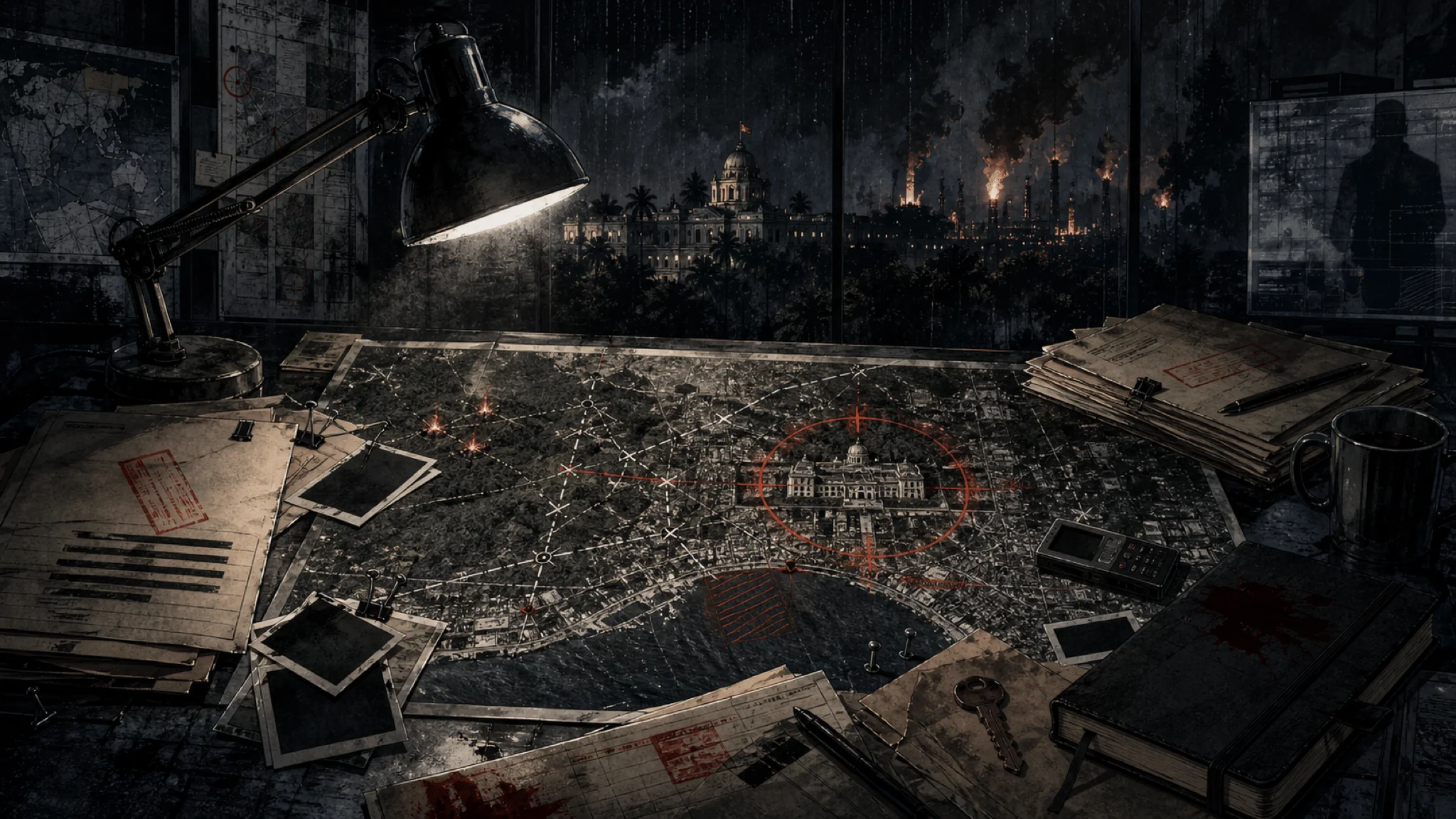
The palace raid tests Jack’s worst instinct
Greer’s captivity gives “Strongman” its most direct thriller engine. Reyes’s men have beaten him, and Reyes first reacts with anger at the guards because Greer is valuable, not because the abuse is wrong. “You are an American spy,” Reyes tells him, which is both accusation and opportunity. Greer is not treated as a person by the regime or as a fully recoverable asset by the chain of command outside it. He is leverage from every direction.
Mike’s decision to help Jack storm the palace plays as gallows loyalty rather than official heroism. He hands Jack floor plans, guesses Greer is on level one, and says Jack has already ruined his career. The line is funny, but it also keeps the operation morally messy. This is not a sanctioned rescue. Mike warns the team that they do not want to be inside when the crowd breaches the gates, and he tells Jack before entry that, however much Jack wants Reyes, they do not have the authority to take him out. That warning becomes the hour’s real fuse.
The rescue itself is efficient, sometimes too efficient, but it has useful texture. Greer fights from inside captivity before Jack reaches him. One of Mike’s men is hit, and Jack immediately clocks the wound as a clean exit, in and out, before ordering him to the roof. Greer, barely upright, greets Jack by calling him “fucked in the head,” and Jack answers with a joke about still having time to leave him behind. The banter works because Greer and Jack let exhaustion sit underneath it. They sound like men using irritation as a way to avoid naming fear.
The Bastos killing is the sequence’s rawest revenge beat. Greer shoots him and says, “That’s for Matice.” The moment is satisfying in the narrow way revenge beats are engineered to be, but the finale immediately complicates the appetite it has just fed. Jack disappears instead of going to the roof. Mike knows where he has gone. By the time Jack reaches Reyes, the crowd outside is already the louder verdict. Jack tells Reyes to listen to what his country thinks of him now, then loses the discipline to stop there.
The confrontation with Reyes is the episode’s clearest moral test. Reyes taunts Jack with sovereignty, daring him to assassinate a head of state and face the consequences. Mike tells Jack to let him go. Jack first says Reyes has to stand trial, then insists Reyes has to pay for what he did. The distinction is the whole scene. Trial belongs to law. Payment belongs to grief. Jack has spent the season hunting the men behind Moreno’s death, and here the show lets that grief become dangerous. Mike’s refusal to let him confuse justice with execution is the finale’s most important act of friendship.
What this episode argues
“Strongman” argues that righteous anger still needs jurisdiction. That is a sharper point than the season always knows how to handle, especially because the Venezuela arc often runs on broad regime-change thriller language. Still, the finale finds a useful correction. Reyes is exposed by documents, weakened by footage of the camp, rejected by voters, and finally overwhelmed by the country he tried to script into obedience. Jack’s job is to get evidence and get Greer. When he tries to become the instrument of Reyes’s punishment, Mike has to pull him back from turning the season’s critique of strongman politics into a different version of one-man authority.
Greer’s late conversation with Jack on the boat gives the argument a quieter afterlife. Greer talks about how he used to sit across from an asset and feel so tuned to the room that he could sense a heartbeat, a sweat response, a shift before it arrived. He says that is what it takes to be great in the field, then admits he cannot do it anymore. The speech is not framed as defeat so much as succession. When Greer explains why Jack took an office job after turning down Moscow, he identifies avoidance without cruelty: behind a desk, friends do not get killed, captured, or go down in helicopters. Greer is handing Jack the work, but he is also naming the cost Jack has been trying to manage by pretending analysis can stay clean.
The Chapin coda makes that handoff count. Back in Washington, Senator Mitchell Chapin first talks as though Venezuela is now a transition opportunity, asking for an introduction to Bonalde. Jack then walks him through Cinco Palmas, Vogler, Northlake Allied, Thorne’s Philadelphia calls, and the mistake Chapin made when Jack arranged travel to London. Chapin’s defense is chilling because it sounds like the language of strategic necessity. China controls most of the world’s tantalum. Venezuela had a deposit. Reyes was, in Chapin’s words, a valuable asset. Moreno’s murder becomes collateral inside a supply-chain argument. Jack’s “respectfully declining” is small, dry, and exactly right. The finale lets him choose evidence over mythology, and the FBI warrant gives his suspicion an institutional path.
Verdict
“Strongman” is a sturdy finale with a stronger final act than opening stretch. The palace assault has the expected Prime Video action snap, but the episode works best when it lets documents, vote counts, phone records, and public pressure do the work that Jack’s gun cannot. Jack is most convincing when he is angry enough to be wrong, and Greer’s exit from fieldwork carries the gravity of a man who knows competence is not the same as invulnerability.
The hour does flatten some of Venezuela’s politics into quick thriller shorthand, and Harriet’s role feels underfed after her season-long entanglement with Max and Jack. Even so, “Strongman” lands the arc’s central correction: exposing a corrupt leader is not the same as owning the aftermath. Jack gets his proof, saves Greer, refuses Chapin’s bargain, and leaves Reyes’s final judgment to the people Reyes tried to silence.
Rating: 8.1/10
More episodes from Jack Ryan — Season 2 — The Venezuela arc — Jack chases a stolen nuclear-capable shipment. Jump to any episode in the season:
Where to go next
Reviewed by Mira Vance · QuizFandom Editor & Lead Reviewer. Every rating is an honest per-watch assessment from the desk that also writes the quizzes — not a press release rehash.