Tom Clancy's Jack Ryan S2E5 Review: Blue Gold Puts a Price on Every Betrayal
A resource discovery reframes the Venezuela plot while Jack's hunt for Max crosses into colder moral territory with force.
“Blue Gold” is the episode where Tom Clancy’s Jack Ryan Season 2 stops treating Venezuela as a fog of corruption and starts naming the commodity underneath the violence. The murder of Senator Moreno, Sergio Bonalde’s disappearance, the jungle operation, and President Reyes’s tightening grip all begin to look less like separate abuses than parts of a resource war with diplomatic cover. Reyes barely needs to appear for the regime’s pressure to shape every room. Jack Ryan keeps chasing the assassin who can answer one question, but the writing is careful about what that chase costs. By the time Max Schenkel is dead and his daughter arrives to find the body, Jack has gained an answer and lost the clean story he wanted.
The mineral clue changes the scale
The title lands through James Greer, and “Blue Gold” is better for letting him carry the breakthrough rather than leaving every deduction to Jack. Greer brings Mike November the material he took from Sergio Bonalde’s home safe and identifies it as columbite tantalite, the ore used to extract tantalum. The explanation is bluntly procedural: circuit boards, GPS systems, jet engines, a worldwide manufacturing chain, and known sources mostly tied to China or the Congo. When Greer says the mineral is called “Blue Gold,” the phrase sounds less like a thriller flourish than a market diagnosis.
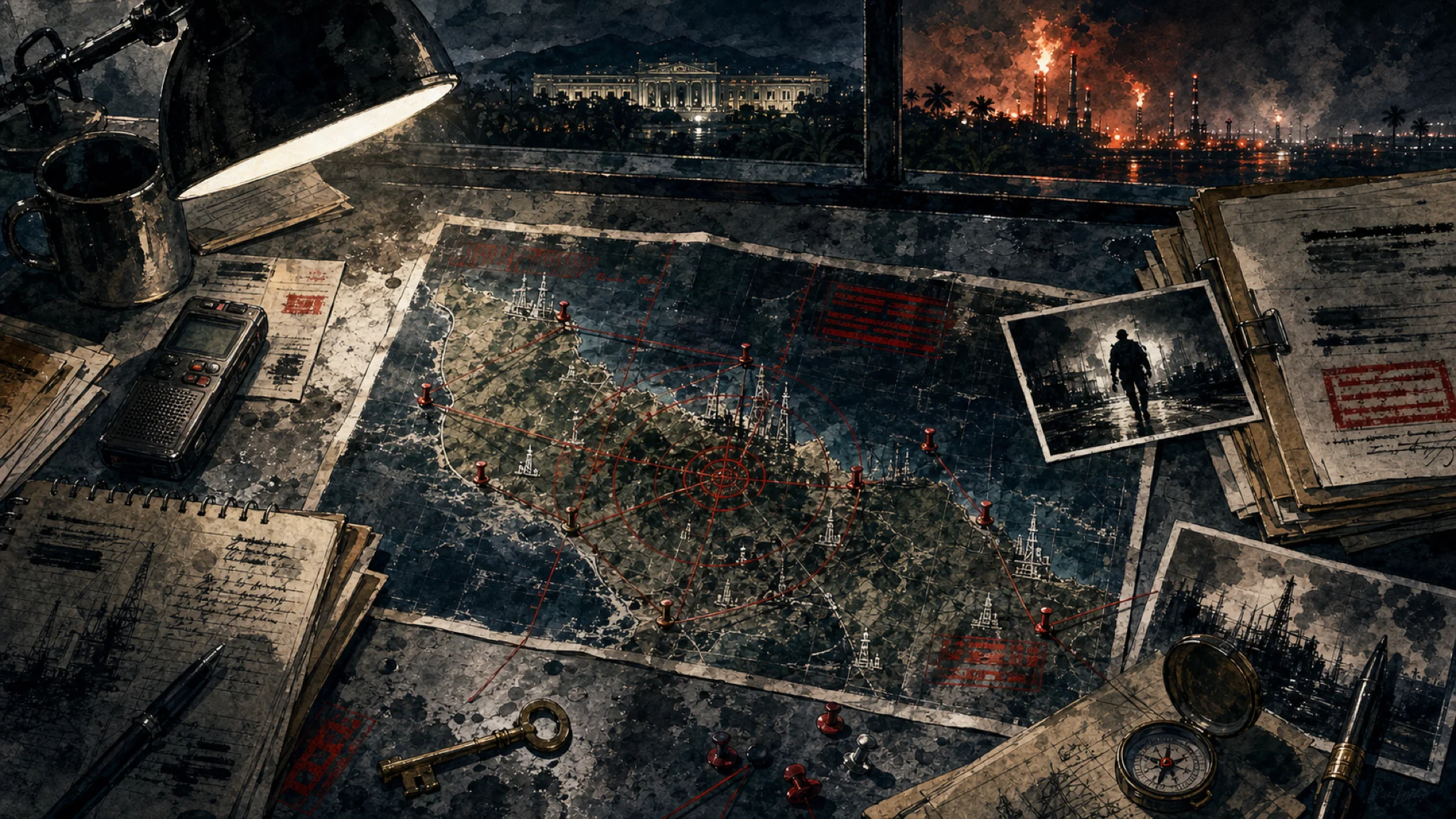
That scene sharpens the season’s politics without pretending the CIA has suddenly become pure. Greer connects the ore to Vogler, the company behind the satellite Jack traced to the South China Sea, and to flash lidar technology that can locate mineral deposits below the earth. The key number is not one shipment or one payoff, but trillions. If Venezuela holds a major deposit, then the Bonalde family, Reyes’s regime, and the dead American senator are all circling a discovery powerful enough to challenge China’s tantalum monopoly. “Blue Gold” does not need Reyes in the room to make him feel present; the system around him is already moving as if the ground itself has become evidence.
Greer’s visit to Gloria Bonalde gives that evidence a human counterweight. After learning that one of Reyes’s men gave Gloria’s daughter a bullet, Greer asks Mike for permission to send José Marzan to train her volunteer security detail. Gloria’s guards are not professionals; they are farmers, cabdrivers, people trying to protect a candidate with civic loyalty instead of state power. When Gloria tells Greer she called him because she needed someone Reyes could not buy off, the line does more than flatter him. It places integrity inside a country where money, fear, and scarcity have become governing tools.
Jack and Harry weigh Max’s daughter as leverage
The London material begins with institutional mistrust. Harry Baumann is stripped of her weapon and ordered onto a plane to Germany after Max is identified as a former German BND officer named Max Schenkel who now kills for money. Jeremy warns Jack that Harry acts in her own interest, and the warning matters because the writing keeps proving that trust is never clean in this story. Harry knows more than she says. Jack needs her anyway.
Max’s own private scene with Annabelle is one of the hour’s sharper choices because it refuses to make him only a moving target. He visits his daughter, lies about his injured eye, gives her a bracelet from South America, asks about school, and says he may be gone longer than usual. The spare phone saved under “Ripley” is tender and tactical at once. Max can be a paid killer, a former intelligence officer, and a father trying to leave a line open. He is not being excused; Jack’s later decision is being made harder to watch.
Jack’s computer work with his friend breaks through Thorne’s cover story. The banking trail leads to Max’s account, a slush account, Cinco Palmas depositing money the day before Moreno was murdered, and Monica Herrera as the lawyer moving the pieces. Then Harry gives Jack the piece she had withheld: Annabelle. Her reason is not sentimentality, exactly. Harry says using children as bait is a line she does not cross — until Jack pushes back, and Harry’s own answer arrives colder than his protest: they use Annabelle, or Jack dies. That calculation is the hinge of the hour, and Jack’s reluctance carries enough tension that it reads as pressure rather than righteousness.
Politics, family, and the wrong answer
Gloria’s rally in Catia gives the Venezuela half of the hour its public voice. She begins with family memory: a father who drove a taxi, a mother who taught school, parents who made sacrifices so food stayed on the table. From there, the speech widens into shortages, worthless money, blackouts, crime, hunger, and the bitter irony of a country with the world’s largest oil reserve unable to feed its children. When Gloria says Venezuela’s resources are being sold behind people’s backs and names President Reyes as the man who betrayed them, the crowd’s chant turns the campaign from subplot into threat.
Greer’s later conversation with Gloria is quieter, but it is just as revealing. She is studying polls and social media, trying to find districts where the tide may be turning, while still worrying that her children could be punished for her choice to run. Greer answers by naming his own son and daughter, and the exchange softens him without making him sentimental. When Gloria asks whether it is better to hold onto hope or move on after Sergio’s disappearance, Greer pauses before telling her hope is not bad. The pause matters; he is not giving campaign language. He is choosing not to bury a possibility “Blue Gold” has not yet resolved.
Mike November works the pressure from another angle. After the intercepted call from Ubarri to his wife confirms that Ubarri feels the walls closing in, Mike visits him in a restaurant and offers protection for his family. Miami becomes the lure, Curaçao the route, and information the price: Reyes’s mining operation in the jungle and how it connects to Moreno’s death. Ubarri’s slip, asking whether he should tell Reyes the CIA approached him, is the kind of small procedural win Jack Ryan often handles well. Mike does not need to announce power. He only needs to notice who named it.
The jungle thread, meanwhile, keeps the hour’s physical danger active without stealing focus from the London and Caracas material. Lisa’s drone feed from the USS Peralta spots smoke near the route after the stranded American climbs down from the rock face. Matice and his team cut toward what may be an indigenous village while Venezuelan forces learn the Americans are heading for the camp. The soldiers joke about bad vibes and bad terrain, but the movement is not filler. It reminds the audience that the resource mystery is happening on occupied ground, where the people closest to the ore may be the people with the least protection from the men chasing it.
What this episode argues
“Blue Gold” argues that information can be morally expensive before it becomes useful. Greer can identify the mineral that explains the season’s money trail, but that knowledge does not protect Gloria’s children. Mike can corner Ubarri with a smart offer, but only after Ubarri’s family has become the pressure point. Jack can force Max into a meeting through Annabelle, but he has to tell a young woman that her father murdered a man in Leicester Square, drag her into the operational frame, and then watch her arrive too late to hear any truth in a form she can accept.
“Blue Gold” also pushes back against Jack’s desire for a simple villain chain. He wants Max to say Reyes hired him because that answer would make emotional and political sense. Max sees that need and denies it. He says he never met the employer in person, that everything happened electronically, and that Reyes was not the man behind the hit. His cruelest line is not a threat. It is the observation that seeing Jack’s pain is a “happy accident.” That lands because Jack has been chasing Max as if the assassin were the last lock on the season’s door, only to learn that Max is another courier inside a larger design.
Verdict
“Blue Gold” is a strong middle chapter because its best reveals make the season wider without making it vague. The tantalum discovery gives the Venezuela arc an economic engine, Gloria’s rally gives the suffering a public language, and the Max-Annabelle material keeps Jack’s field choices ethically charged. Greer carries a bruised steadiness that anchors the hour, while Harry’s guardedness feels earned rather than decorative.
The hour is less elegant when it has to move the jungle pursuit in short bursts, and Max’s death cuts off a dangerous source just as the interrogation starts to become interesting. Still, that frustration is partly the point. Jack gets confirmation that Reyes is not the direct answer to Moreno’s murder, but Harry’s shot prevents him from learning who is. Annabelle’s cry over her father’s body leaves the hour with the right aftertaste: not triumph, not closure, but the damage left when intelligence work drags private love into public violence.
Rating: 8.2/10
More episodes from Jack Ryan — Season 2 — The Venezuela arc — Jack chases a stolen nuclear-capable shipment. Jump to any episode in the season:
Where to go next
Reviewed by Mira Vance · QuizFandom Editor & Lead Reviewer. Every rating is an honest per-watch assessment from the desk that also writes the quizzes — not a press release rehash.