Tom Clancy's Jack Ryan S2E3 Review: The River Mission Finds the Wrong Kind of Cargo
Orinoco sends Jack upriver after stolen cargo and finds a campaign, a marriage, and a covert mission all under surveillance.
“Orinoco” moves Tom Clancy’s Jack Ryan Season 2 away from embassy corridors and into the jungle, but the hour is sharper when it treats the mission as one strand in a larger system of fear. Jack Ryan and James Greer are chasing the shipping trail tied to the Venezuelan conspiracy, yet the story keeps widening the frame around them: Gloria Bonalde becomes a real electoral threat, President Reyes starts hearing danger inside his own house, and Marcus learns that covert work can go wrong before anyone reaches the target. The river operation gives the hour its action spine. The politics around that operation give it weight.
The Orinoco mission begins with damaged confidence
The opening insertion has the useful messiness of a plan that is already compromised before it starts. Matice’s team jokes about Spanish, boat choices, call signs, and whether Marcus should be “Black Mamba” or “Uber,” but the banter sits on top of a practical fact: they are jumping toward a river job they are not officially supposed to be doing. Marcus is introduced as capable and exposed at once. He is the boat specialist, the new guy, and the one who has to prove himself while everyone else turns fear into jokes.
The drop sequence makes that vulnerability literal. The boat hits hard, Marcus gasps in the water, and the team discovers a hole in the hull with wet electronics while they are still more than 20 kilometers offshore. That is “Orinoco’s” first clean correction to the fantasy of covert competence. These men may be trained, but the river does not care about training. Marcus fixes the fiberglass crack only after ordering everyone off the boat, and the scene gives him a practical authority the team has not yet granted him socially.
That rough arrival matters once Jack, Greer, and Mike November link up with Matice’s crew near the mouth of the Orinoco. The mission brief is narrow: ISR only, no air support, no cowboy work, open a container or two, check radiation levels, take photographs, and leave without anyone knowing they were there. The wording is almost calming because it is so procedural. Greer defines the operation as a short look at possible illegal arms and nuclear-adjacent material, while Jack’s job is to test the rad levels. The problem is that we have already seen the tools failing. The radios were damaged on the drop, the boat is the only exit, and the people most committed to control are stepping into a place built to erase control.
The camp search pays that off well. Jack and Greer find containers moved inland because the river is unpredictable, sneak toward the edge of the camp, and discover nothing on the Geiger counter. Matice reads the scene fast and calls it: no weapons, bad call, time to leave. Jack keeps moving anyway, and the writing is careful about how it frames that choice. It is not heroic certainty. It is a man who has followed one pattern too far to accept the first empty box as an answer.
Gloria Bonalde carries private grief into public force
The Gloria Bonalde material gives “Orinoco” a stronger political pulse than the jungle scenes can carry alone. Before Gloria reaches the crowd, we see her at home with her children, dealing with juice, sandwiches, school departures, and an argument over ham. The scene is domestic without being soft. When Gloria tells Ily that many people in the country do not have enough to eat, the campaign’s language of hunger starts inside a kitchen rather than on a podium.
Her aide’s poll update also lands because Gloria does not immediately believe it. Reyes’s numbers are falling, international papers think she could win, and Gloria answers with the grim reflex of someone who understands the country she is trying to lead: “Not in this country.” That hesitation is important. The show is not framing her as naive hope dropped into a thriller. Gloria knows what power does in Venezuela, and her husband Sergio’s disappearance keeps that knowledge personal before the rally makes it public.
The speech turns that grief outward. Gloria says she began the campaign as a protest for herself and in honor of Sergio, then names the dozens of missing patriots who vanished because they refused silence. The crowd response is one of “Orinoco’s” few openly hopeful images, but the hope is not clean. It is dangerous precisely because it becomes measurable. Gloria’s line about hunger, disease, and corruption becomes the accusation Reyes cannot allow to keep gaining volume.
That is why Reyes’s quieter scenes are as revealing as Gloria’s rally. With his adviser Miguel, Reyes denies killing Senator Moreno while also defending coerced confessions as the cost of doing his job. The exchange shows a leader less interested in innocence than in narrative ownership. When Miguel pushes him, Reyes reaches for intimacy, memory, and childhood poverty, recalling stolen offerings after mass and the lesson that Venezuela was their family. The story almost sounds tender until it becomes political cover. Reyes can remember responsibility as a boy and still rule through fear as a man.
Miguel’s later dinner scene is the hour’s most explicit theory of power. After revealing that his house is bugged, he tells his wife to act normal and watch what their daughter says about Nicolas. Then the dinner conversation turns to Max Weber and the state as the organization that holds the right to use, threaten, or authorize physical force. It is a pointed piece of writing, but it works because the house itself has already become evidence. In Reyes’s Venezuela, political theory is not abstract. It is a microphone in the wall, a child’s uncle in the palace, and a family learning to edit itself at the table.
Jack finds proof, then loses control of the exit
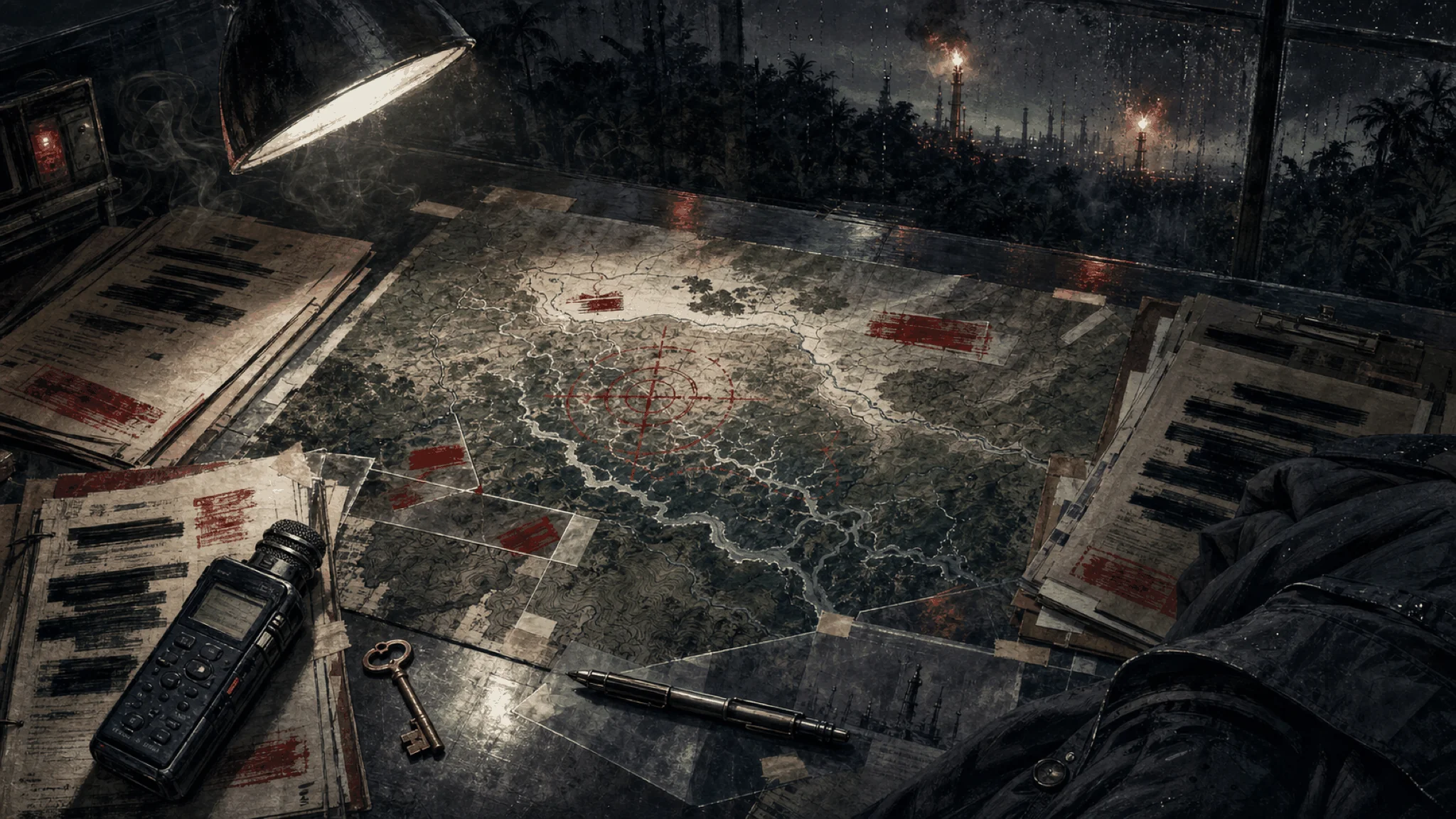
The container discovery is the hour’s best spy-thriller hinge because it gives Jack a win that immediately creates a worse situation. After the first container disappoints, Jack pushes deeper and finds ammonium nitrate. That detail shifts the investigation away from the expected radioactive trail and toward a different kind of mass-casualty threat. It also confirms that the jungle site matters, even if the stolen shipment is not behaving the way Jack expected.
Then the South African from the waterfront catches him. Their exchange is short and useful: the man recognizes Jack through the coffee-beans cover story, Jack is forced to admit he is not alone, and Matice’s team moves in before the camp can fully respond. The scene draws a line between Jack’s analytic drive and the dirtier choices around him. Coyote wants to kill the prisoner and leave. Jack objects because the man is unarmed. Greer solves the problem by shooting off part of his finger for DNA and moving on.
That moment is ugly in the right way. Greer has spent the episode insisting he is fine, brushing off Jack’s concern, and keeping his health private. In the jungle, that denial meets operational pressure. Greer does not become a monster, but he does show how quickly a mission defined as observation can slide into coercion once time, fear, and exposure tighten around the team. The fact that Jack does not get to control that slide is part of the point. He can object to killing an unarmed man, but he cannot keep the mission clean.
The escape sequence finishes that argument. Greer wheezes, Jack asks if he is all right, and Greer snaps that Jack no longer works for him. The team reaches the boat under fire, but Marcus is missing when Matice calls for the engine. “We’ll come back for him” is the kind of line action shows often use as a promise. Here it sounds more like triage. “Orinoco” leaves Marcus alone in the jungle, reframing all that early call-sign teasing as cruelly fragile. The man they renamed “Uber” has become the person the operation cannot afford to rescue in the moment it most needs him.
On the ride out, Greer finally tells Jack the truth: he has a heart condition, the diagnosis is bad, and that is why he left Moscow. The confession is plain, almost drained of drama, which suits the scene. Greer is not asking for pity. He is giving Jack the missing explanation for the shaky body Jack has been watching all hour. His fear is professional as much as physical; if the higher-ups know, he will be put behind a desk or pushed out. Jack asks what Greer is going to do, and Greer does not have an answer. For a character who often survives by sounding certain, that admission cuts deeper than a larger speech would.
What this episode argues
“Orinoco” makes its case that power reveals itself through surveillance, denial, and the stories institutions tell to keep moving. Reyes uses coerced confessions to close Senator Moreno’s murder in public while privately worrying that Gloria Bonalde may actually win. Miguel knows his home is bugged and still has to perform normalcy. Jack enters the jungle to verify one theory and finds evidence of another. Greer performs strength until his body makes the lie impossible to maintain.
“Orinoco” is also skeptical of clean American momentum. Jack is right to keep searching the containers, and the ammonium nitrate matters, but the mission still breaks people around the edges: a prisoner is maimed for a sample, Marcus is left behind, and Greer is forced to admit he is operating with a private medical crisis. The show gives Jack competence without letting competence become moral absolution. That restraint keeps the Venezuela arc from becoming only a puzzle about cargo routes. It becomes a story about systems that make everyone watch what they say, what they know, and what they are willing to leave behind.
Verdict
“Orinoco” is a strong field-operation episode because its action has consequences beyond the firefight. The river mission has enough tactical texture to satisfy the spy-thriller engine, but the strongest work is in the crosscutting: Gloria discovering that public grief can become political force, Reyes turning childhood memory into authoritarian self-justification, and Greer finally letting Jack see the weakness he has been hiding.
The hour is not seamless. Some of the Matice-team banter leans broad, and the Max Weber dinner conversation announces its theme with a heavy hand. Still, “Orinoco” treats pressure as something that moves through bodies and rooms, not only through gunfire. Jack finds proof in the jungle, but “Orinoco” is more interested in the cost of getting out with it.
Rating: 8.0/10
More episodes from Jack Ryan — Season 2 — The Venezuela arc — Jack chases a stolen nuclear-capable shipment. Jump to any episode in the season:
Where to go next
Reviewed by Mira Vance · QuizFandom Editor & Lead Reviewer. Every rating is an honest per-watch assessment from the desk that also writes the quizzes — not a press release rehash.