Tom Clancy's Jack Ryan S2E7 Review: Dios y Federación Makes Rescue a Deal With Worse Men
Jack follows Greer into the jungle as Reyes makes election eve a contest between public grief and private terror.
“Dios y Federación” is the hour where Tom Clancy’s Jack Ryan Season 2 stops treating Reyes’s conspiracy as something hidden beneath the country. The mineral deposit, the corporate money, and Jimmy Moreno’s murder are still part of the same chain, but this episode brings the violence into open streets, family rooms, and a prison camp full of people the regime has erased. Jack Ryan begins with a theory about Vogler Industries and tantalum. Before the closing image of James Greer praying in the dirt, President Reyes has made his oldest ally another casualty of the palace.
Catia makes Reyes’s violence public
The opening conversation between Jack and Mike November lays out the hour’s sharpest piece of conspiracy math. Vogler Industries found the tantalum deposit, but extraction and refining would be toxic enough to require a local partner who can cut through regulation and red tape. Jack names Cinco Palmas as the route, Mike names Reyes as the necessary partner, and the whole theory turns on election pressure. If Reyes loses, Reyes and Vogler get nothing. That is why, Jack argues, Jimmy had to die before anything could be exposed.
The scene is useful because it keeps Jack in analyst mode even while the writing is about to drag him into a rougher kind of operation. Mike asks whether Jack can prove the connection, and Jack has to answer no. The moment matters. Jack has the pattern, but not the document, not the witness, not the piece of evidence that can survive a government that kills faster than he can brief. Then Mike’s phone call reveals that Greer is not where he should be, and the men are almost immediately ambushed after their car fails. A theory session is shoved toward a survival problem before Jack can mistake inference for control.
Catia gives that political argument a body count. Miguel Ubarri arrives after the fires have already done their work, and the neighborhood reads him correctly. A woman screams that his men did this, then names Reyes as the murderer. The scene is brief, but it is one of the hour’s sharpest uses of public space. Reyes’s regime can stage rallies and move elections, yet the people in Catia know where the order came from because the message was designed for them. The fire is not collateral. It is a warning sent to the neighborhood where Miguel and Reyes grew up.
The aftershock follows Miguel home. His wife is entertaining, joking about Bonalde’s supporters as a kind of refugee camp for millennials, when Miguel comes in shaken and says Nicolas sent arsonists to Catia. He tells her that children died in the same neighborhood where they grew up and that Reyes has lost his way. She resists the conclusion because her sister Claudia is married into the palace and because the life they have is built inside that political family. Miguel, however, has already crossed a private line. The Americans have offered protection if he helps take Reyes down, and he tells his wife to prepare two suitcases for the United States. The scene does not frame him as clean. It frames him as late, frightened, and finally unable to keep calling loyalty a virtue.
Gloria fights an election Reyes has already rigged
Reyes’s first public move is almost comically blunt: the National Election Commission has voted to move the presidential election to the next morning. Gloria Bonalde answers the announcement with composure because surprise is a luxury her campaign cannot afford. If Reyes were fair, she says, she would not be running against him. Then she sends her people into the streets to tell voters where to go and when the polls close. Her campaign becomes less a platform than an emergency communication network.
The police visit sharpens that point. Officers arrive at Gloria’s headquarters under the language of extra security, claiming reports of disturbances and rioting. Gloria politely declines the “generous offer,” and the captain corrects her: it was not an offer, it was an order. The exchange is a small authoritarian lesson. Reyes does not need to cancel Gloria’s campaign when he can surround it, slow it, and call the enclosure protection.
“Dios y Federación” is careful to set that forced security against Reyes’s own rally. The rally is all noise, music, and state performance, with a speaker calling on the crowd to show love for the president before Reyes delivers the familiar story of a country rescued from corruption, crime, and economic ruin. The speech is not subtle, but it does not need to be. Reyes is rehearsing legitimacy in public while his private orders are becoming more desperate. The contrast works because the episode lets the rally feel staged rather than powerful. It is a regime performing confidence on the night it has moved the election out of fear.
The dinner scene with Miguel turns that fear inward. Reyes praises the energy of the crowd and asks where Miguel was. Miguel lies about a small family drama, and Reyes almost lets the lie sit before saying the time before an election makes people do strange things. The line is a threat wrapped in intimacy, delivered at a table where everyone understands that friendship has become surveillance. A whisper pulls Reyes away, and the news is that the satellite is down. His answer is immediate: kill the prisoners and bury them in the jungle. When Miguel objects that there are 30 men in the camp, Reyes corrects the number to 41. The precision is chilling because it proves this is not panic. Reyes knows what he is ordering.
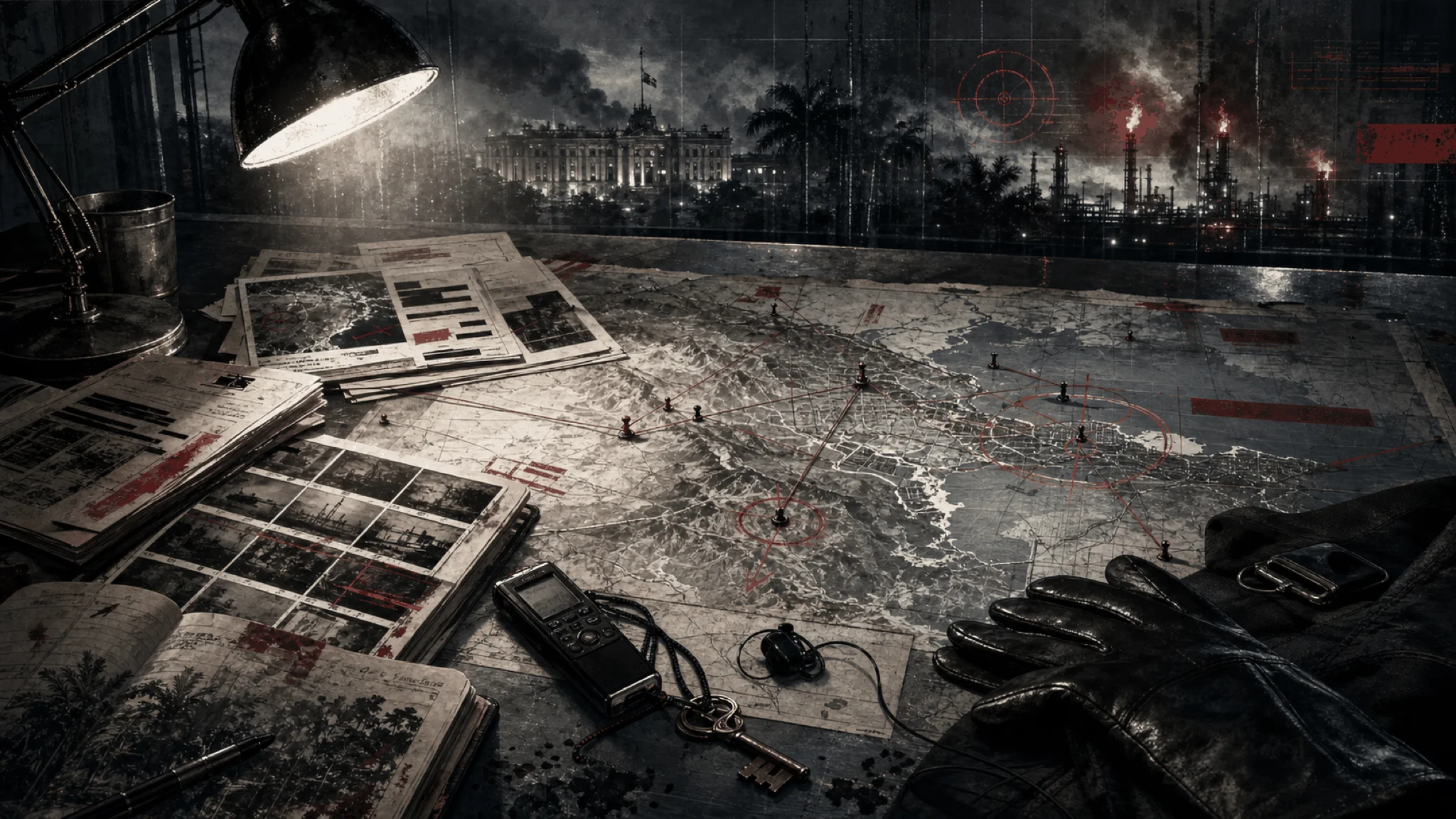
Greer finds proof inside a prison camp
Greer’s captivity gives the episode its most direct evidence of what Reyes is hiding. The first interrogation is ugly in a stripped-down way: cheap rum, a gag, a beating, and a threat about becoming a dead body on CNN. Greer responds with contempt because that is the only leverage left to him. He laughs at the interrogator and says the man’s boss must be desperate to rely on him. It is bravado, but it is also a stalling tactic from a man whose body is already failing him.
The prison camp then widens beyond Greer’s predicament. After an attack of coughing and wheezing, Greer meets Dr. Porfirio González, a literature professor who explains the population Reyes has disappeared: journalists who spoke against corruption, politicians who challenged him, academics, artists, even a sculptor whose offense was mocking the first lady through obscene political art. The list matters more than any one speech about dictatorship could. Reyes’s camp is not full of enemy soldiers. It is full of a civil society removed from view.
Porfirio’s personal reveal gives the political story its strongest emotional turn. Greer tells him that there is an election coming and that Gloria Bonalde is a real challenger. Porfirio asks for the name again, then says she is his wife. That discovery makes Sergio Bonalde’s disappearance concrete in a new way. Gloria has been campaigning with a missing husband as wound and symbol; here, the husband is alive in the jungle, surrounded by the other people Reyes had to disappear so the public story could keep functioning.
Jack and Mike’s side of the rescue plot is less noble than its goal. After José admits that he betrayed Greer because Reyes threatened his family, Mike shoots him and then admits he is not all right. Jack pushes him toward an immediate rescue because Greer has a heart condition and cannot wait for a formal mission. Lisa Calabrese refuses a military operation in Venezuela, so Jack reframes the plan as a humanitarian evac for political prisoners seeking asylum. She will try, but she insists on no guns and no firepower. Jack accepts that limit, then asks for the satellite to be taken out. The request is absurd enough to make Lisa explode, but it also reveals how Jack works in this episode: he keeps converting moral urgency into improvisational leverage.
That leverage becomes openly compromised when Jack approaches the armed contractors with money. He walks into a hostile camp unarmed, offers to hire them, and makes a prison rescue into a paid contract. The contractor leader threatens to keep the money and kill him until Jack mentions five more bags like the first one. A deal follows. The episode does not ask viewers to admire the bargain. It lets the bargain sit there as evidence that Jack cannot rescue Greer through clean channels. He has to buy his way into violence with men who were recently on the wrong side of it.
What this episode argues
“Dios y Federación” argues that the language of legitimacy can be more frightening than open lawlessness. Reyes calls his campaign a defense of Venezuela, calls Gloria’s police enclosure security, calls the early election procedure, and calls mass murder an operational order. The episode keeps pairing those official words with bodies: the dead in Catia, the prisoners in the jungle, José’s corpse after betrayal, Miguel on the palace floor, and Greer in the dirt at the edge of prayer.
“Dios y Federación” is also skeptical about American intervention without pretending Reyes’s victims should be abandoned. Jack is right that Greer and the prisoners cannot wait, and the camp’s existence demands exposure. Yet the rescue depends on bribed mercenaries, a disabled satellite, and a humanitarian cover that blurs immediately into armed action. The critical eye sits in that tension. Jack’s purpose may be urgent, but urgency does not make his methods clean.
Verdict
“Dios y Federación” is one of the season’s stronger late-arc episodes because it lets every strand of the Venezuela story collide without sanding down the politics. Catia makes Reyes’s violence a public accusation. Gloria’s campaign shows how democracy has to scramble when the state changes the clock. Greer’s prison-camp scenes give the regime’s repression a human inventory. Miguel’s death, meanwhile, is a brutal payoff to the episode’s family-room unease: Reyes can mourn old bonds and destroy them in the same breath.
The raid itself is intentionally messy. Jack does not arrive as a clean savior; he arrives after paying men who may walk away from an ambush if the price feels wrong. Greer is not even in the grave the rescuers first search, which keeps Jack from the comfort of immediate success. If the hour has a weakness, it is that the tactical geography of the camp becomes slightly muddy once the shooting starts. Still, the moral geography is clear. Reyes is no longer only protecting a mining conspiracy. He is trying to bury the country that can testify against him.
Rating: 8.4/10
More episodes from Jack Ryan — Season 2 — The Venezuela arc — Jack chases a stolen nuclear-capable shipment. Jump to any episode in the season:
Where to go next
Reviewed by Mira Vance · QuizFandom Editor & Lead Reviewer. Every rating is an honest per-watch assessment from the desk that also writes the quizzes — not a press release rehash.