Marshals S1E1 Review: Kayce Dutton Trades the Ranch for a Badge — and Finds the Same War
Kayce Dutton sold the land, kept the violence, and found out neither one was ever really his to give away.
Marshals, Season 1, Episode 1 — “Piya Wiconi” Paramount+ / CBS
When Kayce sold the Yellowstone Dutton Ranch to the Broken Rock Reservation, the franchise logic said he was stepping out of the arena. Marshals S1E1 spends forty minutes proving otherwise. The premiere opens with a war nightmare — Kayce waking up calling Monica’s name into the dark — and closes with Thomas Rainwater telling him, plainly, “You’re not a killer, Kayce. You’re a protector.” What sits between those two bookends is one of the more confident franchise pilot hours Paramount+ has produced: an episode that earns its thesis not through speechifying but through a procedural that keeps finding its way back to the same family wound.
Morning on East Camp: The Ranch That Isn’t a Refuge
The episode’s first real scene is Kayce and Tate at the corral, and it immediately establishes the friction that runs the whole hour. Tate is late for school, wants to skip chores for a protest meeting on the rez against a rare-earth mine, and throws a line at his father that lands harder than the writers probably let on: “You should be leading the charge here, not waving the white flag.”
Kayce’s answer is not a speech. He just watches Tate drive off. The corral needs safeguarding. The herd can wait. But Tate can’t, and neither can the mine announcement, and before Kayce can settle back into the quiet of East Camp, Calvin — his former SEAL teammate, now leading a new U.S. Marshals unit out of Bozeman — rolls onto rez land with a grin and a pair of fugitives holed up in the hills. The jurisdictional joke lands cleanly: “You know this is rez land. Technically, a U.S. Marshal has no jurisdiction here.” Calvin’s reply: “Good, ‘cause technically what I’m doing for you is illegal as hell.” Two veterans who haven’t lost the shorthand.
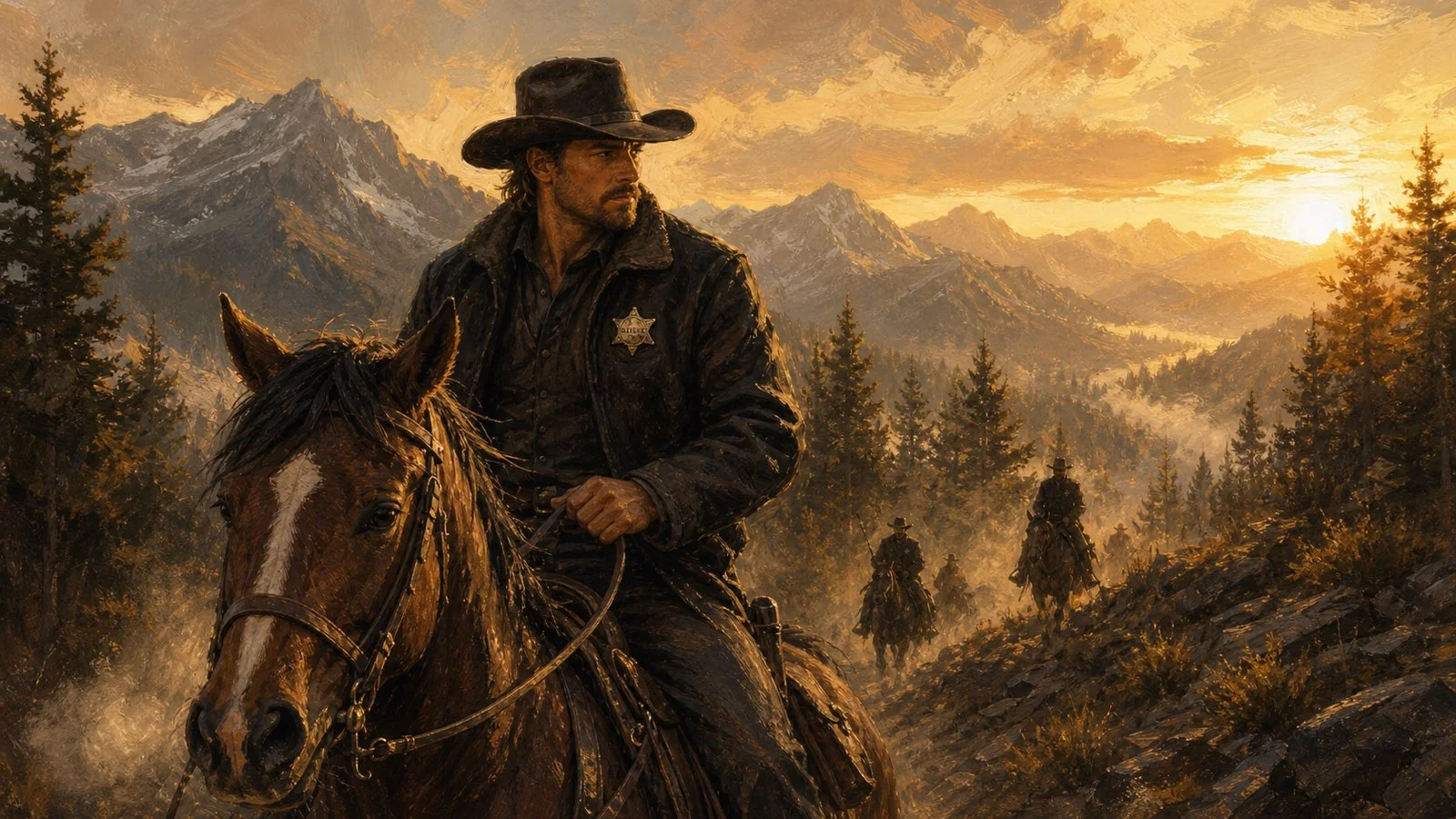
The mountain pursuit that follows — the team on horseback tracking two fugitives through grizzly and rattlesnake country — is the episode’s first piece of pure-franchise pleasure. Kayce takes point not because he has a badge but because he knows the terrain, including the sheepherder cabin “up where I’d track bighorns with my brothers.” The casual mention of brothers who are gone lands like a stone in still water. The show doesn’t explain. You either know the Dutton history or you start learning it here.
The Rally and the Blast: Where the Case Week Becomes Personal
Calvin deputizes Kayce the night before the Interior Secretary’s mine announcement rally, which is the kind of casual bureaucratic decision that saves three lives before the episode is over. The next morning, Broken Rock turns out in force — singing in Lakota, holding photographs of cancer victims from prior environmental dumping — and the political temperature is already past boiling when Thomas Rainwater and Mo arrive.
Rainwater’s greeting to Kayce is one of the episode’s best lines: “This country’s latest form of radioactive colonialism might be worth it if it allows me to see the reclusive Kayce Dutton.” It is affectionate and pointed at once, the way the best Yellowstone universe dialogue tends to work. The show isn’t interested in making the mine debate subtle — Mo is explicit: “America’s policies have long dumped a steady flow of poisons on our people. Using a literal river indicates they’re running lower on imagination than cruelty” — but bluntness is appropriate here because the history is not subtle.
The bomb goes off before the Secretary finishes her remarks. Calvin pulls her down, Rainwater takes shrapnel, and the episode shifts into procedural gear. What matters in the aftermath is that Kayce doesn’t leave. His son is at the rally, the blast radius caught Broken Rock residents, and when Andrea asks how he plans to get locals to open up during the canvas, the answer is three sentences: “My wife is Broken Rock. Raised our son there for a while.” That’s the whole trust architecture.
Jim Kane and the Coercion Reveal: Good Men Who Do Bad Things
The investigation pivot is the episode’s sharpest structural move. Evidence points early to Jim Kane — a Broken Rock member, oil rig worker, cancer-ridden brother in his backstory, explosive access through work. The team builds a clean case: means, motive, opportunity. Then Kayce looks Kane in the eyes at Bozeman General and says: “That man’s not a killer.”
He’s right about the letter of it and wrong about the fact of it. Kane did carry the bomb. What Kayce extracts is the coercion: Kane’s wife Tiva and daughter Lucy have been taken. A former coworker named John Decker — 10th Mountain Division, explosives training — used family photographs to keep Kane in line. The real target was never the Secretary. Decker wanted Rainwater dead because Rainwater’s land-back campaign made him an enemy of the Trail Keepers, an anti-government survivalist group wired into someone with advance knowledge of the Secretary’s trip.
The scene where Kayce breaks through to Kane is where Luke Grimes earns the episode. He doesn’t do the Dutton intimidation routine. He brings his own history instead: “There’s no greater violation than having your child taken. I’ve lived that horror, so I know that sometimes good men have to do bad things. I’ll crawl through hell to find your family, but I need your help.” It works because it’s true. Kayce has lived it. The show knows we know that, and it trusts us to carry the weight without spelling out the Tate kidnapping from Yellowstone’s third season.
Glacier Park and the Reckoning with Kilborn
The Trail Keepers connection resolves fast — maybe a touch too fast — when Andrea links Fish, Game and Parks Director Owen Kilborn to Decker’s Army command. The team helicopters to Glacier Park just in time to realize the tracker on Tiva was a lure. Belle takes a round in the strike plate. Lucy is already separated from her daughter. The compound fight is lean and functional, and Kayce navigates it exactly the way Calvin describes him to the skeptical chief: “one man force-multiplier.”
But it’s what Kayce does after the barn is cleared that matters. A Trail Keeper knows the exfil plan and won’t give it up. Calvin tells Kayce the badge demands they fight clean. Kayce’s answer is the episode in miniature: “You can fight clean. I’ll fight to win.” The line doesn’t endorse torture so much as it acknowledges that Kayce Dutton has never fully belonged to the institutions he serves — not the Navy, not the ranch, not now the Marshals. He operates at the edge of every framework he steps into.
Kilborn dies at Cracker Lake with Tiva in arm. His last words — “You’ve… stopped… nothing” — are deliberately too vague to land as a credible threat but land correctly as a franchise promise: there’s a bigger architecture behind the Trail Keepers, and one hired hand isn’t the top of the chain.
The Closing Scene: Tate, the Ranch, and the Decision That Isn’t Made Yet
The episode earns its title in the final conversation between Kayce and Rainwater, post-case, on East Camp. Mo translates piya wiconi as “new beginning.” Rainwater adds: “They are possible.” Kayce’s response is quietly the most revealing thing he says all episode: “It was nice to kill for someone rather than… something.”
Then the real scene: Kayce and Tate on the porch before dawn. Tate apologizes for the rally. Kayce tells him never to apologize for standing up for his mother. And then Kayce does the thing John Dutton could never do — he admits fault. “I fought so hard to get out from under the weight of the Yellowstone, and here I am, forcing you to live like my family’s lived for a hundred years.” When Tate says he’s not sure he wants the ranch, Kayce laughs. His grandfather warned him this day would come.
What Kayce tells his son is the episode’s actual thesis: “East Camp is your home. It’s not your destiny.” Whether Kayce has applied the same logic to himself — whether he’s chosen the Marshals or just fallen into them the way Duttons fall into everything — is the question the show leaves open, correctly, as a first-hour should.
Pros
- The coercion reveal reframes the entire procedural spine in one conversation; the show earns its thematic point through plot mechanics, not just dialogue.
- Luke Grimes is at his best in the quiet register — the look at Monica’s burial site, the corral scene with Tate, the Kane hospital room — and the episode builds its emotional architecture entirely around that stillness.
- Rainwater and Mo’s presence at the mine rally grounds the franchise politics in specific history rather than generic western-drama atmosphere.
- The jurisdictional jokes between Kayce and Calvin establish the buddy dynamic without over-explaining the SEAL backstory.
- The title payoff — piya wiconi earned through a full procedural hour, not planted in the cold open — is clean franchise storytelling.
Cons
- Kilborn’s arc resolves quickly enough that his “you’ve stopped nothing” dying line feels more like a trailer beat than a genuine setup.
- The Trail Keepers are sketched as ideology-first (anti-land-back, anti-government) but given no human texture beyond Decker, which flattens what should be the season’s antagonist infrastructure.
- Belle’s ATF backstory and the “Skinner” alias are introduced and immediately tabled; the show wants mystery but the moment reads more like a placeholder than a hook.
Universe Context — The Dutton Lineage and What “Piya Wiconi” Costs to Say
Marshals only makes sense if you understand what Kayce gave up and what he couldn’t escape. In Yellowstone, [[kayce-dutton]] was the son who tried hardest to leave — Navy SEALs, then the reservation, then the livestock commission — and kept getting pulled back into the ranch by violence, family loyalty, and [[john-dutton]]’s gravitational field. When Monica died, the thing that had always made Kayce different from his siblings died with her. Monica was Broken Rock, and her death collapsed the clean separation Kayce had maintained between the Dutton world and the reservation world.
The sale of the Dutton Ranch to Thomas Rainwater was not just a plot resolution. It was Kayce refusing to inherit the thing [[beth-dutton]] and Jamie spent seasons destroying each other to control. In Yellowstone’s universe, the ranch is violence made permanent and legal — it is the brand [[john-dutton]] burned into every relationship he touched. Kayce’s decision to sell is the franchise’s most explicit acknowledgment that the ranch was the problem, not the solution.
Marshals tests whether that divestiture actually freed anything. The answer in E1 is: not yet. The Trail Keepers are attacking the same Broken Rock land-back movement that made the ranch sale politically possible. Rainwater — whose campaign to recover Lakota land created the target on his back — is the same man who made the sale of Yellowstone meaningful. The mine that Tate wants to protest is the same extractive logic that built the Dutton fortune in the first place.
Kayce is not ranching anymore, but the land war followed him. What piya wiconi costs is accepting that a new beginning is not the same as a clean one. The episode’s final gift is that Tate already knows this, and unlike his father at that age, is being told he doesn’t have to repeat it.
Rating: 7.6/10
More episodes from Marshals — Kayce Dutton after Yellowstone, episode by episode. Jump to any episode in the season:
Where to go next
Reviewed by Mira Vance · QuizFandom Editor & Lead Reviewer. Every rating is an honest per-watch assessment from the desk that also writes the quizzes — not a press release rehash.