Marshals S1E8 Recap: The Pollard Case Was a Trap, and Andrea Pays for Kayce's Divided Loyalty
Marshals, Season 1, Episode 8 — “Blowback” Paramount Network
Marshals Episode 8 is the season’s pivot from procedural to personal, the hour that finally charges Kayce Dutton (Luke Grimes) interest on debts he has been carrying since the Yellowstone era. The episode opens with a ghost arriving on the ranch and ends with a teammate in a hostage-taker’s compound — and the through-line between those two events is Kayce’s inability to fully inhabit any single loyalty. The Pollard case turns out to be bait, the tip came from nowhere and now points nowhere, and the man behind the kidnapping of Deputy Marshal Andrea Cruz is a grieving father who believes Kayce’s team already destroyed his family. “Blowback” is not the show at its most confident structurally, but it is the show at its most honest about what Kayce costs the people around him.
Garrett Shows Up at the Ranch and Splits the Team Before the Day Begins
The episode opens with Kayce and Tate working the winter fields at the ranch, a rare scene of earned quiet. “Being a father suits you,” Calvin says when he arrives to find them. “Didn’t come natural,” Kayce answers — a line that lands harder by the episode’s end, because the ease visible in those opening minutes is the first thing the plot dismantles. Then a guitar-playing stranger walks up the drive: Garrett, aka Double G, a SEAL teammate Kayce and Calvin last saw at Camp Uhley in Afghanistan and haven’t spoken to in a decade.
Garrett reads cheerful and purposeful on arrival — “Trading in that rifle for a guitar was the best decision I ever made” — but Calvin reads him immediately as damaged. “I know a damaged frogman when I see one,” he tells Kayce afterward. “You caused a lot of his damage.” The accusation is a grenade rolled between old friends in a quiet room, and the show is smart enough not to defuse it. Calvin’s hostility toward Garrett is not personal dislike; it is a known-blast-radius calculation. Garrett is combustible. Kayce is about to find out how combustible, but not before Garrett’s presence has already cost the team something it cannot get back.
The ranch-morning sequence earns its length. The hay bales, the ornery horse being worked on a lunge line, Tate deadpanning “Winter’s coming” at the Omaha man who learned cold in the Hindu Kush — these details register as a life Kayce is actually living, not performing. Which makes the episode’s engine clear: this is what the job is about to tax.
The Pollard Case Is a Setup, and Kayce Knows It First
A tip lands on Reed Pollard — a top-15 Most Wanted bank robber, supposedly holed up at the Ashford Rodeo Grounds outside Bozeman. “He’s never been on our hunting ground,” Calvin says, and the team rolls. The rodeo grounds are deserted for winter, no civilian exposure. Bad everything else.
The takedown turns into an ambush. “Contact rear!” — three of Pollard’s supposed crew go down in the firefight; Pollard himself slips the net. Kayce clips someone, but the body Andrea and Kayce find in a residential shed four blocks from the rodeo is Jack Manning, no priors, no known connection to Pollard, from Pullman, Washington. The rest of the dead are equally clean: Troy Ryan, Kenny Roman, Sam Harold — all from out of state, no criminal jackets, no digital evidence tying them to each other or to Pollard. “Clean jackets don’t mean clean living,” Calvin observes, but these men are not clean-living criminals flying under the radar. They are first-timers who appear to have walked into a Montana job with no history to explain why.
“This is starting to feel like a setup,” Belle says, which is when the second shoe drops: Pollard has been in a Las Cruces, New Mexico jail for five days under an alias. He was never in Montana. Someone used a burner phone to put the most-wanted bank robber in their jurisdiction and draw the marshals out to a deserted location with an armed crew they cannot explain. “Why would someone tip us off about a fugitive a thousand miles away?” Andrea asks. The team does not have the answer yet. It is already in motion against one of them.
The Pollard sequence is well-paced procedural craft, and Kayce’s flat certainty — “I hit him” — followed by a dead body that is not Pollard is the episode’s cleanest piece of misdirection. The show lets you believe his SEAL instincts are reliable, then uses that confidence to tighten the trap around someone else.
Kayce Leaves Andrea Alone, and Clegg Gets His Hostage
Here is where the episode earns its title. Kayce goes to check on Garrett instead of riding with Andrea to the ballistics lab. The scene with Garrett is real and specific — he finds his old teammate mid-nightmare, calling out for Roner, the fourth musketeer from a classified op that went wrong. Kayce grounds him: “Hey. Hey. It’s Coyo. You’re good.” The physical effort of pulling someone back from a flashback, both men wrestling through it, is grounded in a way the show does not always achieve. When Garrett later admits that after the Teams he cycled through jail, psych wards, rehab, and sleeping on the streets — “I feel like surviving’s my punishment for what I did” — Kayce tells him to stay at the ranch as long as he needs.
That decision is right. It is also catastrophically timed, because Andrea goes to the ballistics lab alone.
The smash-and-grab is fast and brutal: a cargo van registered to Treasure State Demolition hits Andrea’s SUV broadside. By the time the team pulls up traffic-cam footage, she is already in the van, unconscious and zip-tied. “DUSTWUN — whereabouts unknown,” Calvin calls it. The footage leaves no ambiguity. “That’s no accident,” Miles says. “Smash-and-grab,” Kayce says. “Classic ambush technique.”
The kidnapper is Randall Clegg, whose sons shot up Broken Rock earlier in the season. One son is dead; the other faces life in prison; Clegg’s demolition business lost its rare-earth mine contracts in the aftermath. He has nothing left to protect. “After what your team has done to my family,” he tells Andrea when she warns him about federal consequences, “the only law that concerns me is an eye for an eye.” His monologue — “Bit by bit, I’ve watched the life sucked from this land by faraway bureaucrats who care nothing for it. I’ve seen the blood of my kin spilled by their puppets” — is frontier-grievance rhetoric delivered as genuine loss. He is not wrong that grief made him this. He is not right that Andrea Cruz is a fair target for it. The episode holds both without resolving either, which is the correct position.
Calvin and Kayce Reckon With Roner, Double G, and Who Was Left Behind
The most textured scene in “Blowback” is not a chase or a firefight. It is Calvin and Kayce standing at the vehicles after Andrea goes missing, Calvin saying what he actually thinks: “You were more worried about your old teammate than the ones you got now.”
Kayce does not argue. “Roner, Double G — that is the third rail in our friendship,” Calvin says, and the phrase is precise: you do not touch it without burning something, but it runs through every conversation they have had. The classified operation Garrett calls out for in his flashbacks clearly cost at least one man’s life, and whatever Kayce’s role was — team leader, the one who made the call, the one who lived — is not resolved. “We both know who Roner’s death is on,” Kayce tells Garrett in the ranch scene. The episode does not parse agreement from deflection, and that ambiguity earns its keep.
Calvin’s counter-argument is not callousness. He has been running blast-radius calculations on Garrett since the man arrived at the ranch. “I just don’t want you in his blast radius,” he tells Kayce. “It feels like we lost two brothers on that op.” The episode lets Calvin be right and still requires him to set it aside: “The only way Drea’s gonna get out of this is if we are pulling in the same direction.” They do. The ranch sequence had planted what becomes a loaded echo: the last thing Andrea said to Kayce before her vehicle was hit was “Hooyah, Senior Chief” — a sign-off, a salute, a thing that now has weight it did not have when she said it.
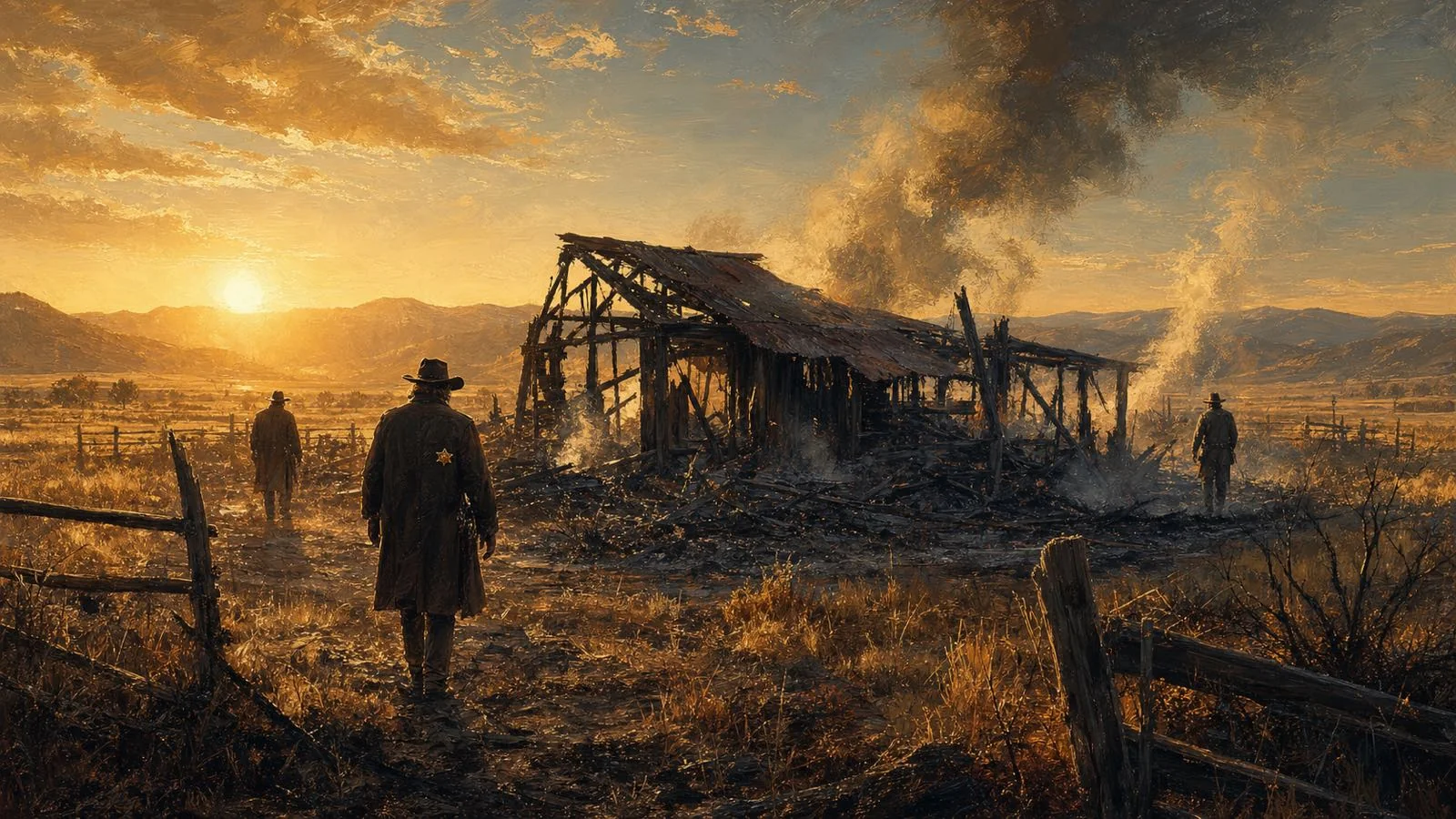
The Compound Assault Begins With Clegg Already Waiting
Calvin’s plan is clean: proceed on foot, fast and quiet, Belle and Miles on the left flank, Kayce and Calvin on the right, clear the main house first. “I know we’re all out for blood right now,” Calvin tells the team, “but remember — this is a hostage rescue. Careful where you send your rounds downrange. Let’s get our girl back.” The tactical composure under emotional pressure is one of the things Marshals does well, and it reads as real here rather than genre formula.
Clegg was ready. The episode cuts on contact — “Contact front!” / “They were expecting us” / “Clegg went and got himself an army” / “They’re gonna overrun us” — the compound has bunkers and a barn full of shooters, and the marshals are outgunned on approach with backup an hour out. No clean play. The episode ends before resolution.
The cutting-point is tighter than ideal — the firefight barely starts before the credits — but the compression is also defensible: “Blowback” was always about the consequences arriving, not about their resolution. Clegg setting his trap, the Pollard misdirection, Andrea in zip-ties, Kayce acknowledging exactly what his divided attention cost: that sequence lands. The shootout belongs to Episode 9.
Pros
- The Garrett flashback scene — Kayce pulling a man back mid-nightmare — is the most physically specific acting the show has put on screen.
- Calvin’s “third rail” line is the season’s sharpest dialogue about what old loyalty costs new loyalty in real time.
- The Pollard misdirection holds until the Las Cruces reveal; the clean-jacket dead crew is a genuinely good procedural beat.
- Randall Clegg’s grievance monologue earns its length — frontier land-rights rhetoric that arrives as human loss, not genre furniture.
Cons
- The episode cuts to black mid-firefight in a way that reads as scheduling rather than dramatic architecture.
- Garrett’s Nashville arc — he’s fine, playing bars, coining song titles — gets undercut by the psych-ward admission without enough buildup; the show needed to pick a register for him earlier.
- Miles and Belle spend most of the hour as comms operators with nothing to resolve except each other’s romantic subplot.
Universe Context: Kayce’s Long History With Blowback
“Blowback” names what Marshals has been building toward all season, but divided loyalty and its body count are not new themes for this character. In [[kayce-dutton]]’s Yellowstone arc, the pattern holds from S1: every time he is asked to choose between the ranch’s logic and something outside it — Monica’s people, his conscience, the costs of his training — the choice arrives late enough to leave damage on people who did not choose the war.
His older brother [[lee-dutton]] died in S1E01 because Kayce was living off the ranch, estranged, unavailable to prevent a confrontation he might have defused. His father [[john-dutton]] absorbed Kayce’s confession about Robert Long’s death and made it useful — the ranch converts his honesty into operational material, a pattern Kayce has been trying to exit for five seasons. When Tate was taken in S2E10, the violence Kayce deployed came with no warning that it was available at that volume; what came home from the Beck compound was not just a rescued child.
The Marshals badge is the latest attempt at a clean arrangement: accountability to jurisdiction instead of inheritance, [[mo]] as a partner who anchors him to the reservation world, law enforcement replacing ownership. “Blowback” demonstrates that the badge does not change the calculus. Kayce still divides his attention between old bonds and new ones. The people who pay are the ones who did not sign up for the old war — and Andrea Cruz, who said “Hooyah, Senior Chief” and drove away alone, is the newest entry on that list.
[[tate-dutton]] is briefly visible in the ranch opening — drier, older, already the product of a childhood that was never going to stay quiet. The kayce-dutton arc ends with the Yellowstone sold to Broken Rock for $1.25 an acre, John buried, the children deciding what the father could not. That resolution is still years ahead in the franchise timeline. “Blowback” is one of the episodes that explains why it took so long to get there.
Rating: 7.8/10
More episodes from Marshals — Kayce Dutton after Yellowstone, episode by episode. Jump to any episode in the season:
Where to go next
Reviewed by Mira Vance · QuizFandom Editor & Lead Reviewer. Every rating is an honest per-watch assessment from the desk that also writes the quizzes — not a press release rehash.