Marshals S1E4 Recap: Kayce Keeps His Badge, Loses His Illusions
Marshals, Season 1, Episode 4 — “The Gathering Storm” Paramount+
The episode title earns itself twice. There is a literal storm — a mountain system that grounds every air asset in the Bridger Range and turns a search-and-rescue into a survival exercise on horseback. And there is the bureaucratic kind bearing down on Kayce Dutton (Luke Grimes): a DOJ civil rights complaint filed by Randall Clegg, a supervisor willing to weaponize it, and a team put in the impossible position of investigating the colleague who keeps pulling them out of trouble. Both storms arrive in the same hour and both force Kayce to prove, again, that carrying the badge costs more for him than for anyone else on the unit.
Gifford Makes His Move
The Clegg complaint is the engine driving every scene that doesn’t happen on a mountain. Randall Clegg has retained attorney Andrew Schroeder — a man with a documented track record of suing law enforcement — and filed a claim that Carson Clegg was unarmed when Kayce shot him at the standoff. Inspector Gifford uses that opening immediately.
He pulls marshal’s badge authority to run an impartial review and hands the investigation to Deputy Cruz. The framing is institutional hygiene. The reality is transparent: Gifford tells Cruz directly that even without smoke behind the Clegg fire, a thorough DOJ process will uncover “other Dutton skeletons that can hurt this team.” He closes with a blunt pitch — Cruz wants out of Montana and back to D.C.; Gifford controls that door. “You want to get out of this ditch your old team threw you in? You better get your hands dirty.”
The scene is the episode’s cleanest villain beat, but it is not cartoonish. Gifford’s logic is institutionally coherent. He is right that a Dutton with a complicated past creates exposure for the whole unit. What he wants Cruz to do with that information is the problem.
What the Mountain Teaches
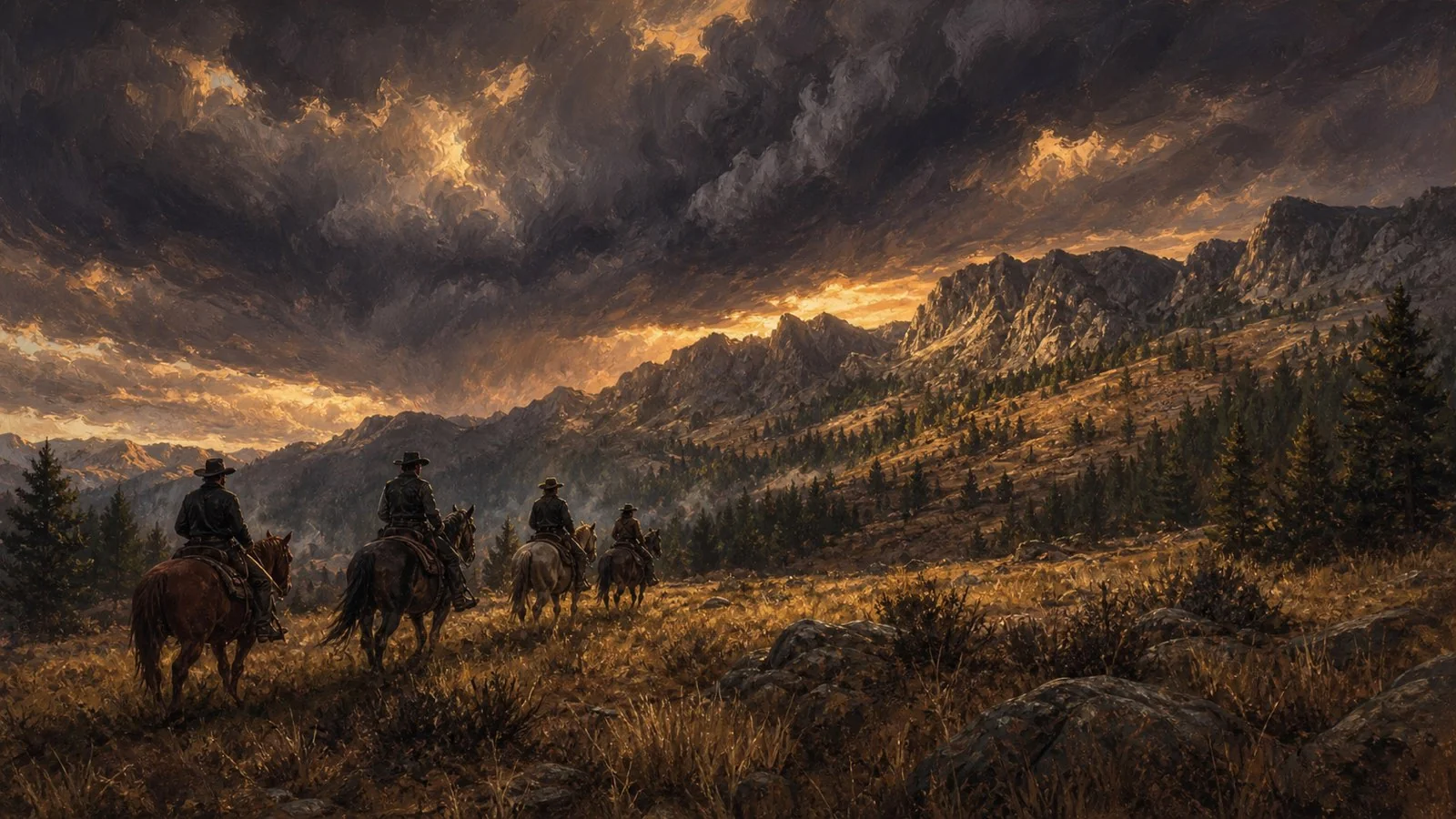
Kayce and Calvin are pulled from the investigation and sent to help Forest Service search-and-rescue in the Bridger Range. Tom Weaver’s helicopter went down in section D4 — over 8,500 feet, a thousand-plus square miles to cover, no air support because the wind has grounded everything including drones. Kayce knows the terrain. He and Calvin go on horseback.
The rescue sequence is where the episode earns its action budget. The trail cams aren’t a mountain safety system — Kayce smells aviation fuel from a distance and follows the sheen on the water to find the crash site. The pilot, Helen, is impaled by wreckage and too fragile to move without tools they don’t have. A bear comes while Calvin is retrieving cutting gear from the horses. Pistols won’t stop it; the shotgun is still with the animals. They drive it off with noise and sheer proximity, but not before Helen dies from the added trauma.
Kayce’s confrontation with Weaver after is one of the episode’s quietest and most pointed scenes. Weaver had ordered Helen to fly in documented storm conditions so he could assess land out in Springhill on a tight acquisition schedule. Kayce doesn’t yell. He just says: “You valued your ranch more than hers.” Then, when Calvin wants to cut Weaver loose for the descent: “I’m responsible for a high enough body count today.” The line is not self-pity. It is an accounting he makes out loud, the same way he has made it silently about every prior body, and it marks the distance between him and a man like Weaver who outsources that math to someone else.
Before they reach Weaver, the marshals encounter a mountain recluse who draws on them for their supplies. Calvin wants to zip-tie him to a tree and collect him on the way down. Kayce notes that if the storm gets there first, that is a death sentence. They release him with instructions to surrender at the ranger station. Calvin asks whether he thinks the man will actually do it. Kayce says: “I wouldn’t.” He says it without judgment, and without irony.
The Investigation Runs on Parallel Tracks
While Kayce is on the mountain, the unit’s investigation proceeds without him. Cruz contacts a DOJ connection from her unfinished law school tenure and discovers the Clegg complaint was filed through Schroeder — whose actual play is to get a DOJ finding against Kayce, then have Randall Clegg sue him personally. The gun Carson was carrying hasn’t been recovered, which makes clearing Kayce on evidence harder. Belle goes to confront Schroeder at his jeweler, a social ambush wrapped in a polite reminder that his new client is under local, state, and federal scrutiny. Schroeder’s answer is not a denial. He says: “Kayce is a chip off the John Dutton block, thinking he can play outside the lines.” Then, when Belle asks whether he can prove Carson was unarmed: “Can you prove he wasn’t?”
Gifford’s deeper play becomes visible in his private conversation with Miles at the Broken Rock hospital. Gifford is hunting a personal motive — something that would reframe Kayce’s shooting as frontier justice rather than lawful force. He finds it. Ernie Cano, the reservation man the Cleggs shot at the standoff, was close to Monica Dutton. Ernie and his wife had Monica and Tate over for dinner when Kayce was deployed. Monica taught at Ernie’s school. Gifford doesn’t need this to be true. He needs it whispered to the press where it can be exploited alongside the Dutton name. “Everyone in Montana will cheer when a Dutton finally learns a badge isn’t a shield for their sins.”
Miles pushes back at each step, but Gifford is not asking for his endorsement. He reports the connection to the Office of Professional Responsibility and tells Calvin that OPR has cleared the way to fire Dutton before the review is finished: “I warned you hiring him was a mistake. Now you can correct that.” Calvin’s answer is flat and final: “You want his badge so bad, do it yourself.”
“Justified and Right Aren’t Always the Same Thing”
The episode’s best dialogue exchange happens on the mountain, mid-climb, when Calvin observes that Gifford is out of line for backing a bogus claim and Kayce explains it as old Dutton debt landing on him. He says it is not the first time he has been punished for doing what he thought was right. Calvin asks when that started. “Pretty much since birth.”
Then later, after Weaver and the bear and Helen’s death, Kayce admits: “There’s only one person ever believed me to be a good man. She’s gone.” When Calvin pushes back — the team believes in him — Kayce answers: “Well, they’re investigating me.” Calvin tells him it is hard for teammates to get close when he keeps them at arm’s length. Kayce’s reply is the cleanest line in the episode: “Just ‘cause I won’t go to the bar with them doesn’t mean I wouldn’t jump into the fire for them.”
That line splits the whole character in two. The Kayce Dutton problem has never been loyalty. It has been proximity. He will die for people he won’t eat with. He will ride into a storm for a man he considers morally bankrupt because Weaver’s daughter deserved to know if her father was alive. The badge, for Kayce, is not institutional approval. It is, as Calvin says at the bar near the end: “a path to penance.”
The Trail Cam Clears the Slate
The resolution of the DOJ threat comes through actual detective work. Belle and Andrea learn that the Cleggs had piggybacked a node on trail cameras set up by a grad student studying gray-crowned rosy finches. The sheriff missed them in the initial processing, focused on locating the missing gun. The cams caught the standoff. The footage is unambiguous — Miles identifies Carson Clegg in frame, and Andrea notes: “Weapon firmly in hand.” Kayce’s shoot was justified on the evidence the Cleggs thought didn’t exist.
Gifford, handed the footage, folds without ceremony: “Glad you cleared this up. I’ll tell OPR to shove it.” Calvin’s read of the clip is brief: “Abuse of the badge looks pretty damn heroic to me, Harry.”
Cruz’s private word to Kayce afterward matters. She tells him she hated upending his world, and that her father despised internal affairs. Then: “Don’t ever play me like that again” — directed at Gifford. She is telling Kayce, without spelling it out, that Gifford tried to use her ambitions as leverage and she refused it. Kayce absorbs this without warmth: “Doubt that’s the last time I’ll deal with him. Or the Cleggs.”
Pros
- The mountain rescue earns its full runtime without padding — bear encounter, impalement extraction, a false summit that forces a vertical climb, and a recluse encounter that lands a character beat, all in one continuous sequence.
- The trail cam resolution is satisfying without being tidy: Gifford wanted a paper trail damaging enough to fire Dutton on motive, and instead the physical evidence destroys the argument cleanly.
- Kayce’s two-line character summary — “Just ‘cause I won’t go to the bar with them doesn’t mean I wouldn’t jump into the fire for them” — is the most efficient description of the post-Yellowstone version of this person the show has produced.
- Weaver’s arc from potential antagonist (“doing a bad impression of your dad”) to humbled patient to genuine debt works because the show doesn’t rush the pivot — Calvin and Kayce disagree about him mid-rescue and the episode lets Kayce update in real time.
Cons
- Gifford’s willingness to manufacture a motive out of Ernie-Monica dinner invites and whisper it to the press is established but not tested — he folds the moment the trail cam footage appears, which lets the show avoid the harder version of the conflict where the institutional threat survives exculpatory evidence.
- Miles’ resistance to Gifford’s pressure throughout reads more like plot function than character work — he objects every time Gifford asks him to act, but his reasons shift without the show giving any one of them real traction.
- The mountain recluse subplot — laid out as a possible wanted fugitive by the closing beat, when Calvin identifies him against a “serial bomber on the lam for three years” alert — is unresolved, landing as an abrupt tag rather than a threaded throughline.
What this sets up for E5
Gifford is not done. Kayce says as much at the bar, and the OPR pathway, while currently closed, remains a tool Gifford can reactivate with new material. The Clegg family — Randall and Wes — remain free. Calvin’s push to pursue the mountain recluse gives the next episode an open case file and a mistake that Kayce, specifically, chose not to make worse by abandoning two men on a mountain to chase one.
Rating: 7.9/10
Universe context: The Dutton name and what it costs in Montana
Kayce Dutton enters Marshals carrying the full weight of the franchise’s most complicated lineage. He is John Dutton’s youngest son, a Navy SEAL who came home to a ranch war he had spent years trying to exit, and the man who spent most of Yellowstone asking whether the violence his family required of him was something he could keep surviving.
The Clegg complaint in “The Gathering Storm” follows a direct line back to that history. Randall Clegg had history with John Dutton when John was Montana Livestock Commissioner. Gifford reads John’s subsequent resignation as “giving up power is close as a confession as a Dutton’s capable of” — and is entirely right that a DOJ investigation into Kayce’s conduct will surface that background whether or not it is relevant to the Carson Clegg shooting.
What Marshals adds that Yellowstone largely held in reserve is an outside view of that name. At the jeweler, Schroeder says Kayce is “a chip off the John Dutton block, thinking he can play outside the lines.” At the hospital, Gifford says “Everyone in Montana will cheer when a Dutton finally learns a badge isn’t a shield for their sins.” The Dutton name in Marshals is not just personal history — it is a specific liability in Montana, where John’s methods as Commissioner were broadly known and broadly resented by people who had nothing to do with the ranch.
[[kayce-dutton]] walks into this episode with that liability pre-attached and no leverage to shed it quickly. His only option is to be so obviously right, on such unambiguous evidence, that the institutional argument collapses. The trail cam footage that clears him was found because his teammates chose to work the case honestly rather than manufacture evidence to support Gifford’s pressure campaign. That is not the Dutton way — the Dutton way is to make problems disappear through force or political machinery. Kayce gets cleared by colleagues who decided his record was worth defending.
[[mo]], absent from this episode but present in the franchise context, represents the partnership the show is building toward: Kayce policing the borderland between the reservation and the outside world, accountable to both and fully trusted by neither. The Ernie Cano thread — Monica’s connection to a man the Cleggs shot — is the first time Marshals reaches explicitly back into the reservation world that defined Kayce’s life before any badge. It is not resolved here. It will be.
The [[dutton-ranch]] thread surfaces briefly when Weaver offers ranch hands to Kayce at the hospital — Kayce has 300 pairs of cattle and a federal career and no obvious way to hold both. The offer from a man whose land hunger Kayce had just measured and found wanting is the show noting, with dry irony, that the Dutton name still opens certain doors in Montana even as it slams others.
More episodes from Marshals — Kayce Dutton after Yellowstone, episode by episode. Jump to any episode in the season:
Where to go next
Reviewed by Mira Vance · QuizFandom Editor & Lead Reviewer. Every rating is an honest per-watch assessment from the desk that also writes the quizzes — not a press release rehash.