Marshals S1E11 Recap: Garrett Dies and the Four Musketeers Finally Bury Roner
Marshals, Season 1, Episode 11 — “On Thin Ice” Paramount+
“On Thin Ice” sends the penultimate episode of Marshals S1 into a Montana blizzard and uses the weather to close off every remaining exit. Kayce Dutton (Luke Grimes) and Calvin (J. Alphonse Nicholson) are trapped in the mountains with escaped convict Neil Lamb while a bomb cyclone shuts down the roads and the reservoir of old grievances between them finally cracks open. The hour earns its title twice: once literally, when Calvin falls through frozen water fighting to survive, and once structurally, as the brittle account of how Roner died in Afghanistan — the story that has been holding the Four Musketeers’ wreckage in place — finally fractures. Garrett dies in the closing minutes, and Kayce walks back off the mountain carrying everything the episode just handed him.
The Mountain Trap and What It Costs to Stay Alive
The episode opens in the present and the past simultaneously. The “Previously on” recap sketches the Four Musketeers — Kayce (“Coyo”), Calvin (“Senior Chief”), Garrett (“Double G”), and Roner — as an Afghanistan SEAL team whose brotherhood imploded on a single op. In the present, Kayce and Calvin are already in the mountains with Neil Lamb cuffed between them, the storm coming in, and Kayce’s truck stranded on the wrong side of the ridge.
The hunting cabin scene that follows does a lot of structural work. The three men are forced to survive together, which means Calvin has to direct Neil in keeping the fire alive — and it also means Calvin has an unguarded hour with Kayce. The episode uses the physical problem (the roof is loading with ice and will eventually collapse; the fire needs constant feeding) as a pressure system that makes the emotional conversation inevitable.
Calvin’s opening shot lands hard: he accuses Kayce of giving Garrett a hero complex by putting him back to work around the horses and the Clegg property. “I’m just trying to give him back the life you took from him,” Kayce answers. Then: “Too bad I couldn’t do that for Roner.” It is the first time the name comes up and it lands without softening, because both men know exactly where Roner is — and what it meant that his body stayed on that mountain.
The Neil Lamb Problem and the Leads Back Down the Mountain
Parallel to the blizzard strand, Andrea and Miles work the office side of the manhunt. Neil made a call from the prison bus driver’s stolen phone after the rockslide escape — one to a burner number, one to Charlie Ripley, a former cellmate from his South Dakota stretch. Ripley is small leverage: a child support warrant and a grudge against Neil he is willing to trade.
The interrogation moves fast. Ripley confirms Neil called to offer him a split of the Ennis bank robbery money; Ripley turned it down. But Ripley also passed Neil the number of Don Benson — a “psycho” from the same prison, someone with an arsenal and a history of violence. Andrea and Miles find Benson in Neil’s phone contacts and move toward the Madison Range as soon as the roads open.
This strand earns its place by doing two things at once: it advances the procedural plot and it gives Miles — via Thomas Rainwater and Senator Conner — the political scene that does the episode’s other significant work. Miles explains that he took the Marshal badge because punishing reservation people for surviving a system rigged against them felt wrong. Rainwater uses the senator’s grounded jet and Miles’s presence to push for a subcommittee hearing on the Crestmark mine. “A weapon, capable of protecting this reservation,” Rainwater tells Miles afterward. Miles’s quiet “Did you just use me as a prop?” is the episode’s sharpest exchange for what it reveals about the limits of working inside institutional power — and it echoes directly off Kayce’s career trajectory in Yellowstone proper.
Calvin Falls Through the Ice
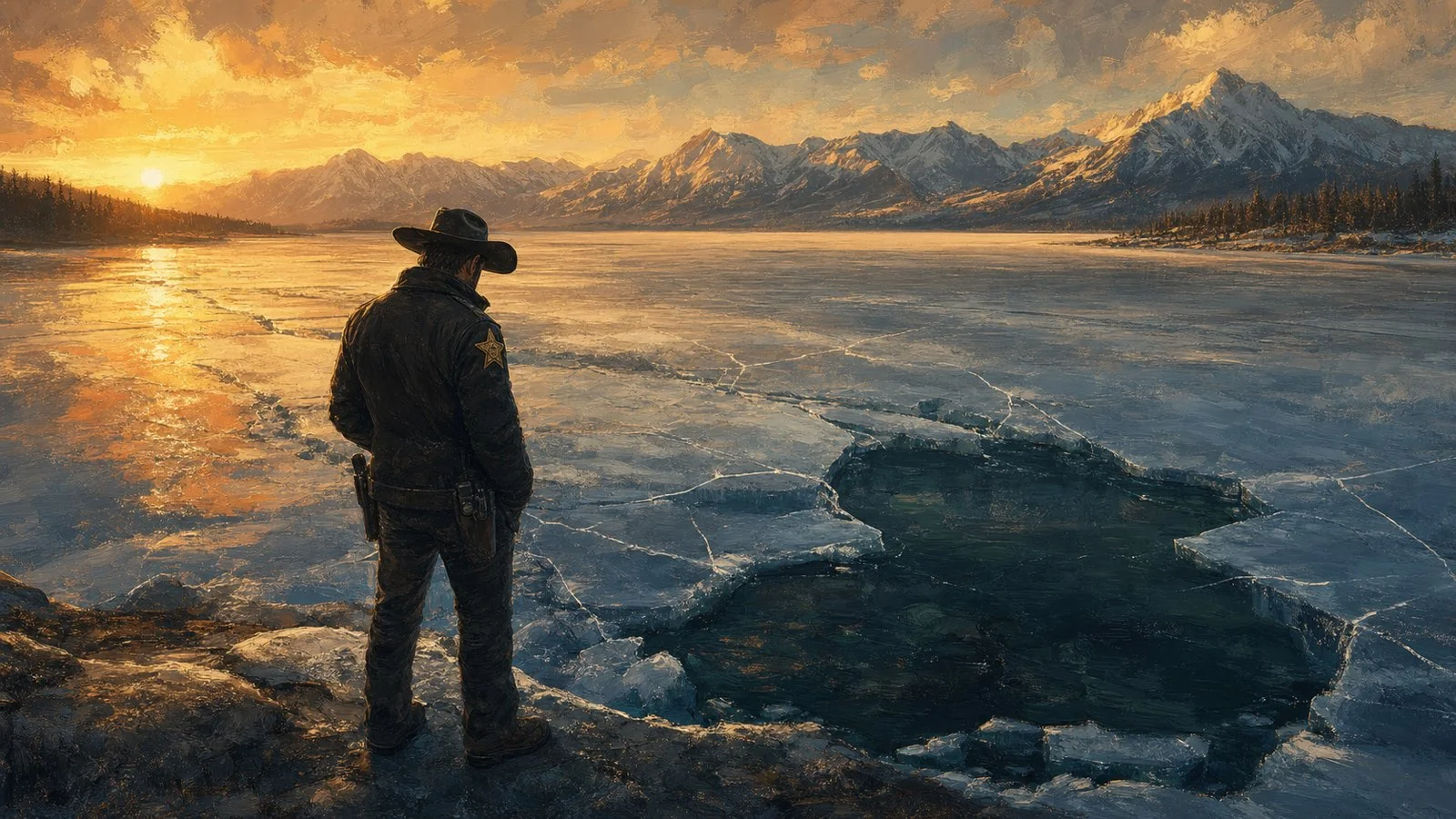
Neil seizes his one opening. He kicks the fire apart, forcing Kayce and Calvin outdoors for more kindling, and makes a run for it. The blizzard is almost a wall. Calvin goes after him, Neil baits him onto a frozen lake, and Calvin goes through.
The scene’s staging matters. Kayce gets Calvin out with SEAL-trained mechanics — rope, leverage, the same hand-over-hand extraction the training built into both of them — and then commandeers Neil’s thermal layer to bring Calvin’s core temperature up. When Neil protests that “the law protects me,” Kayce answers clean: “Only law out here right now is survival of the fittest.” He uncuffs Neil and lets him walk. Neil’s read of the situation — that Kayce won’t shoot him with Calvin watching — is correct, and also wrong in a way the episode saves for later.
Neil eventually reaches Benson, his armed partner. The reunion is brief. When Andrea, Miles, and backup converge on the Madison Range, Benson ends up dead, Neil slips away, and Calvin, barely functional from hypothermia, has to watch Kayce admit that the fugitive got clean. Gifford will be furious. Neither Kayce nor Calvin cares much, because the episode has already told them something that outweighs the case.
The Roner Confession
The best scene in the episode happens near the fire, after Calvin is warm enough to speak. Kayce pulls the story out of him slowly.
Calvin had always let Kayce believe that Roner’s death was on Kayce’s call — that Kayce’s decision had cost their brother his life. The truth was different. Garrett, coming out of RPG shock, told Calvin that Roner was dead. Garrett believed it. Calvin believed Garrett. The fall-back order went out. But drone footage captured minutes after the extraction showed Roner alive on the mountain. He died there later, alone, and they had already gone.
Calvin knew this for years and said nothing. His reason, delivered quietly: “You blaming Double G? He spun out enough as it was. He would’ve suck-started his own pistol for sure if he had to own that call.” So Calvin absorbed Kayce’s blame instead. He let the guilt spread over himself and Kayce and even Roner’s memory rather than let Garrett carry the weight of a call that wasn’t — strictly speaking — even wrong. There were fifty Taliban. RPGs had already fired. It was fog of war.
“Roner’s death wasn’t on you,” Calvin tells Kayce. “It wasn’t on Double G, either. Only war is to blame.” Then, after a long pause: “Can’t outrun your past. So where’s that put us, Coyo? Trying to mend a wound that won’t heal.”
The scene is careful not to turn Calvin into a hero. He held the truth in place for years — not purely to protect Garrett, but because the alternative meant reopening something none of them had the capacity to survive. What the episode argues is that burying the truth was a form of care that eventually became its own damage. Digging it up is the only way to lose Roner without losing the brotherhood at the same time.
Thomas Rainwater and the Crestmark Mine Hearing
The political subplot runs with a quieter violence. Rainwater corners Senator Conner at the casino while her jet is grounded by the same storm. He is direct about the Crestmark mine and what it means for Broken Rock’s water. Conner is careful — she went to Wharton with the CEO, she needs something to sell the subcommittee, and she is not going to stick her neck out on principle alone.
Miles’s introduction changes the math. Rainwater presents him — a Broken Rock-born Marine and Marshal who just ended a hostage situation the previous day — to the senator without warning. Miles speaks for himself: “Broken Rock is sacred land. Idea of leaving it worse for those who follow us — isn’t that the opposite of the American dream?” Conner cannot answer that in front of Thomas Rainwater and survive the optics. She agrees to facilitate a subcommittee hearing.
The scene is a clean calibration of how Rainwater operates. He does not fight the senator on her terms. He brings a human being whose service record and tribal identity collapse her talking points from inside the room. It is the same move the franchise has used since Yellowstone S1 — patience, leverage, institutional aikido — and Marshals is the first time it produces a quick procedural win rather than another long slow push.
Garrett Dies Offscreen
The episode reserves its hardest hit for the final ninety seconds. Kayce comes back down the mountain: Neil loose, Cal alive, Benson dead. A nurse meets him at the hospital entrance. Garrett’s smoke inhalation from the Clegg fire damaged his lungs badly enough that his heart gave out under the strain. He died two hours ago.
The show does not cut to Garrett in his last moments. It does not give Kayce a goodbye. What it gives him instead is the note in Garrett’s belongings — “Brothers forever” — and the line Calvin said in the mountains, which now doubles back: “The best of us don’t come home.”
The timing is deliberate cruelty. Calvin just told Kayce the full truth about Roner and offered the possibility that the remaining Musketeers might repair something instead of just carrying it. And then Garrett dies before Kayce can tell him that Roner was never his fault. The wound stays open. The brotherhood cannot be mended the way Calvin imagined. There are only two of them left.
Pros
- The cabin confrontation earns its weight because the episode builds physical stakes for the full first act before allowing the conversation to happen.
- Calvin’s motive for burying the Roner truth is genuinely complex — it is protective and also self-serving and also possibly correct in the short term — and the script does not simplify any of that.
- The Rainwater-Conner scene is efficient without being thin; Miles’s speech does political and character work in the same thirty seconds.
- Garrett dying offscreen keeps Kayce’s grief private and unresolved, which is the right call for a character who processes damage by carrying it forward rather than expressing it.
Cons
- Neil escaping at episode’s end is procedurally necessary but slightly undercuts the blizzard strand — after everything the episode put Kayce and Calvin through, having the fugitive walk away in the confusion reads as deflation rather than complication.
- Don Benson arrives and dies in the final act without enough screen time to feel like a genuine threat; the episode treats him as a plot mechanism rather than a character.
- Senator Conner’s agreement to facilitate a hearing resolves too cleanly; one scene of a grounded senator and one good speech should not move this particular political needle so far.
What This Sets Up for the Finale
The season closer needs to answer where Neil Lamb goes with no partner, no recovered money, and a full marshal service now oriented toward his capture. It also has to reckon with Kayce’s position: Calvin is alive, the Roner truth is finally out, but Garrett is dead and the reunion the episode was building toward will never happen. Neil’s accusation — that Kayce was in those mountains to silence him because the Duttons operate as “gangsters on horseback” — is still on the table. Kayce told Calvin his hypothermia wiped the memory. Whether that holds when Gifford starts asking questions is the finale’s real open door.
Rating: 8.1/10
Universe Context
“On Thin Ice” sits at the intersection of two threads the Yellowstone universe has been pulling on since its first season.
The first is Kayce’s relationship to guilt. In Yellowstone S1E02, Kayce admitted to John that he shot Robert Long — Monica’s brother — and John absorbed the confession and turned it into operational material for the ranch. In “On Thin Ice,” Calvin has done something structurally identical: absorbed Kayce’s misplaced guilt about Roner and carried it for years because redistributing it was too dangerous. Both John and Calvin made protective calculations that cost Kayce the truth. The difference is that Calvin’s calculation came from love rather than leverage, and the episode is honest that the distinction matters even if the outcome was the same kind of damage.
The second thread is [[thomas-rainwater]]’s long institutional war against the forces eating at Broken Rock’s sovereignty. In Yellowstone proper, Rainwater spent multiple seasons watching political capital burn before the sale of the ranch to the reservation in S5. In Marshals, the mine subplot gives him a smaller, faster theater for the same contest — and it wins a round by putting Miles in the room instead of relying on legal argument. The franchise has always been most interesting when Rainwater wins by means the Duttons would not think to use.
For viewers tracking [[kayce-dutton]]’s arc across both shows, “On Thin Ice” is the episode where the cost of his family’s methods finally arrives as explicit accusation rather than implication. Neil calling the Duttons “gangsters on horseback” repeats what the audience already knew from Yellowstone; what the episode adds is that Kayce hears it now without John alive to absorb and redirect it. He carries it alone, the same way he carried Roner.
Related characters: [[kayce-dutton]] · [[thomas-rainwater]] · [[monica-long-dutton]] · [[lee-dutton]]
More episodes from Marshals — Kayce Dutton after Yellowstone, episode by episode. Jump to any episode in the season:
Where to go next
Reviewed by Mira Vance · QuizFandom Editor & Lead Reviewer. Every rating is an honest per-watch assessment from the desk that also writes the quizzes — not a press release rehash.