Marshals S1E6 Recap: Ten Girls Found, One Father Still Looking
Marshals, Season 1, Episode 6 — “Out of the Shadows” Paramount Network / Yellowstone Universe
“Out of the Shadows” is the episode where the Marshals unit earns its name — not through gunfight choreography but through the slower, grittier work of delivering impossible news, sitting with grief, and infiltrating a biker rally on borrowed cover. The ten missing girls from Broken Rock Reservation come home. The cost of getting there is paid across every scene: a next-of-kin notification that breaks a woman in her own office, a father-son conversation on the anniversary of Monica’s death, a Rainwater monologue that lands harder than any of the physical confrontations. Kayce Dutton (Luke Grimes) spends the episode moving between investigation and inheritance — the badge in his hand, the rez at his back, and his dead wife’s memory pulling at both.
Kayce and Miles Deliver the Notification at Rainwater’s Office
The cold open drops us mid-stall. Calvin has been running the investigation while Miles keeps delaying Ava’s next-of-kin notification. Calvin’s patience runs out in the first scene — two days of round-the-clock work, no new actionables, and Ava’s mother still doesn’t know. “Sera deserves to know the truth, Miles,” Calvin says. “Giving her a shot at closure is your new priority.”
The notification scene at Tribal Chairman Thomas Rainwater’s office is the episode’s gut-punch. Miles freezes. He calls Sera “ma’am” until she corrects him — “You’ve called me ‘Auntie’ since you were in diapers” — and then he freezes again. Calvin delivers the news directly, without ceremony: “I am so sorry, ma’am, but Ava’s no longer with us. She was killed by the men trafficking her.” What follows is not a dramatic beat but an overhead weight. Rainwater absorbs the information before landing on the part that matters most to him: “How can he protect them when you can’t find them?”
Calvin’s quiet reflection to Miles afterward earns its place. He recounts the first casualty notification he ever made — taking the Angel Flight with a fallen teammate, standing next to the XO, not getting a single word out. The XO pulled him aside afterward and said: “We do this job because others can’t.” That line becomes the episode’s thesis, spoken twice — once in the middle of the darkest moment and once at the end, after the girls are found, when it means something different.
The Iron Sentinels Lead and the Mechanic Connection
The investigation arm of the episode moves briskly. Belle pulls security footage linking Bludsoe to mechanic Eli Craig’s garage — a short visit, less than five minutes, with a third party wearing an Iron Sentinels vest. Craig has lawyered up and won’t talk. The connection is thin, but it’s the only thread left.
The Iron Sentinels are flagged immediately as a different class of threat from Bludsoe: ultraviolent, highly organized, a mafia on wheels. “If they can profit from it, they’ll do it.” A clubhouse near Cowan — fully fortified, always busy — is not a door the team can kick. Calvin authorizes surveillance while the rest dig into the Bludsoe-Craig connection.
An intelligence sweep of Bludsoe’s recovered cell produces the next lead: a text placing a nomad named Brimstone — Keith Stelton, Iron Sentinels enforcer — at a rally in the Milk River valley area. “Brimstone’s bringing the entertainment.” That word choice carries all the dread it needs to. Belle has prior undercover history with the Sentinels, specifically with a St. Louis chapter member called Squirrel. She proposes reactivating that cover with fifteen kilos of confiscated meth as the entry ticket.
Calvin’s approval is conditional and reluctant: “If you get burned, you’re gonna be on your own.” Belle’s answer is clean: “I’m happy to do it for these girls. And they’re as good as gone if we don’t try this.”
Rainwater Confronts Kayce on Grief and Guilt
Between scenes, Rainwater and Mo arrive at the Dutton property. Tate missed the preparation for a remembrance ceremony — his horse is gone. Thomas finds Kayce instead.
The confrontation is the episode’s best-written scene. Rainwater does not come to offer comfort. He comes to calibrate something. He notes that Tate is marking “a year without a mother, a friend taken by wolves.” Then, directly: “And a father who returned her to the very same pack.” Kayce doesn’t deflect — “Did you come here to beat me up? ‘Cause I’ve been doing plenty of that myself.” Rainwater acknowledges it and then pivots, relaying what Mo told him about how Kayce has been processing the case. Mo’s line carries the scene’s philosophical center: “The tighter we cling to our grief, the bigger shadow our sorrow casts behind us.”
Rainwater closes with what sounds like an instruction and arrives as something closer to a commission: “Finding our girls is the type of closure that even you can believe in, Kayce. Once you bring us this peace, and if you find the pack of wolves preying on our children — slaughter them all.”
The scene works because Rainwater isn’t asking Kayce to moderate his violence. He’s asking him to aim it. It’s a distinction Kayce has always struggled to maintain, and the show doesn’t pretend otherwise here.
Belle Goes Undercover at the Rally
The logistics of the undercover operation get just enough time. Fifteen kilos staged, cover reactivated, mobile HQ parked at the perimeter, hard armor and rifles staged in case it breaks. Belle walks in as “Brandi,” finds Squirrel, and plays the entry scene at the right pitch — claiming she did two years in Pocatello on an Idaho bust to explain her absence, arriving with product that backs up the story.
Belle navigates to Brimstone through Squirrel and the scene reads like a real undercover introduction: controlled, reading micro-reactions, never overselling. When Brimstone turns cagey — “Not so sure we can be partners, since something ain’t adding up” — she leans into ambiguity rather than closing off the gap. He surfaces a run to Calgary that night, different product, a buyer who’ll take hers too. Then a biker in the crowd places her face: the Laughing Elk casino, a blackjack table, a few weeks back. The cover begins to crack.
The blow-up happens fast. Squirrel pulls her away, her cover is functionally compromised. Kayce sends the team in, she extracts information from Squirrel at gunpoint — “Tell me how Brimstone’s moving the girls” — and gets a location: a box truck out back. The raid goes loud, automatic gunfire, Marshals pushing through a clearing crowd. The box truck carries the girls, not drugs. Miles finds them first. “We’re U.S. Marshals. You’re safe.” One of the girls confirms what Hayley’s tip pointed toward from the start: “You did it. You led us here. The place with the trees.”
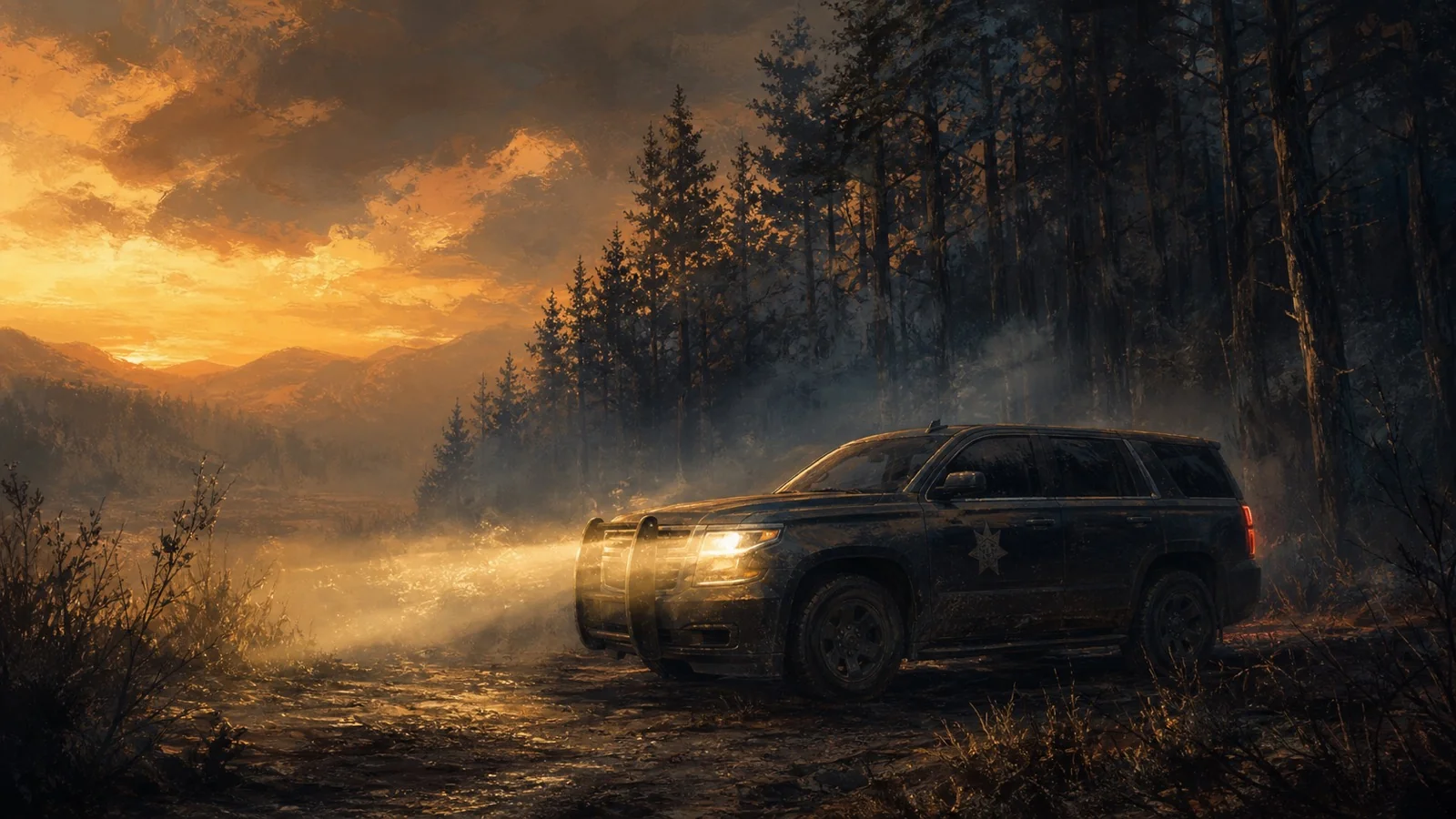
Tate’s Ceremony and the Weight of a Year
While the investigation closes, the personal threads converge on the Broken Rock memorial ceremony for the community’s departed from the past year. This is where the episode’s emotional accounting gets settled.
Kayce has been avoiding the anniversary of Monica’s death all episode, telling Tate he needs to keep his foot on the gas hunting for Hayley. The case closes in time. He arrives at the ceremony and Tate — who earlier said “I’m not the one avoiding it” — meets him without resentment. “I’m just glad you decided to do this.” Rainwater, surprised to see him, offers the closest thing to absolution the show allows for Kayce’s Yellowstone-era decisions: “Losing Monica was painful enough. Your presence makes me feel like I haven’t lost another son, too.”
At the end of the ceremony, Tate produces Monica’s necklace — he’s been clinging to it since she died — and says, “Maybe it’s time I start letting go.” The ceremony closes under Hozier’s “Work Song.” The choice is precise: a song about a man who survives because of love, who would crawl home to her, who was freed by her presence. It maps cleanly onto both Kayce’s relationship with Monica’s memory and the girls finally being returned to their families. The episode earns the needle drop by not explaining it.
Calvin’s parallel thread functions as counterweight to Kayce’s visible grief. He’s better at finding missing girls than reconnecting with his own daughter Maddie. After the rescue, he stands apart from the ceremony itself, choosing to support Tate from outside the circle rather than claim a space in it. The team’s final moment — “If we can bleed together, well, we can grieve together” — lands because the episode has actually earned it through Miles barely holding together at the notification scene and the full team going into an outnumbered rally with nothing but five shooters and one woman’s old cover.
Pros
- The next-of-kin notification sequence is the most restrained and most affecting thing the show has done — Miles’s freeze, Calvin’s clean delivery, Sera’s response.
- Rainwater’s confrontation with Kayce threads political pressure, personal grief, and moral commission without any of them collapsing into the others.
- Belle’s undercover work is specific and procedural — the cover doesn’t hold because of chance, not incompetence, which respects the work she put in.
- The Hozier closing scene earns the needle drop because the song’s emotional logic maps exactly to what just happened, and the show trusts the audience to connect it without underlining.
Cons
- Andrea’s subplot about an apartment unit available across from hers gets telegraphed and then dropped in the same scene — setup with no weight yet.
- The Belle-Squirrel backstory implies a more complex relationship than the episode has time to develop, making Squirrel’s gunpoint cooperation feel slightly underearned.
- The timeline of how Kayce gets from “foot on the gas” to present at the ceremony is compressed nearly to invisibility; one beat of him making the decision to show up would have given the payoff more ground.
What This Sets Up for E7
The ten girls are recovered and Brimstone has been burned as a lead. The next phase of the investigation almost certainly pivots: Hayley is still out there, Greeneyes44 has been linked to fourteen other girls from reservations across Montana, and the total reported-missing count is forty-three — and those are just the ones reported. Calvin has been eating friction from Gifford over resource allocation throughout this episode. That institutional pressure doesn’t go away because of one successful raid.
The Tate ceremony closes the Monica grief arc for this leg of the season, but Kayce’s accountability — to Hayley’s mother, to Rainwater, to the community’s trust — is unresolved. Rainwater’s “slaughter them all” isn’t a figure of speech.
Rating: 8.4/10
Universe Context
Kayce Dutton in the Yellowstone franchise
[[kayce-dutton]] arrives in Marshals as the final iteration of a character the franchise spent five Yellowstone seasons building: a man trained for lethal force who cannot stop questioning whether the cause justifies the body count. His relationship with Broken Rock predates the Marshals badge — he spent years living on the rez with Monica, estranged from John, before Lee’s death in Yellowstone S1E01 pulled him back into Dutton orbit.
The notification scene in this episode resonates differently if you have watched [[thomas-rainwater]] operate across Yellowstone. Rainwater has been managing federal indifference to reservation crisis since the show’s first season — his anger at Calvin is not hot rage but cold recognition: the machinery of law enforcement moves slowly over this ground, and the people who absorb the delay are his. His “slaughter them all” has the same register as his political maneuvering in the main series — not bloodlust, but a man who has learned that justice rarely arrives through the right channels and is authorizing what he cannot officially endorse.
[[mo]] appears briefly but his line — “The tighter we cling to our grief, the bigger shadow our sorrow casts behind us” — is consistent with his function across both properties: moral anchor for Kayce when Rainwater chooses commission over comfort. Mo is the person Kayce trusts to tell him what he doesn’t want to hear. That role doesn’t change because the badge changed.
Tate’s Monica necklace moment is the show’s clearest bridge to Yellowstone S5’s emotional fallout. Monica’s death left Kayce the sole parent and Tate carrying a loss the main series only partially processed. The ceremony here is as close as the franchise gets to addressing that grief directly — and it works precisely because the episode earns it through the case, not through a standalone grief episode disconnected from the work.
More episodes from Marshals — Kayce Dutton after Yellowstone, episode by episode. Jump to any episode in the season:
Where to go next
Reviewed by Mira Vance · QuizFandom Editor & Lead Reviewer. Every rating is an honest per-watch assessment from the desk that also writes the quizzes — not a press release rehash.