Mayor of Kingstown S2E1 Review: A Boat, A Body Count, and No Peace
Season 2 opens in the wreckage of the riot, where every attempted rescue becomes another form of containment.
Mayor of Kingstown begins Season 2 by refusing the fantasy that the prison riot ended when the shooting stopped. “Never Missed a Pigeon” treats the riot as an event that has moved into bodies, streets, paperwork, and family rituals. Mike McLusky (Jeremy Renner) is still trying to move people into safer positions, but the town has lost the thing his work depends on: a hierarchy he can bargain with. This is less a reset than an autopsy performed while the patient keeps walking.
Mike Tries to Give Iris Water Instead of Walls
The episode opens with Mike guiding Iris (Emma Laird) blindfolded onto a seized boat, a strange little mercy staged inside a life built from confiscated property. He tells her she can remove the blindfold only once they are on the water, then admits the boat belongs to a drug seizure and is headed to auction. That detail keeps the scene honest. Even Mike’s gentleness arrives through the evidence locker.
Their conversation is one of the hour’s few pauses. Iris asks whose boat it is, whether Mike knows how to sail, whether they could take it somewhere and get dinner. Mike has no idea how to sail, but the boat has a wheel and an engine. He says they can anchor in the middle of the lake, where there are no bears, and where the sway might cure both of their sleeplessness.
The lake material works because it is not presented as healing. Mike’s voiceover about his father turns the boat into a memory exercise: old age softening the mind, bad memories rotting away, a journal preserving only the good ones. Mike knows better. He says minds do not forget easily; horror takes root, and only madness or dementia can remove it. The line lands over Iris’s fragile calm and Kareem’s nightmare at home.
Kareem (Michael Beach) wakes screaming, and Vanessa has to remind him that he is home. His child appears in the doorway, frightened by a father’s terror that the family cannot fully understand. When Vanessa asks if he wants the light off, Kareem says to leave it on. The moment is plain and devastating. After the riot, even the home bedroom has become a cell that needs visibility to feel survivable.
Mike later tries to move Iris from the boat into witness protection, and the episode sharpens the difference between safety and belonging. Agent Song tells him he cannot know where they are taking her, possibly Denver or Scottsdale, because he may have been followed. Iris refuses once she realizes the arrangement means no calls, no visits, no Mike. She asks why he did something as nice as the boat, and he insists it was for her, a second chance. She hears the self-absolution in it.
The Riot Has No Aftermath, Only New Management
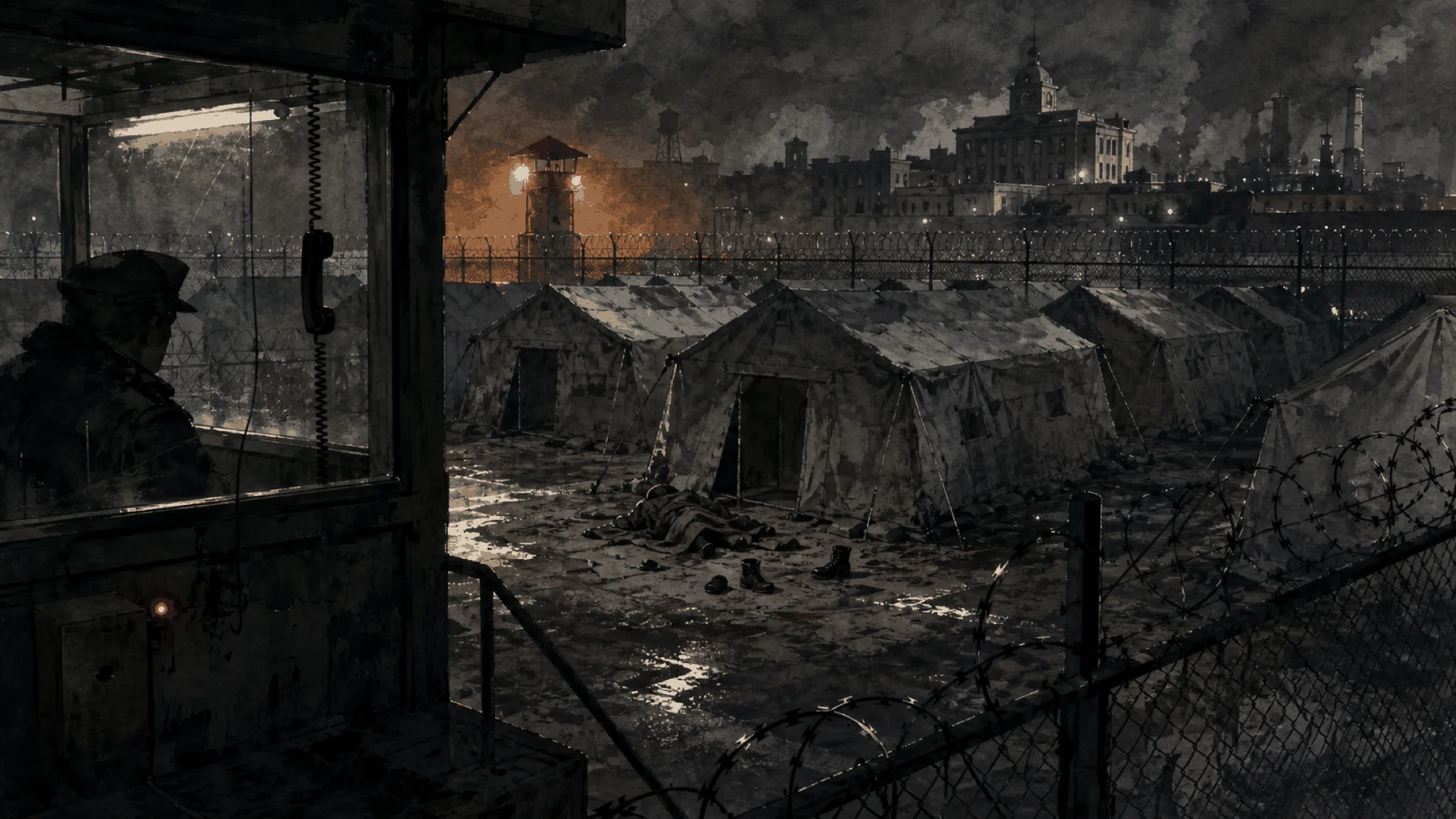
Inside the temporary prison camp, Season 2 states its governing problem with blunt efficiency. The riot exposed that guards controlled the prison only as long as the illusion held. The armed response then destroyed the inmate leadership structure that made the illegal order legible. What remains is heat, detox, tents, and random violence waiting for a new command chain.
The early yard scene shows an inmate beating while a guard reports the location and then asks whether anyone cares. No one does. That is the new correctional posture: observation without intervention, discipline without governance. Robert Sawyer (Hamish Allan-Headley) and his team hit a drug depot at the Towers after a Blood calls in a tip, and Robert shoots a man after ordering him three times to drop his weapon. The raid may be tactically clean, but Mike understands that the cook house belonged to Bunny Washington (Tobi Bamtefa), the one outside leader with enough sense to keep the city from tipping further.
Bunny’s rooftop scene gives the episode its best political diagnosis. He is not up there to look powerful; he is trying to avoid a drive-by. Mike warns him that police drones will notice if he sells from the roof, but Bunny says he is not selling there. He is hiding high enough that anyone who wants to hit him will need something like a helicopter.
Their argument turns on the absence of leaders. Bunny says there is nobody left inside worth choosing, because SWAT and soldiers nearly killed everyone who had authority. The men remaining are too green or too weak to run anything. He also explains how new leaders rise: someone takes a trophy. In this case, that means badge hunting. Mike knows what follows if a badge goes down. Tanks in the streets, guards thirsty for another round, a city using the riot as permission to escalate.
The diner meeting with Ian Ferguson (Hugh Dillon), Carney, Robert, and the others turns the same problem into policy. The officers describe men in the parking lot walking like zombies from heat and detox, whites losing their structure, Mexicans seeming to have one, Bloods and Crips brawling without weapons. Mike asks them to pull back from cook-house raids while increasing street presence. He is not asking them to be gentle. He is asking them to understand that a criminal pecking order can function as public safety when the official one has collapsed.
That is the episode’s sharpest discomfort. Mike is arguing for order through gang management, not reform. The state needs criminals to organize themselves so the state can predict them. Kingstown’s peace is administrative.
Milo’s Absence Becomes the Loudest Fact in the Room
The episode’s strongest engine is Milo Sunter’s missing body. At the diner, Mike asks where administrative segregation is, only to learn there is none; everyone has been thrown together. When he asks whether Milo is in general population, the answer is worse than confirmation. Nobody knows. There are roughly 300 bodies being identified, with burned records, destroyed computers, and cadavers being fingerprinted.
Stevie’s question about Duke tightens the pressure around Mike. Duke’s last call was with Mike before he was killed, and the phone is missing, though the data may still exist somewhere. Stevie is not accusing him as much as asking how much cleanup is required. Mike answers with the only accurate scope: everything is broken, so sweep everything. The line works because it is both obstruction and diagnosis. The riot has made every file, body, phone, and favor suspect.
At the coroner’s, Evelyn gives Mike the scale: 197 dead and 724 criminal investigations. She says internal affairs will be looking at Robert’s team because almost half the dead came through there, with .223 shells left like breadcrumbs and little sign of anyone shooting back. Mike narrows in on Milo, because Milo missing is the single fact that can turn institutional chaos into a private apocalypse.
Evelyn says there are unidentified bodies, including sex offenders tortured and burned. Mike rejects the possibility that Milo is among them. Nobody torches Milo, he argues, because Milo used every gang in the prison and had the intelligence to exploit the riot. When Evelyn asks whether he simply walked out the front gate, Mike says maybe, then asks whether anyone has inventoried guard uniforms. They have not. Mike’s paranoia is also a form of expertise.
That fear finds Iris before it finds proof. While federal agents discuss the odds that Milo is dead or still moving, Iris realizes Mike did not tell her why she was being hidden. Her response is anger, not panic. She reminds them there were three agents with her the last time Milo took her, and she does not believe they can protect her at all. By the time she appears at Mike’s empty office, the question is stripped to its bluntest form: is Milo out? Mike says he does not know. When she asks what his heart tells him, he admits it tells him it is true.
The episode also uses Mariam McLusky (Dianne Wiest) and Kyle McLusky (Taylor Handley) to show how far the fracture spreads beyond Mike’s office. Mariam tries to teach incarcerated women about choice, then cannot continue with armed officers pacing the classroom. Later, a teen named Marco Diaz robs her outside a liquor store. Ian says police found a knife on him; Mariam insists he did not use one and refuses to press charges after seeing how badly officers have beaten him. She can see the pipeline forming in real time.
Kyle, meanwhile, has taken a job on the water and brings Kingstown habits with him. A maple-syrup smuggling stop turns into a near tactical farce because he approaches it like a drug boat, gun drawn and threat level raised. His partner Morass has to explain that drugs go the other way and that tariff-jumpers are not the same category. The scene is funny on the surface, but Kyle’s overreaction carries the prison under his skin. He has left the city, not the posture it trained into him.
What this episode argues
“Never Missed a Pigeon” is named for the old man who sends messages to his son by bird because calls and texts can be missed, but a pigeon never is. It gives the hour its counter-image to Kingstown’s failed communications. Phones vanish into evidence questions. Prison leadership cannot send messages in or out. Federal protection requires Iris to disappear so completely that connection becomes danger. The pigeon is absurdly old-fashioned, yet it is the only system here that still works as promised.
The wider argument is that institutions do not merely fail here; they shed responsibility downward. Guards traumatized by rape and violence ask to return to work or look for revenge. Inmates are dumped into tents and expected to regenerate hierarchy through force. Police inflate charges, look away from beatings, or ask Mike how much cleanup he needs. Mike keeps trying to broker stability, but the hour keeps showing the cost of a town where stability depends on men like him knowing which crimes to tolerate.
Verdict
Season 2 Episode 1 is a strong, grim re-entry that treats the riot as a beginning rather than a climax. The boat scenes with Iris are quiet without becoming soft, Bunny’s rooftop diagnosis gives the street war a credible structure, and Milo’s possible escape gives the hour a clean thread through the sprawl. Some exposition is heavy, especially in Mike’s narration and the policy talk around the tents, but the heaviness fits a premiere tasked with mapping a disaster.
No one in the premiere gets to stand outside the damage, and that is its best quality. Kareem carries it home, Mariam meets it in a classroom and a parking lot, Kyle exports it to a new job, Iris recognizes it before anyone says the name, and Mike keeps mistaking movement for control. Kingstown has survived the riot. That may be the problem.
Rating: 8.4/10
More episodes from Mayor of Kingstown — Season 2 — The prison-town drama widens — Mike McLusky after the riot. Jump to any episode in the season:
Where to go next
Reviewed by Mira Vance · QuizFandom Editor & Lead Reviewer. Every rating is an honest per-watch assessment from the desk that also writes the quizzes — not a press release rehash.