Pluribus S1E01 Review: Carol Sturka Meets the End of Privacy and Mercy
What happens — the short version (spoilers)
- Scientists detect a repeating signal from 600 light years away and decode it into an RNA-like recipe, which they build into a physical sequence in the lab.
- Carol Sturka, a romance novelist who privately resents her Wycaro books, does a book signing and bickers tenderly with her partner Helen over whether her work means anything.
- The world starts breaking down in the background until Helen collapses; Carol gets her to an ER, Helen briefly opens her eyes, then is effectively gone.
- Carol wakes into an aftermath where joined people calmly carry Helen's body, know her name and the spot where she hid a spare key, and insist they only want to help.
- A White House message routes Carol to Davis Taffler, who explains the signal, the deaths, and that the joined are now a single gentle collective.
- Carol is told there are only eleven other immune people; the hive wants to study her difference so they can correct it and let her join, leaving her question "What if I say no?" unanswered.
Vince Gilligan opens his Apple TV+ series by letting a cosmic signal ruin one romance novelist's worst book-tour night.
Pluribus begins with two kinds of language that should not belong in the same hour: a signal from 600 light years away and a pirate-romance passage about Lucasia, Raban, and the immortal sliding sands. That pairing tells us a lot before the bodies hit the ground. This is a pilot about transmission, interpretation, authorship, and the terror of being known too well. It also knows apocalypse is more frightening when the people left standing keep apologizing.
The signal arrives before anyone knows how to fear it
The cold open has the clean thrill of old laboratory science fiction: people in a room, looking at data, trying to make the impossible smaller by naming it. A repeating transmission appears at seventy-eight-second intervals. At first, the objections are practical. Maybe it is reflected from the moon. Maybe it is Fort Collins. Maybe it is some terrestrial chatter from people talking too much about trees. The scene patiently strips away every comforting explanation. The signal drifts. It repeats. It comes from 600 light years away.
Gilligan and company let the discovery carry a little wonder before they poison it. The early conversation about pulse-duration modulation, four frequencies, and quaternary code puts the audience inside the exact mistake that becomes fatal: the human need to decode a message as if decoding were automatically a good act. Four tones look like a puzzle. A puzzle looks like an invitation. By the time the White House broadcast explains that those tones correspond to guanine, uracil, adenine, and cytosine, the earlier excitement feels sickeningly naive.
The choice to start far from Carol is bold because the hour then leaves those scientists behind for a long stretch. The opening does not ask us to bond with the discoverers. It asks us to remember that the catastrophe began as professional curiosity. Someone saw a pattern and wanted to know what it said. Someone decided that an alien recipe for an RNA-like nucleotide sequence should be made physical. The pilot never lingers on blame, but the blame is present in the shape of the story. A signal is not an invasion until someone builds a body for it.
That is why the animal-lab sequence lands so well. Months of testing have produced nothing dramatic in macaques, rabbits, mice, guinea pigs, and finally rats. The researchers are tired enough to joke about donuts and guilty enough to debate heart sticks versus gas. Then a rat that looks dead has a strong heartbeat, bites Jenn through a glove, and a routine disposal becomes the first visible break in the world. The scene is spare, procedural, and awful. It does not need a monster when a lab worker calling a friend’s name down a hallway is enough.
Carol’s fantasy empire is smaller than her grief
When the pilot cuts to Carol Sturka reading from Bloodsong of Wycaro, it seems at first like a different show walking through the wrong door. Rhea Seehorn plays Carol as a woman who has become very good at selling something she can no longer respect. She reads the ornate romance prose with enough professional commitment to keep the fans fed, then punctures the performance the second she is in private. The joke is not that speculative historical romance is silly. The joke is that Carol is trapped inside a success she resents and still cannot quite dismiss, because the people who love it are embarrassingly real.
The signing sequence is full of sharp social detail. A fan worries because Raban is absent from the cover. Another brings a homemade pillow. Someone asks about a Wycaro movie and insists ILM must handle the sliding sand. A man with a real machete corrects Carol on the mast of a two-masted schooner. Carol can be rude, impatient, and visibly allergic to the devotional energy around her, yet the scene never treats the fans as disposable. Their attention matters. Their feeling matters. That tension is important because Carol’s later nightmare is a world where attention becomes total and feeling becomes compulsory.
Her relationship with Helen gives the pilot its human scale. Miriam Shor makes Helen’s affection feel practical rather than sentimental. She manages the crowd, nudges Carol through exhaustion, and refuses to let her partner sneer herself into a corner. In the bar after the signing, Carol calls the tour something to be endured, mocks the purple sand, and compares her own work to a bad Star Trek episode. Helen pushes back without pretending the books are high art. If one person is made happy, she says, maybe that is not art, but it is something. In a series built around collective bliss, that modest sentence is devastating. Helen defends chosen attachment: one person answering another person.
Carol’s contempt and tenderness sit side by side. She wants to write Bitter Chrysalis, her serious book, but cannot release it because it still needs polish, or because she fears what happens when no genre machinery protects her. She jokes about George Clooney as Raban’s real-world model because a safer lie is easier than a charged truth. She asks Helen for cigarettes even though she does not smoke, then fusses over lighter etiquette while emergency news flickers behind them. The end of the world reaches them first as background noise, then as behavior that does not parse: planes flying in parallel overhead, a man sitting wrong in public, Helen staring at a phone instead of answering Carol.
Then Helen falls. The pilot’s most punishing movement is not the global disaster montage but Carol’s narrowing panic. She calls for help. The emergency line loops. Cars sit with dead or vanished people inside. She tries to rescue strangers, fails, curses, keeps moving. When she finds Dr. Nguyen unresponsive and then gets Helen to an emergency room, the show briefly offers the cruelest possible hope. Helen opens her eyes. Carol says “Baby.” Then the body in front of her is not returned to her in any meaningful sense. Helen is there, and Helen is gone.
The hive mind is courteous enough to be monstrous
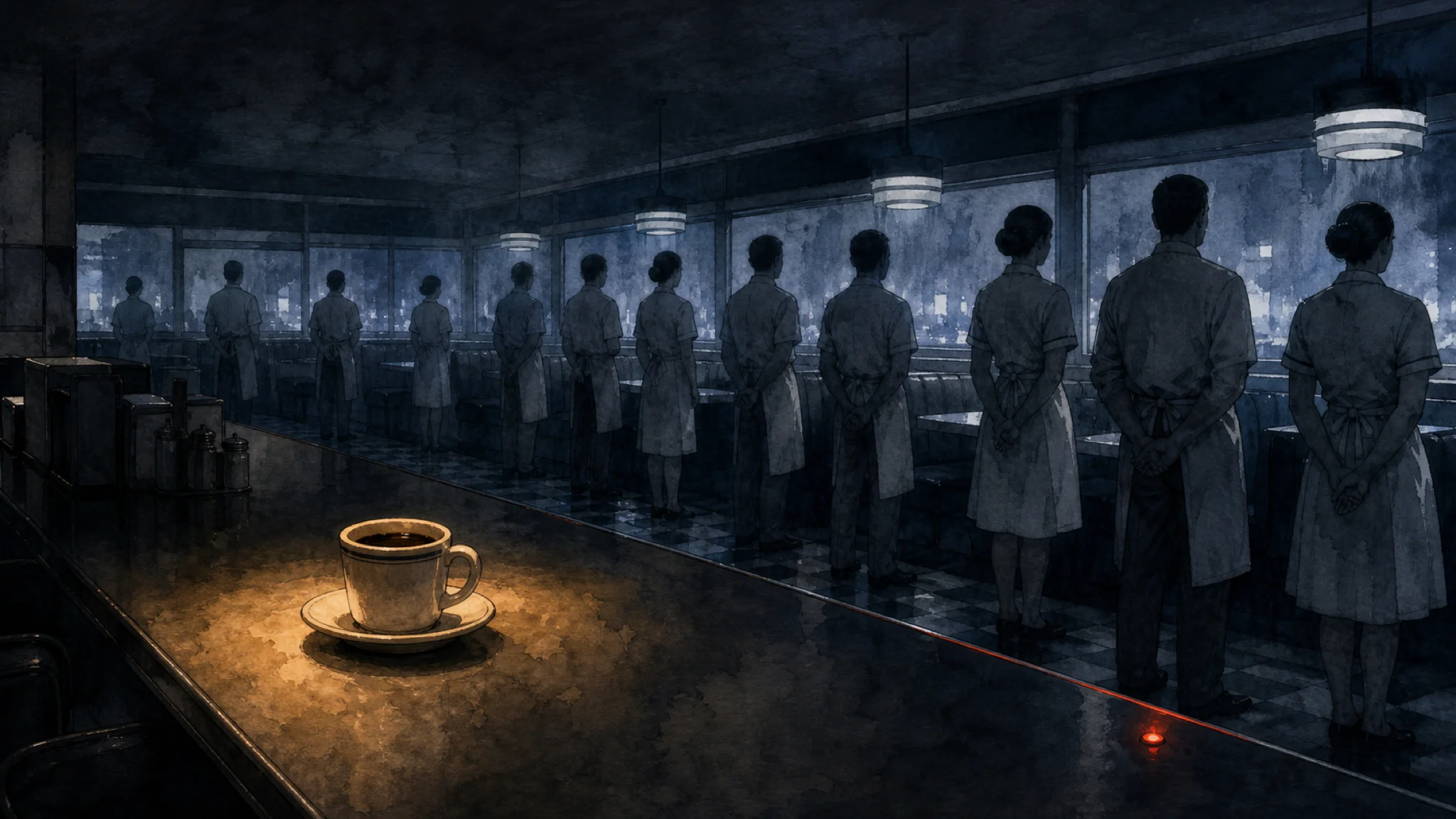
Pluribus makes its joined humanity terrifying by making it calm. Once Carol wakes into the aftermath, people do not lunge at her. They do not chant. They do not threaten. They carry Helen’s body and tell Carol they only want to help. They know her name. They know where she hid a spare key in April 2016, under the right-hand pot. They back away when she asks to be left alone. They send condolences. The politeness is the horror.
This is the pilot’s smartest genre move. Many hive-mind stories lean on bodies made vacant, militarized, or insectile. Pluribus instead imagines unanimity as customer service. Every word from the joined people has the tone of a help line trained never to escalate. They are patient with Carol’s profanity. They validate her confusion. They tell her she is safe. They insist her life belongs to her. The more reasonable they sound, the more frightening the situation becomes, because their courtesy has no privacy behind it.
The White House sequence sharpens that dread with bureaucratic absurdity. Carol turns on the television and finds a direct message waiting for her, complete with a phone number and a line promising no pressure. When she calls, the man speaking from the White House says all the right things in the wrong voice. Peter Bergman appears through Davis Taffler, identified as an agriculture and environmental-protection undersecretary who happens to be alive, nearby, and wearing a suit after the president and several senior officials die. That explanation is funny for half a second, then chilling, because political legitimacy has been replaced by bodily availability. Nobody is in charge, or everyone is.
The joined account of the event is both lucid and morally slippery. Fourteen months earlier, astronomers detected the signal. Scientists created the sequence. The result is described as comparable to a virus but not exactly alive, a kind of spiritual glue binding people together. The phrase is almost embarrassingly gentle. Spiritual glue. It sounds like a wellness product until one remembers the bodies in cars, the dead officials, Helen’s collapse, the shuttered mobile networks, and the global cleanup the joined are eager to perform before Carol has to look at too much of it.
Carol’s immunity gives the series a clean dramatic problem, but the pilot wisely refuses to make immunity feel heroic yet. There are only eleven other people like her in the world, she is told. The joined want to find out what makes her different so they can correct it and let her join them. That is the line where comfort curdles into coercion. They are sorry. They want to help. They also cannot imagine why refusal would remain meaningful once Carol understands how wonderful the collective condition is. Her question, “What if I say no?” hangs in the room because the answer never really arrives.
What this hour costs
The pilot makes a severe claim about happiness: imposed peace is still violence. It places Carol between two communities that love too much. Her Wycaro fans know her words, her characters, her running jokes, and her mistakes with the mast. The joined world knows her house, her grief, her phone number, her partner’s remains, and the old private fact of a hidden key. One form of attention is irritating but chosen. The other is gentle, universal, and unbearable.
That contrast gives the hour its best emotional texture. Carol begins by despising the people who keep her career alive, then wakes into a planet where being understood has become a biological condition. Her old life looks tacky, repetitive, and compromised, but it belongs to her. Her bad jokes, cigarette experiment, manuscript anxiety, and love for Helen are all messy because they are partial. Pluribus suggests that the self may depend on friction: the right to misunderstand, to disappoint, to say no, to keep one ugly little corner unshared.
Verdict
As a premiere, Pluribus S1E01 is patient, unnerving, and unusually confident about when to withhold scale. It gives us enough science to make the premise feel legible, enough grief to keep the apocalypse from becoming puzzle-box decoration, and enough black humor to preserve the Vince Gilligan signature without letting the hour turn cute. Seehorn is excellent from the start, particularly in the shift from professional irritability to raw animal panic. Shor gives Helen the warmth needed for the loss to register fast, and Bergman’s Davis Taffler gives the collective its blandly reassuring face.
The pilot’s only real risk is that its second half explains a great deal at once, with Davis laying out the signal, the RNA recipe, the deaths, the eleven immune holdouts, and the new global order in one extended call. Yet the scene works because Carol keeps interrupting its smoothness with ordinary outrage. She refuses the show’s premise on behalf of the viewer, then refuses the collective on behalf of herself. For a Gilligan pilot, this is near the top tier: precise, funny, mournful, and ready to make cosmic horror out of good manners.
Rating: 8.9/10
More episodes from Pluribus — Vince Gilligan's post-apocalyptic immune-vs-hive-mind drama, episode by episode. Jump to any episode in the season:
Where to go next
Reviewed by Mira Vance · QuizFandom Editor & Lead Reviewer. Every rating is an honest per-watch assessment from the desk that also writes the quizzes — not a press release rehash.