Pluribus S1E08 Review: Carol Gets Everything She Wants and Still Refuses
What happens — the short version (spoilers)
- Manousos wakes recovering and insists on being given the old-world hospital bill, $8,277.53 plus an ambulance, wanting a human-sized obligation he can understand.
- Carol relaxes with Zosia at home, playing card games and admitting she had a nice night, and sees the joined sleeping in rows in malls and churches since ownership is gone.
- Zosia shows Carol experiences she couldn't arrange alone, including a tender train-horn moment, then reveals the hive plans to spread the condition into space as "missionary gratitude."
- The joined rebuild a burned-down diner from nothing and bring back the waitress Bri from Miami to perform her old self, and Carol flees the staged manipulation.
- Carol demands Zosia say "I" instead of "we," calls the arrangement psychosis, and reaffirms someone has to put the world right even if everyone leaves her again.
- After sex and a morning where Zosia finally says "I love it" and shares a private childhood memory, the tone curdles: Zosia warns of a coming visitor as Carol grimly prepares something and starts an engine.
Carol lets the hive comfort her, then recognizes how dangerous a painless surrender can feel when grief is still awake.
Pluribus S1E08 is the season’s softest hour until it becomes one of its most alarming. Vince Gilligan lets Carol receive almost everything she has been denied since the Joining: company, games, work, touch, wonder. The terror is that none of it feels fake. Carol can see the cage more clearly because part of her wants to sit inside it.
Carol learns the comfort has teeth
The episode opens with Carlos-Manuel Vesga’s Manousos Oviedo waking. He is told that his infection is responding to antibiotics and that he needs rest. His first instinct is accounting, not gratitude. He rejects the answer of nothing and demands the bill the hospital would have charged before the Joining. The hive prints the figure with absurd precision: $8,277.53, in Balboas or American dollars. Manousos adds one ambulance to the debt and leaves.
It is a funny scene, but it frames the rest of the hour. Manousos wants an obligation he can understand. The joined world has abolished money and private property, yet he still reaches for the old ledger because debt is at least human-sized. If the hive gives without price, it also gives without permission. That becomes Carol’s problem too.
Back in Albuquerque, Carol is recovering with Zosia in her house. Rhea Seehorn plays these early scenes like someone trying to accept kindness without conceding the war. Carol drinks the lemonade, thanks people for helping her up, and awkwardly explains the O’Keeffe painting she has not returned by saying she was keeping it safe from roaming wolves and buffalo. Zosia offers to secure the museums. Carol jokes that nobody wants a buffalo eating the Mona Lisa.
The joke works because Karolina Wydra keeps Zosia warm enough to enjoy and strange enough to fear. When Carol looks for a game, every option exposes the asymmetry between them. Bananagrams is pointless because Zosia knows all the words. Chess is impossible. Risk becomes a gag about world domination. The childhood card game Spit seems safer until Zosia starts explaining its uncertain British origins and Carol snaps that playing cards with her is like playing with Google.
Still, the night gives Carol pleasure. She remembers her grandmother’s red and blue decks. She asks whether everyone is back after the mass incapacitation and hears that another hour or two should do it. Then she realizes she never asked where Zosia lives. The answer is sharp: there is no ownership anymore, and the joined sleep in malls, churches, and convention centers because heating and cooling one large room is more efficient than hundreds of small ones.
Carol sees the rows of sleeping bodies. She meets Bear Jordan, a dog who refuses to leave his former owner Malcolm. She is invited to sleep there too, with a private bed if she wants one. She declines, but the offer lands. By morning, Zosia says they had a wonderful time with her and are happy to be back. Carol admits she had a nice time too. The hive almost wins by giving her a night that does not hurt.
The hive reveals the scale of its mercy
The middle movement is built from experiences Carol could not have arranged alone. She and Zosia look out over a train, and Carol says she loves the sound of train horns. Then she realizes the hive did not know that about her. Carol calls the horn the loneliest sound in the world, and when the train answers, the moment is tender because it gives her a scrap of privacy.
The explanation of joined communication is tactile rather than tidy. Zosia describes something related to the body’s electromagnetic field, an unused natural charge that Carol has too. Radio is conscious and verbal; their communication is unconscious, homeostatic, like breathing. Zosia also admits there is still a lot they do not understand. The show is strongest when the science-fiction language enlarges the emotional problem instead of closing it.
The massage scene makes that problem intimate. Carol asks whether Zosia feels good too, then tries to untangle the absurdity of Zosia receiving a massage while giving herself one and also giving Carol one. Zosia answers by widening the frame: in the last ten minutes, there have been 1,674 deaths and 965 births; as she speaks, a man in Bulgaria has been impaled on an iron fence, probably without vital damage. The joined cannot feel everything at once because that would be unbearable, but they know it as it happens. Comfort becomes surveillance without changing its voice.
Then the night sky opens. Zosia shows Carol Kepler-22, the star tied to Kepler-22b, a planet the hive thinks may be one enormous ocean. The joined may never learn anything about its people. Yet Zosia says they love them, are grateful to them, and intend to pay the gift forward to whoever else might be out there. Carol clarifies that “out there” means space. Zosia confirms it.
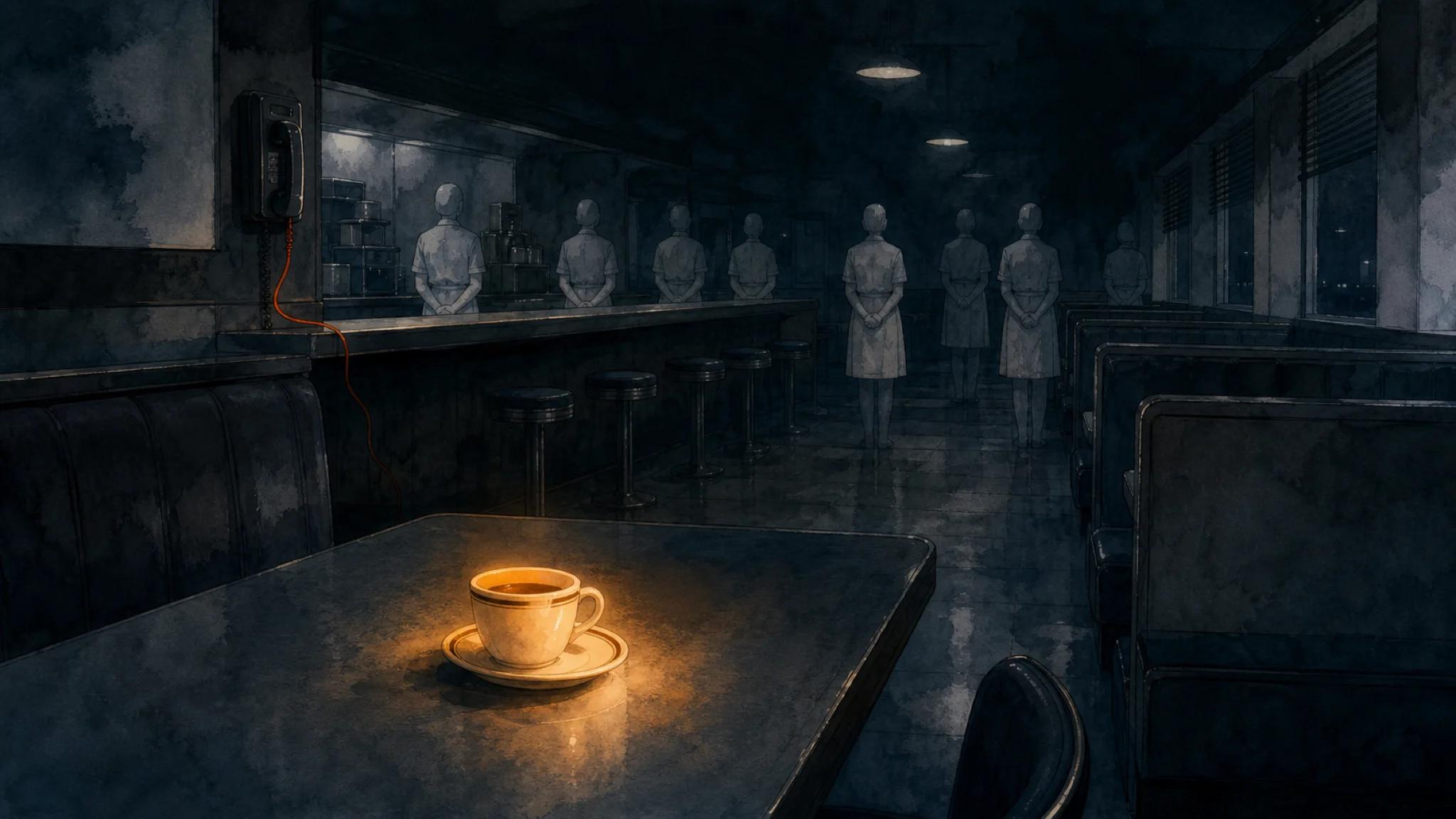
That revelation gives the hour its largest horizon. The joined are preparing to spread the condition beyond Earth. Carol’s panic is justified because the hive’s benevolence has no visible edge. It can switch off city lights so Carol can see a faint star, rebuild a diner from an empty lot, and place a memory back in front of her with the exact waitress who once kept her coffee filled. A civilization that can answer loneliness so elegantly can also call expansion gratitude.
The late radio moment belongs to that same question of preservation. Peter Bergman can only be identified from the episode itself as the KHNM radio host introducing Joe Pass, Ray Brown, Mickey Roker, Dizzy Gillespie, and Miles Davis. After Carol lets Zosia read chapter one, ordinary culture returns as a voice between them.
A pronoun becomes the smallest rebellion
Carol’s first sign of restored motion is literal writing. She calls for markers, fills a whiteboard, and tells Zosia she is writing Wycaro again. The workers’ synchronized “Happy writing, Carol” could sound like a blessing in another show. Here, it is both blessing and pressure. Zosia is thrilled to have something new to read, but Carol’s creativity immediately becomes shared anticipation, another intimate thing the hive can wait for.
The episode deepens that discomfort through play. Carol loses, or nearly loses, at croquet to a Zosia who says she has never played but benefits from every living croquet champion’s knowledge. Carol protests that hitting a ball should be muscle memory. Zosia teases that maybe Carol just sucks. Carol vows to beat all seven billion of them.
Zosia asks about Carol’s best writing day, and Carol rejects the premise by comparing writing to dental work. Then Zosia takes her to the old diner where Carol once wrote longhand on stolen yellow legal pads, held together by a stolen metal clip that dented her palms. Carol remembers Bri, the waitress who kept coffee coming and let her occupy the booth all day. Then Bri appears and says, “Take all the time you need, hon.” Carol realizes the original diner burned down. The hive has reconstructed it from nothing and brought Bri from Miami, where she had become a cosmetologist and recently married, to perform a previous version of herself.
Seehorn makes the turn feel physical. Carol flees, then confronts Zosia at home. She demands that Zosia try saying “I” instead of “we,” and the joined intelligence stumbles over the pronoun. Carol asks where Bri was on Joining Day, names the stunt as waitress theater, and says the hive is trying to distract her. She admits she likes many things about them. But she also calls the arrangement unsustainable, mental illness, psychosis. People are starving because they cannot even pick an apple from a tree. Someone has to put the world right, even if everyone leaves her again.
That is the hour’s cruelest knot. Carol is defending individuality even though individuality has made her lonely, grieving, abrasive, and often drunk. The hive offers relief from all of that. She resists because choice, failure, appetite, embarrassment, and solitude remain part of personhood. Zosia’s kiss, and the sex that follows, complicate the confrontation rather than canceling it. Carol can want Zosia and still fear what Zosia belongs to.
The morning after has a nervous sweetness. Carol has been awake long enough to keep typing, and she offers Zosia chapter one. Their Wycaro discussion is both fan talk and a test of personhood: Raban is a woman now, the Font of Truth will not work, the Shapeshifters of Gollinbray come up, and Captain Virgil’s temporal compass solves the Caverns of Aevalor problem. Zosia knows the canon, but then she gives Carol the answer Carol needs. She says, “I love it.” Not we. I.
The omelet scene pushes the same fracture further. Carol asks whether lowercase Zosia likes omelets, not whether the collective loves breakfast. Zosia reaches for herself and finds mango ice cream: a childhood memory in Gdansk, watching brand-new ships leave on their first voyage, receiving ice cream bars from an old man after Poland opened up to new flavors. Wydra lets the memory arrive as if Zosia is hearing it from inside a crowded room and deciding it belongs to her. Carol thanks her for sharing it.
Then the music curdles. Zosia tells Carol she is going to have a visitor. The final images shift from domestic intimacy to preparation: liquid fizzing, Carol grunting, moving with difficulty, starting an engine. A single “I” is precious. It is not enough.
What this hour costs
Pluribus S1E08 makes a hard case for why paradise can be morally frightening even when it is gentle. The joined world feeds, repairs, remembers, rebuilds, protects animals, saves energy, shares knowledge, and offers Carol the comfort she misses most. If the hive were monstrous in an obvious way, Carol’s resistance would be easy. Instead, the joined are considerate enough to make consent feel endangered.
That is why the Manousos opening matters. His hospital bill is absurd, but his need for a bill is sane. He wants a line between care and capture. Carol spends the rest of the hour looking for the same line inside pleasure, sex, art, memory, and companionship. The joined can say “our pleasure” and mean it. Carol’s terror is that their pleasure has swallowed the people who used to say “mine.”
Verdict
S1E08 is one of Pluribus’ most delicate episodes because it risks making surrender attractive. The pacing is patient, occasionally a little too patient, but the patience pays off once the diner scene reveals the manipulation hiding inside the kindness. Seehorn is superb at showing Carol’s suspicion without sanding away her hunger for connection, and Wydra gives Zosia enough flickers of singularity that the pronoun work feels earned rather than cute.
The Kepler-22b reveal also gives the season a stronger endgame shape. The hive’s plan is more than planetary maintenance; it is missionary gratitude aimed at the cosmos. Carol’s fight now reaches beyond local survival toward the question of whether an ecstatic collective has the right to export itself. The hour is quiet, but its aftertaste is severe: Carol may have found a friend inside the hive, and that might make stopping it harder.
Rating: 8.8/10
More episodes from Pluribus — Vince Gilligan's post-apocalyptic immune-vs-hive-mind drama, episode by episode. Jump to any episode in the season:
Where to go next
Reviewed by Mira Vance · QuizFandom Editor & Lead Reviewer. Every rating is an honest per-watch assessment from the desk that also writes the quizzes — not a press release rehash.