Teach You a Lesson Episode 2 Review: "Episode 2" — Bong Geun-dae goes undercover, Hwa-jin drags Gwon-hyeok to class, and Guun Tech learns what a minute is worth
What happens — the short version (spoilers)
- Choi Gang-seok defends harsh ERPB punishment on camera while Hwang Gi-tae looks for a way to turn the backlash into a campaign against the bureau.
- Bong Geun-dae transfers into Guun High-Tech High, pays protection money, and learns that Park Seong-hwan and Cho In-beom fight to be scouted by Jang Gwon-hyeok.
- Kim Hyeong-ju brings Geun-dae home for ramyeon and explains that he keeps attending because he wants to study cars and get a job.
- Hwa-jin uses Geun-dae as bait, beats the class into obedience, and forces Guun Tech's students through a full-day school schedule.
- A copied-textbook punishment turns into an electric-car brake lesson when Seong-hwan and In-beom are trapped in a car whose brakes do not work.
- Gwon-hyeok enters as the root of the school-gang problem, but Hwa-jin and Gang-seok turn the case into ERPB policy after the boys apologize to Hyeong-ju.
Teach You a Lesson follows its Daehan High opener by widening the fight from one protected bully to a school that has turned violence into vocational training. Guun High-Tech High is not hiding its collapse; students are openly auditioning for gang work, teachers are negotiating with threats, and Bong Geun-dae's undercover transfer act gives the hour a nervous, bruised way inside. Hwa-jin's method is still frightening, but Episode 2 is sharper when it sets his force against Kim Hyeong-ju's ordinary wish to learn. The case lands because the show keeps asking who gets to waste time, who has to buy every second, and what kind of adult power can protect a classroom without becoming another gang in the room.
Choi Gang-seok defends corporal punishment on camera, and Hwang Gi-tae starts looking for the ERPB’s weak spot
The Daehan High case goes viral before the ERPB can enjoy its first public win. Clips of Hwa-jin’s punishments circulate online, protesters gather outside, and the bureau’s slogan-ready catharsis becomes a political target almost immediately. Gang-seok and Hwa-jin expected the backlash. What neither of them can control is how cleanly the argument moves from student violence to state violence.
Gang-seok chooses the blunt answer. Asked about human rights, he gives the press a whole diagnosis of Korean education: private academies have replaced schools, teachers are afraid of students, and public school is the only place left for children without enough money to buy another system. Then he says the thing that will haunt the bureau: corporal punishment, even harsh punishment, will be enforced if that is what protects the right to learn.
That speech is both the bureau’s mission statement and its exposed throat. Hwang Gi-tae, watching from the other side of the political field, understands the opportunity. The ERPB helped remove Ryu Gwang-pil, but it also gives Hwang a cleaner weapon than scandal: he can call the bureau archaic, militarized, and abusive while letting Guun High-Tech prove why people are afraid of schools in the first place.
Bong Geun-dae transfers into Guun Tech, pays protection money, and meets a school where fights are job interviews
Guun High-Tech High announces itself like a warning label: a top thug school, a pipeline for next-generation gangsters, a place teachers avoid. Geun-dae enters as a transfer student with new shoes, a nervous smile, and exactly the wrong instincts for survival. He gets shaken down for protection money almost as soon as he arrives, then asks for a receipt like a man whose bureaucratic brain cannot quite switch off even while being robbed.
The school day that follows is chaos with a career track. Students bully the teacher into making copies, drift out of class for “farming,” use weaker boys as props, and turn department rivalry into public violence. Park Seong-hwan leads the automobile department, Cho In-beom leads the electrical department, and both are fighting for the attention of Jang Gwon-hyeok, the third-year kingpin who barely attends because the gangster life is already recruiting him outside the gate.
Kim Hyeong-ju explains the economy to Geun-dae with the exhausted clarity of someone who has had to survive it. Gwon-hyeok flashes motorcycles, liquor, clothes, tattoos, and rumored money online. The other boys fight to be noticed, win to be scouted, and treat school like a tryout floor. Their ugliest vocational language says the quiet part out loud: Gwon-hyeok is his own corporation, and fist fights are what we get graded on.
Hyeong-ju brings Geun-dae home for ramyeon, and Hwa-jin finds the student who still wants school
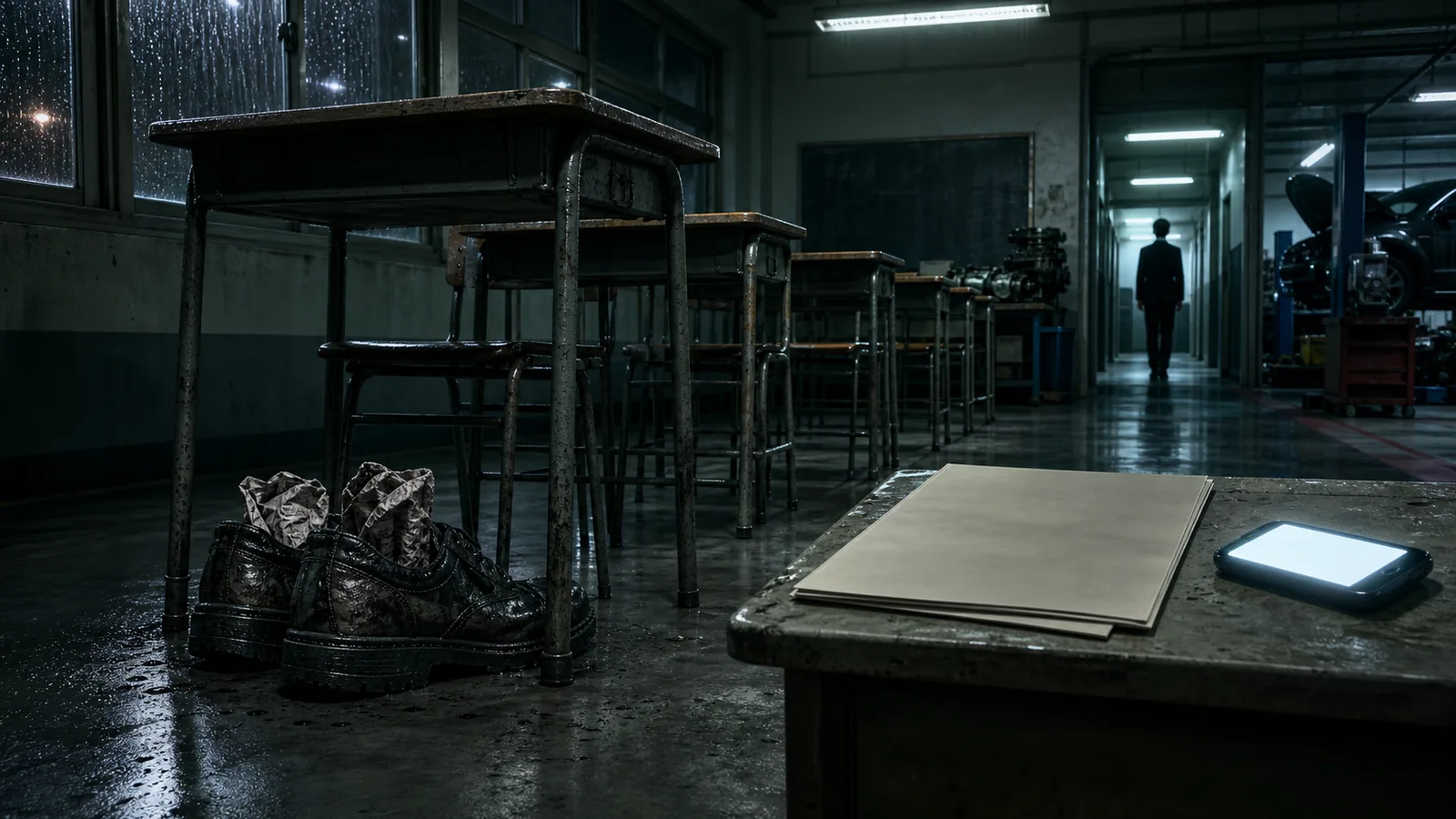
The hour’s best quiet stretch belongs to Hyeong-ju. He is not written as a saint or a mascot for innocence. He is a boy with bruises, a practical plan, and a home where his mother’s wet shoes get stuffed with newspaper because she works long enough for them to stay uncomfortable. He wants to study cars and get a job. He knows Guun Tech may have been the wrong school, but changing schools or taking the GED costs money his family does not have.
That is why his patience feels different from fear. The bullies hit him every day, but he keeps showing up because, as he tells Hwa-jin, it is still school. That line is small enough to miss and hard enough to carry the whole case. Daehan High was about a victim trapped inside a cruelty ritual. Guun Tech is about a classroom stolen from the students who came there for its actual purpose.
Hwa-jin sees that before he starts swinging. He tells Hyeong-ju he researched him, calls him a good kid, and promises to make sure he can learn despite the boys around him. Tender is too soft a word for it. Hwa-jin is still Hwa-jin. But it gives his violence a target more specific than “bad students.” He is not there to make Guun Tech respectable. He is there to give one student’s minutes back.
Geun-dae’s failed code sends the bullies running, and Hwa-jin beats the class into a full-day schedule
Geun-dae’s undercover work is funnier than it is smooth. He sends Hwa-jin a code, gets trapped under a desk, and discovers that his chosen signal, One Flew Over the Cuckoo’s Nest, does not mean much if the person receiving it has not watched the message. Hwa-jin still uses him well. He turns Geun-dae into bait, sends him sprinting through school, and lets the chase gather the boys in one place.
Then he offers them three choices. They can pay back the taxpayer money spent on their education before they leave. They can knock him down and quit freely. Or, if they cannot manage either, they can be grateful and finish school. The second option is the trap, and the boys walk into it with both departments at once.
The fight is staged for release, but the punishment that follows is more interesting. Hwa-jin does not just win the room. He gives it a schedule: wake-up at 6 a.m., extra lessons, regular classes, specialized classes, afternoon classes, evening supplementary classes. Guun Tech’s students wanted school to be a gang lobby. Hwa-jin turns it into a day they cannot escape.
Hwa-jin makes the boys copy their own textbooks, then uses a brakeless car to prove class is not optional
The funniest cruelty in Episode 2 is that Hwa-jin weaponizes schoolwork itself. When the students show up without textbooks, he refuses to let the teacher waste paper on copies. They will make their own books, he says, in the Joseon Dynasty way. If they do not have pens, he jokes, there is always blood.
That would be only a gag if the episode left it there. Instead, the class shifts from obedience theater into an actual lesson about electric cars and brake systems. The boys keep heckling, Seong-hwan complains that none of this will help their lives, and Hwa-jin takes the argument seriously enough to make it dangerous. If they want only useful classes, then they can learn what happens when a brake problem is ignored.
So Seong-hwan and In-beom end up in a car whose brakes do not work, screaming through the exact practical knowledge they refused to hear. The sequence is ridiculous, and the staging leans into it. But it also keeps the case’s moral math intact: at a technical high school, ignorance is not neutral. It can kill someone. Hwa-jin’s punch line after the near-crash is the episode’s cleanest classroom thesis: There’s no such thing as an unnecessary class.
Hyeong-ju protects the lesson, and the Gwon-hyeok interview brings the root of Guun Tech into study hall
Once the classroom starts functioning, Hyeong-ju becomes the person most afraid of losing it. When Hwa-jin catches Seong-hwan and In-beom threatening him again, Hyeong-ju defends them, not because they deserve it, but because he worries one more incident will stop the lessons he is finally getting. Every single second is pretty much crucial to me, he says.
That sentence cuts harder than any punch in the hour. The bullies treat time as something to burn until Gwon-hyeok calls. Hyeong-ju treats it as a resource he cannot replace. The show has never been subtle about class, but this is where the class line feels lived-in: wet shoes by the door, tutoring too expensive, a boy learning brakes because a job might be waiting if school can stay open long enough.
The other boys are still pointed toward Gwon-hyeok. Seong-hwan and In-beom force their way to the interview, drag Geun-dae with them, drink and pose, then stumble back into study hall with their new patron behind them. Hwa-jin asks where they are. They answer from inside the room, already drunk on the belief that Gwon-hyeok’s name can cancel every rule.
Gwon-hyeok knocks Hwa-jin down, Gang-seok names the monster problem, and the schoolyard becomes a war line
Gwon-hyeok’s entrance works because he is not treated as a joke at first. He really can fight. He drops Hwa-jin, the students roar, and for a moment Guun Tech’s entire hierarchy seems to correct itself. The boys chant his name like a passcode, and Gwon-hyeok tells them to use it whenever anyone threatens them.
Hwa-jin lets that fantasy swell before puncturing it. He brought Gwon-hyeok there as a demonstration tool, not as a surprise obstacle. The plan was to make the boys call the root into the open. Once Gwon-hyeok summons his non-student backup, Hwa-jin’s rules change too. Students get restraint. Men who have no business entering a school to fight children do not.
Gang-seok’s parallel television argument sharpens that turn. Hwang’s camp wants Hwa-jin’s classified military record to make the ERPB look like dictatorship nostalgia. Gang-seok answers with the kind of sentence the show almost dares you to reject: when monsters threaten students, a monster can only be taken down by another monster. It is a dangerous line because it is persuasive inside this case. Hwa-jin stands at the school gate and makes the same argument with his body: a school is for people learning or teaching lessons, and one step forward means war.
Hwa-jin makes Seong-hwan and In-beom apologize to Hyeong-ju, then turns the case into ERPB policy
The final punishment is not aimed at Hwa-jin’s pride. Seong-hwan and In-beom apologize to him first, then offer to stop coming to school. Hwa-jin rejects both answers. He makes them think about who they actually harmed, and the boys crawl to Hyeong-ju with panic finally pointed in the right direction.
Hyeong-ju forgives them too quickly because he is Hyeong-ju, and the show lets that hurt. He says it is okay while they beg him to spare them. He cries after, not because the apology fixes anything, but because someone in power finally made the room acknowledge what had been stolen from him.
Hwa-jin’s closing lecture is less about obedience than proportion. If the boys do not want to study, they can waste their own lives. What they cannot do is get in the way of someone else’s. They cannot assume one minute means the same thing to everyone. The ERPB then converts the case into policy: tattoo bans, no motorcycles on campus, organized-crime charges for student gangs, and monitoring of social-media recruitment. The bureaucracy is almost comically broad, but the point is narrow. Guun Tech was not a school with a discipline problem. It was a recruitment site with classrooms attached.
Tiny details worth clocking
- Geun-dae asking for a receipt after paying protection money is the perfect undercover tell: he can act scared, but he cannot stop thinking like a deputy director with paperwork.
- Hyeong-ju stuffing newspaper into his mother’s shoes does more class work than a speech would. The show shows the cost of wet feet before it asks us to care about test scores or transfers.
- The brake lesson fits the school better than a generic punishment would have. Guun Tech’s whole premise is vocational training, so Hwa-jin makes vocational ignorance immediately dangerous.
- Gwon-hyeok’s name briefly works like a gang password, which is why Hwa-jin makes the students say it out loud until the magic drains out of it.
- Geun-dae’s expense report at the end is funny, but the visible medical-bills note he does not claim keeps the joke from erasing what the undercover work cost him.
Final verdict
“Episode 2” is broader and more cartoonish than the premiere, especially once the brakeless-car lesson and schoolyard gang fight kick in. The policy montage at the end also tidies a complicated case into a list of bans and enforcement measures with suspicious speed. For a show this interested in institutional failure, the cleanup can feel almost too efficient.
But the case works because Hyeong-ju gives the hour a human scale. Hwa-jin beating up student gangsters is the advertised pleasure; Hyeong-ju saying every second is crucial is the reason the pleasure has any moral weight. The show keeps returning to the difference between boys who can waste a day chasing Gwon-hyeok’s approval and a boy who cannot afford another lost class. That is where the ERPB’s ugliness becomes hardest to dismiss.
The risk is still sitting in plain sight. Gang-seok’s monster line is thrilling inside Guun Tech and terrifying as a governing philosophy. Episode 2 knows that, at least enough to let Hwang’s attack land before Hwa-jin wins the yard. The hour’s catharsis is loud, funny, and sometimes blunt. Its best argument is quieter: school time is not equal when only some students get to spend it freely.
Rating: 8.1/10 — A bruising, funny, morally uneasy second case that gives Hwa-jin’s violence a clearer student-centered purpose, even when the cleanup moves too neatly.
More episodes from Teach You a Lesson — School-violence K-drama, episode by episode. Jump to any episode in the season:
Where to go next
Reviewed by Mira Vance · QuizFandom Editor & Lead Reviewer. Every rating is an honest per-watch assessment from the desk that also writes the quizzes — not a press release rehash.