Teach You a Lesson Episode 3 Review: "Episode 3" — Choi Ga-yun's case explains the ERPB, Im Han-rim takes Soyeon phones, and Ms. Jung makes Ye-ri answer
What happens — the short version (spoilers)
- A flashback shows Choi Ga-yun saying adults cannot be afraid of children before Cho Gyu-cheol's sentence leaves Hwa-jin and Choi Gang-seok furious.
- Gang-seok vows to create the Educational Rights Protection Bureau in Ga-yun's memory, making the bureau's origin both public service and personal grief.
- At Soyeon Girls' High, Han Ye-ri edits a classroom clip, falsely accuses Mr. Ko of sexual assault, and watches social media destroy him before his death by suicide.
- Ms. Jung becomes homeroom teacher after Mr. Ko, while Ye-ri's follower count and livestream threats keep the school negotiating with her instead of disciplining her.
- Im Han-rim arrives as a trainee math teacher, reveals herself as ERPB, confiscates phones, and uses Bong Geun-dae's evidence to expose the class's malicious posts.
- Ms. Jung rejects Ye-ri's livestream trap and reclaims the classroom, Bong suspends Ye-ri's account, Han-rim stops Ye-ri's knife attack, and Hwang Gi-tae exposes Ga-yun as proof of an ERPB vendetta.
Episode 3 opens the wound that built the ERPB and then sends that wound into a school where a phone can do the work of a fist. The case at Soyeon Girls' High is less about hallway violence than edited clips, doxxing, follower counts, and a classroom where teachers have learned to fear a student's hand around a screen. Im Han-rim's arrival gives the show a new instrument, sharper and funnier than Hwa-jin but aimed at the same collapsed authority. The hour keeps Ga-yun, Mr. Ko, Ms. Jung, and Ye-ri in the same moral frame: when public shame becomes punishment, the people who still have to teach are left holding the damage.
Ga-yun tells Hwa-jin adults cannot be afraid of children, and Cho Gyu-cheol turns her death into the ERPB’s first wound
The cold open finally gives Hwa-jin’s favorite sentence a face. Before it belongs to a bureau announcement or a hallway threat, it belongs to Choi Ga-yun, teasing him on a day off, making him protect her, then stopping when she sees students smoking outside school. Hwa-jin tries to shrug it off. Ga-yun says the line he will carry into every case: a world where adults are afraid of children is a world that is nearing its end.
Then the episode cuts the romance open. In court, Ga-yun is described as a courageous teacher who tried to help Cho Gyu-cheol, a violent student feared by classmates and teachers alike. Cho answers sentencing by saying he loved her. The court weighs his youth and family history and gives him a maximum of four years. Hwa-jin lunges. Choi Gang-seok holds him back.
That sequence is blunt, but the bluntness fits the show. The ERPB is not born from policy language first. It is born from a father and a fiance staring at a punishment that feels too small for the loss in front of them. Gang-seok tells Hwa-jin not to take the easy way out, then says he will become education minister and create the Educational Rights Protection Bureau to honor Ga-yun. It is a clean origin story with a dirty charge underneath it. The bureau begins as public service and grief at the same time.
Han Ye-ri edits Ms. Jung’s classroom clip, accuses Mr. Ko, and lets Soyeon Girls’ High turn into a mob feed
The present-day case is quieter than Daehan High or Guun Tech until it is not. Soyeon Girls’ High looks polished, cheerful, almost harmless through Han Ye-ri’s stream. She greets followers, promotes her friend So-yeong’s account, and treats class as background scenery for a personal broadcast. When Ms. Jung asks for the phone, the first violation is ordinary. Then the edit arrives.
Ye-ri and So-yeong turn a harmless moment into an accusation engine. A teacher cutting gum out of a student’s hair becomes a sinister-looking clip once the audio is removed and sad music is added. Ms. Jung knows what that can do because the school has seen it before. Ms. Hwang once confiscated Ye-ri’s phone and had her address leaked after a video made her look like she was picking up men in a bar.
Mr. Ko tries to intervene as Ye-ri’s homeroom teacher, and Ye-ri escalates. She posts a tearful claim that he sexually assaulted her. Followers swarm the school, strangers identify him in the hallway, his address and family details spread online, and the crowd outside his home becomes part of the punishment before any inquiry can begin. By the time teachers are trying to open his locked door, the case has already been tried by comments. Mr. Ko is dead, and the post is still moving.
Ye-ri turns Mr. Ko’s death into leverage, and Ms. Jung inherits the class that helped destroy him
The ugliest thing Ye-ri does after Mr. Ko’s death is not panic. She performs injury again. When another teacher tells her to clear things up, Ye-ri repeats the accusation in more graphic terms, then turns the confrontation into another stream. The school has no stomach for truth by then. It wants calm, fewer calls, less pressure, something that will smooth over Ms. Jung without making Ye-ri an enemy.
So Ye-ri asks for a favor.
That is the key to Soyeon Girls’ High. The principal can see the damage and still negotiate with the student who helped create it, because Ye-ri’s follower count has become school power. Ms. Jung becomes the new homeroom teacher in a room that treats her as a target before she takes attendance. The girls whisper about whether she took the class to get revenge for Mr. Ko. Ye-ri thanks her for helping her hit 500,000 followers.
The show is not subtle about social media, but it is precise about fear. Ye-ri does not need to hit anyone to control the room. She only has to hold a phone, imply an edit, and let every adult remember what happened to the last teacher who crossed her.
Im Han-rim arrives as a trainee math teacher, breaks Ye-ri’s live stream, and makes phones the first battleground
Episode 3’s best new energy is Im Han-rim, introduced as a trainee math teacher and then almost immediately exposed as something else. The class tests her the way it tests every adult: boyfriend questions, plastic-surgery insults, chanting for a before-and-after photo, a live stream held up like a shield. Han-rim does not flinch. She turns the insult back with a martial-arts answer and then asks for every phone in the room.
Ye-ri makes the obvious move. She tells Han-rim to explain herself to her fans because the stream is live. Han-rim answers by ending the phone’s power over the scene and reintroducing herself as an inspector with the Educational Rights Protection Bureau.
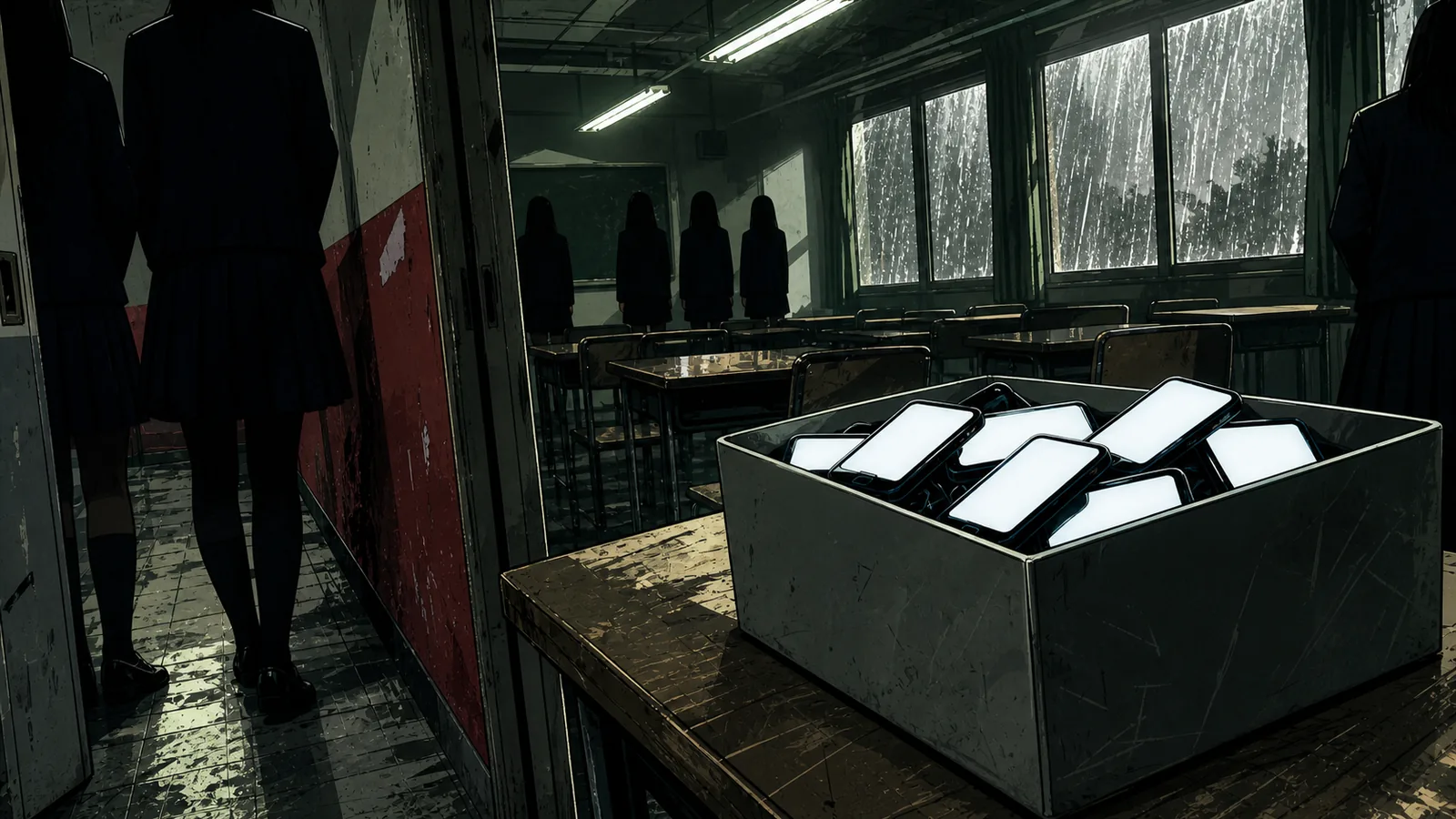
That entrance is broader than Hwa-jin’s first hallway slap, but it has the same logic. The school has mistaken audience for authority. Han-rim reverses the current. If students use phones to put themselves above teachers, the phone becomes evidence, contraband, and eventually a liability. Her first order is simple: put every device in the box. Her second is the real lesson. Hidden phones mean punishment, and the class learns to chant, lift their legs, and listen without the screen between them and the adult speaking.
Hwa-jin makes the teachers write down their fear, while Han-rim and Bong turn Soyeon into an ERPB worksite
The bureau does not only attack the students. Hwa-jin walks into the teachers’ office and asks the adults to document what they have swallowed. False accusations. Edited photos. Personal information leaked online. Malicious comments that turned into a permanent record. He tells them to write it all down, then reads their silence for what it is: not peace, but exhaustion.
That scene keeps the hour from becoming a simple “students today” rant. The teachers have helped create the problem by surrendering, but the show does not treat surrender as laziness. It treats it as learned fear. Ms. Jung worries that parents will complain when Han-rim makes the girls clean their own classroom. Other teachers insist there are no problems because admitting there are problems means inviting Ye-ri’s crowd back into their lives.
Meanwhile, the ERPB becomes a strange little workplace comedy. Han-rim meets Bong Geun-dae, instantly turns hierarchy into a grip contest, and decides his Grade Five public-service rank puts him under her. Hwa-jin tells her the one rule: do not kill anyone. If the urge comes, write the character for patience on her palm three times. It is funny until the episode needs it to be a safety catch.
Han-rim exposes the class’s malicious posts, and Ms. Jung remembers what teaching felt like before fear
Bong’s assignment gives Han-rim the paper weapon she needs. She enters the classroom with printed proof: illegally taken photos, edited posts, malicious comments, and defamatory captions aimed at teachers. The students immediately reach for the language of civil rights and privacy. Han-rim points them to the ERPB’s website and then sends the named offenders outside in military order.
The pressure cracks the class just enough for doubt to leak out. Some girls admit no one saw what Mr. Ko did to Ye-ri. Ye-ri overhears and smooths the room back down, but the old unanimity is gone. The fear of her is still there. So is the first open question about whether she has been telling the truth.
Ms. Jung’s parallel scene is gentler and almost more painful. She tries to leave teaching for academy work, only to be turned away because the scandal follows her. Then a student asks a math question, and Ms. Jung solves it. The next class answers. Students praise her. For a few minutes, school becomes what she wanted it to be: a place where a problem on the board can be solved by someone who knows how to teach.
Han-rim warns her not to be fooled by Ye-ri’s sudden sweetness. Ms. Jung knows that may be true. She still wants to believe a positive change when it is placed in front of her. That is her weakness, and also the reason Hwa-jin refuses to let her quit.
Hwa-jin shows Ms. Jung the students’ letters, and she refuses Ye-ri’s live-stream trap
Ye-ri’s apology to Ms. Jung is all bait. She says she wants to start over, suggests a joint live stream, and offers Ms. Jung a chance to clear up the rumors if she will also talk about the ERPB. The ask is carefully dressed as reconciliation. Underneath, it is the same old demand: put the teacher on camera and let Ye-ri’s audience decide what she is allowed to be.
Hwa-jin pulls Ms. Jung out of the classroom before she can accept the trap. He shows her the posts she cannot outrun and lets her say the thing she has been holding back: Ye-ri with a phone terrifies her. She imagines ending up like Mr. Ko. Hwa-jin answers with Ga-yun, not to compare pain like a contest, but to name the fear he recognizes. After what happened to Mr. Ko, he says, he knows why she is afraid.
Then he turns the case. The ERPB did not come to Soyeon because of Mr. Ko alone. It came because students from Ms. Jung’s own homeroom asked for help. Park Su-jin’s letter says the posts about Ms. Jung are lies, that the class wants her to teach again, that good teachers need protection. Hwa-jin’s point is brutally simple: some of the girls who laughed along are also afraid of Ye-ri. The bureau can hold the line for a while, but only Ms. Jung can make the classroom liveable again.
Ms. Jung makes Ye-ri solve the problem, and Bong takes away the one weapon Ye-ri still trusts
Ms. Jung’s comeback is small until it becomes enormous. She rejects Ye-ri’s live stream, opens the textbook, and calls Ye-ri to the board. Ye-ri refuses in every register she has: contempt, profanity, dead weight, public defiance. Han-rim starts to move, but Ms. Jung stops her. This is her class.
So she makes it her class. She tells Ye-ri the correct answer is not “Who do you think you are?” but “Yes, Ma’am.” She asks for the solution again. When Ye-ri refuses, Ms. Jung punishes her hands and keeps the entire room there until the problem is solved. The scene is uncomfortable in exactly the way this show likes to be uncomfortable. It is not trying to make corporal punishment cute. It is showing a teacher reclaiming an authority she should never have had to win back through pain.
Ms. Jung’s apology lands harder than the strike. She tells the students she should never have let this happen, then promises she will make them answer, listen, and face punishment every time they treat school like a feed. She is not doing it for herself. She is doing it for them.
Ye-ri still thinks the feed will save her. She storms out, tries to expose Ms. Jung as an abuser, and finds her account blocked, deleted, and turned against her. Bong and the bureau surface Ye-ri’s own footage around Mr. Ko, including the smug performance behind the accusation. The influencer machine that protected her becomes a cage with a government lock on it.
Ye-ri attacks Ms. Jung, Han-rim writes patience twice, and Hwang Gi-tae turns Ga-yun into a press weapon
The hour does not let public exposure become a clean punishment. Once Ye-ri loses the account, the internet moves the way it always moves in this show: it hunts the next target. Posts call her a murderer, reveal her home, and make the school mob personal again. Ms. Jung, still the only adult trying to reach her, goes to check on her.
Ye-ri answers with the cruelest reversal in the episode. It would have been better if Ms. Jung died instead of Mr. Ko, she says, because no one listens to her anymore. Then the suicidal language turns into a knife. The case that began with edited footage nearly ends with a teacher bleeding in a student’s home.
Han-rim’s patience rule pays off in the middle of the chaos. The balcony crash, the knife, and the palm-writing are staged like action excess, but the emotional line is clear enough: Han-rim wants to kill Ye-ri and chooses not to. She writes patience twice, disarms her, and gives the sentence Hwa-jin could not give Cho Gyu-cheol in the cold open: live long, but repent.
The political ending is colder. The ERPB announces suspended accounts and punishment for online violations of teachers’ rights, but Hwang Gi-tae has found the bureau’s exposed throat. Ga-yun was Gang-seok’s daughter and Hwa-jin’s fiancee. The first three cases all involve students. Hwang takes that pattern to the press and calls the ERPB a personal vendetta. The worst part is that he is not entirely inventing the charge.
Tiny details worth clocking
- Ga-yun’s “adults are afraid of children” line moves from romantic teasing to courtroom grief to ERPB doctrine, which makes Hwa-jin’s repeated use of it feel less like a catchphrase and more like an inherited instruction.
- Ye-ri’s follower count keeps changing the adults’ behavior before she ever raises her voice. The principal negotiates with influence the way Episode 1’s principal negotiated with political parents.
- Han-rim’s “guardian angel or worst nightmare” introduction is a clean character thesis. She really is both, and the show spends the hour testing which side the room deserves.
- Ms. Jung’s best scene before the confrontation is the simple math explanation at the academy. The episode needs us to see her teach well before it asks us to cheer when she takes the classroom back.
- Bong’s snack-bar humiliation is a silly runner, but it keeps pointing at the same school economy: even the concession stand has been trained to absorb student lawlessness.
Final verdict
“Episode 3” is the strongest serialized hour so far, even though it is also the messiest. The social-media case occasionally pushes its point with a heavy thumb, especially once Ye-ri’s account is frozen and the exposure montage starts cleaning up the facts at cyber-police speed. The final apartment attack also leans hard into action punctuation after a more interesting classroom victory.
The case keeps the punishment thrill close to the fear that made punishment look necessary. Ga-yun’s murder explains why Hwa-jin and Gang-seok built the ERPB; Mr. Ko’s death shows the same adult helplessness in a newer form; Ms. Jung’s terror gives the case its human scale. The best scene is not Han-rim breaking the room or Bong deleting the posts. It is Ms. Jung standing in front of a problem on the board and making Ye-ri answer, because that is the moment the show lets teaching become an act of resistance instead of a job title.
Hwang’s vendetta accusation is a smart place to leave the hour. He is using grief cynically, but he is also naming the question Teach You a Lesson has been carrying since the premiere. The ERPB may be protecting classrooms. It may also be giving wounded adults legal permission to hurt children back. Episode 3 is good because it can feel the difference and still knows how narrow that difference is.
Rating: 8.4/10 — A sharper, more personal case that makes the ERPB origin sting, with Han-rim’s arrival adding force even when the cyber-punishment cleanup moves too fast.
More episodes from Teach You a Lesson — School-violence K-drama, episode by episode. Jump to any episode in the season:
Where to go next
Reviewed by Mira Vance · QuizFandom Editor & Lead Reviewer. Every rating is an honest per-watch assessment from the desk that also writes the quizzes — not a press release rehash.