Teach You a Lesson Episode 5 Review: "Episode 5" — Choi Ji-seon's diary pulls in the ERPB, Hwa-jin turns Mrs. Lee's rules against her, and U-jin asks for his teacher
What happens — the short version (spoilers)
- Choi Ji-seon's diary worries her mother enough to bring in the ERPB, which places Ji-seon on leave and sends Hwa-jin into Year 1, Class 3.
- A flashback shows U-jin's mother, Mrs. Lee, turning Talk Mate access into a rulebook for every classroom interaction and later crossing into Ji-seon's private life.
- Ji-seon's Home of the Heart helps U-jin express himself, but after U-jin hurts Seo-jun, Mrs. Lee turns the apology meeting into threats and demands Ji-seon's private number.
- Mrs. Lee's husband storms into class and nearly hits Ji-seon, Mrs. Lee files a child-abuse complaint, and Gang-seok explains how suspicion alone can destroy teachers.
- Hwa-jin mirrors Mrs. Lee's rules through constant calls, humiliates Mr. Kim at the bank, and gets the principal to hold the proper-channel line.
- Hwa-jin reports Mrs. Lee for child abuse, records her threats, makes her hear U-jin's confession to Ji-seon, and Gang-seok announces a teacher-protection protocol.
Teach You a Lesson moves school violence into elementary school, where the weapon is a parent who knows how to make every professional boundary sound like abuse. Choi Ji-seon's case is about child-protection language turned into a lever: Talk Mate messages, private numbers, parent forums, committee threats, and a law that can make suspicion itself a punishment. Hwa-jin walks into Class 1-3 as a substitute and starts answering Mrs. Lee with her own impossible standard, while Ji-seon has to decide whether one child's trust can pull her back toward the classroom. It is one of the season's most openly didactic hours, but the best parts keep the policy speech attached to bodies: a twitching face, a bank lobby panic show, and a boy asking the teacher he loves why his mother no longer smiles.
Ji-seon’s diary asks whether death will end it, and the ERPB removes her before Class 1-3 gets Hwa-jin
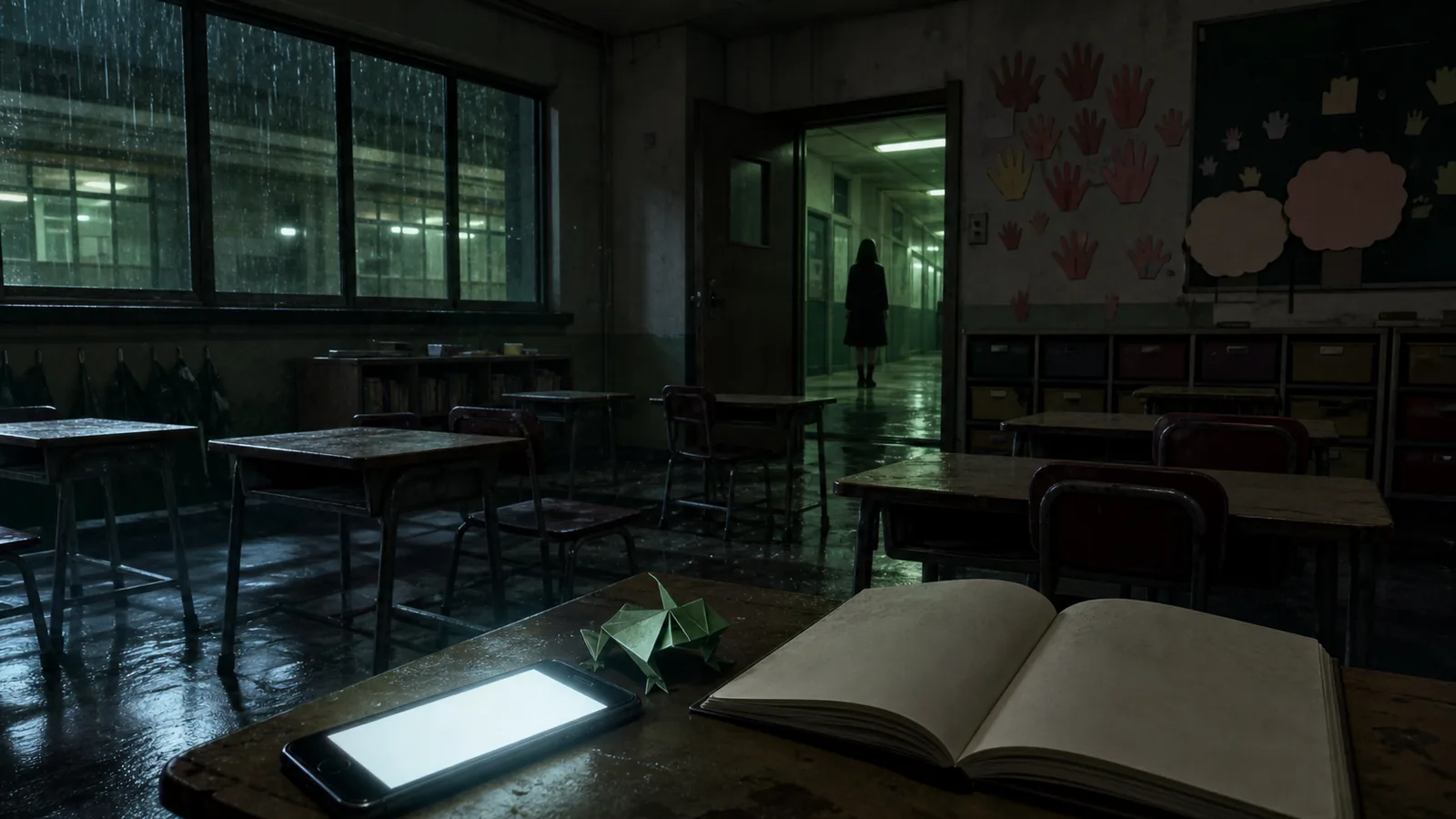
The first image is a first-grade classroom after the warmth has been drained out of it. The walls still have hand trees, dream posters, and a “Home of the Heart,” but Choi Ji-seon’s voiceover is already a goodbye note to her mother: I want to live. But living has become unbearable. The last instruction is the part the hour refuses to soften. If her mother reads the diary, she will understand, and whatever she does, she must never forgive the person who did this.
The ERPB intervention begins administratively, without catharsis. Ji-seon is taken through a mental-health assessment, told there will be no negative consequences, then immediately placed on leave because the results say she needs help. A fellow teacher objects that elementary teachers everywhere are stressed, burned out, and depressed. The answer she gets is cruelly practical: leave is preferable to death.
That is the hour’s starting pressure. The bureau arrives before a bruising hallway fight or a viral mob; it pulls a teacher out before she disappears. Ji-seon still asks who will take care of the children. The answer is Hwa-jin, and his first day in Class 1-3 is funny in the exact way the story needs it to be funny: bathroom chaos, lunch chaos, an origami frog, and Hwa-jin quietly asking Ga-yun whether teaching was always this hard. The man who usually enters schools as a threat is suddenly the adult outnumbered by six-year-olds.
U-jin’s mother turns first-day concern into a rulebook, and Ji-seon starts recording the things she cannot say
The flashback to Ji-seon’s first day makes the case smaller and uglier. She introduces herself, lets the children introduce themselves, and notices Kim U-jin before his mother ever becomes a storm. U-jin is quiet. His mother is polite. She asks Ji-seon to contact her through Talk Mate if there are questions or concerns, then immediately turns that access into surveillance.
At first, the demands sound almost reasonable if each one is separated from the next. Do not make U-jin feel disliked. Do not call on him for math in front of the class. Do not mark spelling errors with a slash. Do not use words like “no,” “stop,” or “don’t do that.” Do not force greetings. Do not scold noise. Take U-jin’s side in every clash. Ji-seon writes them down as if a perfect list can keep her safe.
Then Mrs. Lee crosses the school wall. She finds Ji-seon’s Instagram, comments on her clothes, calls a wedding photo sexualized content, and tells her taxpayer money pays her salary. The principal’s answer is to disappear the teacher’s private life: change the account, or better yet, stop using social media. Ji-seon deletes the app and tells herself she can go back after retirement. The line is almost absurd until the concessions start eating her life one piece at a time.
The Home of the Heart lets U-jin hurt Seo-jun, and Mrs. Lee turns the apology into a private threat
Ji-seon builds the Home of the Heart to give U-jin a place where feeling can become speech instead of behavior. She tells him he can express what he feels there and do what his feelings tell him to do. For a moment, it works like a child’s paradise: running, cheering, passes, games, attention. Then U-jin is bumped during play and hits Seo-jun hard enough to leave him crying over his eye.
The parent meeting is where the case curdles. Seo-jun’s mother is angry but still trying to move through the ordinary channels of injury, apology, and repair. Mrs. Lee refuses the premise. If Seo-jun pushed first, he should apologize. If U-jin cried, he is the harmed child. If U-jin might feel traumatized, then Seo-jun must pay for it. Ji-seon tries to say U-jin was at fault, and Mrs. Lee turns the sentence back into an accusation: all of this is Ji-seon’s fault because she did not take U-jin’s side.
The breakdown comes through repetition. Mrs. Lee demands Ji-seon’s private number, invokes her angry husband, and keeps calling until the ringtone itself becomes a threat. In class, Ji-seon hears all of this is your fault over the children’s voices. Outside her home, Mrs. Lee waits in person. The harassment mechanics are blunt: the abuse can occupy every hour of the day without one spectacular event.
Mrs. Lee files a child-abuse complaint, and Gang-seok gives the bureau the law it has to fight
Mrs. Lee’s husband makes the private threat physical. He walks into Class 1-3, yanks U-jin out, and nearly hits Ji-seon in front of the children. The school does not become safer afterward. Mrs. Lee files a child-abuse complaint anyway, accusing Ji-seon of humiliating U-jin, emotionally abusing him in the Home of the Heart, and encouraging another child to ignore him. When Ji-seon says the law changed and she will not be immediately suspended, Mrs. Lee barely cares. Teach by day, she says, then go to the police station after work. If the process takes more than a year, quit.
That is the case’s legal trap. Ji-seon can be innocent and still lose her class, her sleep, her name, and her will to live before innocence means anything. Mrs. Lee posts her number on a parent forum under a child-abuser accusation. Other parents call the principal. Children still need lunch served. The Home of the Heart sits empty while Ji-seon’s diary asks whether dying will end it.
Gang-seok’s briefing gives the hour its procedural spine. Reports against teachers have risen past 11,000, but only 1.6% lead to prosecution. Suspicion alone can start an investigation, and a false or unfounded report leaves the parent with little more to do than say, My bad. Han-rim calls the law a loaded gun in parents’ hands. Gang-seok answers by naming the bureau’s next job: if the system cannot protect teachers at the point of impact, the ERPB has to become the shield.
Hwa-jin flatters Mrs. Lee at the classroom door, then turns every U-jin rule into a call she has to answer
Hwa-jin starts against Mrs. Lee with obedience so exaggerated it becomes a mirror. When she catches him hiding behind the classroom door, he praises U-jin’s math ability, compliments her as if giftedness must come from her, and promises never to become a strange teacher. Mrs. Lee relaxes because she thinks she has found an adult who can be managed.
Then he starts calling.
The gag is broad, but it is built from the exact rules that broke Ji-seon. U-jin is sleeping; can Hwa-jin wake him, or would shaking him be physical contact? Can he call the boy’s name, or would that startle him? Can another student wake him, or would embarrassment become trauma? Should he leave him alone, or is that neglect? The spelling-test call is even pettier. If a slash harms self-esteem, what symbol should mark a wrong answer? A star means important. A triangle means partially correct. Polygons? Semicircle?
By the time Hwa-jin asks which hand children should use to wave, Mrs. Lee is the one saying what Ji-seon was never allowed to say: stop calling me, do your job, no more. The scene has the blunt satisfaction of a prank, but it also clarifies the case. Mrs. Lee did not want careful teaching. She wanted authority without responsibility, access without boundaries, and a teacher who could be blamed for every possible outcome.
Hwa-jin kneels in Mr. Kim’s bank, and the principal finally tells Mrs. Lee to use the proper channels
The bank scene is the hour at its most shameless. Hwa-jin walks into Mr. Kim’s workplace, asks for U-jin’s father, drops to his knees, and performs the terror Mrs. Lee has been using as a weapon. He begs not to be beaten. He lists the slash marks, the math questions, the “don’t do that” language, and the father’s earlier classroom rage. When Mr. Kim loses his temper in front of coworkers and management, Hwa-jin drops the act just long enough to warn him: if he ever hears my husband is angry again, Mr. Kim is done.
It is satisfying and ugly at once. Hwa-jin is humiliating a bully in the public space where humiliation can cost him something. He is also making the case look ridiculous in a way Ji-seon’s pain never was. The scene survives because the father’s anger has already entered the classroom, but it still pushes the show’s revenge-comedy setting to its edge.
The better institutional turn comes back at school. Mrs. Lee storms into the principal’s office and finds an adult who has finally remembered her role. Use the app. File through proper channels. Contact the president if she wants. The principal tells her teachers have rights too, then says the line Mrs. Lee most needs to hear: teachers are also loved by their parents. Hwa-jin follows by refusing to make the ERPB the only shield in the building. Teachers need a mentor, he says, and the principal is still a teacher before she is an administrator.
Hwa-jin reports Mrs. Lee for child abuse, and U-jin calls Ji-seon back to the Home of the Heart
The parent-council scene turns Mrs. Lee’s favorite law back on her. Hwa-jin hands her a child-abuse report and says he saw her grab U-jin and pull him from his seat. He also claims he noticed bruises during gym. The point is the suspicion standard. A teacher who has reasonable suspicion must report it. If Mrs. Lee is cleared, Hwa-jin will apologize. Because, as she told Ji-seon, that is the law.
The punishment spreads the same way Mrs. Lee’s post did. Other mothers gossip that she bullied Ji-seon into hospitalization, that U-jin is odd because of her, that they are glad their children are not in his class. It is hard to cheer cleanly because the show is deliberately letting the machine turn. Mrs. Lee built a parent-forum weapon, then finds herself inside it.
Ji-seon gives the case the grace it would lack without her. U-jin calls her back to the classroom because he did what she taught him: he followed his feelings and wanted to see her. He says he feels sorry because his mother hurt her. Then the child’s wound comes out plainly. His mother hates him, never smiles at him anymore, and always seems angry. Ji-seon hugs him and tells him he is going to be okay. For once, the Home of the Heart becomes a room where a child can say the truth without being made into evidence.
Hwa-jin makes Mrs. Lee hear U-jin’s confession, and Gang-seok turns the case into a teacher-protection protocol
In the final confrontation, Hwa-jin makes Mrs. Lee sit with the damage behind her defense. She says everything she did was for U-jin, that any parent would protect a child, that Ji-seon cannot understand because she has no child of her own. Hwa-jin makes her watch the teacher she tried to destroy comfort the son she claims to be saving. Then he asks what kind of adult she wants U-jin to become: one who never apologizes, one who lives alone with no friends or colleagues, one who cannot see other people.
The hearing makes the private behavior legible in public. The legal argument renames Mrs. Lee, identified there as Kim Ji-yeong, as “A” and Ji-seon as “B,” then walks through coercion, stalking, intimidation, and assault. The underwear comments, the messages, the visit to Ji-seon’s home, the husband sent into school, and the breakdown all become ordinary crimes once the parent-teacher frame is stripped away. Hwa-jin’s question carries the hour: if these actions are criminal in regular society, why are they permitted between a parent and a teacher?
Gang-seok turns that answer into policy. From now on, the ERPB will dispatch an investigator immediately when a teacher is accused of child abuse or a complaint is filed, and if the teacher is found not guilty, the bureau will fight back. He promises annual psychological checkups and apologizes to teachers who died or kept fighting alone. It is a speech-heavy ending, but the montage gives it a human aftertaste: Ji-seon back with children, U-jin drawing, Hwa-jin finding Ga-yun’s notes about Gyu-cheol and the old question of forgiveness waiting in the next room.
Tiny details worth clocking
- The classroom sign that says “We do not climb on the windows!” is funny before Hwa-jin enters, then becomes a tiny warning label for the whole episode: elementary teaching is already physical chaos before parents add legal fear.
- Ji-seon’s class notes describe U-jin as “thoughtful” and “smiley” in the same stretch where Mrs. Lee is telling everyone the teacher emotionally abused him. The show makes us see the teacher’s record before the parent’s accusation rewrites it.
- Hwa-jin promising he will never become a “strange teacher” turns into the case’s sharpest joke, because his strategy is to become the strangest teacher Mrs. Lee has ever met.
- Han-rim explaining patience as a knife slicing the heart echoes her restraint gag, but here it also fits the teachers’ case. Adults keep being asked to absorb pain without moving.
- The final Ga-yun diary pages do not resolve anything yet. They remind us that Hwa-jin’s teacher-protection politics still run through one dead teacher, one convicted student, and a forgiveness question he has not escaped.
Final verdict
This is one of the season’s clearest issue hours, and sometimes that clarity hardens into speech. The legal briefing, hearing, and ministry apology all land with the weight of a public-service argument, and the bank sequence pushes Hwa-jin’s humiliation tactics so far into farce that the case briefly risks becoming a prank on a bad parent instead of a study of a teacher’s collapse.
Ji-seon keeps pulling the hour back to lived damage. Her face twitching when the phone rings, her diary asking whether death would end the pressure, and her instinctive return to the Home of the Heart all give the policy material a pulse. U-jin helps too. He is the child being taught that love means surveillance, grievance, and fear, until the teacher his mother attacked becomes the only adult he can tell the truth.
The thesis lands in Hwa-jin’s hearing question. A complaint system without reciprocal protection can become the violence it was built to prevent. The correction is restraint: a principal holding the office line, a bureau taking the legal blast, and Ji-seon sitting with U-jin in the room she built before anybody thought to protect her.
Rating: 8.2/10 — A forceful teacher-protection case with a strong Ji-seon/U-jin heart, held back slightly by a very didactic final stretch and one revenge-comedy set piece that nearly overplays the pain.
More episodes from Teach You a Lesson — School-violence K-drama, episode by episode. Jump to any episode in the season:
Where to go next
Reviewed by Mira Vance · QuizFandom Editor & Lead Reviewer. Every rating is an honest per-watch assessment from the desk that also writes the quizzes — not a press release rehash.