Teach You a Lesson Episode 6 Review: "Episode 6" — Yun-jin's diet pills expose Min Ji-ung's gang, Gang-seok sends the boys to prison, and Hwa-jin makes the parents face the victim
What happens — the short version (spoilers)
- Gang-seok warns Hwa-jin about revenge before Hwa-jin and Geun-dae interrupt middle-schoolers stealing a car with Yun-jin barely conscious in the back.
- At the police station, Yun-jin calls the boys her friends, Mr. Lee signs them out, and Hwa-jin learns Hyeonjin Middle cannot expel them because middle school is mandatory.
- Han-rim finds Yun-jin locked in a utilities building with heart-shaped pills, and a flashback shows Min Ji-ung using weight-loss pressure to pull her into selling drugs.
- Yun-jin reports Ji-ung through the school police box, but after police return him to class, he drags her back to the utilities room and locks her in again.
- Yun-jin tells Han-rim the gang sells drugs and coerces students into selling pills, while Ji-ung admits the business and dares Hwa-jin to lock him up.
- Gang-seok sends the boys to Gimcheon, Han-rim and Geun-dae make prison status work against them, and Kim Su-gyeom becomes the fear mirror Ji-ung cannot control.
- At the Ministry of Justice meeting, Hwa-jin exposes phentermine and more than 50 million won in sales, Yun-jin refuses Ji-ung's apology, and Gang-seok denies the parents' release request.
Protection runs straight into the juvenile-offender loophole in Episode 6, where the harm is adult in scale and the legal answer keeps calling the perpetrators children. Hyeonjin Middle School looks ordinary until the ERPB follows a stolen-car joyride back to a drug business, a terrified girl, and a gang leader who has learned to turn his age into armor. The hour is built around one ugly reversal: Min Ji-ung and his friends keep saying they are minors, so Gang-seok and Hwa-jin make them spend a few days in the place that word is supposed to keep them from reaching. It is blunt, carceral, and morally loaded in the way this show likes to be, but Yun-jin gives the case a wound sharp enough to make the lesson feel less like policy theater and more like a rescue.
Gang-seok warns Hwa-jin about revenge, and a stolen car turns dinner into the next ERPB case
The hour starts in Hwa-jin’s apartment, which makes the case feel personal before the case even arrives. Gang-seok brings kimchi, complains about instant rice, and says the thing the bureau keeps trying not to say out loud: Once we become motivated by revenge… it’ll mean we’ve gone too far. The warning is not abstract. News coverage is already tying the ERPB’s rising popularity to Ga-yun’s murder and asking whether the bureau is a public institution or grief with state power.
Then the episode throws Hwa-jin out of that quiet room and into a ridiculous chase. He and Geun-dae spot middle-schoolers breaking into a running car with a girl barely conscious in the back. The boys turn the theft into a street performance: water guns, fireworks, insults, a stolen-car joyride so reckless it would be funny if Yun-jin were not slumped behind them like cargo.
That contrast is the whole setup. The boys are laughing because the world has trained them to laugh. They are fourteen, they know the word “juvenile offender,” and they know adults will spend more time explaining why punishment is impossible than making the harm stop. Hwa-jin hanging onto the chaos while Geun-dae tries to keep his noodles alive is broad comedy; the girl in the back seat keeps it from floating away.
Mr. Lee signs the boys out of the police station, and Hwa-jin learns why Hyeonjin cannot hold them
At the police station, the case becomes procedural very fast. The boys are named for car theft, driving without a license, and traffic violations, then immediately switch into the practiced chorus of remorse. It was curiosity. It was puberty. They are deeply sorry. Please forgive them. They have done this enough times to know which language makes adults tired.
Yun-jin protects them at first, or protects herself from what happens if she does not. They are her friends, she says, and they should all be left alone. The lie lands in the worst possible way because everyone in the room can see it and nobody can force it open. Even the police chief admits the pattern: the boys have been brought in before, and warning them is usually the end of it.
Mr. Lee, their homeroom teacher, arrives to sign the custody handover form, and the show makes his helplessness almost embarrassing to watch. Han-rim and Hwa-jin are reported for child abuse through an app by the same boys they just stopped. Mr. Lee says the school has no idea what to do. Middle school is mandatory, expulsion is nearly impossible, and the boys have learned the exact size of the cage around adult authority.
Han-rim finds Yun-jin in the utilities building, and the heart-shaped pills lead back to Min Ji-ung
Hyeonjin Middle looks normal in daylight until Min Ji-ung walks through it. He hits Jung Seung-jin for not greeting him properly, orders him to carry his things, and treats Hwa-jin’s investigation as a celebrity appearance. The other students know the script too. They have seen nothing. They do not know anything. Please leave them alone.
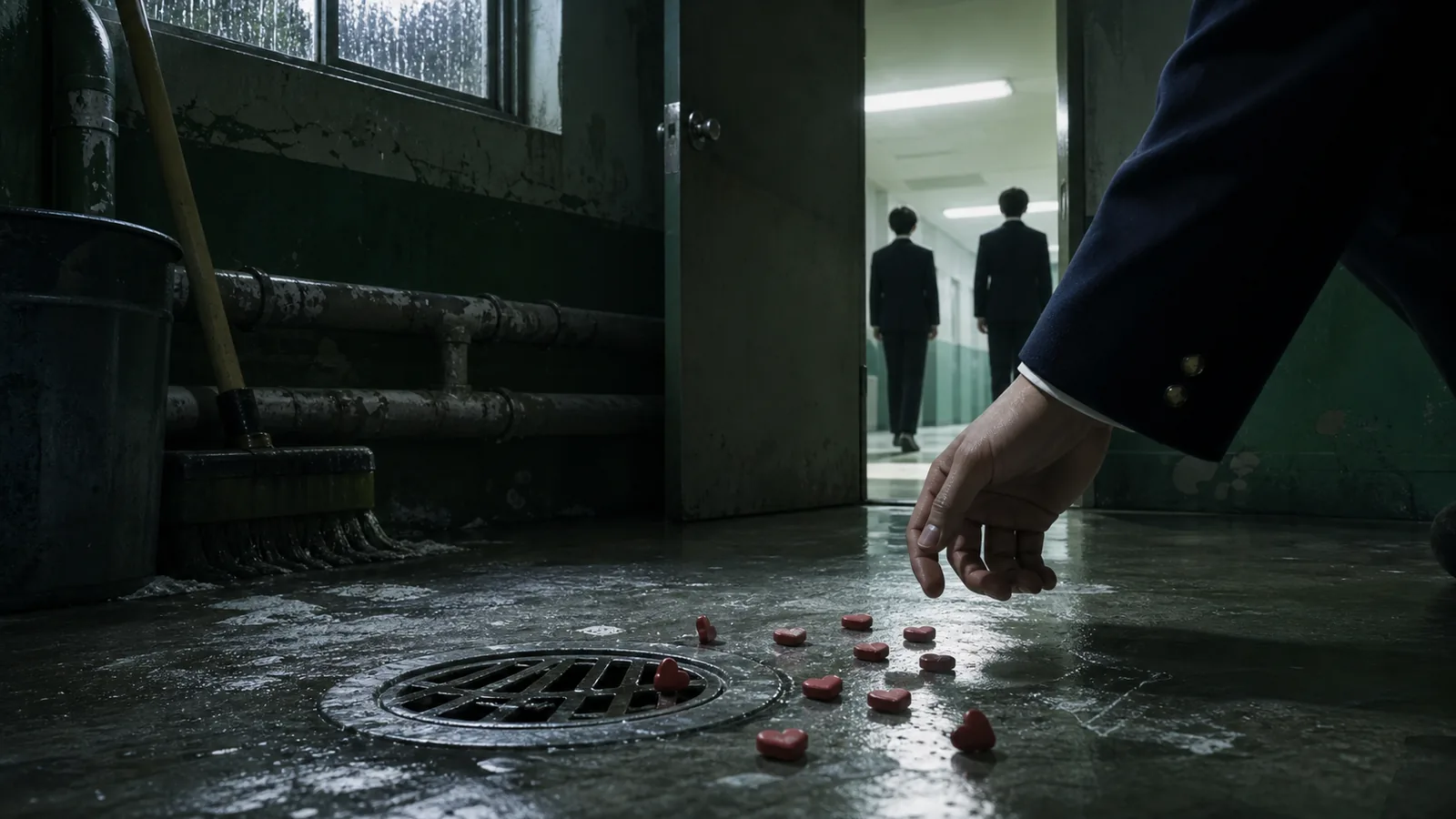
Geun-dae’s surveillance instincts give Han-rim the first real path. Yun-jin is missing from class, and the camera trail points toward a utilities building near the gym. Han-rim kicks the door open and finds her locked inside, sick, frightened, and carrying pills she calls vitamins until Han-rim offers to take one herself.
The flashback is one of the episode’s nastier little machines. Yun-jin is a girl posting dance Shorts, being told by friends and boys that prettiness is a weight-loss project, and wanting badly enough to believe the lie when Ji-ung offers a cute heart-shaped pill. First it costs 30,000 won. Then 50,000. Then she is selling for him, raising prices for him, and begging to stop while he holds the drugs over a drain and makes addiction sound like a job-performance review.
Yun-jin reports Ji-ung, and he locks her in the same room after police bring him back to school
Yun-jin’s first attempt to escape is tiny and enormous at once. She drops a report into the school police box, and for one brief morning the school gets to cheer as Ji-ung and his boys are taken away. Students wave them out, joke about expulsion, and wonder who finally wrote the letter. The relief is real because the fear has been communal.
Then the boys come back.
The science lesson on heat transfer is still on the board when Ji-ung walks into class and makes the law itself part of the threat. He knows Yun-jin wrote the report because someone told him about it. He knows he has problems now, but he also knows he is a minor, so he turns the classroom into a demonstration. He drags Yun-jin back to the utilities room, locks her in, takes a group photo, and leaves for food as if he has just handled a schedule conflict.
That is where Episode 6 gets more frightening than the car chase. The earlier chaos looked uncontrolled. This is controlled. Ji-ung does not need to hide from school because school has already failed to keep him gone. The punishment Yun-jin hoped would end things becomes a delivery system that returns him to her angrier than before.
Yun-jin tells Han-rim about the drug business, and Ji-ung dares Hwa-jin to lock him up
Yun-jin’s interview is the hour’s center, and the writing is smart enough to let despair speak plainly. She has testified before, asked teachers, the school, and police for help before, and every time Ji-ung came back. Every attempt to make the system move made life worse. By the time she says, The only way I’ll escape is if I die, the line does not feel like melodrama. It feels like a status report.
Hwa-jin promises her the bureau will be different. That promise carries risk, especially in this show, where the ERPB’s difference usually means the rules are about to bend around violence. But Yun-jin gives them the missing case: Ji-ung’s gang sells drugs to students, gets them dependent, and then coerces them into selling pills too. The bullying is not separate from the business. It is the business model.
Ji-ung’s response is almost too perfect a villain speech, which is also the point. He admits the sale, shrugs at it, and repeats the shield adults have handed him. He is a kid. Kids mess up. He will keep doing it until adulthood, then stop. If Hwa-jin has a problem with it, he can lock me up. The taunt works because everybody in the room knows the ordinary system probably cannot.
Gang-seok sends the boys to juvenile prison, and Han-rim teaches them what their age means inside
The ERPB answer is as theatrical as the offense. Hwa-jin and Han-rim load Ji-ung’s crew into a truck and take them to Gimcheon Juvenile Prison, while Gang-seok asks the correctional side to cooperate and takes responsibility for the fallout. The prison official names the legal and ethical danger plainly: abuse charges, negligence charges, a public reaction that could turn on the bureau. Gang-seok’s answer is the show’s bluntest parental line of the hour: One of us needs to be the adult.
The intake sequence strips away the boys’ schoolyard performance piece by piece. Names, addresses, accessories, uniforms, body searches, numbers. The boys who made other students afraid of hallways now have to ask when they leave, where they are, and whether anyone knows they are there. Episode 6 is not subtle about the mirror it is building, but subtlety would almost be dishonest for a case this blunt.
Han-rim gets the cleanest catharsis. Ji-ung threatens to report everyone once he gets out, and she tells them they have one way to leave: defeat her. Four boys rush one inspector and discover why Geun-dae is more worried for them than for her. When she explains that an officer may use force against an inmate who uses violence, the line is pure ERPB release valve. The same boys who kept hiding behind the law finally meet a version of the law with hands.
Prison turns “juvenile offender” into a target, and Kim Su-gyeom makes Ji-ung feel the fear he sold at school
The prison stretch works best when it stops being a revenge fantasy and becomes social engineering. Han-rim and Geun-dae run the boys through roll calls, classes, physical drills, labor, and tiny humiliations, but the real trap is status. The guards announce that juvenile offenders get served first. The boys receive the sausages before everyone else. The room immediately understands the invitation.
Ji-ung tries to keep performing power because that is the only language he has. He shoves an older inmate into the dishwater, then watches the man cover for him instead of telling on him. Hwa-jin explains why: Kim Su-gyeom began as a bullying victim, snapped, killed the bullies, and is already serving the maximum sentence. Ji-ung has spent the episode treating other people as trapped. Now he is trapped with someone who has even less to lose.
The spoon-search scene is the episode’s smartest scare. Ji-ung thinks he can frame Su-gyeom by claiming he took the missing spoon, only for the search to find toothpaste instead. The false accusation does not disappear. It becomes a debt. When Su-gyeom finally lunges, he says killing another person will not change anything for him. That is too neat as a moral lesson, but it hits the case’s nerve: fear is different when the target cannot call an adult and make it stop.
Gang-seok faces the parents, and Yun-jin refuses the apology that only starts after prison
The parent confrontation is where the episode stops pretending the boys raised themselves. At the ministry, the parents call the ERPB an enemy of human rights and demand answers. Gang-seok calls the prison visit a field trip because that is where the boys will end up anyway. It is a vicious line, but it also exposes how quickly the parents can organize when their children are the ones locked away.
At the Ministry of Justice meeting, the same parents who ignored the victims suddenly have legal language, settlement language, and future-protection language ready. Their sons are children. Their sons made mistakes. Their sons deserve another chance. Hwa-jin makes Ji-ung swallow a lookalike vitamin and lets him panic because he thinks it is one of the pills he sold. Then the bureau names the actual drug as phentermine and shows the scale of the network: more than 50 million won in sales.
Gang-seok’s speech is didactic, but the staging gives it a clean target. If parents did not teach the boys to do unto others what they would have done unto them, and school could not, society now has to. Ji-ung’s apology comes only after prison, fear, and a failed defense by his parents. Hwa-jin sends him to Yun-jin instead, and Yun-jin gives the hour its necessary refusal: I will never… ever forgive you for what you’ve done. When Ji-ung answers by threatening to kill her because he is a juvenile offender, Gang-seok denies the release request and sends the boys back.
Yun-jin asks for one promise, and the final prison hook widens the lesson beyond Hyeonjin
The aftermath does not pretend Yun-jin is healed because Ji-ung is removed. She thanks the bureau, receives the small thing she asked for, and then asks for the only promise that could make sense after her case: Can you make sure that no one turns out like me? It is a devastatingly modest dream. She is not asking for revenge, fame, or a perfect future. She is asking for one less child to become evidence after everyone else has failed.
Gang-seok’s public answer is broader and harsher. Schools will no longer accept students with criminal records in the classroom, and the bureau will protect innocent students from offenders. The line has force after Yun-jin’s testimony. It also leaves a bruise. The show has spent six episodes proving that adult institutions fail victims, then answers this case by expanding exclusion and correctional power. That tension is not a flaw by itself, but it is too large to tuck neatly under victory music.
The closing prison beat keeps the victory unstable. Ji-ung and his friends are not the only violent kids in the system, and the BS gang hook suggests a larger economy waiting behind them. A new boy is threatened because a boss is paranoid. The door closes, but the machine keeps making rooms.
Tiny details worth clocking
- Gang-seok’s kimchi visit is doing more than softening him. He warns Hwa-jin about revenge right before approving the season’s most revenge-shaped intervention.
- Geun-dae’s cup noodles are the right running gag for this case because he keeps protecting food while everyone around him escalates into state violence.
- The heart shape of the diet pills is nasty visual irony. Ji-ung sells Yun-jin self-harm as beauty, care, and celebrity promise before turning it into labor.
- The science lesson on heat transfer sits right before Ji-ung returns to punish Yun-jin. Pressure moves from the hotter object to the colder one until everyone is burning.
- The sausages in the prison cafeteria are the cleanest status trap. The boys get the privilege they think they want, and the room immediately turns that privilege into danger.
- Yun-jin asking for a promise instead of a harsher punishment keeps the case from becoming only a scare-straight fantasy. Her dream is prevention, not spectacle.
Final verdict
Episode 6 is the season’s bluntest hour so far, and sometimes that bluntness becomes a problem. The juvenile-prison field trip is staged with such engineered precision that the case can feel less like an investigation than a controlled moral experiment: every guard cooperates, every inmate functions as a lesson, every parent arrives at exactly the right pressure point. The final policy swing about criminal-record students is also huge, and the hour does not spend enough time with the children who might be caught by that net in cases less clear than Ji-ung’s.
Yun-jin is what keeps the case grounded. Her first line about Ms. Choi, her hunger to be pretty enough, her shaking refusal to testify again, and her final refusal to forgive all keep the hour attached to a girl rather than an argument. Ji-ung is almost cartoonishly vile, but the systems around him are not cartoonish at all: police procedure, mandatory schooling, parent denial, school fear, and a reporting process that returns the bully to the victim with a name attached.
The thesis lands in the gap between Gang-seok’s opening warning and Yun-jin’s last request. Revenge may mean the bureau has gone too far, but doing nothing has already gone too far for the students trapped with boys like Ji-ung. Episode 6 chooses the bruise. It makes the boys feel fear, makes the parents watch, and then leaves the audience with the uncomfortable fact that relief only arrives once the ERPB becomes frightening enough to replace every adult who should have acted sooner.
Rating: 8.1/10 — A forceful juvenile-offender case with a strong Yun-jin center and sharp procedural reversals, held back slightly by an over-engineered prison lesson and a final policy swing that needed more room to breathe.
More episodes from Teach You a Lesson — School-violence K-drama, episode by episode. Jump to any episode in the season:
Where to go next
Reviewed by Mira Vance · QuizFandom Editor & Lead Reviewer. Every rating is an honest per-watch assessment from the desk that also writes the quizzes — not a press release rehash.