Teach You a Lesson Episode 8 Review: "Episode 8" — Seungyeon High's urine tests expose Heart Pill, Hwa-jin traps Hyeon-min's mother in her own schedule, and Gyu-cheol becomes Gi-tae's new weapon
What happens — the short version (spoilers)
- The ERPB orders nationwide urine tests under a health-screening cover, and Hyeon-min collapses during Seungyeon High's Class S early-admission exam.
- Seungyeon mothers try to block the tests because their children need academies and CSAT prep, while Hwang Gi-tae quietly approaches Cho Gyu-cheol about his injured hand.
- Hyeon-min's report card drops after the exam he fainted through, and flashbacks show his mother moving the family to Gangnam, removing his door, and limiting him to three hours of sleep.
- Yeong-jun's mother points Hyeon-min's mother toward Da-hui's mother, whose tutor network and pills turn the parent hierarchy into a drug pipeline.
- The urine results show methylphenidate and atomoxetine, then Hyeon-min's own test reveals a Heart Pill substance near a lethal dose.
- Hwa-jin and Han-rim break into Hyeon-min's apartment, stop him from taking more pills, and Hwa-jin separates his mother from him as a child-abuse offender.
- Hwa-jin makes Hyeon-min's mother live under her own study plan, while Hyeon-min tells Hwa-jin he took the pills because he wanted to live.
- Hyeon-min refuses this year's CSAT and med school, Gang-seok announces CSAT drug screenings, and Full Moon, Snowman, and Heart Pill pull Hwa-jin back toward Ga-yun and Gyu-cheol.
Teach You a Lesson moves from street drugs and gambling rooms into a cleaner, richer, more respectable kind of harm in Episode 8, where the contraband is passed through mothers' meetings and called a study aid. Seungyeon High is the sort of school that turns college admission into a battlefield, and the hour follows that pressure until Jung Hyeon-min's body starts treating ambition like poison. The case is less physically explosive than the last two, but it may be the season's most uncomfortable parent episode because the abuse keeps arriving in the language of sacrifice. Hwa-jin's answer is pure ERPB symmetry: if Hyeon-min's mother built a prison out of schedules, pills, hunger, and three hours of sleep, she can try living inside it herself.
The ERPB orders urine tests before the CSAT, and Hyeon-min collapses in Seungyeon High’s Class S
The episode opens with policy before it opens with a victim. News reports say the Educational Rights Protection Bureau has ordered mandatory urine tests at schools nationwide, officially for kidney and diabetes screening, unofficially because drugs are circulating among students. Seungyeon High refuses at first, citing final exams, which already tells you where the hour lives: in a school where the calendar is more sacred than a child’s body.
Class S makes that point before anyone explains it. The room is a med-school pipeline, full of seniors aiming for Seoul National University Medical School, and the test is framed as the last early-admission chance before the CSAT becomes the only remaining route. Hyeon-min bleeds, shakes, and drops in the middle of the exam. The adults do not all read that as an emergency.
His mother reads it as lost time. She storms toward the nurse’s office asking whether he finished, gives him medicine, and pushes him back toward the paper because it will literally kill us if he can’t take it. The line is melodramatic until the episode keeps proving she means it more literally than she knows. Hyeon-min is already being asked to convert his own body into one more admissions tool.
Hwa-jin holds the Seungyeon mothers at school, and Hwang Gi-tae starts working on Gyu-cheol’s injured hand
The urine-test standoff is the hour’s first public fight, and it is staged like a class war with designer bags. The Seungyeon mothers arrive furious because their children are due at academies. They talk about one-point differences, early admission, consultants, tutors, daycare-to-med-school planning, and Daechi-dong like it is sovereign territory. One mother says the parents and students are at war.
Hwa-jin’s answer is cold enough to cut through the performance: We’re doing this so people don’t die. He tells them the ERPB can handle Daechi-dong, threatens CSAT penalties for anyone who skips testing, and notices Hyeon-min’s mother in particular because he has already seen the boy in bad shape. The bureau is not chasing delinquent kids this week. It is walking into a parent economy that can make a controlled substance sound like good preparation.
That case runs beside Gi-tae’s quieter move at the detention center. He approaches Cho Gyu-cheol, asks about the injury from the juvenile-prison incident, and offers help under the smile of a politician who likes “giving opportunities.” After Episode 7 turned Ga-yun into campaign gossip, this is the next step. Gi-tae is not only attacking the ERPB from the outside. He is looking for a living symbol inside Hwa-jin and Gang-seok’s oldest wound.
Hyeon-min fails the exam after fainting, and his mother turns one report card into a life sentence
The hospital-testing sequence is small but ugly. Hyeon-min is anxious, his mother gives him something to drink, and then the report cards arrive by email. The exam he collapsed during is the one that tanks him. He apologizes to his mother for a result his body was screaming through.
Her response is the clearest window into the case. She tells him children who cannot handle pressure need medication, asks whether it is so hard to take one pill, and turns his failure into her humiliation in front of the other mothers. The line that keeps landing is not about ambition. It is about debt. She keeps telling him what she has done for him, how much she has bowed, how hard she has worked, until the child becomes an investment that has started underperforming.
The flashbacks tighten that economy. A consultant tells her Hyeon-min is already far behind Gangnam children who have been preparing for medicine since birth. She moves the family into a cramped Gangnam apartment advertised by its previous tenants’ SNU-med success, takes the door off, pins up the goals, and turns a child’s day into three hours of sleep and a glucose packet at dinner. The apartment stops being a home. It becomes a cram-school cell with a mother’s fear for a lock.
Da-hui’s mother gatekeeps access through tutoring and pills, and Hyeon-min’s mother goes looking for something stronger
Hyeon-min’s mother does not become this dangerous by herself. She has to enter a whole maternal hierarchy first. Yeong-jun’s mother explains that Da-hui’s mother is the “mama pig,” the one with the tutoring coordinators, admissions consultants, academy programs, and information everybody else trails after. Working mothers cannot really enter the circle unless status buys them a pass. Doctors and professors matter because student records need hospital volunteering and university research.
That is how the drug arrives with no alley, no gang, no visible criminal brand. Hyeon-min’s mother brings gifts, learns the tutor names, and absorbs the rule that a child’s grades depend on the parent’s effort. When Hyeon-min cannot focus enough, Da-hui’s mother produces a pill and says it made Da-hui’s grades rise.
The first pill is only the doorway. Hyeon-min improves, gets into the med-school prep class, and his mother goes online asking for something stronger. The transaction that follows looks like any other parent-network favor until the ERPB results name the substances: methylphenidate and atomoxetine, rarely prescribed together, illegal without authorization, and serious enough to send the mothers to police questioning. Then Hyeon-min’s result comes back with something else too, a heart-pill substance close to a lethal dose. The case has moved from focus to survival.
Hwa-jin and Han-rim break into the apartment, and Hwa-jin names the pills as “something that kills kids”
By the time the ERPB reaches Hyeon-min’s apartment, he has crossed from pressure into withdrawal. His early-admission chance is gone, his mother still pivots to the CSAT, and his answer is no longer polite exhaustion. He tells her to get the meds. The door will not open. Hwa-jin takes the dangerous route in because the boy could die if he waits.
The scramble inside is one of the episode’s rougher action beats because the violence is a child fighting for poison. Hyeon-min grabs for the pills, Han-rim and Hwa-jin pull him away, and the ambulance takes him while his mother screams for her son as if the ERPB has stolen the thing she was protecting. Hwa-jin’s correction is brutal and necessary. Students may call the drug something that keeps them awake, helps them focus, improves grades, or gets them into med school. The bureau calls it something that kills kids.
The mother tries ignorance first. She did not know it was a drug. She only heard it helped concentration. Hwa-jin pushes past the performance because Hyeon-min’s body has been giving her evidence for months: nosebleeds, suicidal notes, panic, dependence, and a child asking for stronger pills because the first dose no longer holds. When she finally admits she only meant to give it until the CSAT, the case has already judged her. Hwa-jin separates her from Hyeon-min as a child-abuse offender and leaves her with the cleanest punishment the ERPB has invented all season: If you want med school that badly, then go yourself.
Hwa-jin gives Hyeon-min’s mother the mirror treatment, and Hyeon-min admits he took the pills because he wanted to live
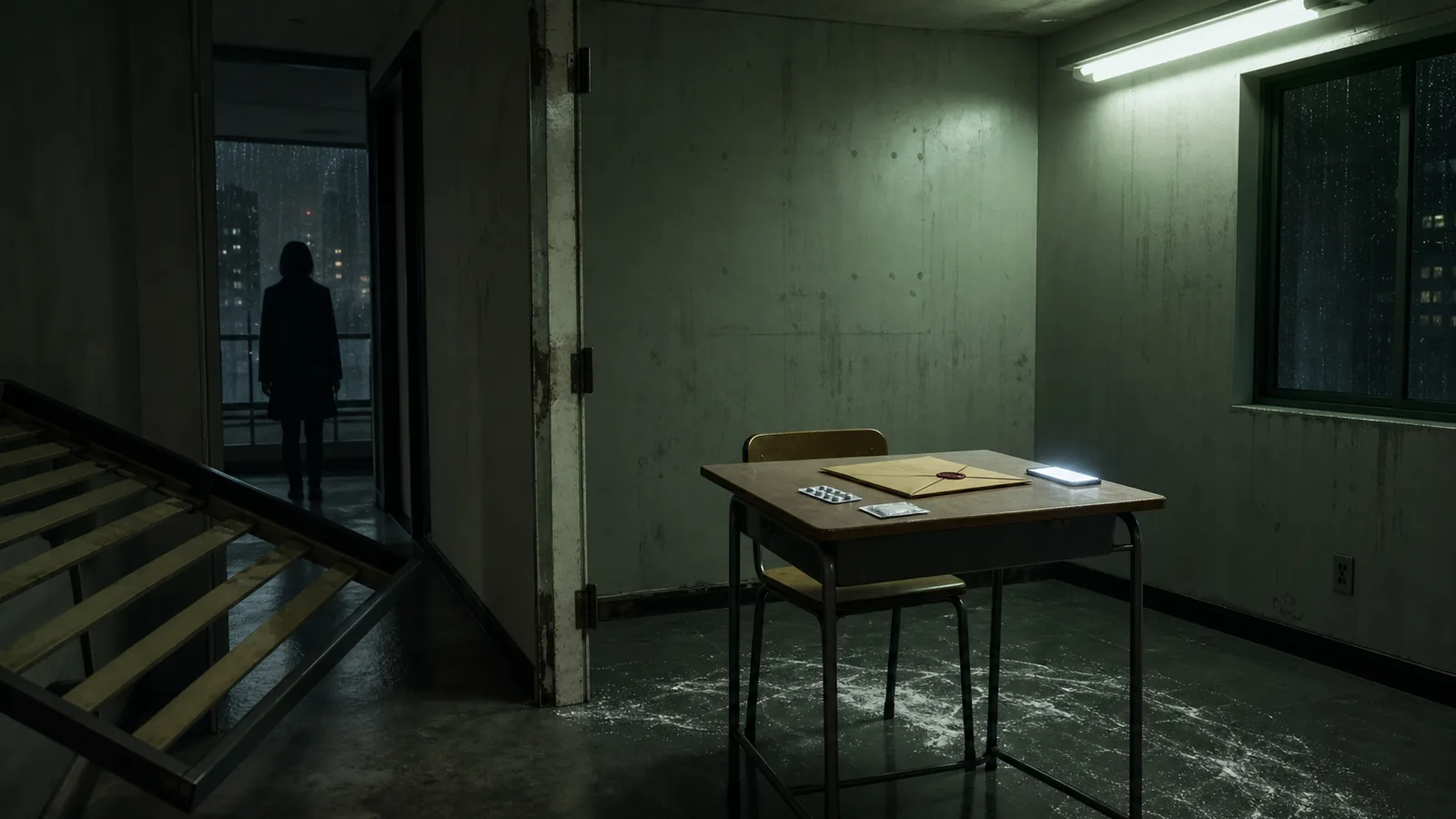
The mirror treatment is ridiculous on the surface, which is part of why it works. Hwa-jin locks Hyeon-min’s mother in the apartment, hands her the study plan and meal schedule she made, and tells her she can see her son when her practice scores clear the med-school cutoff. Three English sections. Error logs. Nutritional support instead of dinner. A wake-up call after three hours. Then the bed starts getting in the way of studying, so the bed goes too.
It is theatrical, but the episode gives the cruelty a target. She keeps insisting that she sacrificed everything for Hyeon-min, and Hwa-jin finally reverses the sentence: Hyeon-min sacrificed himself for her. The flashbacks answer him. The child’s doctor drawing is praised because it makes Mommy happy. The med-school dream becomes a family script before he has the language to refuse it. Every later complaint from his mother comes dressed as love and lands as a debt collection.
Hyeon-min’s hospital scenes are quieter and better. He wakes up, apologizes because Hwa-jin got hurt protecting him, and asks for just one pill. Hwa-jin refuses with the blunt addiction logic the hour needs: one becomes one more, and one more is already too much. Hyeon-min’s own explanation is the wound underneath the case. He did not take the pills to become some perfect test machine. I took those pills because I didn’t want to die. I wanted to live. The drug was not ambition to him. It was the thing that briefly muted the hell ambition had made.
Hyeon-min refuses the CSAT this year, and Gang-seok turns Heart Pill into a national crackdown
The recovery stretch earns its softness by refusing to make Hyeon-min magically whole. He cannot name what he likes. He knows a million things his mother likes and not one thing of his own. Hwa-jin and Han-rim’s answer is almost childlike because Hyeon-min has been robbed of the childish stage where people get to try things without turning them into applications. They bring him books about jobs, sit with him, and let the question become smaller than med school for once.
The visit with his mother is the real test. She arrives worried and loving until the CSAT enters the room, and then the old machine starts humming again. Hyeon-min tells her he is not taking it this year and is not going to med school. He will keep studying, maybe try next year, but not like this. The line that breaks the case open is painfully simple: even if I don’t go to med school, or take the CSAT… I’m still your son.
She cannot accept it. Not yet. He goes to treatment anyway and leaves her with the sentence she has spent the episode using backward: she needs to stop sacrificing herself for him and start living her own life. Gang-seok’s press conference gives the case its public consequence. Large numbers of students have tested positive for unapproved ADHD drugs, including the parent-student “study aid” called Heart Pill, and the ERPB will screen students before the CSAT. Anyone positive will be disqualified. It is a harsh ending for a case about children being crushed by academic stakes, but after Hyeon-min, the show is not pretending the drug economy can be solved by a softer memo.
Full Moon, Snowman, and Heart Pill lead Hwa-jin back toward Ga-yun while Gyu-cheol thinks about school
The final hook is where Episode 8 turns the weekly case back toward the season arc. Geun-dae looks over the seized drugs and learns that the designs change while the ingredients stay the same: Full Moon ten years ago, Snowman five years ago, newer branding after that. Hwa-jin asks to see one batch more closely, and the edit cuts to dealers panicking that the ERPB has shut everything down. Their answer is simple. The bureau has to disappear.
Hwa-jin, meanwhile, is searching the question the show has been circling since Gyu-cheol apologized: what should he do about the boy who killed Ga-yun, and whether forgiveness is even possible. The episode does not flatten that into a noble answer. It places Gyu-cheol’s parole conversation beside the old courtroom framing: the prosecution seeking fifteen years for premeditated murder, the defense insisting Ga-yun had been changing him and that her death was an accident.
Gyu-cheol says that if he gets out, he would like to go back to school. After an hour about a boy nearly dying because school became a parent’s god, that line does not land cleanly. School can be a weapon, a cage, a market, a shelter, and a second chance depending on who controls the room. Episode 8 leaves Hwa-jin staring at that contradiction while Gi-tae is already trying to make it useful.
Tiny details worth clocking
- The episode opens with the ERPB pretending the urine tests are ordinary health screening, which lets the case start inside bureaucratic language before it reveals the drug panic underneath.
- The Gangnam apartment listing is perfect nightmare real estate: not a nice home, not even a deposit, just proof that two previous boys made it to SNU Med School.
- Hyeon-min’s removed door becomes more than a control detail once Hwa-jin starts removing the bed. Privacy and rest are both treated as obstacles to performance.
- Da-hui’s mother’s plate set is a nasty social cue. Hyeon-min’s mother learns that access has to be purchased, then learns the real merchandise is medication.
- The birthday-code question quietly says how little Hyeon-min’s mother has been seeing her son as a person. The whole apartment is built around his future, and the present child is still hard for her to read.
- The children’s career books are almost too soft for this show, but that is the point. Hyeon-min needs picture-book permission to imagine wanting something.
Final verdict
Episode 8 is one of the season’s most morally focused cases, even when the mechanics get broad. The mirror treatment is pure Teach You a Lesson: blunt, punitive, staged for maximum irony, and easier to enjoy than to defend as procedure. Locking a mother into her own child’s study schedule is a cleaner revenge device than a realistic intervention, and the episode sometimes lets that device run so neatly that the father’s absence, the school administration, and the wider supply chain blur behind one mother’s punishment.
But Hyeon-min keeps the hour from becoming a simple bad-mom morality play. His collapse, his nosebleeds, his apology for failing an exam after fainting, his withdrawal, and his inability to name one thing he likes all point to a system bigger than one apartment. The mothers’ inner circle matters for the same reason. The drugs do not enter Seungyeon High because children are wild. They enter because respectable adults can launder danger through information, sacrifice, and status anxiety until nobody wants to call it abuse.
The thesis lands in the gap between Hyeon-min’s sentence and his mother’s refusal. He is still her son without the CSAT, without med school, without the future she bought so hard it became a cage. Episode 8 works because it makes that obvious sentence feel almost impossible to say. The ERPB punishment may be too tidy, and Gang-seok’s national crackdown raises questions the hour does not have time to test, but the case itself is sharp: a child nearly dies trying to survive the life his mother insists is love.
Rating: 8.4/10 — A bruising academic-pressure case with a strong Hyeon-min center and a smart parent-network drug pipeline, held back slightly by an overly neat mirror-treatment punishment and a policy ending that moves faster than the episode can interrogate.
More episodes from Teach You a Lesson — School-violence K-drama, episode by episode. Jump to any episode in the season:
Where to go next
Reviewed by Mira Vance · QuizFandom Editor & Lead Reviewer. Every rating is an honest per-watch assessment from the desk that also writes the quizzes — not a press release rehash.