Teach You a Lesson Episode 9 Review: "Episode 9" — Gyu-cheol returns to school, Seong-gu becomes Mr. Wi-Fi, and Han-rim turns Chi-ho's committee trap back on him
What happens — the short version (spoilers)
- Cho Gyu-cheol is released on parole and readmitted to school, while Gang-seok refuses to block him because that would be revenge.
- Gyu-cheol is taunted by Jong-su's crew, then reports Seong-gu's bullying to the ERPB after a Yatcha fight report points the bureau toward Jinwon High.
- Hwa-jin identifies Seong-gu as the class's human Wi-Fi, and Geun-dae and Han-rim use Chi-ho's cloned voice to get the W-I-F-I password.
- Seong-gu's account history exposes food orders, game subscriptions, scooter rentals, resale scams, and fraud being run under his name.
- Chi-ho frames Seong-gu by sending a filthy video to Ji-hyo, then files first with the school violence committee using a lawyer, psychiatric records, and a fake loan repayment.
- Hwa-jin finds Seong-gu crying by his phone and gets him to say nobody believes him, while Gyu-cheol's earlier report gives the bureau a path back into the case.
- Han-rim goes undercover as the new human Wi-Fi, the bureau hacks Chi-ho's crew into their own account panic, and Hwa-jin uses the second committee to clear Seong-gu's name.
- Ga-yun's old video gives Gang-seok and Hwa-jin one night of grief, but Gyu-cheol gives Hwang Gi-tae Chi-ho's suicide recording and turns the ERPB's win into a national scandal.
Teach You a Lesson sends Cho Gyu-cheol from prison back into a classroom in Episode 9, while the ERPB has to decide what protection means when the student making a report is also Ga-yun's killer. The weekly case looks lighter at first because the weapons are phones, passwords, food orders, game accounts, and committee paperwork instead of fists, but the damage is brutal: Seong-gu is made invisible precisely because he has no bruises to show. Gyu-cheol becomes the uncomfortable hinge between those two stories, reporting another student's abuse while Hwa-jin and Gang-seok are still trying to survive what he did to Ga-yun. The committee stretch turns institutional procedure into a mirror trap, then leaves the bureau exposed to the same manipulation it just beat.
Gyu-cheol is released on parole, and Hwa-jin warns him to live like a normal student
The hour opens with the worst possible school gate. Parents chant that they do not want a murderer near their children, reporters crowd Cho Gyu-cheol, and the parole decision is framed in the language of remorse, good conduct, youth, and reintegration. Gang-seok can see the speed of it: the release, the readmission, the paperwork moving as if someone had greased every hinge.
He still refuses the easy answer. Gyu-cheol has served the sentence the law gave him, and the Bureau has no authority to stop a student from returning to school. Gang-seok says the quiet part with the kind of restraint that hurts more than rage: if he stopped Gyu-cheol, that would be revenge.
Hwa-jin is already at the school. His warning is colder than a beating because it sounds almost merciful. Gyu-cheol is a test case. Eat, sleep, breathe, study. Live like a normal student. The old wound is standing in a uniform, and Hwa-jin chooses surveillance over punishment for now.
Jong-su’s crew taunts Gyu-cheol, and a Yatcha fight report sends the ERPB toward Jinwon High
Gyu-cheol’s new classroom proves that “normal” life is not waiting for him. The teacher introduces him carefully, the students stare, and Jong-su’s crew immediately turns him into a spectacle. They ask whether he killed a teacher, call him killer, toss a knife line at him, and dare him to react. Gyu-cheol does not. He keeps his head down because Hwa-jin’s warning is already in the room.
The case arrives through a different student, but the texture matches. A report says a student attacked a teacher for confiscating a phone and challenged him to a Yatcha fight, bare-knuckle, no rules, no referees. Authority has not collapsed quietly here. It has been replaced by a phone-game pecking order with violence sitting one tap away.
Then Gyu-cheol walks into the ERPB and reports bullying. Han-rim nearly explodes when he invokes Ms. Choi’s lesson about protecting students having a hard time, and the reaction tells you how raw the Ga-yun wound still is. Gang-seok keeps the bureau door open anyway. Gyu-cheol may be the boy who killed Ga-yun. He is also a student making a report.
Hwa-jin finds Seong-gu in the middle of the crowd and names him as the class’s human Wi-Fi
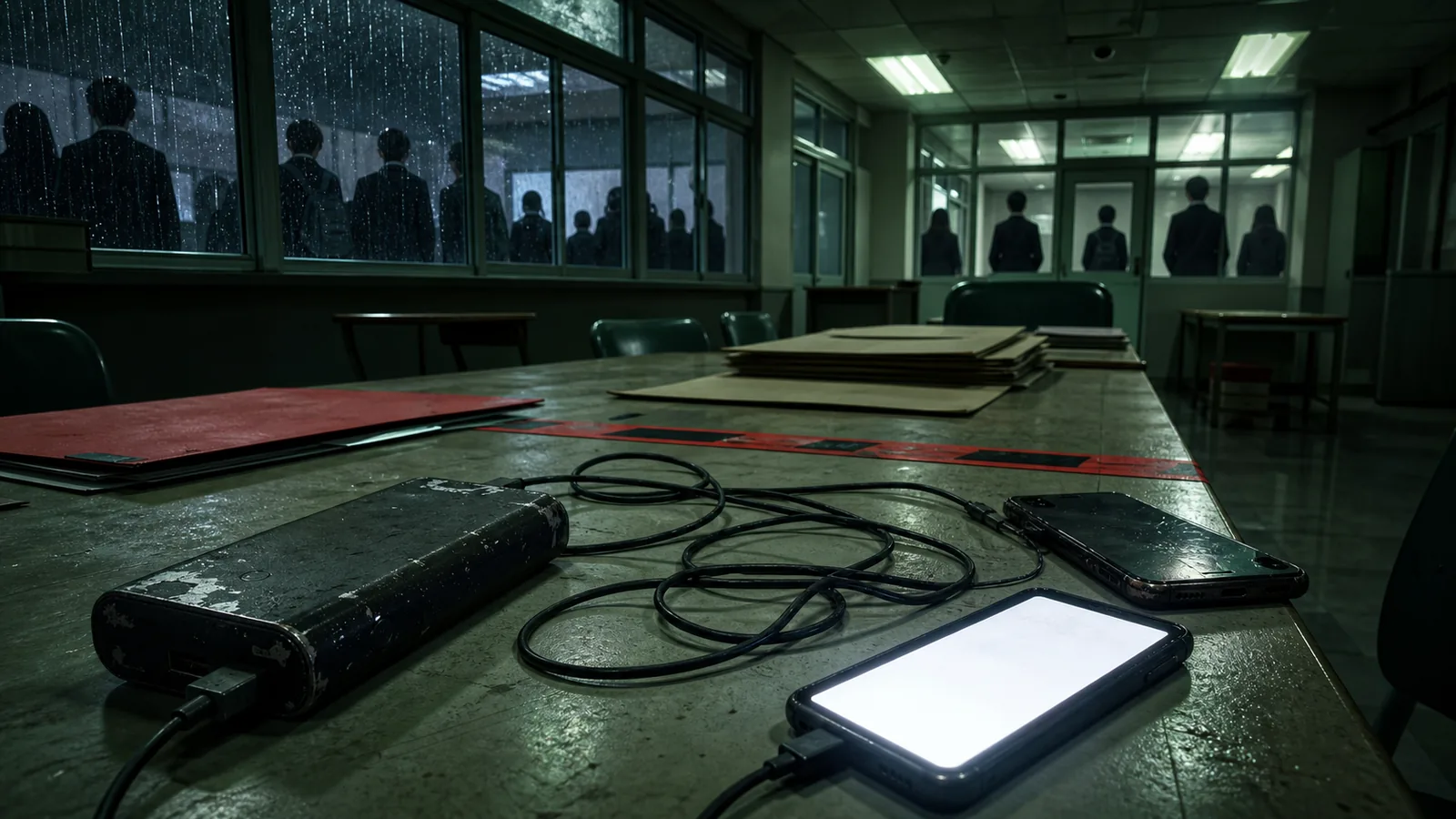
Jinwon High’s staff do not see anything alarming. Seong-gu has friends, he seems to enjoy school, and the boys around him look loud in a familiar way. Hwa-jin sees the pattern faster than the adults paid to watch the classroom. Seong-gu is always in the middle of the group, always first with his phone, always carrying the power bank.
The nickname is humiliating because it is accurate: Mr. Wi-Fi. The boys are not only borrowing Seong-gu’s hot spot. They are turning his presence into infrastructure. If he vanishes, the games freeze. If the signal weakens, they notice. If he gets scared, they can soothe him in public and tighten the leash in private.
Chi-ho’s control is built to look friendly. He tells Seong-gu to relax when the ERPB appears, calls him buddy, worries over him just loudly enough, and asks to be excused with the smoothness of a student who knows the room will believe him first. By the time Geun-dae’s old acquaintance blows his cover at school, the bureau has enough to know the case is digital, social, and harder to prove than a bruise.
Geun-dae clones Chi-ho’s voice, and Seong-gu’s account history exposes food orders, scooters, subscriptions, and fraud
The investigation turns into one of the episode’s funnier procedural builds. Geun-dae clones Chi-ho’s voice badly, Han-rim takes the phone and does it better by simply yelling like Chi-ho, and Seong-gu gives up the password: W-I-F-I. The joke works because the answer is also the thesis of the abuse. They have made his identity as usable as his signal.
The account history is a map of exploitation. Seong-gu’s name is attached to food orders at different addresses, paid game subscriptions, e-scooter rentals, resale scams, undelivered items, and eat-and-runs. The volume is impossible for one boy to manage, which is the point. His friends have turned him into a shared login and a disposable suspect.
The episode gets nastier when the victims of those scams find him. Seong-gu is beaten for AirPods and money he did not steal, then goes back to Chi-ho for help because the account is under his name. Chi-ho gives him the trap sentence every bully with leverage loves: if he did nothing, Seong-gu would be the only one screwed, so Seong-gu should be thankful.
Chi-ho frames Seong-gu with a filthy video, and the first committee turns the victim into the accused
The home scene is one of the hour’s ugliest turns because it understands how quickly evidence can become theater. Seong-gu’s mother goes to Chi-ho’s house with the account charges. Chi-ho is ready. A filthy video lands on his sister Ji-hyo’s phone from Seong-gu’s account, and the room flips in seconds.
Seong-gu says Chi-ho did it. Nobody believes him. Chi-ho’s mother threatens police, Seong-gu’s mother apologizes on his behalf, and Chi-ho warns that next time he will send it to every girl in class. The harm is not only the video. It is the public proof that even Seong-gu’s mother can be forced to treat him like the culprit.
The school violence committee repeats the same violence in official language. Chi-ho files first, arrives with a lawyer, psychiatric records, and a story about false rumors and psychological distress. Seong-gu tries to explain the stolen accounts, but he has no proof clean enough for the table. Then the staged repayment lands: one million won from Lee Chi-ho, labeled as loan repayment. By the time Seong-gu’s mother apologizes to Mrs. Lee, the committee has done exactly what the boys did in the classroom. It has used Seong-gu’s name against him.
Hwa-jin finds Seong-gu crying by his phone, and Seong-gu finally says his life is over
The episode’s strongest quiet scene comes after the committee, when Hwa-jin tracks Seong-gu through his phone connection and finds him alone. He does not start with a lecture. He tells him to cry. If Seong-gu keeps it inside, nobody will know he is crying. If he keeps silent, nobody will know he has been wronged.
That gives Seong-gu permission to say the thing the hearing would not hear. He told the police, his parents, and his teachers. Nobody believed him. The boys were using him, but they were also the only friends he had. Chi-ho promised to come clean, kept delaying, then accused him first. Now everyone will think Seong-gu is a liar and a bully.
Hwa-jin’s answer is as plain as the show gets: he believes him, he is there for him, and Seong-gu can trust the ERPB. The line echoes Gyu-cheol’s earlier confession that if the Bureau had existed two years ago, he might not have killed anyone and nobody might have died. The episode does not ask you to forgive Gyu-cheol for saying it. It lets the sentence sit there anyway.
Han-rim becomes the new human Wi-Fi, and the ERPB makes Chi-ho’s crew feel their own account trap
Han-rim’s undercover entrance is broad and silly on purpose. Geun-dae dresses her as a dork, tells her not to make eye contact, and then has to coach her through every insult because her first instinct is to hit people. The act holds together for one reason: Chi-ho’s crew is greedy enough to believe in a better victim.
She offers streaming accounts, game levels, a router, cables, chargers, and unlocked-phone convenience. The boys hand over their phones because the thing they trained Seong-gu to provide has arrived in a richer package. Then Geun-dae and the bureau make the mirror exact: game accounts hacked from Colombia, porn spam sent to a mother, Chi-ho’s account cursed into a 300-year suspension, scooters charged until the bill climbs, and Jong-su’s bike listed as free.
It is funny in the brutal, procedural way this show often is. It is also morally messy by design. Han-rim gathers proof and gives the boys a controlled taste of the panic they built for Seong-gu. When Chi-ho grabs her and demands the truth, she admits it was her, then asks whether the amount of suffering is enough to make him prefer death over returning to school. She has barely started.
Gang-seok gives Han-rim the committee floor, and Hwa-jin defines violence without bruises
The second committee is the first one turned inside out. Chi-ho arrives calling himself the victim, asking why he has to prove anything, and naming the new student as the hacker. Then Han-rim enters drooling and injured-looking, Hwa-jin appears with power of attorney from Minister Choi, and the ERPB produces an official document placing school violence committees under the bureau’s remit.
It is absurdly satisfying to watch Chi-ho forced into the machine he used on Seong-gu. Hwa-jin performs the same injury language Chi-ho’s lawyer used earlier, and Chi-ho snaps because he recognizes the act. Han-rim pushes it until he grabs her, then twists his wrist and asks whether he has reflected on the pain he caused. The catharsis is engineered. That is the point.
By the time Hwa-jin speaks, Chi-ho’s damage is already visible without a bruise. He left Seong-gu terrified, disbelieved, humiliated, and begging the person hurting him for rescue. Seong-gu even wished he had bruises, because visible injuries might have made his parents believe him. Hwa-jin reduces the committee’s job to something it should have known before the bureau entered: A victim is a victim. A bully is a bully. And a liar is a liar.
Ga-yun’s video gives Gang-seok and Hwa-jin one night of grief before Gyu-cheol hands Gi-tae a suicide recording
The aftermath lets the case breathe. Seong-gu gets protective measures, a new ID, and help restoring his accounts. His mother apologizes to him in front of the committee, and Gyu-cheol quietly watches his report become a rescue. Hwa-jin, who told him not to get involved, admits he is glad Seong-gu is all right. That is as much grace as the episode can give.
Then the hour moves to the wound underneath the season. Hwa-jin finds Gang-seok drinking, one glass set aside for Ga-yun, and takes him home. The old video is almost unbearable in its ordinary warmth: Ga-yun teasing her father and Hwa-jin into an arm-in-arm toast, threatening no marriage and no grandchildren until the men stop acting like children, laughing them into a family shape that will never happen.
The cut after that is vicious. Chi-ho, ruined by the committee, is told by Gyu-cheol that everything has gone exactly as planned. Gyu-cheol was the one who reported the bullying to bring the ERPB down on Chi-ho, and the next piece is the recording of Chi-ho saying his life is over because of the ERPB and the only way out is death. He gives it to Hwang Gi-tae, then reveals the deeper play: Gi-tae did not drag him into this. Gyu-cheol dragged Gi-tae into it. The episode ends with Chi-ho’s fall from the Jinwon High rooftop turned into national scandal, and the Bureau’s clean victory suddenly looks like evidence for its enemies.
Tiny details worth clocking
- The password being “W-I-F-I” is almost too on the nose, which is why it works. Seong-gu has been reduced so completely that even his secret sounds like his job.
- Gyu-cheol’s report uses Ga-yun’s old lesson about students protecting other students, and Han-rim’s anger shows how hard it is for the bureau to hear a true sentence from him.
- The fake one-million-won repayment is a sharp committee trick. It does not erase what Chi-ho did, but it gives the table one clean document to believe.
- Han-rim being told that a dork never makes eye contact is a funny undercover note until Chi-ho’s crew immediately proves how quickly a “dork” becomes prey.
- The 300-year game suspension is a perfect Geun-dae punishment: childish, technical, and emotionally catastrophic to the exact kind of boy it targets.
- Ga-yun’s video matters because it is not heroic. It is domestic, petty, funny, and full of the family future Gyu-cheol’s case destroyed.
Final verdict
Episode 9 is the season’s sharpest committee episode because it treats paperwork as action. The phone-account abuse is specific enough to feel contemporary without becoming a tech gimmick, and Seong-gu’s pain is drawn through systems rather than speeches: apps, passwords, account histories, staged deposits, psychiatric records, school-board procedure, and a mother being taught not to trust her son. That makes Han-rim’s sting land with real force. The bullies are beaten by the shape of their own cruelty.
The weakness is that the sting is so clean it almost overpowers the ambiguity the episode is clearly trying to preserve. Watching Chi-ho panic is satisfying, but the bureau’s method is also an official imitation of the abuse: hacked accounts, public humiliation, performed victimhood, and a committee room engineered to break a child into confession. The ending knows this, which helps. Chi-ho’s rooftop fall and Gyu-cheol’s recording do not excuse him, but they do turn the ERPB’s victory into a political weapon before anyone can enjoy it for too long.
The thesis lands in the space between Seong-gu’s invisible bruises and Gang-seok’s glass for Ga-yun. Violence in this show keeps changing forms: a knife, a phone, a school committee, a parole file, an audio clip. Episode 9 works because it lets the weekly rescue feel good, then makes that good feeling dangerous. The ERPB can tell the committee that a victim is a victim and a liar is a liar. Gyu-cheol’s last move proves the public will still have to decide who gets to say which is which.
Rating: 8.6/10 — A strong, uneasy digital-bullying and committee-trap hour with a painful Seong-gu center and a major Gyu-cheol/Gi-tae turn, held back only by a payback sting that runs a little too neatly before the ending complicates it.
More episodes from Teach You a Lesson — School-violence K-drama, episode by episode. Jump to any episode in the season:
Where to go next
Reviewed by Mira Vance · QuizFandom Editor & Lead Reviewer. Every rating is an honest per-watch assessment from the desk that also writes the quizzes — not a press release rehash.