The Evil Lawyer Episode 1 "Allegation" Review: Jittri breaks a corpse-trafficking case, Mek reopens a factory-fire plea, and Techin turns a golf course into a murder trap
What happens — the short version (spoilers)
- Jittri defends Boonlue by turning Yupin's stolen-baby grief into a legal argument about whether the stillborn child counts as a corpse under the charged law.
- Mek takes Panitarn Boonprayook's waste-plant fire case and grows suspicious that a poor security guard is taking the fall as the supposed factory owner.
- Ang uses Dr. Atchara's name to get villagers talking, and Mek learns Por's debts, Kratai's care, and Panitarn's family pressure may explain the bought confession.
- Panitarn retracts his guilty plea, after which Mek receives a 300,000-baht bribe and a warning from Techin to leave the waste-plant case alone.
- Techin lures Mek to Saraburi with Ang's boat-party secret, reveals Nay Oo as the dead waitress's sister, and tries to erase her as evidence.
- A shot implicates Mek, Techin makes the gun a shared-fingerprint trap, Mek beats Techin with the golf club, and Jittri arrives in custody as his only way out.
The Evil Lawyer opens with a courtroom victory so ugly the win feels like evidence against the whole profession. The hour then splits its argument between Jittri, who can make cruelty sound procedural, and Mek, a public defender still angry enough to notice when a confession has been bought. Around them, Ang tries to turn political charity into real help, Techin weaponizes a hidden boat-party death, and the law keeps arriving after power has already set the room.
Jittri lets Yupin testify, then turns a stillborn baby into a legal loophole
The cold open is almost unbearable before Jittri says a word. Yupin is rushed into surgery after a crash, begs the doctors to save her baby, then relives the cremation day when she learned the coffin was empty. The trail leads to Boonlue, a monastery raid, and the photos of a child turned into a luk krok talisman. Yupin’s grief blows through court decorum: she lost her husband, lost her son, and now has to describe the theft of the body in front of the man accused of profiting from it.
Jittri’s first move is silence. She does not cross-examine Yupin. She waits until the doctor takes the stand, then narrows the room down to vital signs, fetal heartbeats, and the legal threshold for personhood. The question is obscene in the plainest possible way: if the child never survived delivery, can the indictment for desecrating a corpse stand?
That is where the series plants its thesis. Jittri is not confused about the human cost. She knows exactly what she is doing, and she makes the court record say it anyway: the infant had no vital signs, therefore the infant was deceased before legal personhood, therefore the prosecution may have charged the wrong thing. The line that detonates the room is hers: “How can you say the child died, when the child was never alive?” The horror is not that she breaks the rules. The horror is that she may be right inside them.
Suwat’s man congratulates Jittri, her pregnant assistant quits, and Yupin throws blood for the cameras
The aftermath tells us what kind of ecosystem Jittri works in. A man congratulates her, says Mr. Suwat sends his thanks, and invites her to wine in Prachinburi because there are more cases he wants her help with. It is not a victory lap. It is a hand on the shoulder from a patronage network, the kind that sees a courtroom argument as a service that can be booked again.
Her assistant’s resignation lands harder because it is small and private. She thought working under Jittri would make her better; instead she hates herself. Jittri answers with the cleanest self-indictment in the episode: “I’m simply doing what the law allows.” When the assistant calls her disgusting, Jittri does not defend her morality. She widens the guilt until it covers the building. If her work is evil, then everyone in the courthouse is evil too.
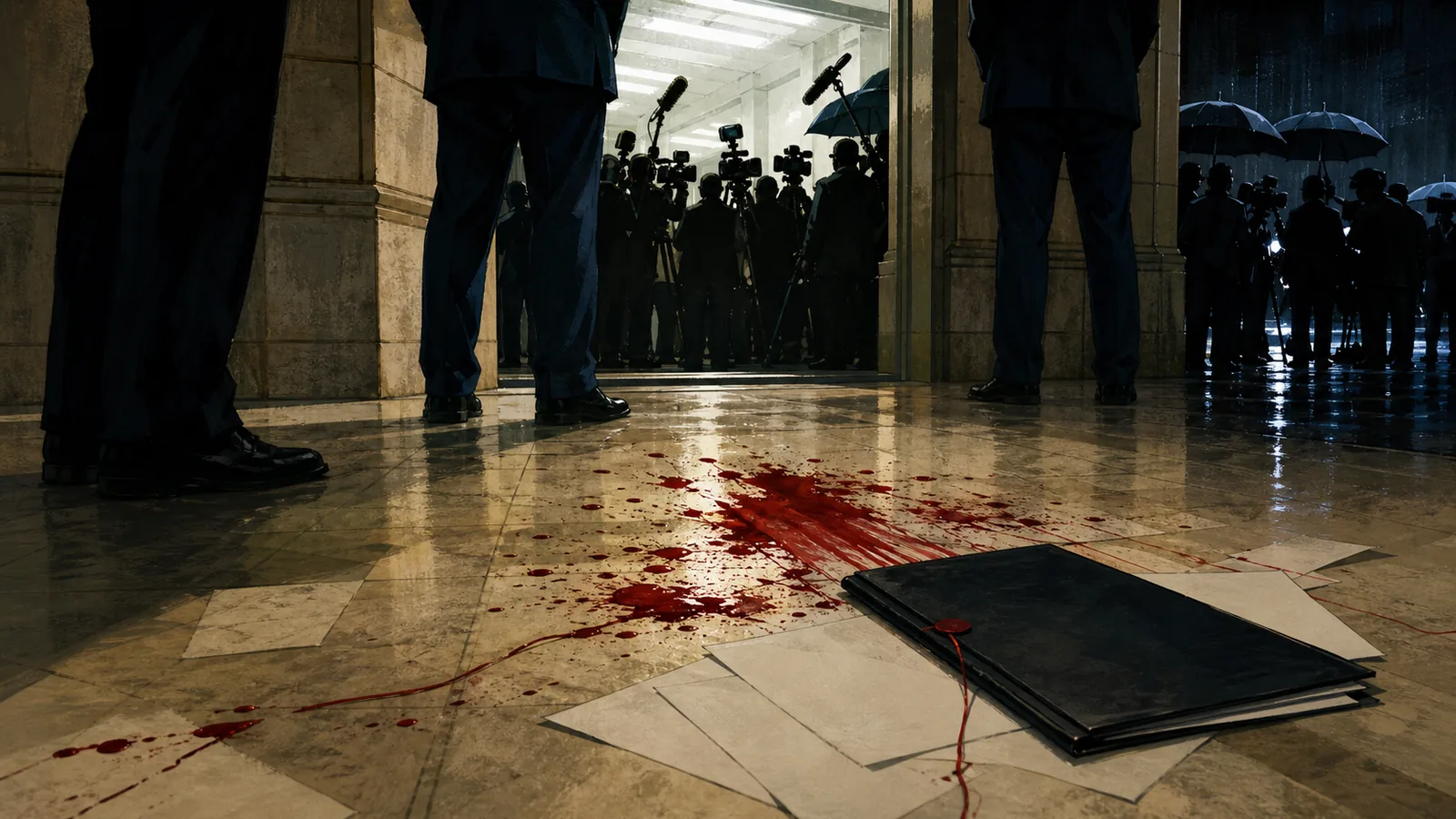
Then the public gets its own verdict. Reporters swarm. Yupin throws pig’s blood. The live stream catches the splash, the insults, the mother screaming that she carried her baby for nine months. The show is sharp about spectacle here. Jittri’s legal argument already happened inside the courtroom; outside, the case becomes a clip, a bounty rumor, an image people can replay while deciding what kind of monster she is.
Mek takes Panitarn’s fire plea and notices the confessed factory owner does not fit the file
Mek enters from the opposite end of the courthouse economy: public cases, dry jokes from colleagues, one recycling-plant arraignment that everyone expects to pass quickly. The defendant is Panitarn Boonprayook, listed as managing director of Rungruang E-Waste Recycling, charged with criminal negligence causing a fatal fire and massive property damage. His son Aon wants the case over. Panitarn has confessed. The victims are seeking ten million baht in damages. The machinery is ready to move.
Mek is the only person in the room bothered by how smooth it looks. He asks for a moment with Panitarn because the confession feels wrong, and the plaintiff’s lawyer immediately pushes the moral language of remorse. The court asks again, Panitarn says guilty, and Mek has to stand there while the man walks himself toward prison.
The hour does not make Mek heroic by making him polished. He is frayed, angry, and bad at hiding contempt for lawyers who treat poor defendants as paperwork. Outside court, he snaps that Panitarn does not look like a factory owner. It is an ugly sentence, and the episode lets another lawyer needle him for it. But Mek’s instinct is pointing at a real fraud: the file says owner; the body in front of him says fall guy.
Ang uses Atchara’s name at the relief tent, and Mek finds Por’s real life in the neighbors’ gossip
The Ruam Thai Party relief event gives the factory fire a second stage. Dr. Atchara poses with a one-million-baht donation, while Ang slips away to hand out help-center cards and check on the villagers. The party wants photographs. Ang wants complaints. That gap is the most useful thing the episode gives her in the premiere.
Mek arrives digging for answers and is immediately mistaken for a thief while searching Por’s house. Ang saves him by invoking the exact name she admits she does not like using: she is Dr. Atchara’s daughter, and that makes people listen. The rescue is funny for about five seconds, then it turns into testimony. The neighbors explain that Por owes money around the community, that his son ran off after baccarat debts, and that Por is caring for his granddaughter Kratai. They also say he was a security guard at the waste-processing plant, off the day of the fire because of a shift change.
That scene is the premiere at its best: gossip becomes evidence, charity becomes access, and an old relationship becomes an investigative tool neither Mek nor Ang fully knows how to handle. Their personal wound is still raw. Mek asks what he did wrong. Ang says it has only been three months. A flashback fills in the break: after a boat party, she changed, left the law center, joined her mother’s party, and told Mek she wanted to break up without giving him the real reason.
Panitarn retracts his plea after Mek makes the case about Kratai
Mek’s second attempt with Panitarn is less about legal theory than family pressure. He lays out the shape of the deal: Panitarn is paying off his son’s baccarat debt, taking the fall for the factory owners, and leaving Kratai with the very son who already abandoned his responsibilities. The son storms in drunk and furious, which only proves Mek’s point.
The courtroom reversal is quiet, which makes it better. The judge asks whether Panitarn pleads guilty. Mek tries to speak for his client’s rights, the judge cuts him off, and Panitarn has to answer for himself. He does. “I’m not guilty. I’ll fight the charges.” A case that was supposed to be processed in minutes becomes a problem for whoever arranged the confession.
The reaction arrives fast. The opposing lawyer warns Mek that the case is bigger than he thinks, then calls someone he addresses as Dad and reports that Mek has taken it. A childhood golf memory follows, with a lesson about trust, opportunity, and promises. Then Mek finds a 300,000-baht deposit from Tae, Class of ‘49. The bribe is blunt on purpose. It is the system checking whether a man who talks about rights has a price.
Techin offers Mek Ang’s boat-party secret, introduces Nay Oo, and makes the threat physical
Techin’s phone call turns the factory case into the Ang case. He tells Mek the deposit is only the start, then dangles the one thing Mek cannot ignore: what happened after the boat party three months earlier. Mek goes to Saraburi, where Techin wastes time with golf because making people wait is part of the performance.
The information comes in pieces. A body was found in the Chao Phraya River on July 10th. The boat party was July 1st. Techin says a waitress died that night and asks whether Ang could have been on a boat that small without knowing. He pushes the accusation further, claiming that if Ang helped dispose of a body, her new political life would be over.
Then he brings out Nay Oo, the caddie he has been abusing in front of Mek. Techin says the dead waitress was Nay Oo’s sister and that Nay Oo was on the boat. He is careful enough to explain why the VVIPs would stay silent and cruel enough to say no one would risk everything for one Burmese girl. The threat stops being blackmail and becomes a demonstration. If Nay Oo disappears, the evidence disappears with her.
Techin makes Mek part of Nay Oo’s shooting, Mek kills Techin, and Jittri walks in as the only exit
The shooting happens with the sick logic of a trap that has already been built. Nay Oo begs, promises she will return to Myanmar, and says she will not talk. Mek offers to drop the factory case. Techin does not take the deal because the deal was never the whole point. He needs Mek implicated, not merely obedient.
By the time the shot is fired, Techin has made the frame explicit: the gun now carries both men’s fingerprints, and Mek will go down beside him if the police test it. It is a vile joke, and a precise one. The boat party death, the factory case, Ang’s silence, Nay Oo’s fear, and Mek’s prints all collapse into one setup. Techin keeps needling him, even dragging in Mek’s family history and his judge father, until Mek beats him with the golf club.
The cut from violence to news report is merciless. Mek Piriyawich is the suspect. Techin Methaneepaisal is the victim. Techin is Police General Anan’s son. Bail is pending. By the time Jittri enters the holding room, the public story has already been packaged. Her offer is as blunt as her courtroom style: listen carefully, because she is Mek’s only way out.
Tiny details worth clocking
- Jittri’s assistant being pregnant turns Jittri’s courtroom argument into something even uglier in the office afterward; Jittri knows exactly which wound she is pressing.
- The courthouse gossip about Jittri’s past cases does efficient world-building: tycoon, colonel, shaman, all acquitted or defended through methods people do not trust.
- Ang dislikes using Atchara’s name, but it is the only reason the villagers stop treating Mek as a thief long enough to talk.
- Panitarn’s granddaughter Kratai never appears, yet she becomes the reason the plea changes.
- Techin’s golf setting is not decoration. The deposit, the childhood lesson, the 3-iron, and the murder weapon all make the trap feel personal to Mek before it turns legal.
Final verdict
As a premiere, “Allegation” is built like a legal brief with blood under the staples. It opens by making Jittri impossible to admire cleanly, then spends the rest of the hour proving why someone like Mek might still need her. The clean institutions do not arrive as protection. They arrive as paperwork, press language, party optics, and charges that already point at the weakest available body.
The clunkiest stretch is also necessary: Techin explains a lot on the golf course. The boat party, the dead waitress, Nay Oo’s sisterhood, Ang’s possible exposure, the VVIP silence, and the factory pressure all come out in one extended villain performance. It is dense, and a little too conveniently staged. But Techin is cornering Mek, and every piece of information is tied to an immediate act of force.
What makes the premiere stick is the contrast between Jittri’s first win and Mek’s first loss. She dehumanizes a child through legal definition and walks out covered in blood. Mek humanizes a fake factory owner and ends the hour accused of murdering a police general’s son. The show is not asking whether the law can be pure. It is asking who gets to dirty it first.
Rating: 8.7/10 — A harsh, tightly wired premiere with one heavy exposition stretch, but its courtroom cruelty, factory-fire reversal, and golf-course frame-up give the series a strong legal-crime engine.
More episodes from The Evil Lawyer — Thai courtroom revenge, power, and frame-up fallout. Jump to any episode in the season:
Where to go next
Reviewed by Mira Vance · QuizFandom Editor & Lead Reviewer. Every rating is an honest per-watch assessment from the desk that also writes the quizzes — not a press release rehash.