We Are All Trying Here Episode 1 Review: What Hwang Dong-man Hears
What happens — the short version (spoilers)
- Seok-gu pitches his producer a screenplay about a state agency that kills unbearable people, with Dong-man as the first target — and admits Dong-man is basically his muse.
- At his dying writing academy, Dong-man riffs brilliantly on poverty as a writer's gift until a student asks the question that floors him: so why haven't you made it?
- At the Sister Vengeance celebration dinner the Eight Club performs around Dong-man, and Hyo-jin calls him a ghost while the group quietly decides to cut him off.
- On a rooftop Dong-man tells a neighbor he comes up there to shout his own name, claiming his voice spreads him into the trees and rocks around him.
- After trashing the film at the after-party, Dong-man throws a rock at Gyeong-se's car and accidentally hospitalizes him, then still goes to pitch his script Weather Maker and gets told he has no inner power.
- At the final dinner, with Gyeong-se in a leg cast, the friends tell Dong-man to stop clinging — and he fires back: why do I have to live the way you want me to?
"Sister Vengeance" opens with a successful director writing a pitch about a state agency that quietly kills the people who make everyone else miserable, and the first target is a man we haven't even met yet. By the end of the hour, that man has heard, out loud, every cruel thing his oldest friends have spent twenty years swallowing.
A pitch meeting that is really a confession
Park Hae-young’s pilots like to bury their thesis in something that looks like a joke. Here, the joke is Seok-gu’s screenplay, and he can barely pretend it’s a screenplay. He sits in his Kopark Film office two days before his fifth movie premieres, surrounded by his own posters, and tries to sell his producer on the National Department of Stress Management — a future agency that monitors citizens for being unbearable jerks and dispatches a kill squad when someone crosses the line. The first name on the screen is Hwang Dong-man.
It’s a confession dressed up as high-concept SF, and the producer reads it immediately. “Dong-man’s kinda like your muse.” Seok-gu doesn’t argue. He just stayed up all night writing about killing him.
What follows is a structural trick the rest of the episode rides on: every scene Seok-gu pitches, the show then dramatizes in reality. The kimchi-stew scene where Dong-man refused the spicy soup and pouted? We get the flashback. The unemployed-test-subject Emotion Watch story? Dong-man tells it himself at the after-party with the same beat-by-beat rhythm Seok-gu used. The pitch and the life are the same draft, and Seok-gu is the only one with the discipline to write it down.
That’s the device. The deeper move is what the device exposes. Park Hae-young is not interested in whether Dong-man deserves to be eliminated. He is interested in the fact that successful, accomplished, fifty-something director Seok-gu — Eight Club member, five films deep, drinks flowing, money flowing — has built his next screenplay around a man who never made anything. Whose career consists of teaching a writing class above a flickering hallway sign for the rent he can’t pay. Whose tenth-year script is being passed around as proof of his irrelevance. He is the muse. The producer says thank him. Seok-gu can’t.
The writing class is the only room he’s the smartest in
The cut from Seok-gu’s office to Cheongram Writing Academy is brutal in its quietness. Dong-man walks past a tenant being chased for the maintenance fee — which we will later learn is his fee, on his apartment, with the landlord herself letting herself in and asking why he’s behind, I can come into my own place however I want to — and into a classroom of two students. The school is dying. There are no contest winners. There is no banner. There is no one else.
Inside that room, he is brilliant. The riff he gives Myeong-hun on poverty as a writer’s gift — that poverty is etched in every cell, that it trains you to notice every pair of shoes by the door, that the rich don’t know who they are because no one has ever made them survive — is the most alive he sounds in the entire episode. He is right about it. He is also, by his own logic, the perfect writer, because he is the poorest man in any room he enters. And then Myeong-hun, who has been half-listening, lifts the floor out from under him with one question.
“So why haven’t you made it?”
Dong-man hears it twice. The episode literally repeats the audio. It’s the line the whole hour is built to answer, and it’s the line nobody — not Seok-gu in his office, not Hyo-jin saying he should be cut, not Jun-hwan offering pity, not the producer who will deliver the verdict in the back half — actually wants to answer for him. They want to answer around him. Park Hae-young’s whole career is built on the gap between what people say at the table and what the person at the bottom of the table hears anyway. This episode is one long demonstration of that gap closing.
The Eight Club and the chair that isn’t there
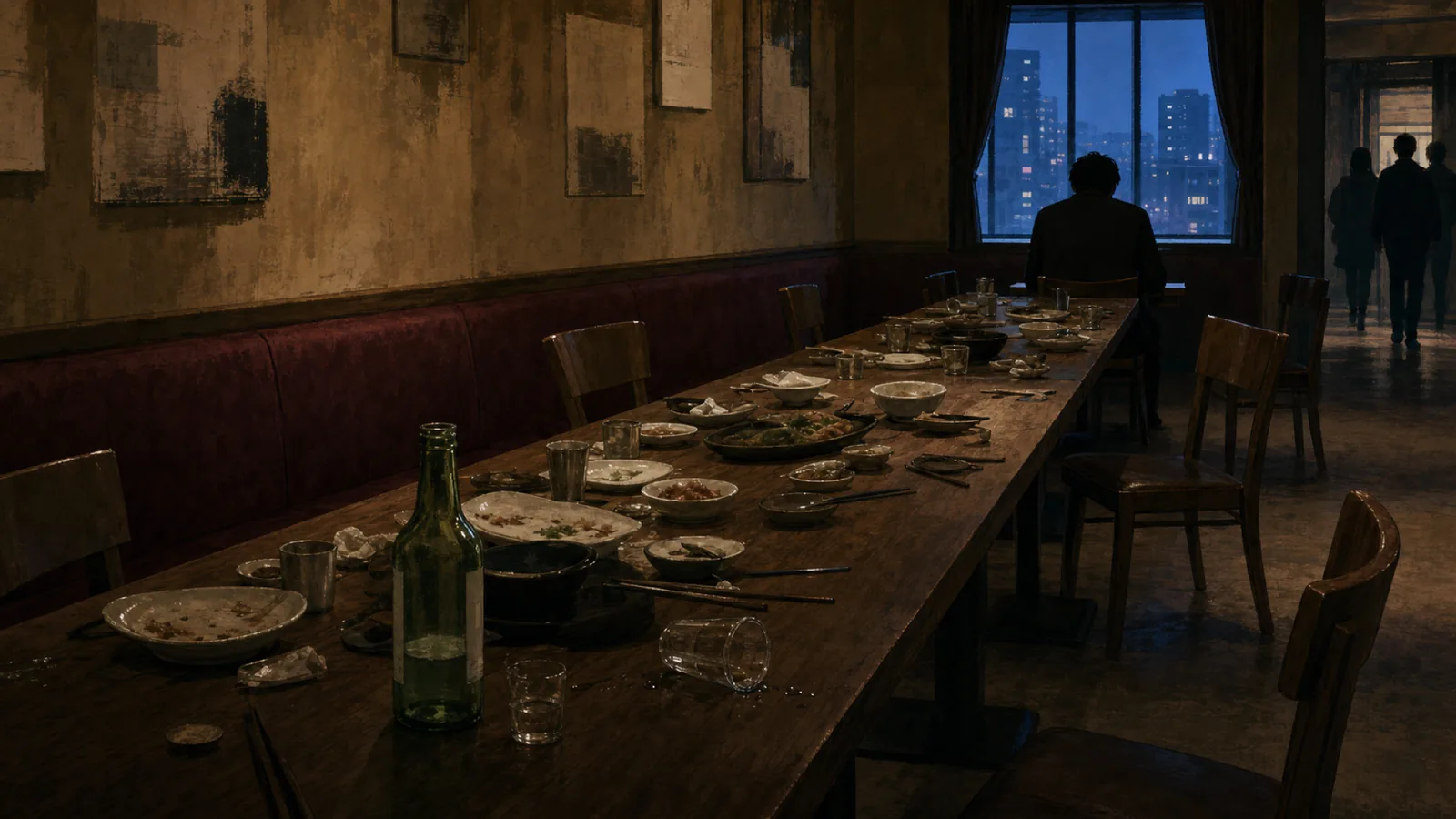
The Sister Vengeance celebration is the episode’s set piece, and it works because every character at the table is performing a slightly different version of the same denial. Park Gyeong-se makes his “to flowing” toast. The drinks are flowing. The money is flowing. Then Dong-man arrives and the room goes one degree colder and everyone keeps performing harder.
Dong-man performs hardest of all. He retells the Emotion Watch story for the sixth time. He repeats his catchphrase — you’ll end up like me — to Park Gyeong-se’s face on premiere week. He calls “Sister Vengeance” a great title and means it as a knife. He eats too fast. He talks too much. Jun-hwan, who is the closest thing he has to a friend in this group, tells him to slow down because he eats like he’s angry at the food.
Then the others split off to a second bar and they have a conversation he’s not supposed to hear. Hyo-jin, the proudly cold director who advocates cutting people from your life like a hobby, calls him a ghost — The Sixth Sense’s dead-kid line, except now it’s a forty-something man at a barbecue restaurant who doesn’t realize he’s already gone. Seung-tae and Jun-hwan defend him, half-heartedly, the way you defend a relative everyone has agreed is hopeless. The decision is made in his absence. Someone should tell him.
What Park Hae-young does with this scene is the move that elevates this from a snarky industry satire into something rarer. He doesn’t editorialize. He lets Hyo-jin be witty and lets her be correct about Dong-man’s behavior, and he also lets you feel that Hyo-jin is the kind of person who reaches for the phrase “cut ties” with the ease of someone who has never been on the receiving end of it. Both readings sit on the screen at once. The episode trusts you to hold them.
The rooftop and the producer’s office
Two scenes near the middle of the hour are doing quieter, longer-range work.
On the rooftop, Dong-man runs into a woman from his building and confesses, with a strange mix of pride and exhaustion, that he comes up there to shout his own name. He explains why. When his voice touches a tree, that tree becomes his. When his voice touches a rock, the rock is his. He spreads himself out by speaking. It is, almost word for word, the philosophy of the man who can’t shut up at parties. Park Hae-young’s best move in the beat is to give the protagonist’s most annoying behavior its tenderest possible motive without excusing it. The woman tells him she has heard him shouting. She means it kindly. He flinches.
The producer’s office comes later, after a screening that goes catastrophically — Dong-man trashes Sister Vengeance to Park Gyeong-se’s family at the after-party, gets recognized by the lead actress, then in a flash of rage pelts Park Gyeong-se’s car with a rock on his way home and accidentally lands the man in a hospital bed. He still goes to pitch Weather Maker, the script he has been chasing for years. The producer’s reader, nicknamed Ax for how cleanly she used to dismantle scripts, can’t even bring herself to be cruel. The verdict is colder than cruelty. Your protagonist has no power. People watch movies to see power. A creator can’t create something he doesn’t have inside.
That line lands harder because by the time it arrives, you’ve watched Dong-man absorb the same diagnosis in five different registers. He doesn’t have it. He doesn’t have it. He doesn’t have it.
The dinner-table verdict
The final scene is the one the whole hour has been building toward. Park Gyeong-se, in a leg cast from the accident Dong-man caused and won’t admit to, sits across from him at a long restaurant table while the others ring around the verdict. Live more constructively. Live productively. Stop clinging. Stop being jealous. The hammer-drops — You can’t come here anymore. Between adults this is called cutting ties — actually arrive after the title-card cut, in the next-episode preview, telegraphing how decisive that table has already made itself.
And Dong-man, who has spent the entire episode being too much — too loud, too hungry, too quick to repeat the same broken story — finally goes still. He looks up. He asks the one question Park Hae-young has been waiting for him to ask.
“Why do I have to live how you want me to?”
It’s the line the whole episode rotates on. Seok-gu’s pitch wanted him eliminated because he makes people miserable. The Eight Club wants him gone because he won’t perform success. The producer wants him to stop writing because he doesn’t have the inner power great writing requires. And underneath every one of those judgments is the assumption that he should agree — that the appropriate response to twenty years of failure is to apologize for taking up the chair. He doesn’t agree. He doesn’t apologize. He asks the question back, and the scene ends there.
Tiny details worth clocking
- The Emotion Watch is a brilliant Park Hae-young object. It doesn’t tell Dong-man how he feels. It tells him what he is hiding. “Deeply ashamed” reads at the moment he’s halfway through performing outrage at being called unemployed.
- Park Gyeong-se’s “to flowing” toast — booze, writing, money, even piss — works as the Eight Club’s whole philosophy in one breath. Things should flow. Dong-man is the man for whom nothing has flowed for two decades, and his presence at the table is therefore a structural insult.
- The Russian soldier’s coat the rooftop neighbor wears, with the bullet hole through the chest, is the show telegraphing its interest in people who carry around the place where a wound went in.
- The maintenance-fee scene is one short exchange — the landlord herself letting herself in, asserting I can come into my own place however I want to — and it tells you the entire economic geometry of Dong-man’s life faster than any monologue could.
- Park Gyeong-se’s lead actress recognizing Dong-man at the after-party and asking “what films have you made?” is the single worst moment in his night, and his stammered “I…” hangs in the air a beat longer than is comfortable.
- Myeong-hun’s question is asked twice in audio because it’s the one Dong-man can’t stop hearing. The repetition isn’t a flourish. It’s a diagnosis.
Verdict
This is Park Hae-young in his most concentrated register — My Mister more than Another Miss Oh — asking a question almost no Korean drama is willing to sit with for an hour: what do you do with the friend who refused to surrender, refused to make the practical pivot, refused to admit the dream was over, and now sits at your celebration dinner as a reminder that you’re allowed to be successful only because he stayed in the role of the failure? Hwang Dong-man is rude, exhausting, hungry, ungenerous, and the show softens none of it. It just keeps asking, gently, whose comfort his disappearance would actually serve.
The risk going forward is real. Twelve episodes of “Dong-man absorbs another humiliation” could collapse into misery, and the rooftop scene is the clearest signal the writers know they need another gear. The voice-touching-the-tree philosophy is too specific and too lonely to be set decoration. It’s the seed of whatever room Dong-man is going to learn to walk in next.
For a debut hour, this is a confident, literate, slightly cruel piece of work that trusts its audience to hold contradictions. The closing line earns the episode’s title.
Rating: 8.4/10
More episodes from We Are All Trying Here — Failure, envy, and the work of staying human. Jump to any episode in the season:
Where to go next
Reviewed by Mira Vance · QuizFandom Editor & Lead Reviewer. Every rating is an honest per-watch assessment from the desk that also writes the quizzes — not a press release rehash.