We Are All Trying Here Episode 7 Review: The Night Everyone Says the Quiet Thing
What happens — the short version (spoilers)
- A catering co-worker gives Dong-man the words 'I need your help,' explaining how saying them pulled him out of a foot-wide hole — and pulled himself out too.
- Gyeong-se hires writer Jeong-min on camera under cruel terms — no credit, no interviews, total silence — and she laughs so hard she gets the job, because he wants an audience, not a partner.
- Dong-man rehearses a defenseless love speech to Eun-a alone in a tower, calling her the Goddess of the Wind and vowing to wait on standby forever.
- It's revealed Eun-a is actually Byeon Si-on, the daughter actress Oh Jeong-hui abandoned, recasting the season's odd glances and warnings.
- At the midnight beach Eun-a publicly says 'I like Hwang Dong-man' twice, but his watch prints FLUSTERED before he can scramble out a late reply.
- The next morning Eun-a refuses her mother's apartment and money, telling her she's gone from a rejecting mother to a leech siphoning her successful child, and bans her from acting close.
Episode 7 stretches a Loyal Catering year-end shift into a beach sunrise and lets four people accidentally tell the truth: a co-worker about a narrow dark hole, Dong-man about a goddess he'd wait for forever, Mi-ran about her mother, and Eun-a — in public, to a captioned room — about who she likes. None of them walked in planning to.
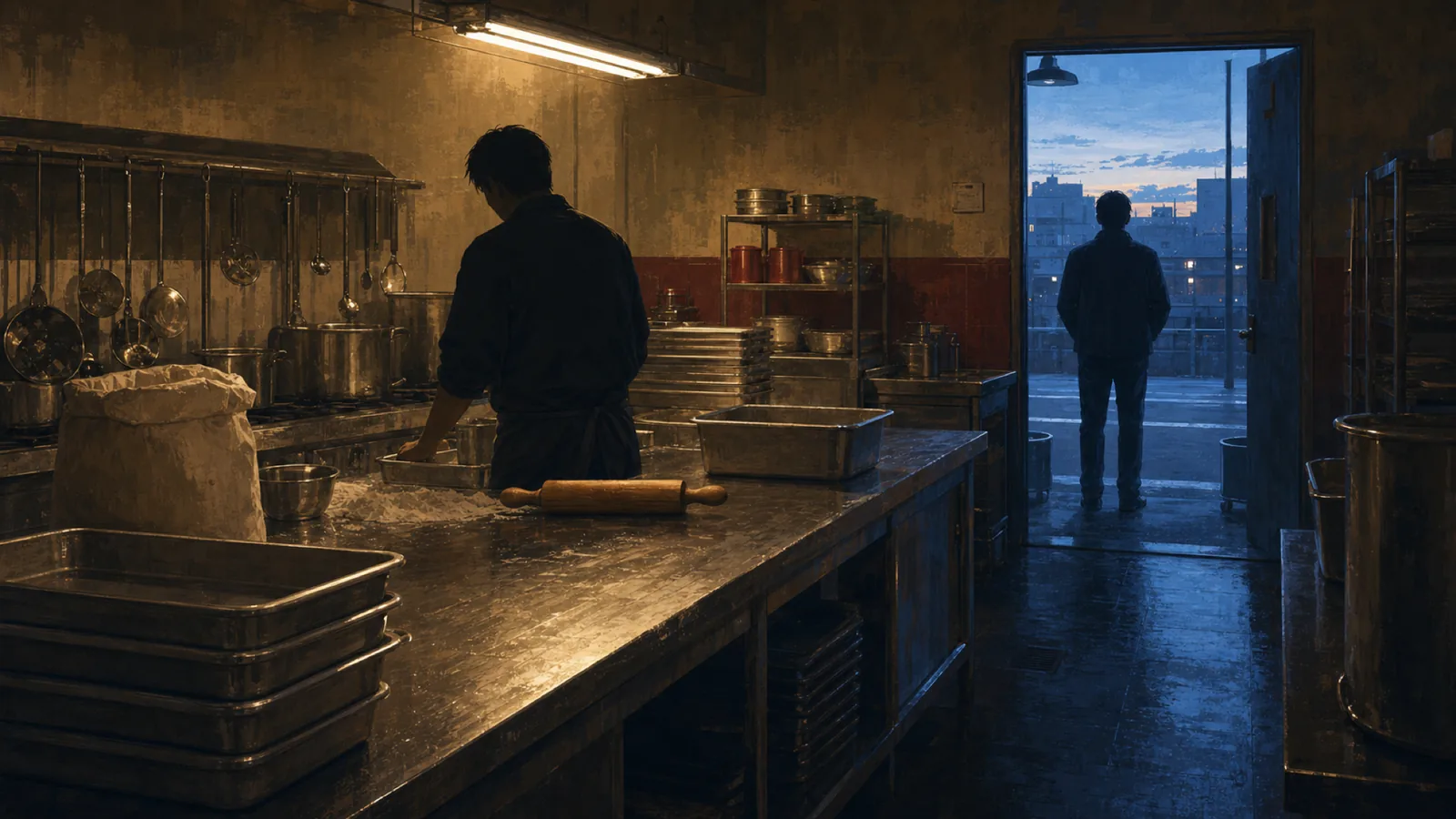
The catering kitchen does the heaviest lifting before the film world says a word
The cold open is doing more than setting up the year-end push. A co-worker stops Dong-man mid-load and tries to ask the most embarrassing question a Korean man his age can ask another. Have you ever asked someone for help? Not a favor. Help, when you’re struggling. The co-worker doesn’t need an answer. He’s there to give one. He describes the worst feeling he knows — being wedged in a hole no more than a foot wide, and how the act of thinking about asking for help is what widens it. He came back from his own narrow place carrying four words he had never said in his life: I need your help. He tells Dong-man, on a loading dock, that the words he found to pull Dong-man out ended up pulling himself out too.
It’s a gift exchange disguised as small talk, and it earns the title card — No One Comes into Your Life by Mistake — without sentimentality. Park Hae-young then cuts straight to Yeong-sil’s monologue — if I had just one wish in life, it would be to die of old age. Cats, trees. Just like leaves falling. The people who survive the narrow places all end up speaking the same dialect, no matter their tax bracket. Then we drop into the film world, where almost no one speaks it.
Park Gyeong-se hires the writer he can’t read against, on purpose
The Park Jeong-min interview is a small horror set. Gyeong-se opens by mistaking her for a man, pivots into a joke about how female and male writers hate each other, and details the contract on camera. He’ll take all credit. He’ll keep all interviews. He won’t read her samples — he doesn’t read anyone’s. If she breathes a word about working on the show, he’ll rip her head off. He demands she confirm she can keep quiet no matter what.
And Jeong-min laughs. So hard Hye-jin hears her through the door. I’ve never met a director as funny as you, she says. That’s the line that hires her.
Hye-jin tells him to keep looking — Jeong-min had a typo on her first line; his instinct needs a writer who can push back. He refuses. I just need someone who’s helpful to you, she says, naming what he actually wants. He goes back into his room and re-watches Jeong-min’s laughter on his phone, looped, because someone laughing at his cruelty as if it’s a comedy bit is the only mirror he can stand right now. After Episode 6’s Knock Knock Knock humiliation, after Eun-a’s notes shaved his ego clean, what he hires here isn’t a partner. He hires an audience. That this is also a woman saying yes to working anonymously is the bitter joke. Jeong-min has been credited as a second writer her whole career and just accepted a job where her name will never appear. She had to laugh.
“The Goddess of the Wind” is the most defenseless love speech in the show so far
Catering Dong-man does something inside Lux Tower he could never do inside Agit. He puts down his crate, looks across the city, and rehearses out loud what he’d say to Eun-a if he weren’t a man who has spent twenty years failing to debut. Who would dare abandon you? Who would ever dare to reject you? Me, Hwang Dong-man — you can use me all you want and then toss me aside. If you come back, I’ll still be right there. He calls her the Goddess of the Wind. He volunteers to wait his whole life. He volunteers, if she’s bored, to date someone else briefly and come running back at her signal — warning the other woman from the start: I belong to Miss Byeon Eun-a. He works up the math on his own loneliness — if she wants him alone forever, on standby forever, then that’s the deal. What a great life that would be.
It plays as parody until you clock the co-workers nudging each other behind him. This guy’s so lovable with goodness. Dong-man has the emotional vocabulary; he just refuses to use it where the words might land. He saves the goddess speech for a balcony in his head and saves the I need you text for after Eun-a has already gone silent.
Eun-a is Oh Jeong-hui’s abandoned daughter, and Agit becomes a confession booth
The episode’s biggest plot reveal is wrapped in two of its funniest scenes. Dong-man, drunk on his own fandom, marches into the back room at Agit and delivers a perfectly composed worship speech — the breath he held during her takes, the punch back script note she once gave that he still uses, the confession that he wishes he’d never quit Dogs and Cats so he could at least be on nodding terms with her now. Then he tells her why he actually left. The set toilet was a hole in the ground. He couldn’t, he tried to pick it up, the bottom was open, he panicked and ran knowing whoever disappeared would be blamed. Young, shy, 20-something Hwang Dong-man became the bathroom legend of Dogs and Cats in one bad afternoon.
The line crashes Oh Jeong-hui’s polite I-don’t-remember-you posture. She softens, asks what films he’s done, and he has to admit he hasn’t debuted. The recovery in her eyes — I see. Well, I’m sure you’ll debut soon — is the kindest cruelty in the hour. Outside the room, Gyeong-se hears that Dong-man came in as a fan, and unloads: Every industry’s got guys like that. He’s been trying for 20 years. Mi-ran is sitting at the same table.
The reveal lands later in the parked-car scene. Eun-a, the producer whose real name is Byeon Si-on, says the line that recasts the entire season: Don’t let anyone know I’m the poor, unfortunate child that Oh Jeong-hui abandoned. And I won’t tell anyone either. The Episode-6 oddities — Eun-a’s overlong gaze at Oh Jeong-hui across a table, the boss’s strange handling of her, the way Oh Jeong-hui herself warns Eun-a (separately) to keep her distance from Mi-ran — snap into focus. The actress everyone is afraid of is the absent mother of the producer everyone calls Ms. Byeon Eun-a.
Two beach confessions, and one caption that ends the night
Eun-a runs from her office to Agit in the rain because reading Dong-man’s Weather Maker draft made her cry and she wants to hug him in person. The wrap dinner spills onto Mi-ran’s car onto a rockfish stall onto a midnight beach. The crew dances like Zorba the Greek on wet sand. Across the road, the older drinkers watch them and say, look at those idiots — without any heat. It’s the gentlest scene the show has given us.
Mi-ran tells Eun-a why she used to leave her pencil case at home in elementary school. She wanted to be the annoying kid who forgot pencils so nobody would notice the real problem. I was scared they’d see what the real problem was. She dresses down for the same reason. Eun-a lands her usual gift right back: You’ve got this weird talent. You have the ability to ground other people. Whenever I talk, I’m always up in the air, flapping around. But when I’m with you, I end up landing. And Mi-ran answers: I don’t want to land today. It is Eun-a, not Mi-ran, who carries the actual mother-confrontation into the parked car by morning.
A few feet away, Dong-man and Eun-a build a private metaphysics. He says he likes old movies — there’s always a tailor shop, a radio repair sign, something. It feels like we’re right here, but actually, we’re reminiscing right now. Our lives are already over. We’re 99 years old, in bed, right before we close our eyes, taking a look back on the days we miss. Eun-a answers him in his register: So then, this right now — is it my memory or yours? He builds the room. She moves the furniture. They both pretend they’re talking about cinema.
Then Mi-ran, watch in hand, calls everyone out. Clearly, someone likes someone here. So who likes who? Eun-a says it. I like Hwang Dong-man. She says it twice so no one can pretend they didn’t hear. The watch on Dong-man’s wrist — the emotion-display device that flashed unknown in earlier episodes and green tonight to signal she doesn’t hate you — prints, without consent, the word that ends the moment: FLUSTERED. A man who just composed a soliloquy about waiting for her forever sees his own internal state captioned in front of his friends and can’t even take credit for the flutter. He scrambles a I, uh… I like Byeon Eun-a a beat too late. I said something honest about liking Dong-man, and it makes him feel flustered, Eun-a says. Is that fair? It isn’t. He is most dishonest with her when she is being most direct. Later, on the beach, she tells him — calmly — I felt fine around you today. Usually I feel nervous. She shows him the green watch. I’m a slave to people’s emotions. A sponge. She tells him what color he is to her right now and asks for nothing. He pretends to sleep. She catches him. By morning he’ll text I need you into a black phone.
The morning: what the daughter is allowed to want
The hangover is institutional. Choi corners Eun-a — hands off Lee Jun-hwan’s film, that’s twenty billion at least, no producer debuts with a budget like that — and she names what he won’t: Is Oh Jeong-hui demanding this? He explodes that he is Choi Film, and we all know the answer is yes.
In a car outside, Oh Jeong-hui keeps trying to gift Eun-a out of her grandmother’s house. New officetel, fully furnished, debit card, PIN is your phone number. You said you’d never say you’re Byeon Si-on, that poor little girl. So you should move out. She admits her own embarrassment plainly — I am. You’re right. It’s embarrassing. A daughter living with a step-grandmother is a story that runs in the press, and the press is one of Oh Jeong-hui’s working materials.
Eun-a refuses all of it. I wish I had been born out of thin air. No sperm, no egg, no mother, no father. Then the kill shot, delivered without raising her voice: You went from a mother rejecting her child for being disappointing, to a leech who just siphons off her successful one. That’s even worse. Then the ban. From here on out, don’t you ever act like we’re close.
It rhymes with the catering co-worker’s narrow hole, on purpose. He had to find four new words to pull himself out. Eun-a finds her own: that’s even worse. Same weight. Opposite direction.
Tiny details worth clocking
- Yeong-sil is Eun-a’s pen name on Dong-man’s pitch script. She likes that it doesn’t stand out. She also likes that her name is now welded to a piece of writing that may pull him out of his hole.
- The watch that printed FLUSTERED is the same diegetic emotion-meter Eun-a first learned to read on Mi-ran in Episode 5. It’s most cruel when its readings are most honest.
- Hwang Jin-man — sleeping through the beach trip, finally — is the only one in the friend group not currently confessing anything. The brother who hasn’t slept in years sleeps through the night he was allowed to sit out.
- The rockfish vendor refusing to sell the squid (they cost too much, I put them in there to draw people in) is a tiny ars poetica for the whole industry: the thing on display is bait; the working margin is somewhere quieter.
Verdict
Episode 7 is where We Are All Trying Here turns into a confession chain. A catering co-worker about a foot-wide hole. A rookie writer about working under any conditions, laughing. A failed director about the toilet story he carried for twenty years. A producer admitting, in public, that she likes the man whose internal state then betrays him on his own wrist. Another producer admitting she dresses down to keep the real problem hidden. A daughter telling her mother, with surgical care, that she would rather have been born from nothing than be the climb her mother uses for altitude.
Park Hae-young’s quietest move is to put the catering shift before the film world and the beach after it. The kitchen offers help without invoice. The film world offers it with credit conditions. The beach is where the friends accidentally become the only audience that doesn’t bill. Dong-man whispering I need you to a phone that doesn’t pick up is the cliff the show needs to make Episode 8 expensive. He had the words. He had the audience. He just had them in the wrong order.
Rating: 8.8/10
More episodes from We Are All Trying Here — Failure, envy, and the work of staying human. Jump to any episode in the season:
Where to go next
Reviewed by Mira Vance · QuizFandom Editor & Lead Reviewer. Every rating is an honest per-watch assessment from the desk that also writes the quizzes — not a press release rehash.