We Are All Trying Here Episode 3 Review: A Watch That Tells You Who You Already Were
What happens — the short version (spoilers)
- A new XIMFIT watch labels people with the things office culture never says aloud, and Dong-man embraces his 'destructive' reading as liberating permission to stop being good.
- Dong-man's cruel group-chat message about Gyeong-se's film is seen after Gyeong-se climbs a mountain reading his bad reviews, and Gyeong-se confronts him with 'you're a nobody, nothing.'
- Dong-man reads aloud Jin-man's teenage poem 'I Was Two Tenths of a Millimeter' while talking his drunk brother down with fried rice.
- Hye-jin, who secretly co-wrote the script that won Dong-man his grant, tells him to never utter her name and tallies that he's destroying the 97 percent of their past that was good over the ugly 3 percent.
- Eun-a, getting her hand stitched, tells an old woman scattering coins that the first person to mark her with an X was her mother — and the woman replies that the word 'mother' is overrated.
- Dong-man's watch reads worried, surprised, flustered, and he laughs to tears realizing he isn't a monster, then chases the grandmother down to ask where to scatter coins.
An emotion-reading wristwatch hands Hwang Dong-man a one-word diagnosis — destructive — and he wears it like a costume for an entire hour, until a stranger scattering coins on a hospital floor calls his bluff and an old woman sets the diagnosis back where it really started: with his mother.
XIMFIT, the gadget that flatters your worst opinion of yourself
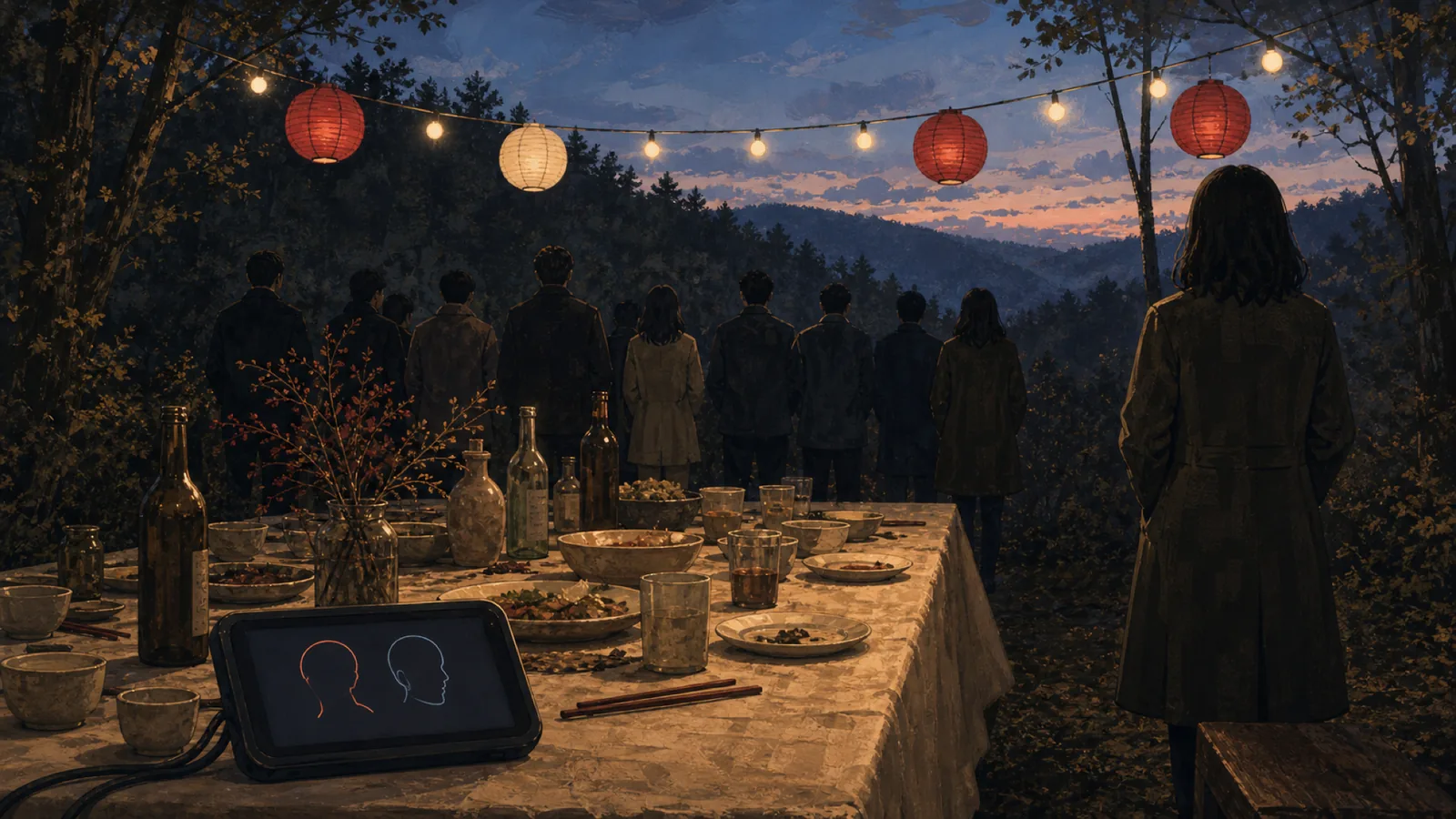
Episode 3 opens at AS Group’s company fall retreat, where a new emotion-reading wristwatch called XIMFIT is being rolled out as a wellness gimmick. The retreat is a thin pretext. What the watch actually does is print, on a tiny screen, the labels polite Korean office culture has spent decades agreeing not to say out loud. One catering worker glances at her profile and reads aloud the demographic placard somebody filled in for her: unemployed man in his 40s. Another reads woman, 30s, mental issues. Park Hae-young writes the moment without underlining it. The technology is not the satire — the recommendation form somebody filled in to qualify the staff for the wellness perk is. The watch is just the receipt.
Dong-man receives his diagnosis and decides it is liberating. The watch told him he was excited watching a near-miss car crash, thrilled during a televised hostage attack, disappointed when everyone got out alive. He produces these confessions for Byeon Eun-a at a picnic table with the lightness of a man at a wine tasting. I run on destruction, he tells her, grinning. Let’s quit pretending to be a good person. The watch is a permission slip. He has wanted, for years, a way to confess that he was relieved when his old friend Gyeong-se’s film tanked, that he cooked himself fresh rice and danced alone in his kitchen — and now a piece of consumer hardware has handed him the cover story. The hour spends the next forty minutes taking that cover story apart.
Eun-a hears it differently than he means it. She returns him the cleanest sentence he hears all hour: you feel like someone with a thousand open doors. The compliment lands flush against the self-flagellation he is staging, and he cannot quite catch what she has handed him. He is too busy admiring his new label.
The group-chat misfire is funny until it is a public flogging
The destructive-guy bit comes apart because Dong-man did the worst possible thing with it before the watch ever printed a verdict. He typed it into the group chat. How did this movie even make it out into the world? I guess it comes down to whether your wife is an executive producer. He thought Gyeong-se had left. Gyeong-se had not — Yeong-su had quietly re-added him and forgotten to mention it.
The friends’ panic-management scene that follows plays as pure farce: a network of small cowardices. Don’t tell him to leave without reading anything — that’ll make him read it for sure. Just leave it alone. Hope he leaves first. The comedy is the realism. These men are not bad. They are simply hoping a notification dot will save them from having to be honest with anyone, including each other.
It does not. Gyeong-se climbs Mount Jiri carrying every brutal review of Sister Vengeance in a printout, reading them aloud as he climbs, chewing and swallowing them so he will not, as he says, carry them forever. He summits. He thinks the work is done. He opens the group chat. And he finds Dong-man’s lines waiting there, identical in cruelty to the strangers’ reviews — the matching of a friend’s voice to a stranger’s contempt is what breaks him. He drives back. He finds Dong-man on the street and delivers the speech that ought to ruin him: You’ve never once stepped into the ring. That’s why you’ve got no empathy. If you and I were boxers, I would be the one in the ring, taking a beating, while you’re outside watching, never having seen the inside of it. The closer is the killshot. You? You’re a nobody. Nothing. Nothing. Nothing.
Dong-man’s response is what makes the hour dangerous. He walks away repeating Asshole. What an asshole. He doesn’t know who I am. He is twenty minutes into wearing destructive as a name tag and does not yet have the equipment to hear what was actually said.
The poem his brother wrote when he was a teenager
The slow center of the episode belongs to Hwang Jin-man, Dong-man’s older brother — a former poet, now a corner-store owner Park Hae-young writes with the deliberate quiet of a man who long ago decided not to be impressed by his own talent. Late in the hour Jin-man tries to climb onto something high in his apartment, drunk, and Dong-man talks him down with fried rice. Then he reads aloud Jin-man’s old high-school poem.
I Was Two Tenths of a Millimeter. A sperm a tenth of a millimeter. An egg twice that size. How did all this hatred fit in there? How did all this emptiness fit inside? An ant the same size walks along, and the speaker presses it under his nail. Inside, my hatred and my emptiness pop.
The poem rhymes, deliberately, with the watch on Dong-man’s wrist. Both are devices trying to fit the largest possible human contents into the smallest possible container. The watch gives Dong-man one word, destructive, and he wraps a personality around it. Jin-man at sixteen wrote a poem that admitted the whole tangled inventory and could not solve it any better. One brother bought a gadget. The other wrote a poem and went quiet for twenty years.
Hye-jin says the part Dong-man has been hiding from himself
Then the second wall comes down, and this one does not play for laughs. Ko Hye-jin — Gyeong-se’s wife, Gobak Film’s CEO, the producer Dong-man has just publicly accused, in writing, of buying her husband his career — does not, as it turns out, see the chat. Gyeong-se’s relief, later, is that she had already left the group thread before the message landed. The marriage is spared knowing. The marriage gets to keep operating without ever processing this one.
But Hye-jin is carrying her own private receipt, and Park Hae-young waits until the third act to cash it. Dong-man has just won a state script grant for Weather Maker. The producer at Kopark loved it — top three of everything I’ve read — then said she could tell a woman had helped write the female character. Hye-jin is that woman. She sends Dong-man the messages he has not had the dignity to send her: I got the grant. Thanks for helping out. Then: Don’t tell anyone you were involved in my script. Don’t even utter my name anywhere.
The exchange converts a private resentment into a precise indictment without raising its voice. I lost five teeth writing it. You didn’t work nearly as hard. Hye-jin’s reply is the line of the hour: Cursing you, considering how much I liked you, it feels like my heart is getting burned with acid. And then the accounting that lands like a verdict: There were times you were violent and abusive, although it was only 3% of our time together. Now here you are, trying to tear down the other 97% that was good. Now all that’s left is that ugly 3%.
Dong-man recasts the criticism as the critic’s character flaw. He calls her a coattail-rider. He calls her a loser. He has spent the hour declaring himself destructive and has, finally, located someone willing to take the diagnosis literally.
The grandmother on the hospital floor knows where the damage actually started
The episode’s last twenty minutes belong to two strangers — an old woman scattering coins outside an emergency-medical center, and Eun-a, who has cut her hand badly enough to need stitches. Picking up a coin off the ground gets your mood to shift, the catering driver had argued earlier. Small victories. So the old woman scatters coins on the hospital floor on purpose, for whoever needs one.
Eun-a tells her she goes back, every time she bleeds, to the elementary-school classroom where she was nine years old and a group of children marked her with an X. The grandmother asks who the first person was. Eun-a’s answer comes out in single broken letters. M. O. T. H. E. R. The unfinished word stops there, and the grandmother answers it with one quiet sentence: That word’s overrated.
It is the only sentence in the episode that lifts a label off someone without putting a new one on. The watch flatters; the poem confesses; Gyeong-se accuses; Hye-jin convicts. The grandmother, alone, performs a small subtraction.
Dong-man crosses her path by chance. His own watch reads worried, surprised, flustered — anything but excited — and he laughs himself half to tears at finding out the diagnosis was never the whole inventory. I’m not a destructive guy. I’m not. I am not a monster! Then he chases the grandmother down the corridor to ask where she lives, because he has a bunch of coins to scatter, and the camera lets him run.
Tiny details worth clocking
- The catering driver’s tip — when you’re down, pick a coin off the ground — is delivered casually in act one and quietly authors the entire third act. Park Hae-young plants and pays his small set pieces with almost rude precision.
- Eun-a’s confession that her favorite thing to read is a menu — the finest writing one can produce — tells you everything about why this show’s dialogue refuses to stop noticing food.
- Sister Vengeance sitting at no. 4 in ticket sales after 3,000 free tickets gives the funniest indictment of the Korean theatrical-release machine the show has run yet: the producers know what the math means before the director does.
- The bar owner at Agit speaks an ethic the show has been quietly building: men on the verge of success can turn into villains; everyone here has done it and been ashamed ever since; people still charging ahead aren’t allowed in this place. Agit is a sanctuary for the chastened, not the innocent.
- The stage-greeting throwaway — I didn’t work all the way to the bone, unless you count losing my arm — captures the gap between what a flailing director needs from a Q&A and what a co-star will actually risk on his behalf.
Verdict
Episode 3 is the run’s first full-octave hour, and what makes it work is structural rather than dramatic. Park Hae-young writes Dong-man as a man auditioning a label for himself, then arranges, with a watchmaker’s patience, for every other character in the building to either refuse the label, ratify it more brutally than he can survive, or replace it with something more precise. The watch was never the satire. The satire is the speed at which a person will accept a diagnosis if the diagnosis comes with a screen. The episode’s loveliest move is to put the only honest reader of human interior on a hospital floor with a handful of coins, and the only honest writer-of-feeling in this show stocking shelves at a corner store, and to let those two strangers correct what no piece of consumer hardware ever could. Three hours in and Park Hae-young is already operating at the level his best work always reaches — half a degree off room temperature, deadly serious, and unwilling to mistake a label for a life.
Rating: 8.6/10
More episodes from We Are All Trying Here — Failure, envy, and the work of staying human. Jump to any episode in the season:
Where to go next
Reviewed by Mira Vance · QuizFandom Editor & Lead Reviewer. Every rating is an honest per-watch assessment from the desk that also writes the quizzes — not a press release rehash.