We Are All Trying Here Episode 6 Review: The Producer Who Threw the Rock
What happens — the short version (spoilers)
- Dong-man discovers it was Eun-a who threw the rock through Agit's window after Gyeong-se insulted him, and he's thrilled rather than alarmed.
- Eun-a tells Jin-man her purpose in life is to become a strong, grounded mother, and he inscribes his old poetry book to her with that wish.
- Hye-jin tells her husband Gyeong-se plainly that he's old and outdated, that a series will expose him where two-hour films hid it, and that he should let Eun-a and Dong-man help.
- At the Eight Club reunion Dong-man tells Gyeong-se they're both shallow surface-skimmers, then declares he can explore the whole ocean now and is no longer one of them.
- Eun-a pitches actress Mi-ran a role by describing a woman who operates from her heart alone — unknowingly describing herself, the woman who threw the rock.
- The watch agency plays Eun-a an UNKNOWN recording of Dong-man talking Jin-man down, matching watch 38 and 4,000, and she names it: it's a cry for help, the words 'I need your help' she's never been able to say.
Episode 6 puts a creative drought next to a violent act of loyalty and lets the camera linger on the gap — Dong-man floats through traffic on his new engine while Eun-a, three nights ago, picked up a rock and aimed it at her own boss's window.
The rock through Agit’s window says what the season is about
The hour opens with Dong-man monologuing himself out of a twenty-year creative coma. Vroom. The engine he never knew he had has turned on. He should have fallen in love years ago. He is going to scoop pearls off the sea floor now.
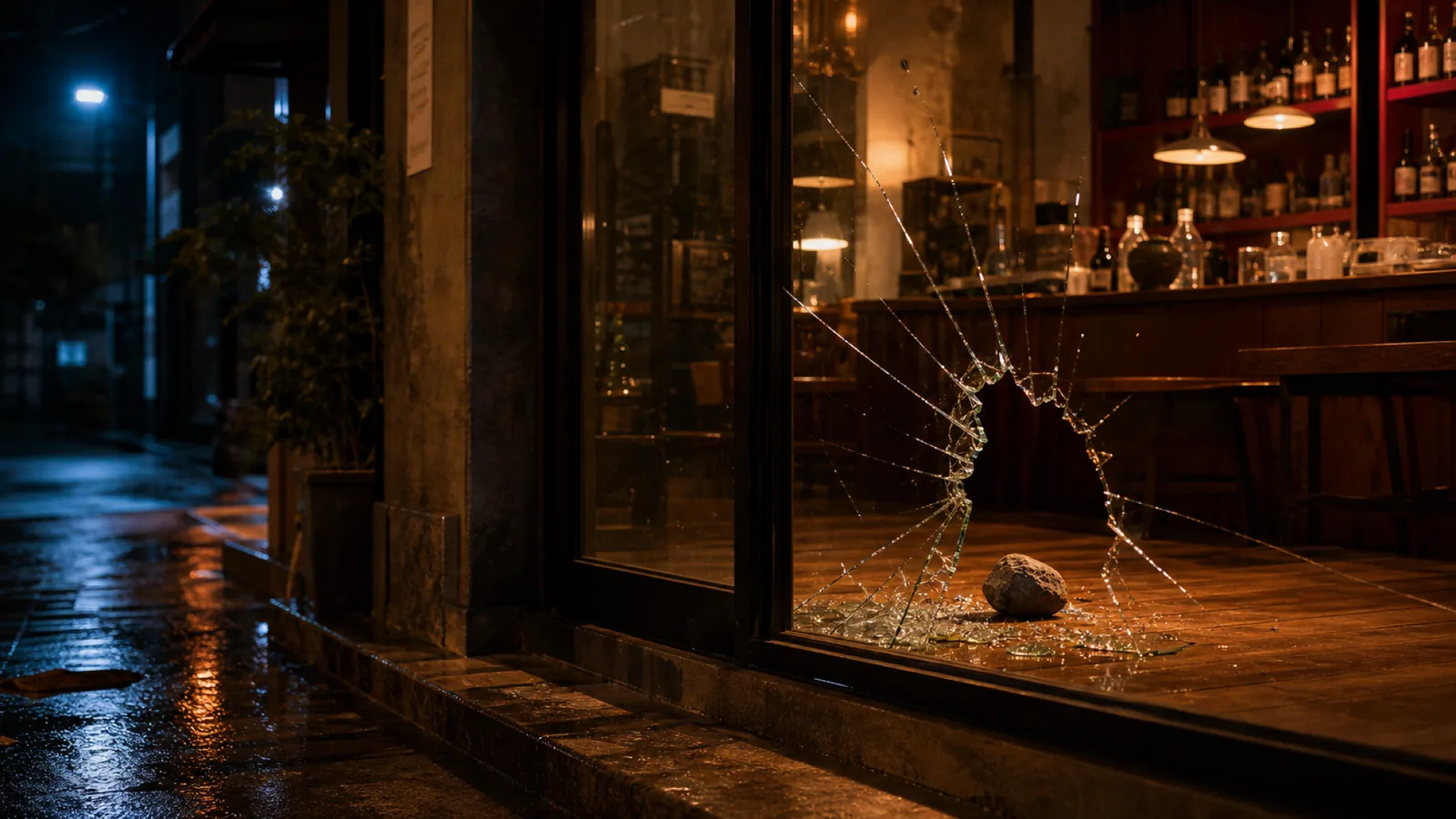
Then a line from a friend — “Turns out it was Eun-a” — re-organizes the previous five episodes in our heads. The rock through Agit’s front window. That was the producer. Gyeong-se had been bashing Dong-man in the directors’ group chat, and Eun-a picked up something heavy and threw it for him before either of them had named what they were to each other.
Park Hae-young’s screenplays do this thing where the romantic gesture is reported, never witnessed — the camera doesn’t show the throw, just Dong-man learning about it and yelling “Oh, shit! She’s awesome, isn’t she?” in the same breath. He is composing love poems to the telephone pole outside Eun-a’s grandmother’s gimbap shop, fantasizing about being the gimbap “rolled tight in your hands,” while she has committed property damage on his behalf. His love is metaphorical. Hers is a felony.
Hyo-jin gets the next move right. She corners Eun-a outside Agit — what could you possibly see in him? — and Eun-a refuses to translate. Don’t try to understand. Don’t be a control freak. Instead she names Hyo-jin’s sin: that she can ruin someone’s day with one wrong look, that she knows how fragile people are, that she behaves like she doesn’t. I won’t tolerate it. The Ax is sharp again, edge pointing in a new direction. The rock and the warning are the same act.
“I want to be a strong mother” is the line the whole episode rotates around
Eun-a brings kimchi jjim to Dong-man’s place expecting to leave it for him and his brother Jin-man, the former poet supposedly off in Daegwallyeong picking napa cabbage. Jin-man is home. He is drunk. The brothers are wearing matching bright-red watches like embarrassing twins. Dong-man tries to redirect; Eun-a stays.
Jin-man asks her, between bites, what’s your purpose in life? Not career. Not ambition. What kind of person do you want to turn into.
And Eun-a, who has spent six episodes weaponizing her competence, answers without thinking. To be a strong mother. Not strong because of money or status. Grounded. Unwavering. Centered no matter what. The kind of person who makes everyone calmer.
The shot Park Hae-young writes around that answer is a vacuum. Dong-man narrates it after: when Eun-a says something true, the air around her empties — the three of them are suddenly eating dinner in space. Jin-man, who has not written a poem in years and is welding for a living, gets up, finds his old book Days Like This, Days Like That, and inscribes the front page: To Ms. Byeon Eun-a, I hope you become a strong mom. He hands her the work he has been hiding from.
What lands quietly is what we learn later — Jin-man’s own daughter Yeong-sil was adopted out without his knowledge, the law treats him as a father whose whereabouts were “unknown.” A man who lost his daughter is blessing a woman who wants to be a strong mother. Park Hae-young writes those parallels and trusts us.
Gyeong-se gets called outdated, and nobody softens the blow
The director-and-producer marriage at the heart of Choi Films cracks audibly. National Stress Management Department has eight episodes greenlit, and OTT wants a co-writer brought in because they don’t trust Gyeong-se to deliver alone. Hye-jin, his wife and CEO, tries to tell him with love. He throws a tantrum. She keeps trying. He keeps yelling.
Then she says it. You’re old. Outdated. And you have been for a while. His features hid the problem because two hours is a length you can fake. A series exposes you. If this project flops he is finished. Eun-a is a magician with rewrites and she’s working with Dong-man now, so Gyeong-se can be the man who tanked Sister Vengeance and watched his rival break out, or he can let someone help. The line that closes the fight is the end.
Later, at the Eight Club reunion — Yeong-su seats Dong-man and Gyeong-se shoulder-to-shoulder so they can’t see each other — Gyeong-se needles Dong-man about the cold-coffee Beethoven moment, and Dong-man, gentle and devastating, names the truth: We’re alike. We’re both shallow. Our work skims the surface. Then he pivots: But now I can explore the whole ocean. I’m not one of your kind anymore. Bye. Koo Kyo-hwan plays it weirdly tender, like a man breaking up with his former self in front of the man still trapped there.
Eun-a builds a movie out of the wreckage of her mother’s career
The middle of the hour runs the same engine on a different track. Oh Jeong-hui — Eun-a’s biological mother, an actress whose scandal just tanked a ten-million-ticket hit — needs a comeback role. Her agency wants an exclusive interview to control the narrative. She refuses. I’ll tell the public on my own.
Eun-a’s piece of the machine is to land Jang Mi-ran, a star who keeps getting offered shrewd, refined women and keeps not believing she can play them. Watch the producer work. The bigger mismatch isn’t the violence. It’s the kind of characters you’ve played. They have brains. You’re not built like that. Then the rescue: In real life you have raw magnetism. We want to see you play someone part human, part beast. Then the locked-in pitch: This character doesn’t think, or ponder, or calculate. She operates from her heart alone. That’s what makes her scary. This might be the first part that has ever fit you.
Eun-a is describing herself. She has narrated her own profile to Jang Mi-ran as a casting pitch. She operates from her heart alone. The woman who threw a rock through a window because someone insulted Dong-man in a group chat.
“I need your help.” Eun-a learns the phrase she has never said.
The closing twenty minutes are why Park Hae-young is Park Hae-young. The Emotion Watch agency calls Eun-a in for a software update and tells her there’s an Unknown category in her logs — twice now, an emotion the device can’t classify. They play the audio. Hyung. What are you doing? Were you drinking? Come on down. I’ll make fried rice for us. It’s Dong-man, talking his brother off something high. Eun-a was on the line, listening. Her body registered something the system can’t name.
Then the technician says there’s another file with the same pattern. Number 38… and number 4,000. The receipt was planted earlier — Eun-a got watch 38, Dong-man got 4,000 — but the reveal still detonates. That person describes the feeling as implosion, about 7% bitter desperation mixed in. The technician calls it characteristic of childhood neglect.
Eun-a names it. It’s a cry for help. “I need your help.” That’s something I’ve never been able to say in my life. Go Youn-jung plays the line like foreign currency she has never spent.
She has already had the other phone call this hour — with Si-on, her abandoned daughter, who used to be called something else and who told her don’t pretend you have a maternal bone in your body. The cry-for-help Eun-a hears in Dong-man’s voice is the one she didn’t hear in her nine-year-old’s. The implosion is generational. The watch finally measured it.
Tiny details worth clocking
- Jin-man names his lost daughter Yeong-sil, an old-fashioned name picked precisely so she wouldn’t stand out. He says it sounds tough. He says he likes it. He is talking about a child he hasn’t seen in years and trying not to cry.
- Oh Jeong-hui’s Best Actress speech is the public version of what she could not say in private — I took away the happiness of my daughter because I couldn’t raise her all the way through. Si-on hears it, possibly from a rooftop, possibly with a nosebleed starting.
- The matching bright-red watches on the Hwang brothers mean nothing in the moment and will mean everything by season’s end. Two grown men in identical wrist trinkets. They are not okay.
- Gyeong-se’s father, drunk at the reunion, delivers the constipation-and-script-writing monologue — I’d brace myself and go for it, and it would come out — and it lands as the kindest framing of what Gyeong-se can no longer do.
- Eun-a’s closing daydream has Dong-man asking her what weather she wants. I love wind. Any wind, no matter the season. A callback to a throwaway line at the gimbap shop.
Verdict
This is the hour where We Are All Trying Here stops being a workplace ensemble and reveals itself as a study of who has the words for their own wound and who doesn’t. Dong-man can finally write because the engine in him is on. Eun-a, who has had it running her whole life as fuel for revenge, has just learned there’s a different word for what she’s been burning. Gyeong-se has been told plainly he doesn’t have the words at all. Jin-man has them and hasn’t said them since his daughter was taken.
The cliffhanger isn’t romantic. It’s we should find Yeong-sil. Eun-a, who wants to be a strong mother, decides to help find a daughter who isn’t hers — belonging to a man who blessed her one drunk evening over kimchi jjim. The strong mother she wants to be doesn’t start with her own child. It starts with someone else’s. And she is going to need help. She is going to have to say so out loud.
Rating: 8.6/10
More episodes from We Are All Trying Here — Failure, envy, and the work of staying human. Jump to any episode in the season:
Where to go next
Reviewed by Mira Vance · QuizFandom Editor & Lead Reviewer. Every rating is an honest per-watch assessment from the desk that also writes the quizzes — not a press release rehash.