We Are All Trying Here Episode 2 Review: Hwang Dong-man Yells His Own Name Back at the World
What happens — the short version (spoilers)
- Hye-jin tapes a HWANG DONG-MAN NOT ALLOWED sign to her bar and calmly explains, in a rehearsed speech, that he is too exhausting to be around.
- Gyeong-se runs an Eight Club intervention in Hye-jin's living room, framing failure as contagious to ratify a decision the group has already made.
- Dong-man tries three times to deliver his 'two kinds of guys' monologue at Gyeong-se, finally getting it all out before the bravado dissolves into a giggle.
- Eun-a's Emotion Watch reads UNKNOWN over her stress nosebleeds; the doctor says it's mostly anger, despair and sadness plus something with no name yet, which she calls implosion.
- Older brother Jin-man quietly dismantles the uncle who took the family fortune at the inheritance dinner, then later punches a director defending Dong-man and earns a second banned sign.
- On the cab ride home Jin-man begs Dong-man to quit at forty, and Dong-man finally admits his goal isn't success — it's to not feel so anxious.
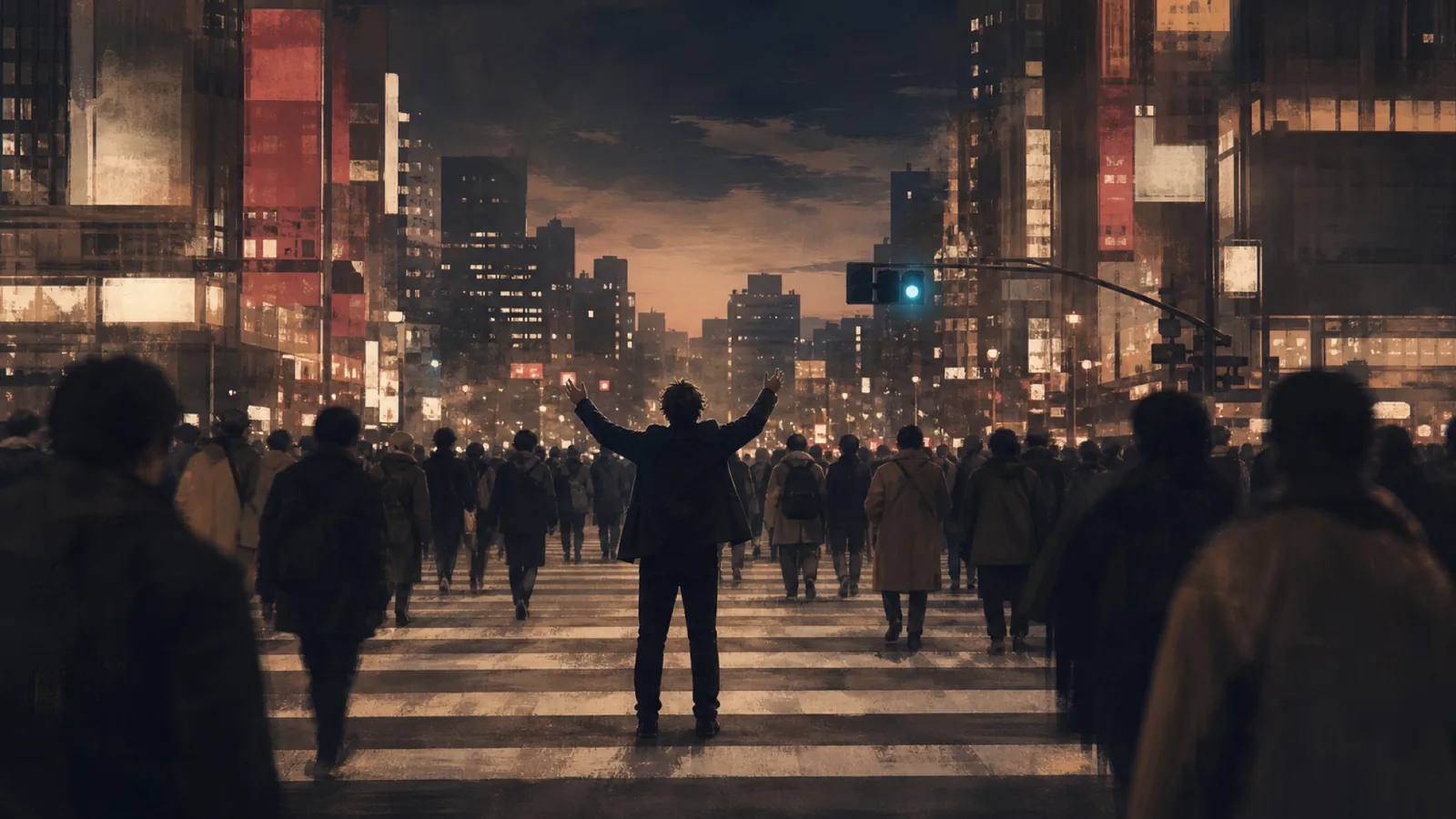
Episode 2 picks up where Choi's "stop trying" speech left a bruise and answers it the only way its protagonist knows how — by walking into the middle of a city street and shouting his own name into the noise. The hour that follows is about who gets expelled from rooms, who gets banned by sign, and what a man does the morning after he has been told, in plain language, that twenty years of his life were a waste.
A sign on a door is a small, polite form of murder
The funniest and saddest object in this hour is a piece of printer paper. HWANG DONG-MAN NOT ALLOWED. Ko Hye-jin tapes it to the door of her own bar — a bar she has spent years stocking with one specific brand of liquor in case one specific friend wants a drink — and we sit with it long enough that you can feel how much paperwork it took, internally, to print.
Park Hae-young loves this kind of cruelty. Not the operatic kind. The administrative kind. Hye-jin does not raise her voice when she throws Dong-man out. She gives him the courtesy of three minutes and twenty-seven seconds of speech, asks him not to interrupt, and then explains, with the precision of a person who has thought about this in the shower, exactly why he is exhausting to be around. I plan to live to a hundred, she says, so I can’t afford any more stress from you. It is the politest excommunication in recent K-drama memory. Hye-jin reads it calm, almost tender, and it becomes one of the hour’s two or three quietly devastating moments.
The Eight Club intervention that precedes it is the louder, uglier mirror of the same act. Gyeong-se gathers his director and producer friends in Hye-jin’s living room and runs a sales pitch: Dong-man is rotten fruit, failure is contagious, guys like him know how to make failure contagious. Listen for the cadence. It is the cadence of men who have already decided and are workshopping the script they will use to feel good about it afterwards. Even the friend who pushes back — I can’t say I haven’t been guilty of that on occasion — gets steamrolled, because the meeting was never a deliberation. It was a ratification.
What Park Hae-young keeps doing here, and what makes the cruelty land instead of curdle, is letting the people doing it tell on themselves. Gyeong-se’s whole case rests on the claim that Dong-man celebrated his flop. Maybe. Or maybe Dong-man sent a man whose movie had just bombed a box of coffee beans, and that man could not bear receiving kindness from the one person whose kindness might mean nothing.
“There are two kinds of guys in this world” — three takes, one black eye
Halfway through, Dong-man tries to deliver the monologue he has been writing in his head all day. There are two kinds of guys in this world. The kind who blaze their own trail, and the kind who refuse to do anything but complain and talk shit. He gets one line out before Gyeong-se, blocking his car, charges him. He tries again. Action. Gyeong-se charges again — same beat, same trip, same fall onto his face. (The cast that surfaces later is Dong-man’s, not Gyeong-se’s, and for a different injury entirely.) He tries a third time. Ready? Action! He gets the whole monologue out this time, all the way to talking shit makes them feel like they’re better than everyone. And then, having delivered his speech to a wreck of a man face-down on the asphalt, he cracks. Come on, tell me that isn’t a sick burn. The bravado dissolves into something closer to a giggle.
Already, in his second hour, this is who Dong-man is. He calls action, gets the take, calls cut, reviews the footage in his head — director of his own life. The cast on his hand later is cover for the same instinct: he wrapped his own wrist in plaster, alone, in the middle of the night, because the pain of being torn apart by Choi felt like bones breaking and he wanted his body held together. Dong-man plays the bit so tenderly that you almost miss what it is. A forty-year-old man performing a director’s eye on his own humiliation because that is the only language he has fluency in. The Ax has not even appeared in his orbit yet, and you already know exactly what she will see when she reads his script.
Eun-a’s nosebleed has no name yet
The parallel track belongs to Byeon Eun-a, and it is where the show’s ambient sci-fi conceit — the Emotion Watch, which reads its wearer’s emotional state in real time — finally pays interest.
Eun-a bleeds when she gets stressed. The watch reads UNKNOWN. The doctor, calm and methodical, explains that they need feedback from patients with equivalent symptoms before they can assign an emotion to the pattern; so far, nobody else has shown it. It looks like anger, despair and sadness make up about 90% of it. The other ten percent — something the database does not yet have a word for.
What Eun-a names, when asked, is implosion. I wanted to erase myself. And then she does what Park Hae-young heroines do when offered an opening: she travels backwards through it, to a second-grade classroom where she had her first nosebleed and felt completely alone, paralyzing, unable to breathe. The grown version of that feeling, she says, has one new ingredient. It’s like I’m witnessing other people’s weakness and insecurity. The line gets a reprise later, with a hard edit, when she adds the part the doctor did not get: and that makes me feel like I could stand up to them.
Both Eun-a and Dong-man run on a default channel the world has not invented a word for yet, and both are about to find each other on the only frequency that picks it up — a script called Weather Maker. When she finally reads it and tells Dong-man, in the season’s first real moment of mutual recognition, this director has nobody he loves — you can hear the watch glitch in real time. Anger, despair, sadness. And something else.
Jin-man, the inheritance dinner, and a brother who throws punches in two registers
Hwang Jin-man arrives in this episode pre-loaded: an older brother who has been gone, a former poet who now welds and forages cabbage, a man with no money and a clean conscience about it. He plays in the lower register of the cast — quieter than Dong-man, twice as dangerous when crossed.
The inheritance dinner draws blood on its own. The Hwang uncle — the one who walked away with the family fortune because Jin-man kept his promise to a dying father and refused the legal fight — asks Dong-man, scatterbrained, to find a celebrity to sing at his daughter’s wedding. The old aunt scolds him for taking too long. The uncle smiles, eats, lets the humiliation simmer. Jin-man waits. Then, very quietly, he takes the uncle apart. You know my father never cared about money. And that meant you could walk away with the Hwang family fortune. So count yourself incredibly lucky. I truly take pride in being the better man. The grace note, delivered just before he asks the uncle not to attend their grandparents’ memorial again, is that Jin-man does not raise his voice once.
He raises his fists later, at Hye-jin’s bar, after he learns about the sign. He shows up drunk-ish, eats his brother’s banned steak, and delivers the longest unbroken comic monologue of the hour — the one about the Earth’s 23.5-degree axial tilt and ten billion tons of annual food production and how everyone there could just sit and be happy to live off the bounty of the earth instead of tearing their hair out over movie politics. He punches a director who calls Dong-man a hopeless cretin. He gets a second sign printed on his behalf: HWANG DONG-MAN AND HIS BROTHER NOT ALLOWED.
It is the most generous gesture in the hour, and Jin-man can read the bill perfectly. He tells Dong-man so on the cab ride home, with the brutal clarity of someone who has been the family’s emotional ballast for too long. Forget movies and just leave with me. You’re forty. Have some self-respect and leave the industry. He is begging in the only register men of his generation are allowed to beg in — anger.
What Dong-man finally admits, after Jin-man has yelled himself out, is the rule he is trying to live by. I don’t wanna be anxious. To not feel so anxious. Not success. Not the debut. Just the absence of the thing.
Tiny details worth clocking
- The cast on Dong-man’s hand is fake. He wrapped it himself in the middle of the night because the stop trying speech felt like fractures and he wanted to be held together. He is also lying to his brother about it. Two truths, one bandage.
- Gyeong-se’s flop got it from the world, but the thing he cannot forgive is the box of coffee beans Dong-man sent him while it was happening. Kindness from a man you have already decided is beneath you is unforgivable.
- Hye-jin’s eviction monologue is internally dated. I plan to live to a hundred. She has been rehearsing that line for a long time, possibly years.
- The Emotion Watch is treated as ordinary, almost dull infrastructure. Nobody marvels at it. Park Hae-young drops the sci-fi into the world like a hospital appliance and watches the dread settle.
- The Joseon-script line on the door of Jin-man and Dong-man’s house — HWANG JIN-CHEOL — LEE SUN-OK — is the parents. The brothers are still living in the house of dead names.
- Eun-a’s closing line to Jin-man, when he hands her a container of his grandmother’s side dishes, is you are more beautiful than the weather. The script title is Weather Maker. The episode places its love story squarely between meteorology and grandmother food, and somehow that is exactly right.
Verdict
Episode 2 is the hour Park Hae-young’s hand becomes unmistakable. The Choi monologue from the premiere — the one that sounded like the show’s whole argument — turns out to have been bait. The real argument is quieter, and it belongs to a man who does not yet know how to say it without inventing a director’s slate first. To not feel so anxious. The whole season will be the slow project of teaching Dong-man and Eun-a how to speak that sentence to each other without the Emotion Watch flickering to unknown.
The Eight Club expulsion arc is funnier than it has any right to be. The Jin-man movement is the most fully drawn supporting performance in the show so far. And the closing pivot — Dong-man marching back into Hye-jin’s bar to deliver his real monologue, ending with when I’m done being worthless, I’ll bring a shining truth into the world — earns the next ten episodes without needing to. Watch how Hye-jin smiles, against her will, in the corner. Watch Gyeong-se in the coda, alone, rewinding the bruise and concluding his rival has the devil on his side. Petty people, painfully observed, slowly forced to admit the man they wanted to delete keeps inventing weather.
Rating: 8.6/10
More episodes from We Are All Trying Here — Failure, envy, and the work of staying human. Jump to any episode in the season:
Where to go next
Reviewed by Mira Vance · QuizFandom Editor & Lead Reviewer. Every rating is an honest per-watch assessment from the desk that also writes the quizzes — not a press release rehash.