We Are All Trying Here Episode 5 Review: The Hour Everyone Finally Admits They Have Been Eating Hwang Dong-man Alive
What happens — the short version (spoilers)
- The cold open reveals Dong-man, not Gyeong-se, is the one being beaten in the courtyard — drunk and bored, he started it himself.
- At the police station Dong-man can't name his job, so Eun-a answers 'he's a film director, I'm his producer,' a generous lie that becomes binding.
- On a snowy riverside bench Eun-a tells Dong-man her watch reads 'lonely' and that it can't register love at all — a relief, since she always assumed she'd been skipped on it.
- Jin-man stands up at an Eight Club gathering and names it as a feeding circle, listing the characters each member has secretly built from Dong-man's life.
- Gyeong-se confesses to Jin-man by phone that his acclaimed debut film was secretly Dong-man's drunk anecdote, and that stealing it is why he's picked on Dong-man for twenty years.
- Eun-a quietly declares she wants to give every stolen story back to Dong-man and to be the only one he sees, framing it as a producer's claim on his voice.
Episode 5 opens with a man getting beaten in a courtyard and ends with another on his knees, confessing he has been chewing on a stranger's life for two decades. In between, an emotion watch tells the truth nobody in the room dares to. This is the hour We Are All Trying Here stops being polite about what the Korean film world does to people like Hwang Dong-man.
The fight that nobody is fighting
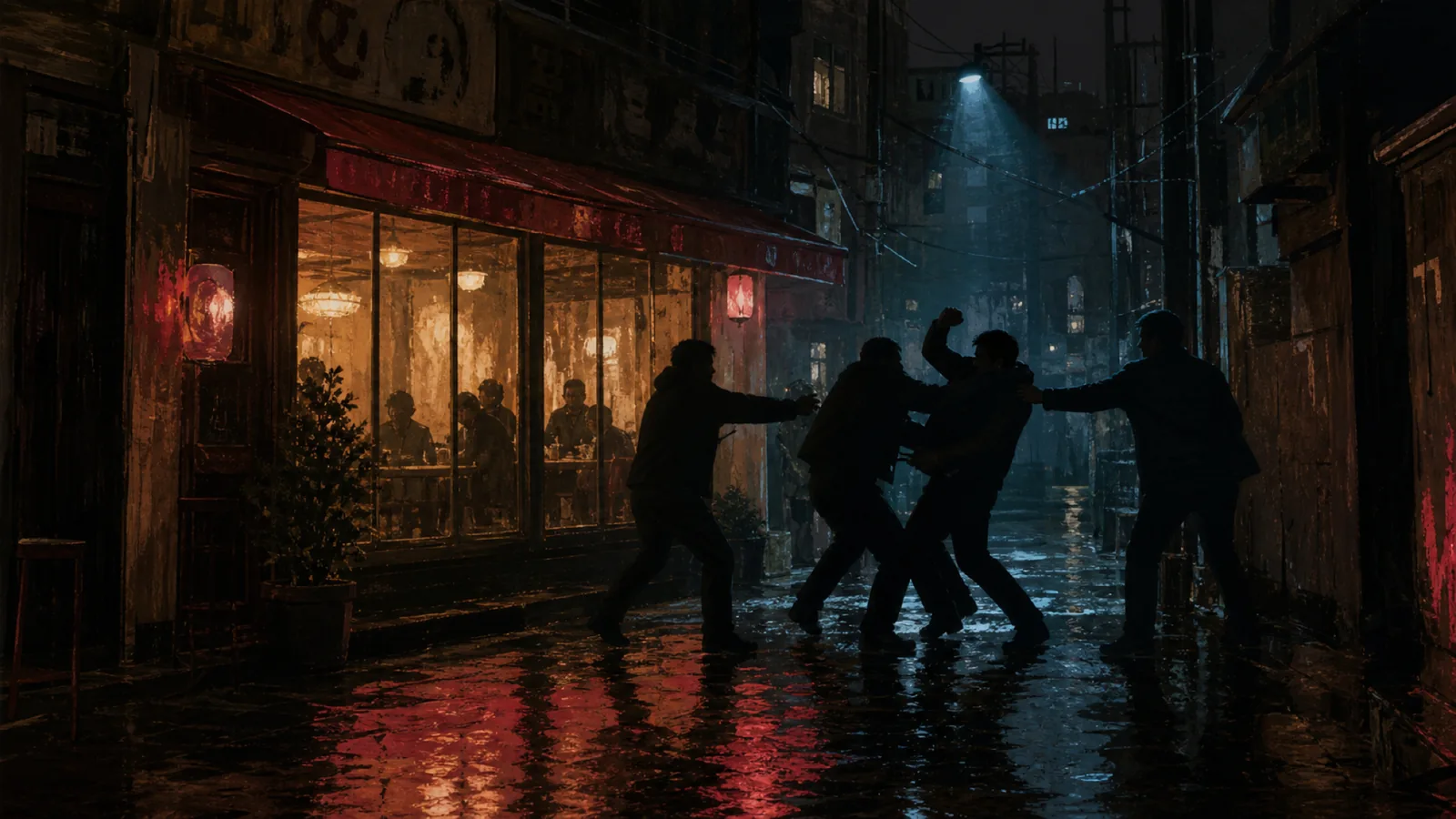
The cold open is set up to look like the E01 intervention catching up to itself. A man is on the ground. Bystanders shout that someone is going to get killed. The whole sequence is framed for misreading.
Then the camera tilts and the geometry resolves. Dong-man is the one on the ground. Park Gyeong-se is the one watching. The “he’s gonna kill him” panic is about people trying to drag a stranger off Dong-man before he caves his face in. The fight has nothing to do with the writing-room frostiness Episode 1 established. Dong-man walked into it on his own, drunk and bored and ready to throw a rock through a window, because that is the size his life has shrunk to.
The police-station scene plants the episode’s structural rhyme. Asked his job, Dong-man cannot say “film director.” He cannot say anything. The silence stretches until Byeon Eun-a — who has every professional reason to be elsewhere — answers for him. He’s a film director. I’m his producer. The credential is fictional in the moment and binding by morning. It is the most generous lie anyone tells in this hour, and the one that makes everything else possible.
The ER sequence is an extended joke with a bruise underneath. Hospitals will not admit Dong-man because his vitals are normal. He cannot fake unconscious. He volunteers his own name when nobody asks. By the time he is on his knees in an alley pawing through a sewer for a 500-won coin he threw up earlier, the bit stops being slapstick and becomes the kind of comedy that hurts. He has been beaten into a state he still cannot perform convincingly. He is so bad at being a victim the system refuses to treat him as one.
The watch tells him something Eun-a already knew
The episode’s emotional centerpiece is a long, drifty scene on a riverside bench, snow coming down, where Eun-a confesses what her watch has been doing all day. The device is a low-key science-fictional conceit the run has been slipping in around the edges — a wristband that names what the wearer is feeling in real time. Hers spent the day on red. The word it landed on was lonely.
What follows is one of the warmest passages of dialogue the run has produced. Eun-a tells Dong-man, with no theatrics, that she has always assumed love is something she got skipped on. She gets longing, missing, all the bordering states. Love itself she cannot locate. Then she tells him, with a small laugh, that the watch does not register love — apparently love is a concept, not an emotion — and the relief in her voice is staggering. If the machine cannot find it, she has not been failing a test the rest of the world has been quietly grading her on.
Dong-man, who minutes ago was vomiting in a sewer, becomes a careful audience for this. He stammers a defense of the watch’s blind spot. Emotions are out of our control, he offers. You could love someone for a tenth of a second. He is trying to give her permission to revise her self-diagnosis without flagging that he is doing it. He has said nothing about himself. He has just made room.
Eun-a’s loneliness has been measured by an instrument that cannot lie. The man sitting next to her has been declared a non-emergency by every hospital in the district. Two people the relevant systems have failed to register, finding each other on a bench nobody is monitoring.
The Eight Club is a feeding circle and Jin-man is the one who names it
The back half hinges on Hwang Jin-man — Dong-man’s older brother, former poet, current proprietor of an Agit-shaped life — finally saying what he has been chewing on for an entire run. The Eight Club is the writers’ room nucleus this show has been quietly profiling: mid-career screenwriters and directors who orbit Gyeong-se, drink at the same bar, share notes, trade jokes that keep getting harder to laugh at.
Jin-man stands up in the middle of one of their gatherings and reads the room aloud. Ki-ri’s screw-up brother-in-law in X-Family? That is Dong-man. Seung-tae’s loan shark? Dong-man. The sewer-coin story we just watched will be in someone’s draft inside a month. Gyeong-se’s stalled Department of Stress Management cannot finish without him. Every person at that table has been quietly harvesting Hwang Dong-man for material, and the guilt is exactly what powers their contempt. We feel safe because he’s so naive, Jin-man says. We feel guilty for it, so we yell at him.
It is one of the cleanest indictments of a creative-class ecosystem a K-drama has produced in years, delivered with the rhythms of a man who has clearly rehearsed it in his head while making tea. Jin-man does not break the table. Later, in a separate scene, Eun-a is the one who plans the return — I want every story — then says she will give every single one of them back to Hwang Dong-man, until he finally realizes how brilliant he is. He is not protesting that they steal. He is protesting that they steal and withhold the knowledge of the theft, which keeps Dong-man feeling like a man with nothing to offer.
Eun-a, sitting in the corner, registers her own quiet objection. I’m against Dong-man rejoining The Eight Club. I want to be the only one he sees. The line reads like a romantic admission and is closer to a producer’s claim — a partner stating in front of witnesses that this writer’s voice will not be diluted again on her watch.
Gyeong-se’s bottle-opener confession is the cruelest mirror
The Jin-man speech is set up by an earlier scene that doubles it from the opposite angle. Gyeong-se, sleepless and crumbling, calls his hyung in the middle of the night and pours out a secret he has carried since college. His debut film The Lustful Bottle Opener — the one critics keep telling him was his best work, the comparison that has slowly hollowed him — is Dong-man’s story. A drunk anecdote about ripping a fridge door off when he saw the bottle opener he had given a girl displayed on another man’s kitchen. Gyeong-se took three days to write it. Dong-man blacked out and never remembered.
And then, the line that doubles as the hour’s thesis: That is when I started picking on him. Gyeong-se has been the cruelest critic in the room for twenty years because Dong-man is the man he robbed. Every brutal note in a writers’ meeting has been a small payment on a debt that cannot be settled. The cold open’s “you hated me first” exchange turns out to be technically true and morally backwards. Gyeong-se hated Dong-man first because Gyeong-se had taken something first.
Jin-man answers with one of the most generous absolutions anyone here has received: That was a beautiful confession. I’m proud of you. He is not letting Gyeong-se off the hook. He is acknowledging that a man who has been holding his throat shut for two decades has finally let himself say the sentence.
Tiny details worth clocking
- Eun-a is, the hour quietly reveals, Oh Jeong-hui’s biological daughter — the actress in the middle of a tabloid neglect scandal. The grandmother she lives with is not blood; she is her stepmother’s mother, a woman who chose to keep raising her after every legal reason to do so had evaporated.
- Mi-ran’s “watermelon licker” routine — Gyeong-se holding the fruit up, dripping with juice, refusing to crack it open — is the funniest critical read of a director’s flaw the run has produced. The man who cannot finish a film is still licking the rim of a story he stole.
- Ma Jae-yeong, the friend who just won the grant Dong-man should have, is also a plagiarist — his script Knock Knock Knock lifts Eun-a’s voice wholesale. Every “successful” writer in this orbit is metabolising someone else’s interior life. The difference is whether they admit it.
- The wedding singer doing a sugary love song while Dong-man watches from a back row lands the closing image: All I want is to make a film, so I can feel less worthless for just a little while. Not success. Not recognition. A small unit of dignity, rented by the hour.
Verdict
Episode 5 is the strongest hour of the run so far because it stops circling and finally names the architecture. We Are All Trying Here has been read by some viewers as a comedy about creative people being mean to each other. It is a story about a closed economy where the most generative person in the room is the one with no credits, the one everyone steals from while reassuring themselves he could not have used the material anyway. Park Hae-young gives every thief their own real grief — Gyeong-se’s hollow second act, Mi-ran’s irreparable arm, Ki-ri and Seung-tae’s stalled drafts — so the theft never reads as villainy. It reads as the way a system eats its softest people when nobody is willing to be the one to stop.
The construction is what raises the rating. The opening fight rhymes with the Eight Club confrontation. The hospital’s refusal to register Dong-man’s pain rhymes with the watch’s refusal to register love. The bottle-opener flashback rhymes with the wedding singer’s debt. Two people who have failed every test the surrounding culture set for them sit on a bench in the snow and discover, through a flawed machine, that they have been measuring themselves against the wrong things.
What to watch for: whether Jin-man’s claim sticks, whether Eun-a’s producer credit becomes contractual, and whether Dong-man will let himself remember the bottle opener — because Jin-man, in the small hours, did not actually tell him.
Rating: 8.9/10
More episodes from We Are All Trying Here — Failure, envy, and the work of staying human. Jump to any episode in the season:
Where to go next
Reviewed by Mira Vance · QuizFandom Editor & Lead Reviewer. Every rating is an honest per-watch assessment from the desk that also writes the quizzes — not a press release rehash.