We Are All Trying Here Episode 9 Review: No Evil in Him, But Strength
What happens — the short version (spoilers)
- Dong-man opens narrating a caged-lion image — the door is open and he can run or stand — and Eun-a returns his revised script admitting she'd hoped to watch him fail.
- At the signing Hye-jin walks him through brutal warnings, including that not a single person except his parents wants him to succeed.
- Two debut-film breakdowns are braided in one hour: Jin-man's, told as a war story of begging God to let him finish, and Gyeong-se's birthday confession that he felt relief when filming was scrapped.
- Hye-jin tells Gyeong-se she'll help him run and hide forever if he can't keep going — translating the show's title into a vow that the trying isn't the heroic part.
- A loan shark blasts threats and Dong-man's contact list, but in private offers ten million won for one truly scary thing; the man admits collectors are terrified too, scarier prey than predators.
- Asked whether he wants his villain more evil or stronger, Dong-man chooses stronger and finishes the line in voiceover: there's no evil in me, but there is strength.
Dong-man signs his director's contract, gets congratulated, gets warned, gets jeered at, gets a loan shark blasting his contact list — and somewhere in the middle finds out that the lion outside the cage is not as scary as the one he had been pretending to mock.
The caged-lion monologue is the show changing its register
Episode 9 opens on Dong-man, alone, narrating the thing he could not say out loud for eight episodes. A caged lion is easy to mock. You can call its whiskers stupid, joke about its age. He has been doing that to cinema for twenty years. Now the door is open and he says — almost mildly — that he can run or he can stand. The line itself is the green light. He has already chosen.
Cut to Eun-a returning his revised script. I was hoping to see you fail completely. Then, with that flatness Byeon Eun-a uses when something has cost her: Why the hell did you write so well? She had a small, secret rooting interest in his collapse — it would have validated the years of telling people like him no. He has spoiled the script and her resentment in one move. Now I’m tempted. In Park Hae-young’s vocabulary that is closer to a confession than a compliment.
The contract scene that follows is where Park’s irony bites. Dong-man asks Hye-jin, with kid-at-his-first-job alarm, whether the natural-disaster clause is normal. Of course it is. Her parade of warnings — plagiarism accusations, scandal scrubbing, the old you who will come for you — is delivered with the patience of someone who has watched twelve directors make this same face across this same desk. Not a single person in this world wants you to succeed. Except your parents. The hour’s sense of humor is that this counts as encouragement.
Two debut-film breakdowns told twice
The family farewell dinner turns the hero into a son again so his older brother can scare him sober. Jin-man’s debut-film prayer — he begged God to just let him finish, promised lifelong attendance in return — is the most accurate description of mid-shoot Korean cinema you will hear this year. I wondered, how badly do I have to get hurt to be pulled from the film? The brother who once called Jin-man at three in the morning and could only say the name Dong-man before sobbing for an hour is at this table now, smiling, passing a bowl of rice.
Hours later, at Gyeong-se’s birthday, the same speech gets told in reverse. He blows out the candle and wishes only for forgiveness — because I’ve committed too many sins. When his friend Jun-hwan sobbed on the phone mid-shoot, Gyeong-se’s first feeling was relief. It finally got scrapped. The two voices. I’m debuting and run away. Terrified of being asked what he made, suddenly grateful to have something to say, suddenly more terrified of having to deliver it. I’m even more afraid of looking pathetic if I admit I’m scared.
Park Hae-young has braided two debut-film breakdowns in one hour — the older brother’s, told as a war story, and the husband’s, told as a sin. Both men survived. Neither came out clean. The message to Dong-man, sitting between them in industry age, is that the thing he has spent twenty years sneering at can take you apart in ways the cage outside never threatened.
Hye-jin’s vow is the line that translates the show’s title
Then Hye-jin speaks. She tells her husband that fear is not something you endure. What kind of reward justifies putting up with that? She offers him a way out he has never been offered before: she will help him run, she will help him hide forever. The childhood story she tells — pounding heart of unknown origin, eating alone, sleeping alone, going to school like nothing was happening — tells us where her competence came from. Her gift to him is not survival. It is permission to not have to.
This is We Are All Trying Here translating its own title. The trying is not the heroic part. The trying is the part that breaks you. The generous gesture, the one a Park Hae-young protagonist offers exactly once per drama, is the one that says if you cannot keep trying, I will not love you less. Gyeong-se hears it as a romcom line. I like that. He has been married to her long enough to know the size of the sentence she just said.
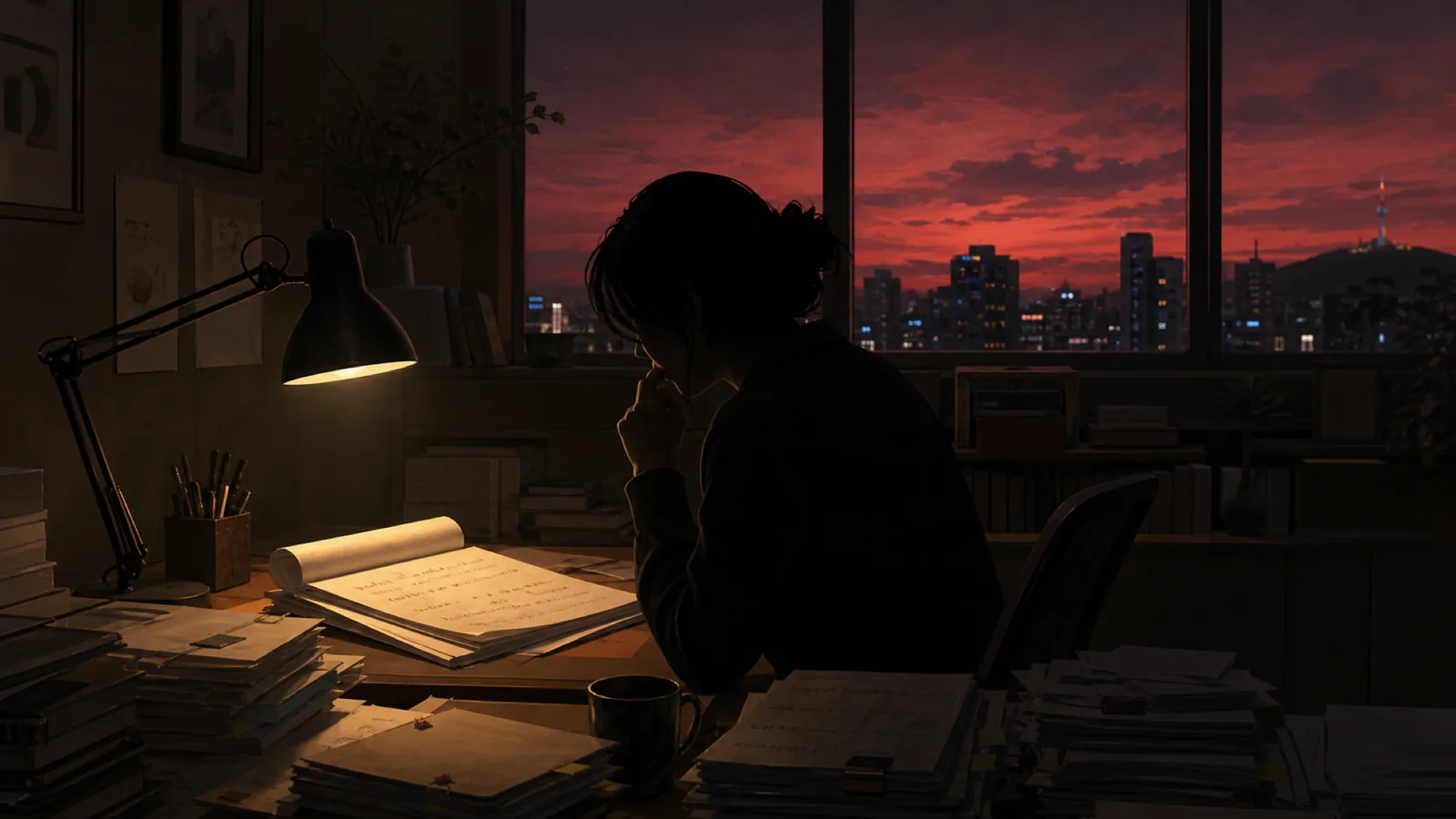
Jang Mi-ran is the show’s broken mirror, and the writer is using her hard
The actress Mi-ran is the version of Dong-man who already arrived. She gets recognized in restaurants, paid more than her mother, turned into a tabloid. She is also drunk on a bar stool telling Eun-a that when she says I love you on camera she means it, every time, and the man across from her does not. How could all of that have just been acting? The hour uses her to short-circuit the fantasy Dong-man is walking into.
I look too normal, so I messed up my face to match my mind is the bleakest sentence anyone has spoken on this show. She is asking her ex for one true line — say you liked me — and he refuses, citing professionalism. Her drunk stumble out of the bar, screaming at strangers to watch her drama because winter is for falling in love, would be comic in another show. Park Hae-young frames it as documentary.
Eun-a watches this and tells Dong-man, on a bench afterward: I’m starting to like you. She has spent the hour watching the apparatus chew the actress she used to admire and decided, against her own professional interest, to step into the chewing for the writer she just green-lit.
The loan shark is the writers’ room, and Dong-man finally writes
The hour’s masterstroke is the loan-shark sequence. He borrowed 1.7 million won and by the time the calls escalate he owes nearly twelve. The threats are pure boilerplate — I’ll slice your gut open, gouge your eyes out, make a soup of your organs. Dong-man finally talks back. Cliché writing comes from a lack of understanding of the world. He lectures a man with a baseball bat about the structural laziness of Korean gangster cinema. You scare people for a living and you’ve never stopped to think what actually scares them.
Then the loan shark shows up at the boarding house and Dong-man hides while his roommates take the swing. The loan shark has already texted everyone in Dong-man’s own contact list. He has been turned into a public nuisance. Then he finds the man again, in private, and offers ten million won for one truly scary thing — anything from this man’s hard life that would teach a writer what fear actually feels like. The loan shark stares at him and says, almost tenderly: You people are scarier than we are. We barge in with our shoes on so we can run away.
It is the funniest line of the season and the saddest. The man terrorizing Dong-man is admitting he, too, is terrified — of the people he collects from. He has been performing a clichéd villain because the actual material — a scared man in shoes, in someone else’s apartment, in a job that disgusts him — is too pathetic to use. Dong-man writes the scene in his head in real time. Then he closes the man out: You were able to push around the old Hwang Dong-man, but I’m not the same man anymore.
When Gyeong-se asks later whether he wants the villain more evil or simply stronger — most people confuse the two — Dong-man pauses. Stronger. In voiceover, alone, he finishes the sentence the show has been circling for nine weeks: There’s no evil in me. But there is strength.
Tiny details worth clocking
- The contract photo is staged like a wedding photo. Two strangers in suits, one camera, cheese. Hye-jin’s face is the only honest one in the frame.
- The choir monologue Hye-jin offers Gyeong-se — I barely opened my mouth and beautiful sounds came out — is the cleanest description of marriage in nine hours.
- Oh Jeong-hui’s casual demand for Dong-man’s screenplay, the one already attached to Noh Kang-sik, is the petty engine that will run the back half of the season. Bring it to me. No discussion. No reason.
- Dong-man scrolling a five-minute loan-approval ad after admitting he went to a loan shark because his cat needed emergency surgery and his card was maxed is the quietest indictment of the industry yet. He just got greenlit. He still cannot cover a pet vet bill.
- Gyeong-se’s on-set OK, we’ll go with this — torched by the actor who can see he is being given up on — is the most damning two seconds of directing the show has filmed.
Verdict
Episode 9 is the turn the season has been building, and it lands because it refuses to call itself one. Dong-man does not become a director by signing the contract. He becomes one by realizing, mid-fight with a loan shark, that the fear he has spent his twenties writing as cliché has a specific shape and a specific cure — look at it directly and put down on paper exactly what you saw. Park Hae-young has spent eight episodes asking whether his lead has anything inside him strong enough to survive the thing he has been mocking. The answer arrives in voiceover at minute fifty: not evil, but strength.
Two debut-film confessions set the boundary. The wife’s vow opens an escape hatch. The actress’s drunk monologue makes the fantasy specific. The loan shark’s shoes-on admission gives Dong-man the line he has needed for twenty years. And the producer who wanted to watch him fail is now, against her own interest, on the bench beside him. The season’s hinge, told in the writer’s natural register: dinner table, bus stop, bench, with a screenplay closing the door.
Rating: 8.7/10
More episodes from We Are All Trying Here — Failure, envy, and the work of staying human. Jump to any episode in the season:
Where to go next
Reviewed by Mira Vance · QuizFandom Editor & Lead Reviewer. Every rating is an honest per-watch assessment from the desk that also writes the quizzes — not a press release rehash.