Clarkson's Farm Season 5 Episode 1 Review: Rest, Sheep and One Very Expensive Bonfire
What happens — the short version (spoilers)
- Jeremy returns with a doctor's rulebook
- More lamb, more sheep, more trouble
- Oscar Piastri finds the trailer harder than the car
- EasyCare sheep refuse to enter the pen
- The pub is a business made of leaks, thefts and generators
- Bonfire logistics meet a dead sheep
Clarkson's Farm returns with Jeremy under doctor's orders, the pub demanding more meat, the sheep refusing to be anything like easy, and Bonfire Night turning into a very British mix of farm accounts, machinery, theft, tax and smoke.
Jeremy returns with a doctor’s rulebook
The episode begins with a reminder that the farm did not pause just because Jeremy had been carted off for tests. A few weeks earlier, he had been trying to open the pub while also doing harvest, before power cuts, dead fans and no gas helped turn the whole thing into a medical warning light. By the time he returns to Kaleb, the main relief is basic: he is back and not dead.
The hospital story is serious, even when Jeremy translates it into plumbing. One artery was totally blocked, another badly clogged, and doctors fitted stents. The farm consequence is blunt: no driving for a week, and no manual labour for six weeks.
That leaves the farm with a problem. Almost every useful job requires lifting, pulling, chasing, driving, climbing or arguing with Kaleb while doing one of those things. Lisa’s recovery regime adds cottage cheese, Greek yoghurt and kale, which is bleak enough before remembering that the farm rears beef, lamb and pork. Even the gentle dog walks become work-adjacent when the sheep ignore the long grass and eat the mown path instead. Jeremy has been told to slow down. The sheep have not.
More lamb, more sheep, more trouble
The pub’s demand for meat drives the first proper farm decision. Jeremy says they need ten fat lambs a week, so he buys another flock. Kaleb’s reaction is not joy. He is surrounded by the animal he least wants more of, and the name EasyCare does not impress him.
The sales pitch is practical enough on paper. These sheep do not need shearing because their hair falls out by itself. They are described as easy to breed and easy to lamb. John and Louise, who sold them, explain the wedge shape and long neck. Jeremy, newly aware of his own maintenance schedule, likes the phrase EasyCare for obvious reasons.
Kaleb’s position is simpler: no sheep is easy to care for. Before he is proved right, another livestock question is answered. End Game the bull is judged by scan results rather than reputation, and five of the seven cows are pregnant. If the pub needs beef as well as lamb, the bull has done enough to keep that supply conversation moving.
Oscar Piastri finds the trailer harder than the car
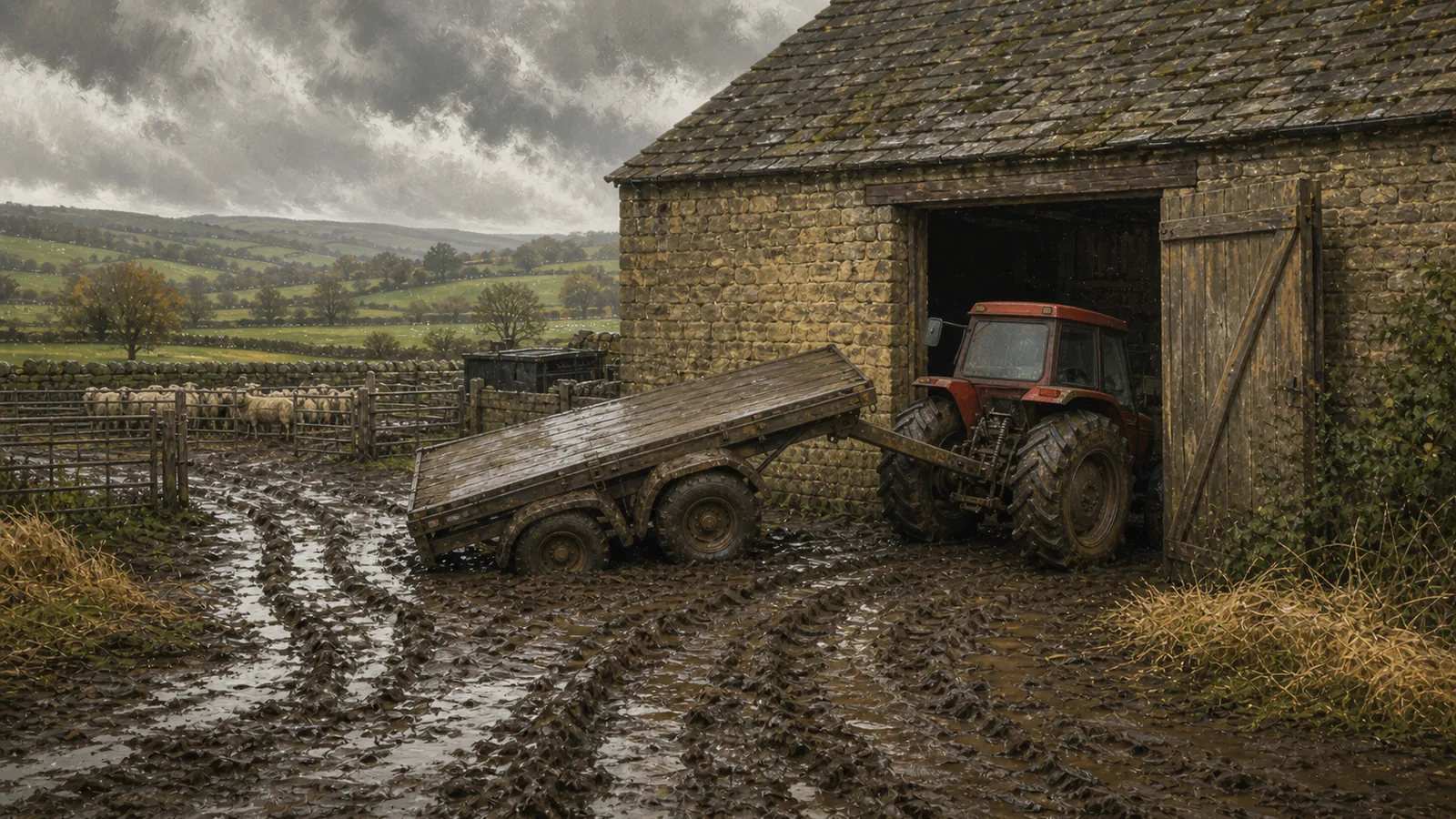
The visit from Oscar Piastri is used properly: as a man placed in front of a dolly trailer and asked to do a real farm task. Kaleb, who initially asks what he does, gives the lesson with the calm certainty of someone explaining a natural law. Open the back window. Sit turned round. Use the left hand to steer. Relax in the cab. Remember that the dolly moves one way and the back goes the other.
It is a neat reversal of status. A Formula 1 driver can take a racing line through Eau Rouge, but the trailer does not care. The barn is over there, the wheels are doing something else, and every correction creates another angle. Jeremy and Kaleb watch the attempt drift from confident instruction to tea-break resignation.
The sequence belongs because it is genuinely about machinery. Reversing a trailer is one of those practical skills that looks simple from the outside and immediately humiliates anyone who treats it as steering a car backwards. Oscar keeps going after everyone else has accepted the answer. The tractor still wins.
EasyCare sheep refuse to enter the pen
When Dilwyn comes to check the EasyCare sheep, the name finally meets the field. Jeremy cannot help because he is under orders not to do manual labour, so Kaleb has to herd them into an inspection pen. The sheep disagree. Quickly.
The first attempt collapses into rural farce: a serious veterinary job defeated by animals with no interest in the diary. The sheep get into a Neolithic fort, Jeremy tries to use the car as technology, and for a moment the pen is only yards away. Then a group jumps the electric fence, the rest follow the opening, and everyone is back where they started.
The film crew is drafted in. Gaps are closed. Formations are tried. Kaleb bleats, directs people around the edges, and eventually wants to go home and try again tomorrow. Dilwyn has come out, a bill has been created, and no useful inspection has happened. Even failed handling costs time and money.
The following morning adds a second sheep shock. Lisa has bought five Valois sheep at GBP2,000 each, with an idea of breeding them. Jeremy and Kaleb register the GBP10,000 total with very little calm.
The pub is a business made of leaks, thefts and generators
The doctor’s ban on going to the pub is partly about alcohol and mostly about stress. Jeremy ignores it because the pub has become a machine for producing problems. The electricity supply is not strong enough. New cables would cost GBP200,000, so a hired generator is being used, with fuel costing GBP100 a day. Cooking oil worth GBP200 has been stolen. Light bulbs and urinal traps disappear. Four hundred glasses a week are being nicked.
Then there is water. A 6,000-litre tank fills overnight and still is not enough. The overflow car park needs hardcore because vehicles have been getting stuck, including a fire engine. The tent gathers condensation, and wind shakes it down like rain. Charlotte at the butcher’s counter has to deal with customers making comments about her looking like Kaleb.
The pub is not a romantic sideline with a bar and a view. It is power supply, water pressure, theft, mud, staffing, fuel, stock and the daily discovery that some small fitting has vanished. The joke about Jeremy being HR works after that list.
Bonfire logistics meet a dead sheep
Bonfire Night brings another job Jeremy cannot officially do. He tells Kaleb he is there to advise, then argues about the shape. Jeremy wants a pole and a wigwam structure. Kaleb thinks pallets can do the job. Logs are collected, the small telehandler becomes Jeremy’s farm mobility scooter, and stress becomes a conversational weapon.
They eventually get a proper structure standing, after mud, darkness and the usual dispute about who has just knocked what over. A couple of days later, with Kaleb away in Cornwall, Jeremy tries again to get the EasyCare sheep checked. The dogs do not help. One sheep is dead.
Dilwyn’s field assessment is blunt: an ear is gone, there is a wound, crows have been at the carcass, and gangrene is present. He suspects dog worrying as part of the story and wants a post-mortem back at the yard. The resulting scene is deliberately unpleasant, and Jeremy even apologises for it. Still, it belongs. This is the cost of keeping animals, not in theory but in smell, weight, rot and the need to know what happened.
The mood does not lift much at the pub, because the bonfire has been set alight early. Annie says a car-park attendant confessed, and the CCTV shows someone carrying something in and throwing it onto the structure. The fire was apparently good, just 72 hours too soon. So the team rebuilds it.
The budget turns the party into a warning
The final turn is from farm nuisance to farm politics. Charlie returns from holiday and comes straight in with the budget. The headline figures are laid out plainly: from 2026, farmers with agricultural assets over one million pounds will face 20% Inheritance Tax, while the government claim quoted in the news is that three quarters of claims will be unaffected.
Jeremy and Charlie reject that framing. They talk through the problem in assets rather than cash: land, cows, tractors, combines, implements. Charlie then adds more bad news from the same budget area: a carbon tax on fertiliser from 2027, a 76% cut to the 2025 basic payment, and pick-up trucks reclassified as cars for tax. The discussion is not subtle, but it is grounded in the farm’s running costs and the gap between owning valuable equipment and having spare money.
That anger feeds the Bonfire Night party at The Farmer’s Dog. The garden fills, the food is British-reared or grown, a drone show makes shapes including Pepper, a sheep, a pig, a combine, a pint and Gerald, and then the effigy burns. The joke lands, but the closing note is not just celebration. Jeremy says making fun of the government will not be enough.
Tiny details worth clocking
The strongest running gag is Jeremy treating doctor’s orders as management: he cannot pull logs, cannot herd sheep, cannot be stressed, but can still supervise everyone else’s labour.
The EasyCare name is set up with enough sincerity to make the failed penning funnier. The practical claims may be real, but the sheep still have legs, instincts and no interest in Dilwyn’s schedule.
The pub figures are the episode’s most sobering arithmetic. GBP100 a day in generator fuel, 400 glasses a week, and a water tank that still cannot cope are not punchlines so much as recurring costs.
The Oscar Piastri segment works because nobody needs to pretend reversing a dolly trailer is glamorous. It is a skill, and the barn is a very honest judge.
The post-mortem scene is horrible, but it stops the sheep story from staying cute. Livestock comedy always sits close to livestock loss.
Final verdict
Season 5 opens with a practical episode built around the gap between plans and what the farm permits. Jeremy’s health scare could have made the hour sentimental, but it is mostly used to alter the labour system. He becomes a pointing device with opinions, while everyone else has to absorb the physical work.
The sheep material is the best-balanced part, moving from sales pitch to chaos to genuine loss without pretending those are separate worlds. The pub thread is just as useful: power, water, mud, theft, staff, stock, and the unending expense of keeping a public-facing farm business open.
The budget ending is broader and angrier than the rest, but it follows naturally from the accounts-led view of farming. After watching money leak out through generators, glasses, animal handling and rebuilds, a tax conversation feels like the same ledger, only bigger.
Rating: 8.2/10 - A sharp, grounded opener that turns recovery, sheep, pub logistics and Bonfire Night into one clear argument: farming is funny until the bill arrives.
More episodes from Clarkson's Farm S5 — Farm chaos and village stakes, episode by episode. Jump to any episode in the season:
Where to go next
Reviewed by Mira Vance · QuizFandom Editor & Lead Reviewer. Every rating is an honest per-watch assessment from the desk that also writes the quizzes — not a press release rehash.