Clarkson's Farm Season 5 Episode 6 Review: Dams, Dare Food and a Dry Spring
What happens — the short version (spoilers)
- The cows make freedom look simple
- Mission Control finds a use for bossiness
- The Lambo sells itself badly
- Dare Night begins as a spreadsheet problem
- The crop plan waits for rain
- The dam grant meets the rulebook
Clarkson's Farm season 5 episode 6 starts with the rare sight of Diddly Squat behaving itself: cows back on grass, lambs arriving cleanly, snails multiplying and machines doing clever work. Then the bill arrives, in the form of warning lights, grant paperwork, stolen snail eggs, pub customers with dangerous chilli sauce, and a dry spring that begins to make the crops look very exposed.
The cows make freedom look simple
Episode 6 opens in the warm part of spring, which is dangerous territory for this programme because it briefly allows everyone to look competent. The cows are released from their winter confinement, and the field immediately becomes the sort of scene that would make a farm brochure look undersold. Jeremy, Lisa and Kaleb guide them out, the calves get their first proper run at open grass, and even Jeremy’s worry about Endgame is put into plain farm language: Charlie and Kaleb have talked about selling or eating him, and Jeremy is having none of it.
That is the nice version of Clarkson’s Farm sentiment. It is not written in sugar. It is attached to a real beef animal, a real breeding job already done, and the awkward fact that affection and farm economics do not always want the same ending. Endgame is not a pet in the ordinary sense, but Jeremy treats him like one in the moment, which is exactly where the comedy sits.
The EasyCare sheep then do their bit for the argument that some livestock can, occasionally, be easy. Jeremy says there are sixty-six lambs so far and only two lost, which on this farm counts as almost suspiciously smooth. A ewe produces twins while Jeremy and Lisa watch, Kaleb explains the yellow staining as stress, and everyone gets to enjoy lambing without too much wrestling. Kaleb calls it his kind of lambing: done at a distance. For a farm that often turns birth into emergency theatre, this feels almost rude.
Mission Control finds a use for bossiness
The episode’s machinery thread begins with Kaleb doing variable-rate fertilising while Jeremy monitors him from Mission Control. The tractor is spreading nitrogen at 140 kilograms per hectare, the system is opening and shutting the spreader as needed, and Jeremy can see the dashboard from his chair. It is remote farming with just enough data to be useful and just enough ego to become unbearable.
The Apollo routine is funny because the underlying system is actually doing a job. Jeremy can see Kaleb’s speed, the field position and the fertiliser output. He also catches that one side of the spreader is not working while the other is throwing out product. That is not just a gag about a man in an office pretending to be Ed Harris. It is fertiliser, money and crop nutrition being watched live.
Kaleb’s best point is that he quite likes this version of farming because Jeremy is indoors and out of his way. Jeremy’s best point is that being indoors still lets him spot a mistake. The show does not have to choose between them. It lets the technology be useful while making clear that the person enjoying it most is enjoying the chair nearly as much as the data.
The Lambo sells itself badly
The green Lamborghini has not turned a wheel in weeks, caught between its own technical faults and the arrival of the AgBot. Jeremy decides to sell it, which means inviting an agricultural auctioneer to value a tractor that starts well enough and then immediately fills the cab with alarms.
This is one of the episode’s neatest bits of farm accountancy. Jeremy presents the Lambo as a magnificent low-hour machine with sat nav, Trelleborg tyres and air conditioning. The tractor answers with a service alarm, a distributors warning and a coolant level alarm. Jeremy suggests one fault might be a loose wire costing pennies. The auctioneer suggests the market may be less romantic.
The valuation lands between 50 and 60 thousand pounds, with the auctioneer leaning towards 50 to keep it competitive. That hurts because Jeremy paid 80. At the Cambridge machinery sale, the Lambo at least recovers some dignity by climbing to 70,500 pounds, even while beeping its way through the ring. It is still a loss, but not the disaster first advertised. Kaleb sums up its finest moment by observing that it looks best going away.
Dare Night begins as a spreadsheet problem
Jeremy’s pub idea is to run a Dare Food Night at The Farmer’s Dog, serving food people would not normally choose. Nick the chef immediately reduces this to the business problem underneath: the pub serves six or seven hundred people a day with food they like, and Jeremy is proposing fewer people eating food they do not.
That is why the scene works. Jeremy frames it as waste, cost and changing meat prices. Cheaper cuts and overlooked animals might help if people can get over texture and habit. Nick frames it as service, seats and whether a special event can be made to function. The menu talk moves through tripe in milk and onions, sheep’s heart, pig’s ears, snails, snail caviar and brains. It is gross-out television, but with a stock control question underneath.
The snails bring the farm diversification problem back into the room. Lisa has thousands of newborn snails in the polytunnel and sees the eggs as the next generation for her cream plans. Jeremy needs snail caviar for the pub and does not expect permission. His attempt to harvest it with tweezers and magnifying eyewear turns one of the smallest products on the farm into one of the most labour-intensive. By the time he realises how little he has collected, the pub special has already become a lesson in why unusual ingredients are not automatically cheap.
The crop plan waits for rain
For a while, the onion and beetroot field offers just enough encouragement to keep everyone hopeful. Charlie finds the tiny red beet seedlings. He finds onions too, barely visible but present. Jeremy wants to become the onion king of Chipping Norton, and Kaleb has to retract a complaint about the AgBot missing a strip when Charlie explains the divide between crops.
The problem is not the drilling. It is the sky. Weeks have passed without rain, though Charlie initially thinks the crop can last another two or three weeks if cooler weather arrives. The FarmDroid does its weeding, Kaleb finds the process fascinating, and the field still looks like one of the smartest on the farm if you ignore the fact that almost everything important is happening at seedling scale.
By the end of the episode, that optimism has gone. A radio report says the dry spring is the driest since 1956, with March and April getting only half the usual rainfall. Charlie shows Jeremy flag leaves curling to protect moisture, yellowing from stress, and shoots that have shrivelled. Jeremy repeats Harry Metcalfe’s warning that the UK is losing 100,000 tonnes of wheat a day. The short crop also means less straw, which means less bedding for cattle. Then the onion and beetroot field gets its verdict: after six and a half weeks, much of it has frazzled, and Charlie says large areas need re-drilling.
The dam grant meets the rulebook
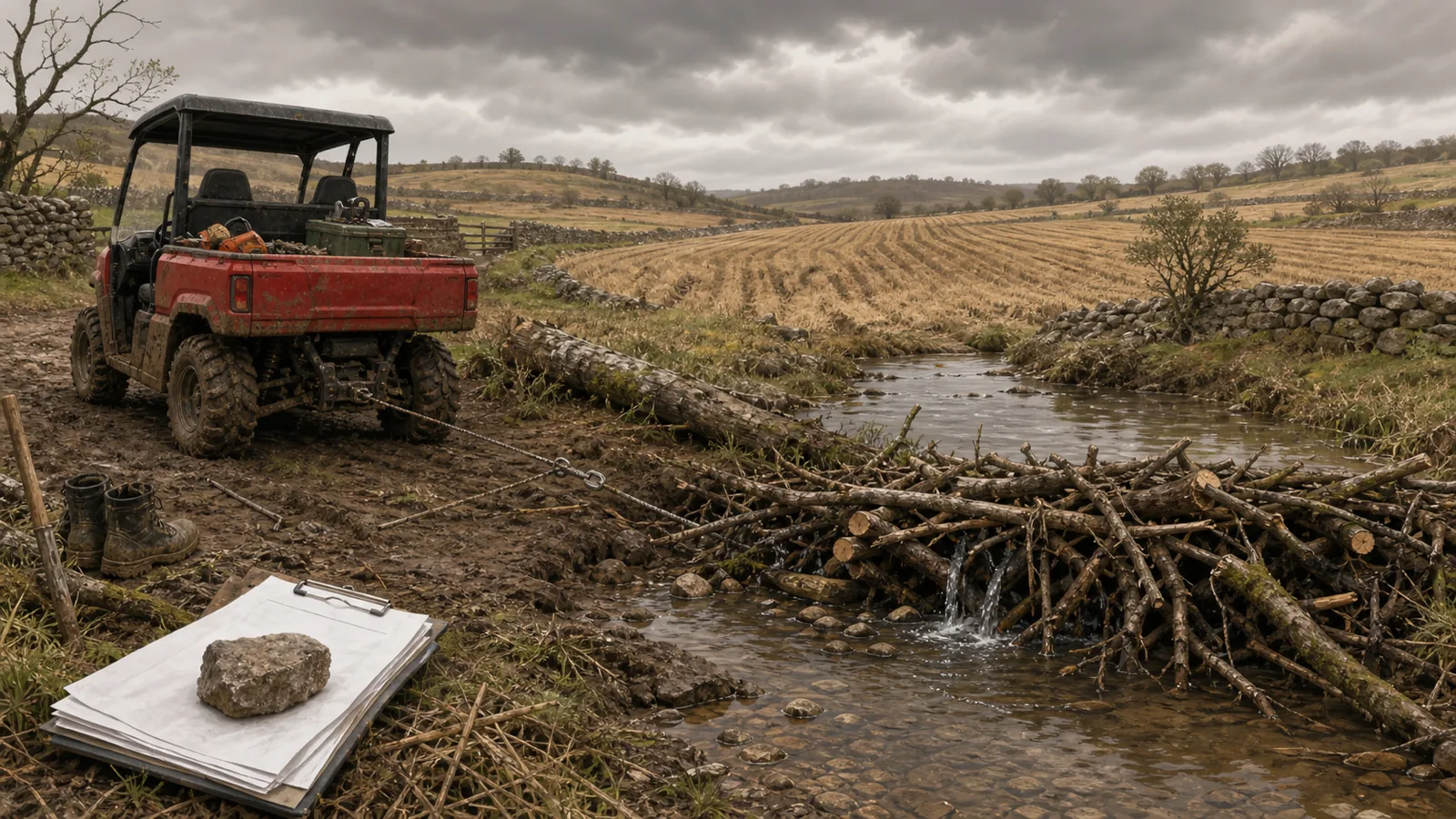
With the Droid doing the patient work, Jeremy goes looking for a job and finds one on a government website: large leaky woody dams. The grant number is precise enough to be irresistible, 764 pounds and 42 pence for each dam. The purpose is sensible too: slow water, hold some of it back, let sediment settle and reduce flood risk downstream.
Jeremy and Kaleb head to the stream in the new UTV, where health and safety has apparently supplied trained divers because they are near water. The RoboMulcher returns to favour by smashing through foliage, the UTV winch pulls out a fallen tree, and the first dam is treated as money earned. The sequence has the old Clarkson machinery pleasure, but this time the machine chaos is in service of an environmental scheme rather than an argument with a hedgerow.
Then Charlie arrives at the second dam site and reads the part Jeremy has skipped. They need approval from Catchment Sensitive Farming before doing the work. They also cannot simply do the job first and claim the grant afterwards. Jeremy tries to float various ways around this, including not showing the already altered bit of stream. Charlie insists they follow the rules. It is a very Clarkson’s Farm result: a good idea, a government payment, useful work, and one unread paragraph bringing the whole enterprise to a halt.
Dare Night survives, mostly
The final event is the pub dinner, and it is staged like a challenge but run like a service. Jeremy explains the point to the room: meat is expensive, familiar cuts are becoming luxury items, and there are cheaper things people might eat if they can get past texture. The guests then start with snails, garlic butter and snail caviar, which goes better than Jeremy had any right to expect.
Cotswold Fried Squirrel is less straightforward. Some people like it, but the smell becomes the story. Pig’s ears do better. Lamb’s brain and stuffed heart divide the table, with Annie especially reluctant to join in. There is real kitchen work behind the silliness: Nick and the chefs are prepping hearts, brains, ears and squirrel, while Thomas supplies chilli sauces at seven, nine and fifteen million Scoville units as palate cleansers.
Jeremy has already tested the fifteen million version and discovered pain in places a palate cleanser should not reach. At dinner, he distributes milk as fire extinguishers and warns everyone about the cocktail-stick version. The room coughs, laughs and suffers; one guest ends up outside losing more than composure. The practical conclusion is modest but useful. Pig’s ears have fans. Snails may have a future. Lisa would prefer Jeremy to stay away from her snail operation. For The Farmer’s Dog, though, the night is busy, memorable and just about survivable.
Tiny details worth clocking
Gerald appears during the cow release in classic Gerald fashion: present, cheerful and largely untranslatable, which is enough.
The UTV earns its place quickly. Jeremy likes it, Kaleb admits it is comfortable, and the dogs like it so much they keep jumping back in when logs are meant to go in instead.
The dogs also get their own strange spring storyline when Arya is put with Rodeo. The scene is ridiculous, but it belongs in an episode already full of breeding, eggs and uncomfortable biology.
The auction screen is the only reason Jeremy can follow the machinery sale. Kaleb understands the auctioneer; Jeremy treats the display as rural subtitles.
Charlie is at his most useful when he is boring. The dam scene depends entirely on him noticing the approval requirement before Jeremy turns a grant scheme into an argument with the authorities.
The chilli sauce tasting is one of those bits where the danger is made funnier by Thomas being scared of his own product. Nobody in that room needed a larger spoon.
Final verdict
Episode 6 is strong because it spends most of its time showing how quickly a good spell on a farm becomes a list of consequences. The animals look happy, the lambs arrive cleanly, the technology is genuinely useful and the pub has an idea that might turn cheap, overlooked food into an event. For a while, Diddly Squat seems to have found several ways of making spring pay.
Then the episode starts pricing everything. The Lambo has to go and loses money. The dam grant exists, but only if the paperwork is done in the correct order. Snail caviar is possible, but harvesting it is absurdly fiddly and cuts across Lisa’s plans. Dare Night works, but only after chefs, guests and chilli victims all carry part of the load.
The dry weather gives the hour its weight. The jokes are still there, but the final turn in the fields is not comic at all. The flag leaves, failed shoots, short crop and ruined onion and beetroot patches make the earlier optimism feel fragile. Last year was too wet. This year is too dry. The farm can buy robots, build dams and invent pub nights, but it still ends the episode looking up at an empty sky.
Rating: 8.4/10 - A funny, practical episode that turns spring optimism into a ledger of machinery losses, grant rules, pub risks and weather damage.
More episodes from Clarkson's Farm S5 — Farm chaos and village stakes, episode by episode. Jump to any episode in the season:
Where to go next
Reviewed by Mira Vance · QuizFandom Editor & Lead Reviewer. Every rating is an honest per-watch assessment from the desk that also writes the quizzes — not a press release rehash.